Free printable practice
Ordering Numbers 0 100 Practice Activities
Grade 1 printable activities for ordering numbers from 0 to 100 using number lines, place value, and least-to-greatest reasoning.
Free printable worksheet PDFs
Preview every available page, then download the free worksheet PDF for home, homeschool, tutoring, or classroom practice.
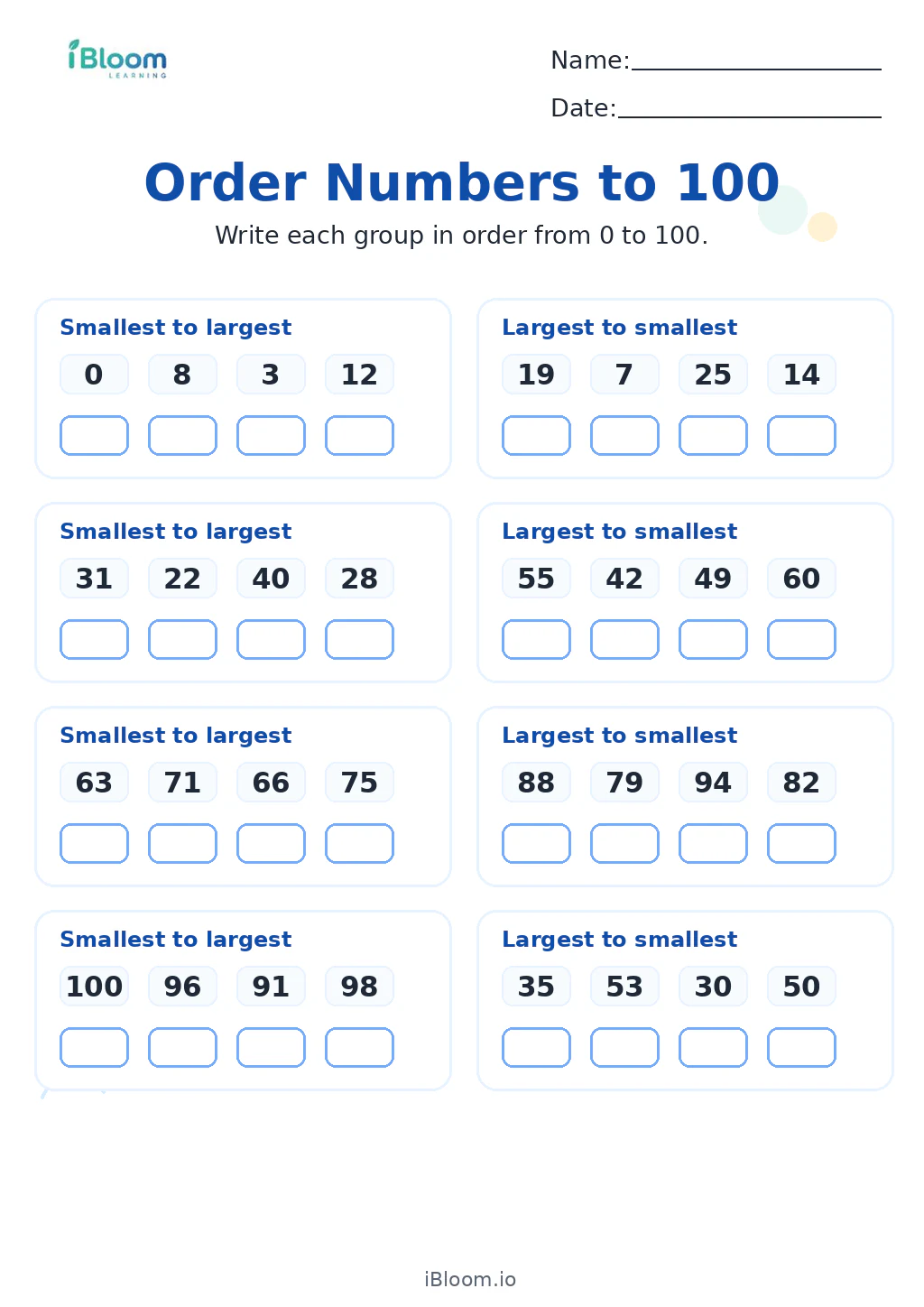
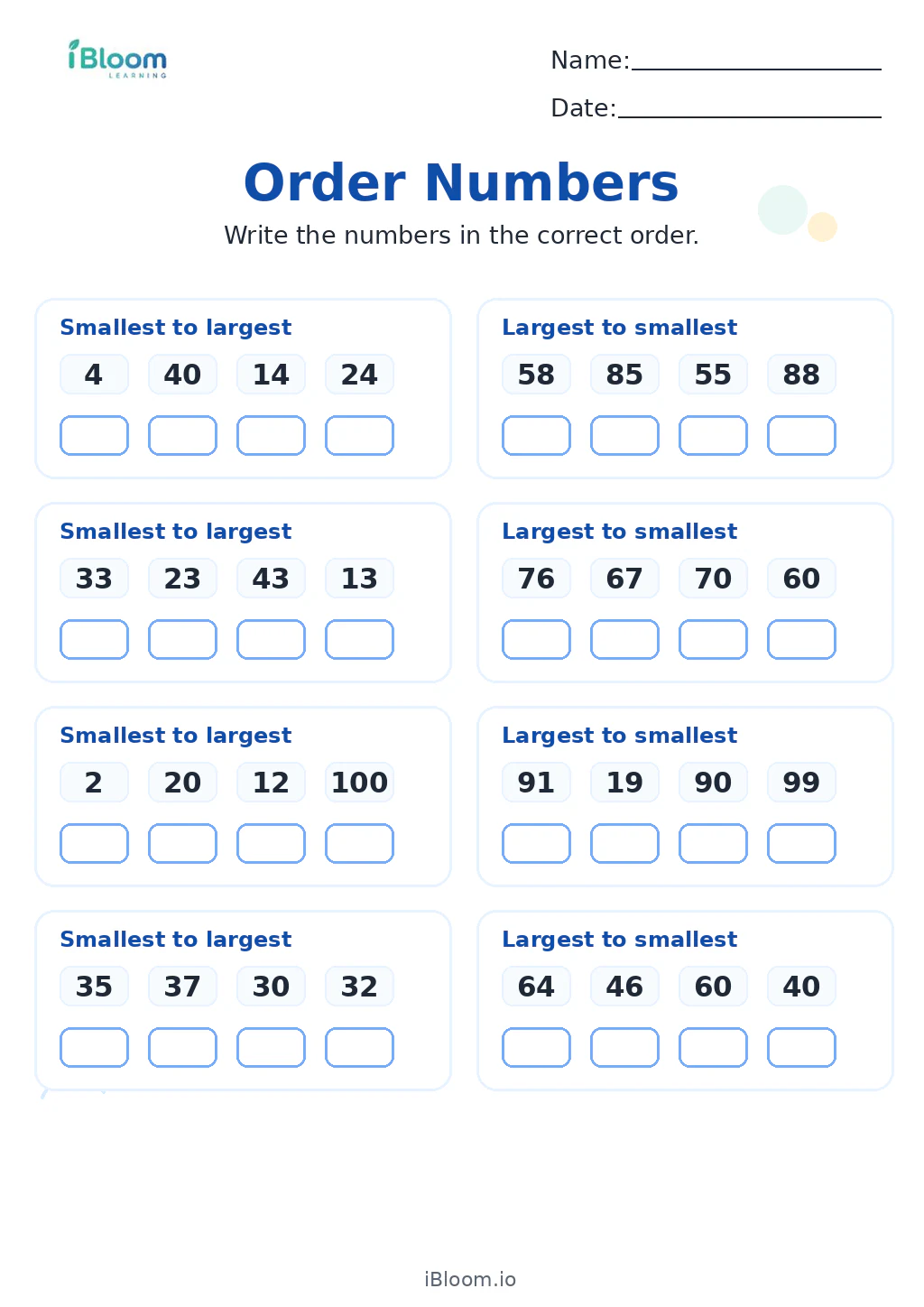
Preview the exact activity before downloading it.
Practice that builds confidence
Building order from 0 to 100
These Grade 1 ordering numbers worksheets help children arrange numbers from 0 to 100 in the correct sequence. Students practise comparing values, deciding which number comes first, and using words such as least, greatest, before, after, ascending, and descending.
The printable activities include sets of two-digit numbers to order, number line thinking, and place value clues based on tens and ones. They are designed for the Comparing Numbers unit and give children repeated practice moving from simple number order to more thoughtful reasoning.
Ordering numbers is more than counting aloud. Children learn that 47 comes before 52 because 4 tens is less than 5 tens, and that 63, 66, and 69 follow a growing pattern. These worksheets keep the range within 0 to 100 so Grade 1 students can focus on comparing tens, then ones, without being overloaded by larger numbers.

From counting to comparing
Early tasks may feel like filling in familiar sequences, but the goal is to help children explain the order. A set such as 18, 8, 28 asks them to notice that 8 has no tens, while 18 has 1 ten and 28 has 2 tens. When numbers have the same tens digit, such as 34, 39, and 31, students compare the ones digit to decide the correct order.
Parent practice routine
At home, choose three numbers from a worksheet and ask your child to build them with tens and ones drawings, say each number aloud, then place them from least to greatest. Next, reverse the same set from greatest to least. Keep the talk simple: “Which number has more tens?” and “If the tens are the same, which ones digit is smaller?” This routine turns each problem into reasoning instead of guessing.

Classroom uses for teachers
Teachers can use these printables for morning work, math centers, small-group reteaching, or quick checks after a comparing numbers lesson. They also work well with manipulatives: students can model numbers with base-ten blocks, mark them on a 0–100 number line, or sort number cards before recording answers on the page.

Common errors to watch for
Some children order by the first number they see instead of comparing all numbers in the set. Others may think 9 is greater than 21 because 9 sounds or looks larger as a single digit. Watch for reversed directions too: a child may know the values but write greatest to least when the task asks for least to greatest. Encourage them to underline the direction words before starting.
Free printable PDF download
Use this ordering numbers 0 to 100 worksheets grade 1 page to preview the activity, print it, or download it as a PDF for quick practice. It works well for homework, homeschool lessons, tutoring, morning work, revision, and classroom centers.
Answers and answer key support
After the child completes the worksheet independently, parents and teachers can use the answer support or answer key information to check the work, review mistakes, and choose the next practice step.
Why iBloom worksheets help
The practice is focused on one clear Grade 1 skill: ordering numbers 0 to 100 within comparing numbers. The pages give enough variety for fluency while keeping the number range familiar. A child-friendly strategy is: read the numbers, compare tens, compare ones, then check the direction. Saying this quietly while working helps students slow down and make confident choices.
Helpful answers
Frequently asked questions
What does ordering numbers 0 to 100 mean in Grade 1?
It means arranging numbers within 0 to 100 in the correct order, usually from least to greatest or greatest to least. Children use counting, number lines, and place value to decide the sequence.
How can I help my child order two-digit numbers?
Ask your child to compare the tens digit first. If the tens digits are the same, compare the ones digits. For example, with 42 and 48, both have 4 tens, so 42 is smaller because 2 ones is less than 8 ones.
Should children learn least to greatest before greatest to least?
Many children find least to greatest easier because it follows forward counting. Once they are comfortable, practising greatest to least helps them understand that number order can also move backward.
Why does my child say 9 is greater than 21?
This is a common early place value error. Children may focus on the digit 9 without noticing that 21 has 2 tens. Using tens-and-ones drawings or base-ten blocks can make the size of each number clearer.
Are these worksheets only for independent practice?
No. They can be used independently, but they are also useful for guided practice, math centers, homework, review, or small-group support with number order and comparing numbers.
Is this ordering numbers 0 to 100 worksheets grade 1 free?
Yes. You can preview it for free and use the printable worksheet for home or classroom practice.
Can I download this ordering numbers 0 to 100 worksheets grade 1 as a PDF?
Yes. Use the worksheet download option to save a printable PDF, or print the worksheet directly from the page.
Does this ordering numbers 0 to 100 worksheets grade 1 include answers or an answer key?
When the activity has fixed answers, iBloom includes answer support so parents and teachers can check the completed worksheet.