




About this worksheet
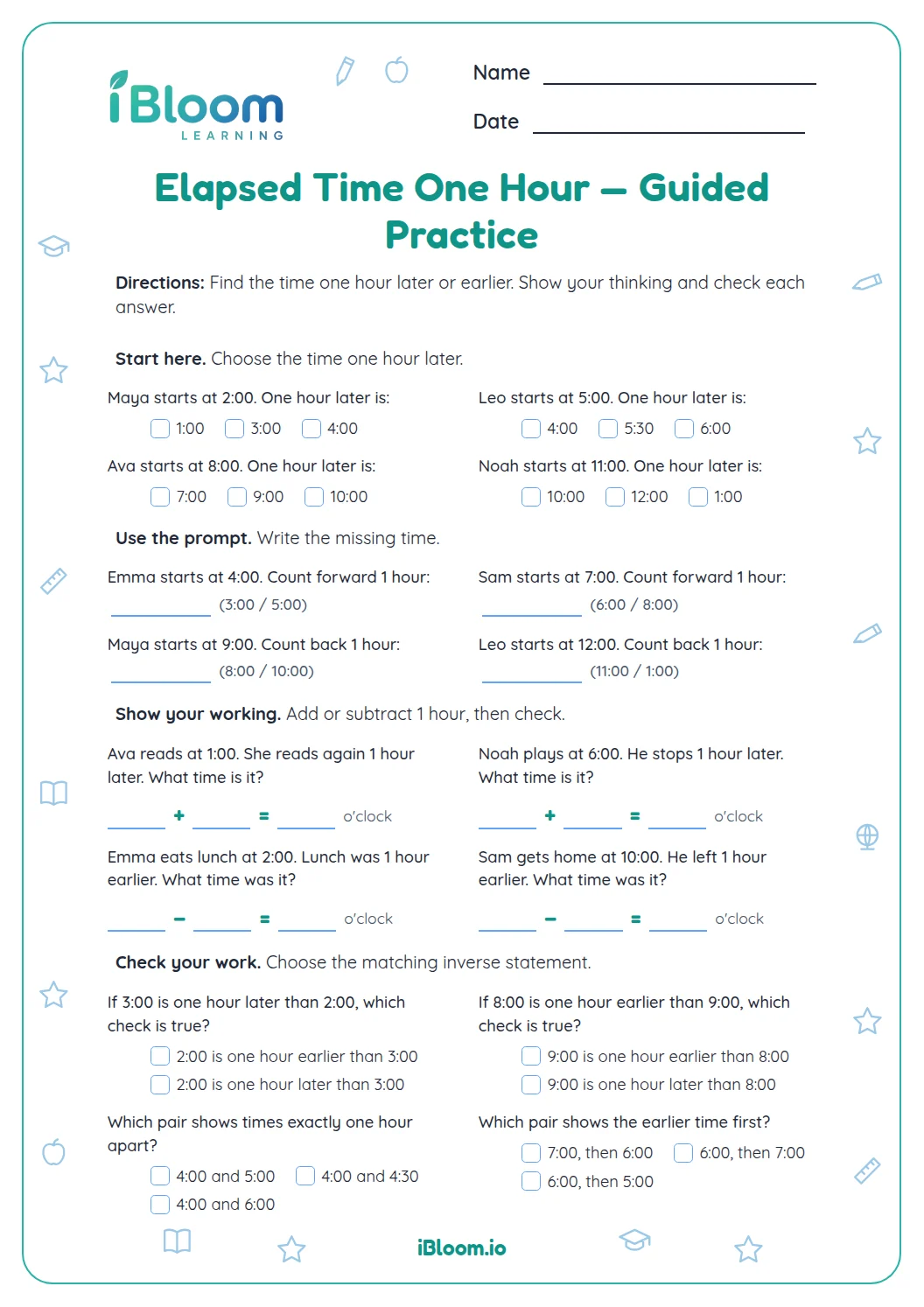
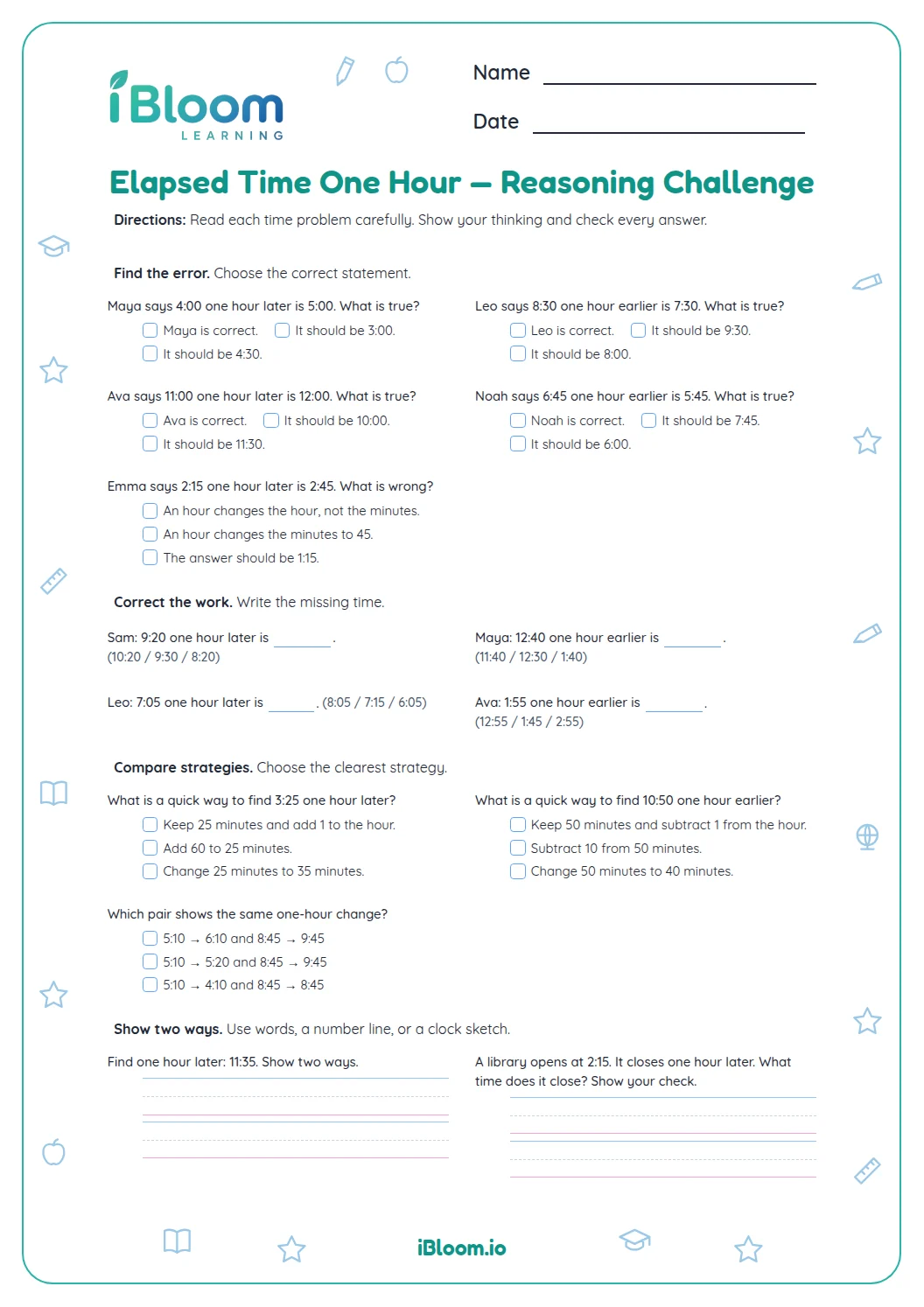
This printable worksheet gives Grade 1 learners focused practice finding a time one hour before or after a given time. The first part uses direct questions; later items put the same one-hour interval into short situations. Times stay on the hour or half-hour, and the separate answer key accepts equivalent digital time formats.
Aligned to 3.MD.A.1
What kinds of time questions are included?
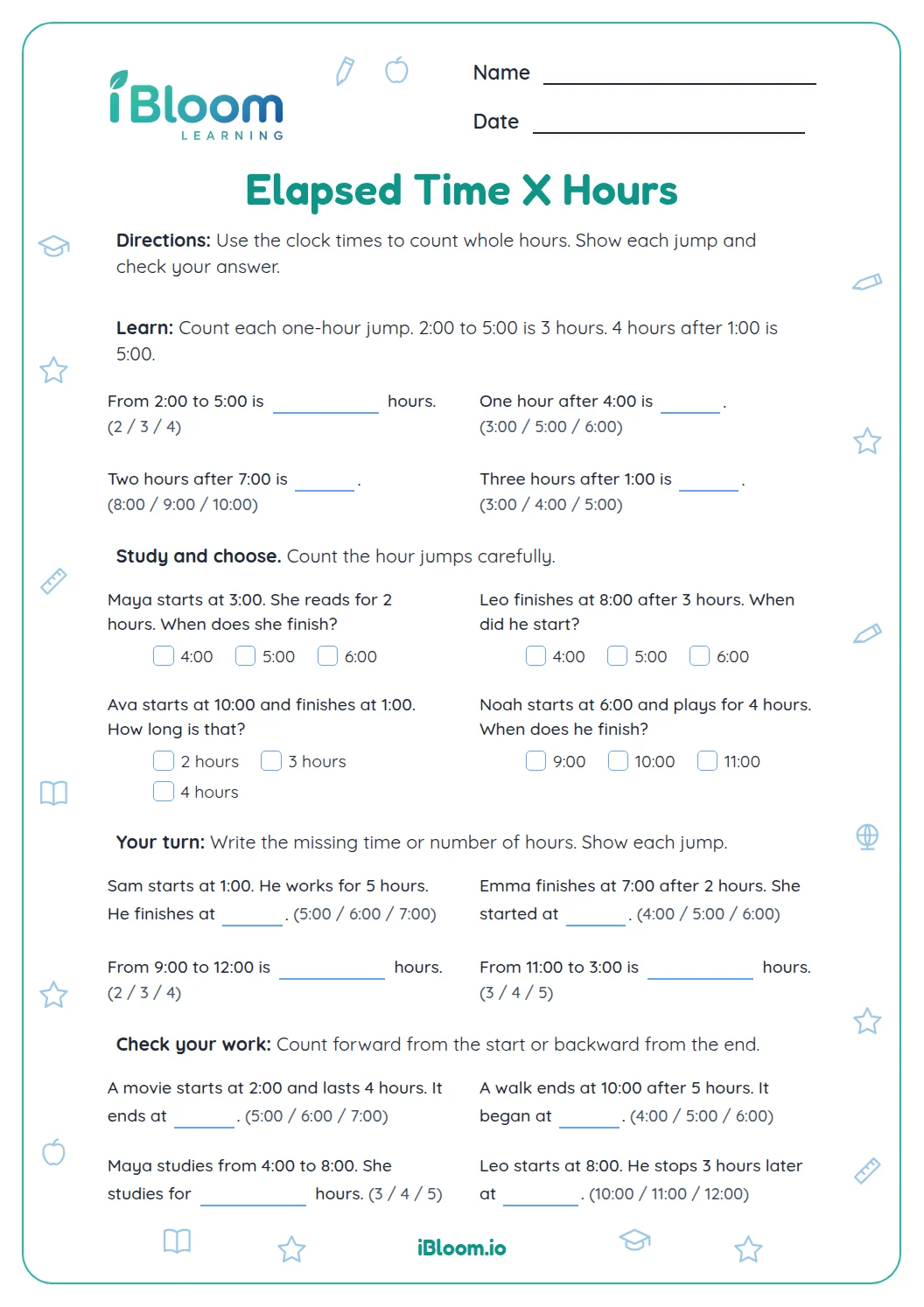
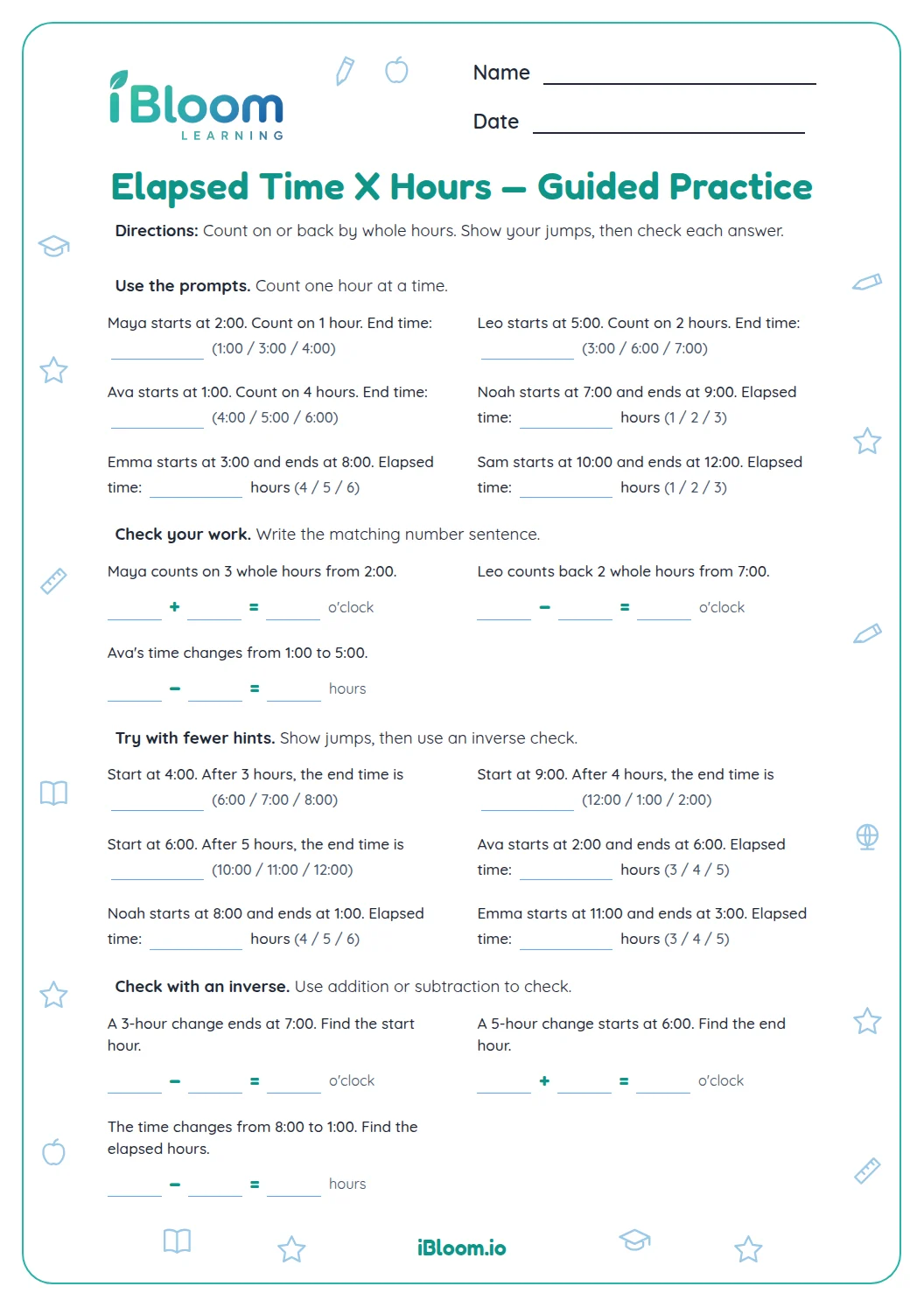
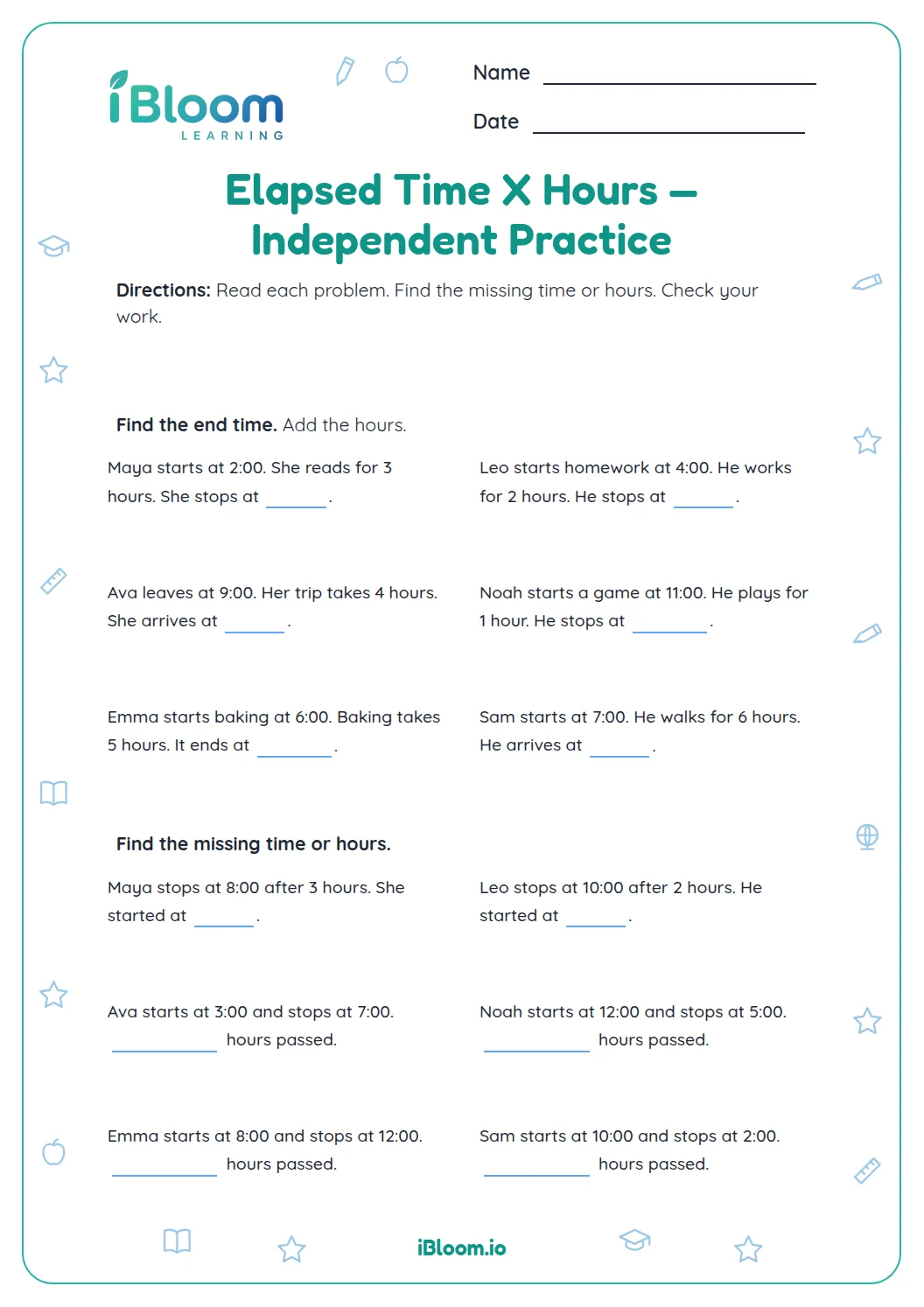
The first eight items ask for a time one hour later or earlier. The final eight apply the same interval to short situations and time sentences. Every time is on the hour or half-hour.
- Part A: four times one hour later and four one hour earlier
- Part B: eight everyday or independent time problems
How do you find a time one hour later?
Keep the minutes the same and move the hour forward by one. One hour after 7:30 is 8:30. To go one hour earlier, move the hour back by one and keep :30.
How can a child check an elapsed-time answer?
Move forward or backward one hour from the answer. The minutes should stay the same, and the starting or ending time should match the prompt.
How to use this worksheet
- 1Read whether the question says before or after.
- 2Keep :00 or :30 unchanged for a one-hour interval.
- 3Move the hour forward for later and backward for earlier.
- 4For a story, identify which time is given and which is missing.
- 5Check by moving one hour in the opposite direction.
One-hour time checks
The mistake
Changing the minutes as well as the hour.
The fix
For exactly one hour, keep :00 or :30 unchanged.
The mistake
Moving forward when the question asks for earlier.
The fix
Say “before” or “after” aloud before changing the hour.
The mistake
Confusing the start time with the end time.
The fix
Underline the time given and identify whether it is the start or finish.
Common Core alignment
The one-hour intervals give focused practice measuring and solving elapsed-time problems.
Measure time intervals and solve elapsed-time problems.
On this sheet: The story questions find a missing start or end time across a one-hour interval.
Show the official wordingHide the official wording
Tell and write time to the nearest minute and measure time intervals in minutes. Solve word problems involving addition and subtraction of time intervals in minutes, e.g., by representing the problem on a number line diagram.
What to practice next
Make more practice
Further reading
Questions parents and teachers ask
What does one hour later mean?
One hour later means moving the hour forward by one while keeping the minutes the same. For example, one hour after 7:30 is 8:30. The worksheet also asks for times one hour earlier and uses short situations with these same whole-hour and half-hour times.
How many questions are included?
There are 16 questions in two parts. Eight are direct before-or-after questions, and eight use short situations or time sentences. The practice sheet is paired with a separate answer key so a child can try the items before checking responses.
Why are the times on the hour and half-hour?
All questions use :00 or :30, so children can focus on the one-hour interval. For a one-hour change, these minutes stay the same. The examples use the same simple rule, letting children concentrate on whether to move the hour earlier or later.
Which standard does this worksheet practice?
The page is labeled Grade 1 and keeps the practice to one-hour steps with whole-hour and half-hour times. The listed Common Core reference is the Grade 3 standard that names measuring time intervals and solving elapsed-time problems; this sheet practices that skill in a simpler range.
How can a parent help without giving the answer?
Ask whether the prompt says before or after, then ask the child to keep the minutes and move the hour one step. For a story, first identify whether the given time is the start or finish. The separate answer key is useful after the child has tried each item.