




About this worksheet
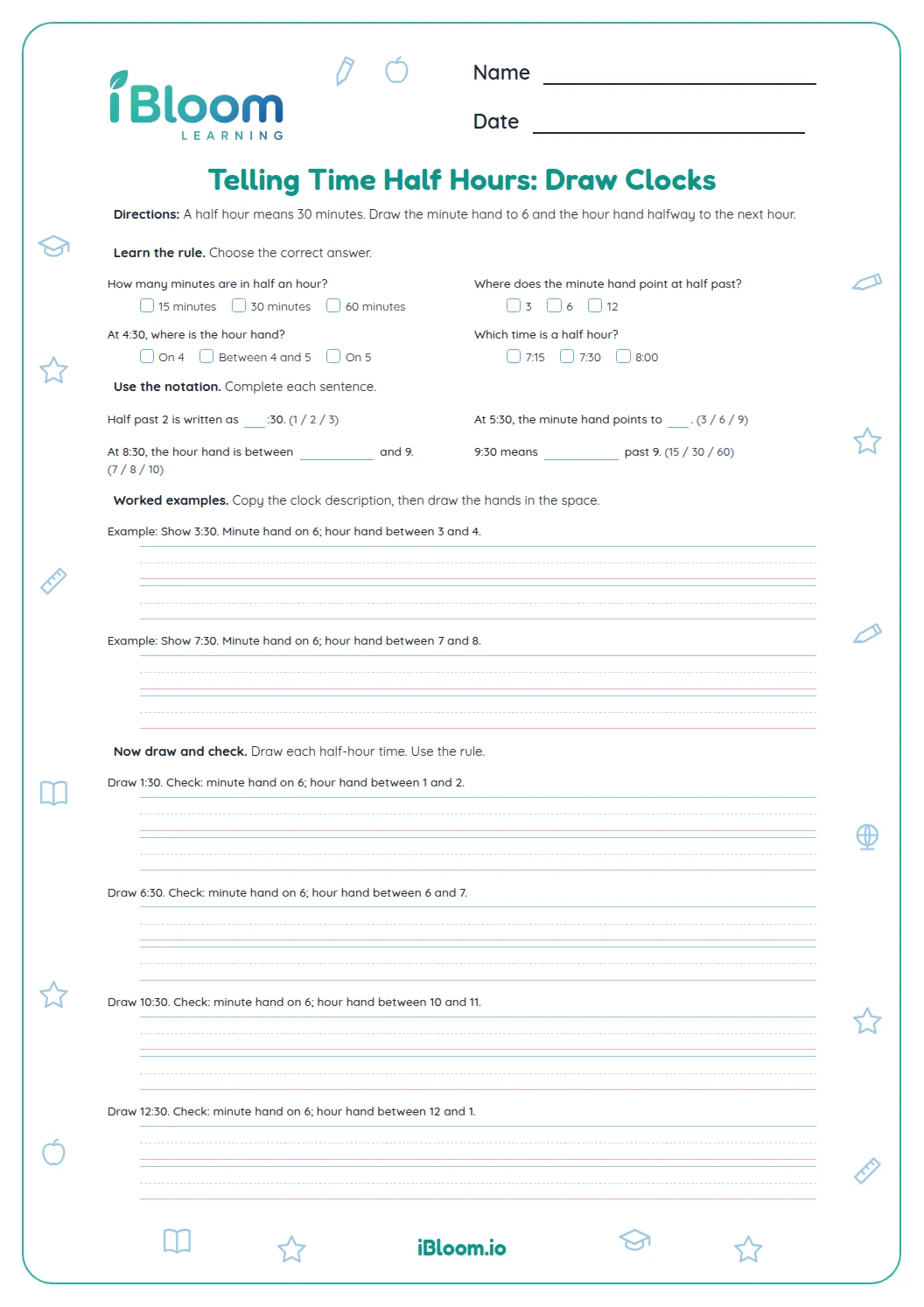
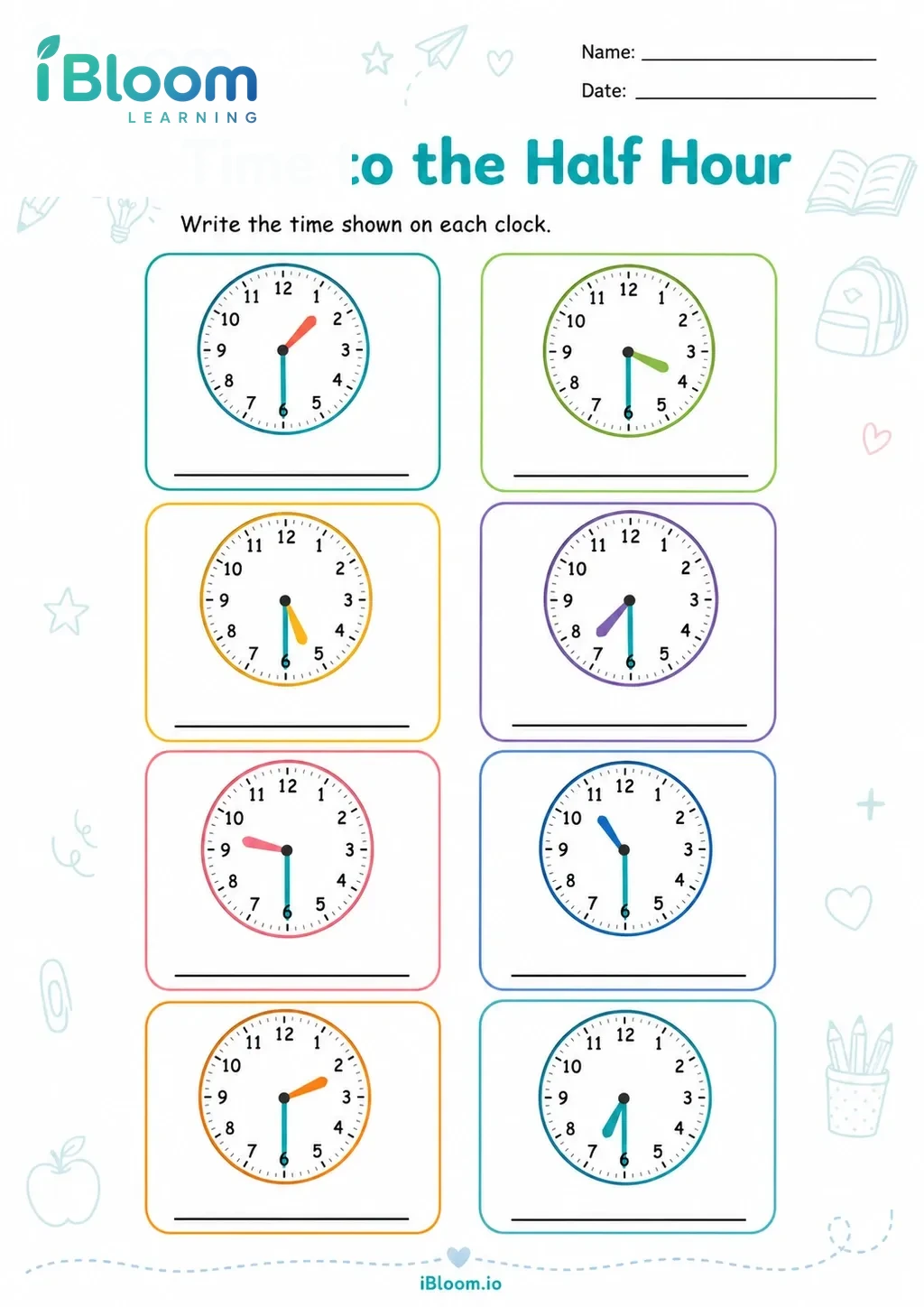
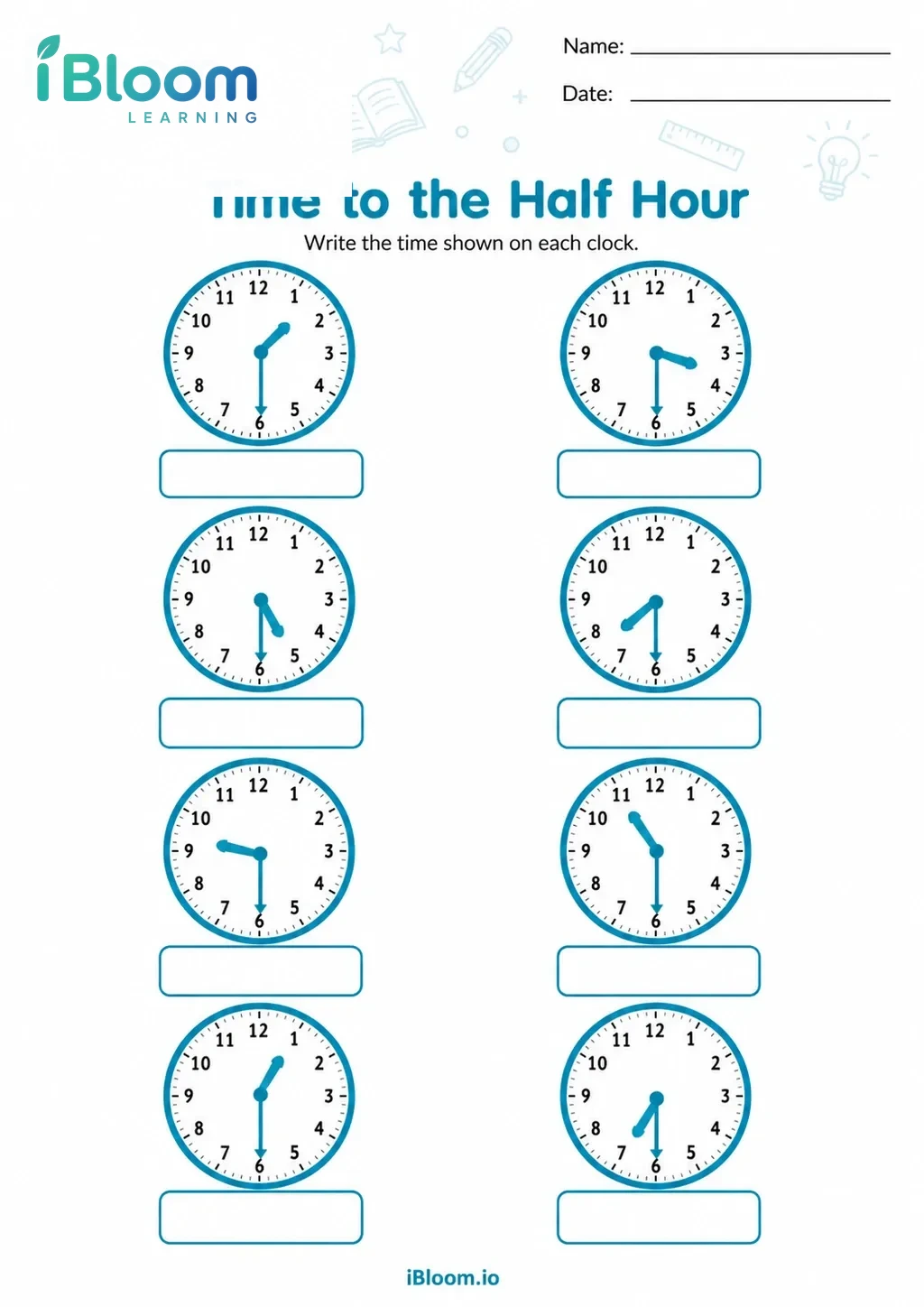
This Grade 1 printable builds half-hour time skills with six analog clock readings and ten short reasoning questions. Children read clocks with the minute hand at 6, match spoken time clues to digital times, and work out which half-hour comes before or after a given time. The answer key supports checking each response. This practice aligns with Common Core standard 1.MD.B.3: tell and write time in hours and half-hours using analog and digital clocks.
Aligned to 1.MD.B.3
How do you read a clock at :30?
At a half hour, the minute hand points to 6. The hour hand sits between two numbers, so use the number it has passed.
- 1The clock shows 2:30.
- 2The minute hand points to 6; the hour hand is between 2 and 3.
- 3Answer: 2:30
What kinds of time clues are included?
Part A has six analog clocks. Part B mixes spoken time names, the minute-hand position, and questions about half an hour earlier or later. Children choose the matching time or phrase.
- Read each analog clock
- Match a clue to a half-hour time
- Move forward or back by half an hour
How can the key support practice?
Check answers after a few questions. For a missed item, point to the minute hand first, then ask which hour the short hand has passed.
How to use this worksheet
- 1Find the 6 on the clock; the minute hand points there for :30.
- 2Name the hour the short hand has passed.
- 3Write the time using :30.
- 4For earlier or later clues, move one half hour at a time.
- 5Check the answer key after completing a section.
Common mistakes and quick fixes
The mistake
Reading the next hour instead of the hour just passed.
The fix
At 2:30, the short hand has passed 2 and is moving toward 3.
The mistake
Putting the minute hand on 12.
The fix
For :30, point the minute hand to 6.
The mistake
Moving a full hour for “half an hour later.”
The fix
Move forward 30 minutes: 3:30 becomes 4:00.
Common Core alignment
This worksheet practices the following Common Core skill.
Read and write half-hour times from analog clocks and time clues.
On this sheet: Children read analog clocks and identify matching half-hour times.
Show the official wordingHide the official wording
Tell and write time in hours and half-hours using analog and digital clocks.
What to practice next
Make more practice
Further reading
Questions parents and teachers ask
What does this worksheet practice?
This Grade 1 sheet practices reading analog clocks at half past the hour and reasoning about time clues. Six clock drawings show :30 times, followed by ten questions about matching, naming, and moving by half an hour. The answer key is separate for checking each response.
How many questions are included?
There are 16 questions: six clock readings and ten multiple-choice time clues. Children first read the analog clocks, then use words and simple time changes to identify a half-hour time. The worksheet spans three pages, and its separate answer key spans three pages as well.
How do you read a half-hour clock?
At a half hour, the minute hand points to 6. The hour hand has moved beyond one number but has not reached the next. Name the hour it has passed, then write that hour with :30, such as 2:30.
What kinds of time clues are included?
The clue questions ask children to match “half past” language with digital time, identify where the minute hand points, and decide which half-hour comes before or after a given time. Each choice has one correct time, and the directions are printed above the questions.
How can the answer key help?
After a child finishes a group, compare the written times with the answer key. If an answer differs, return to the clock and check the minute hand first, then the hour hand. This keeps the review connected to the clock-reading strategy.