

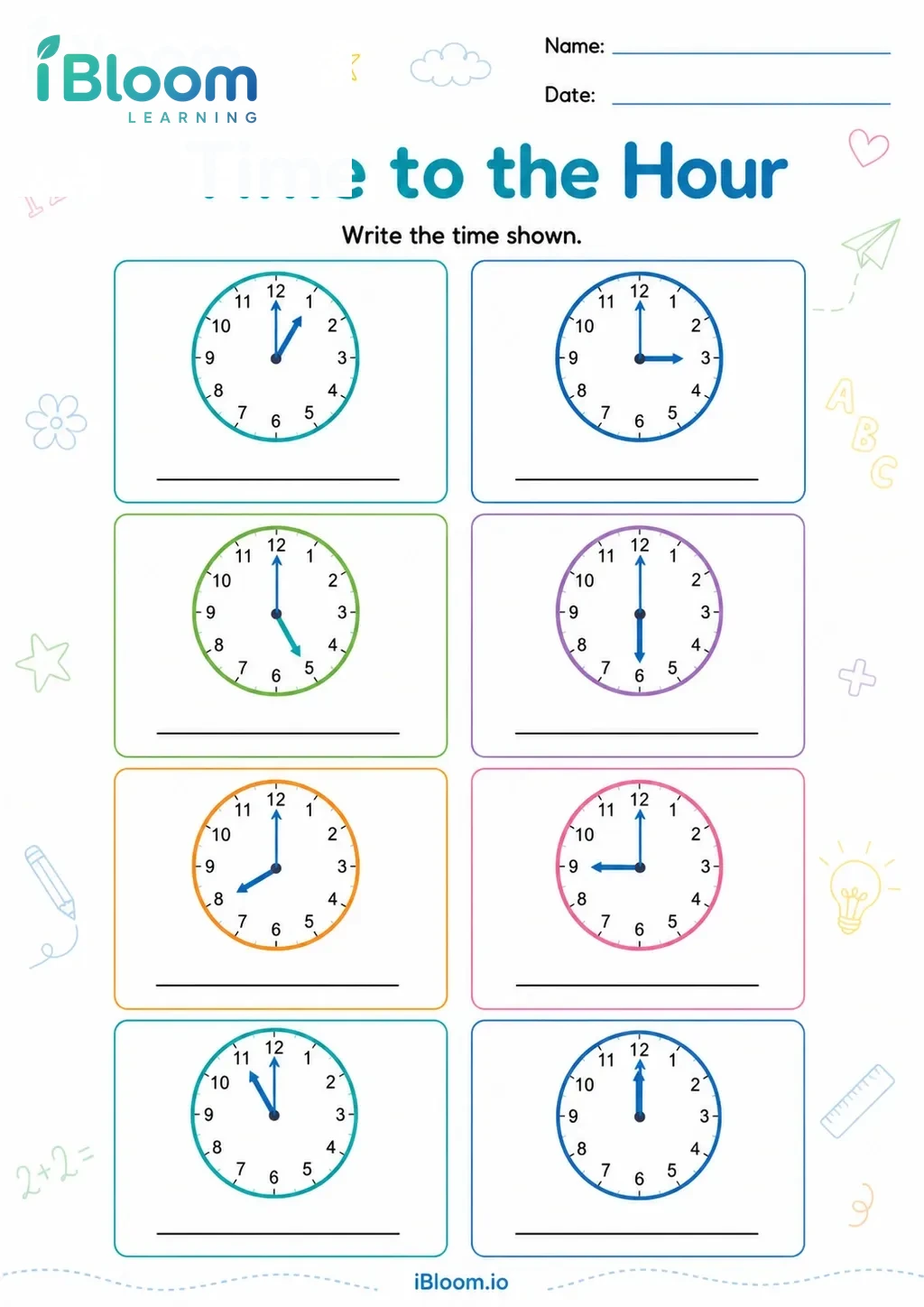
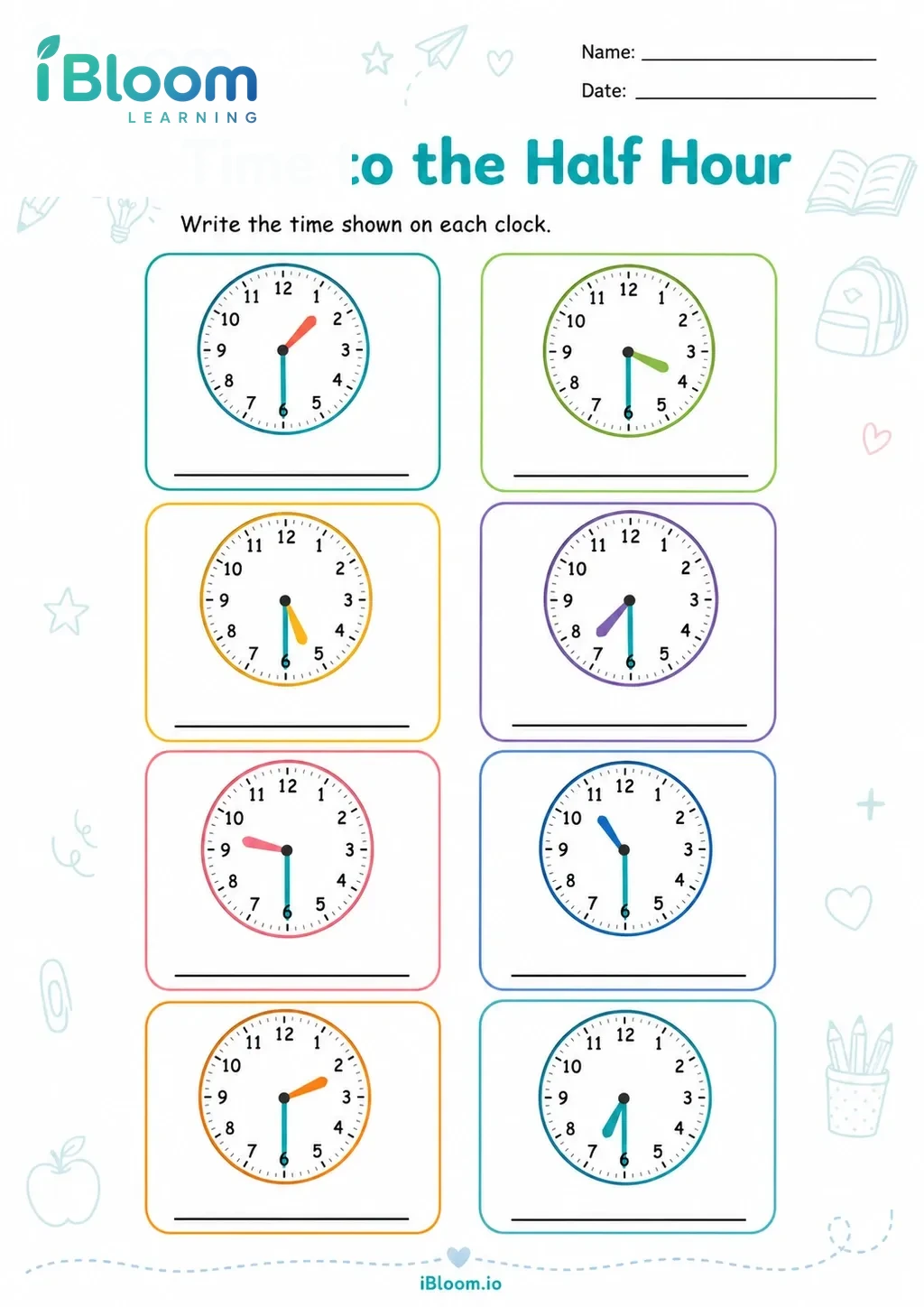
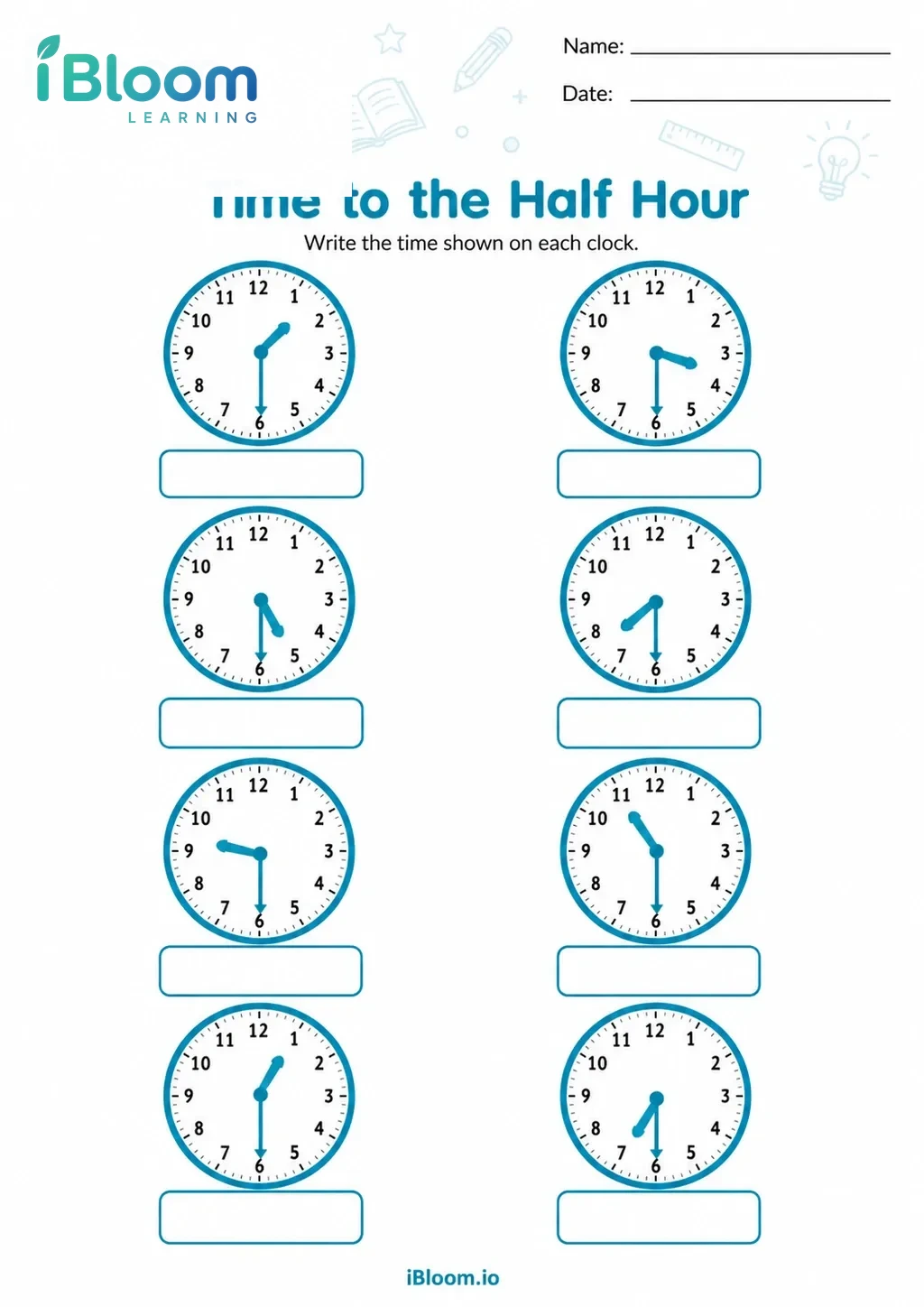


About this worksheet
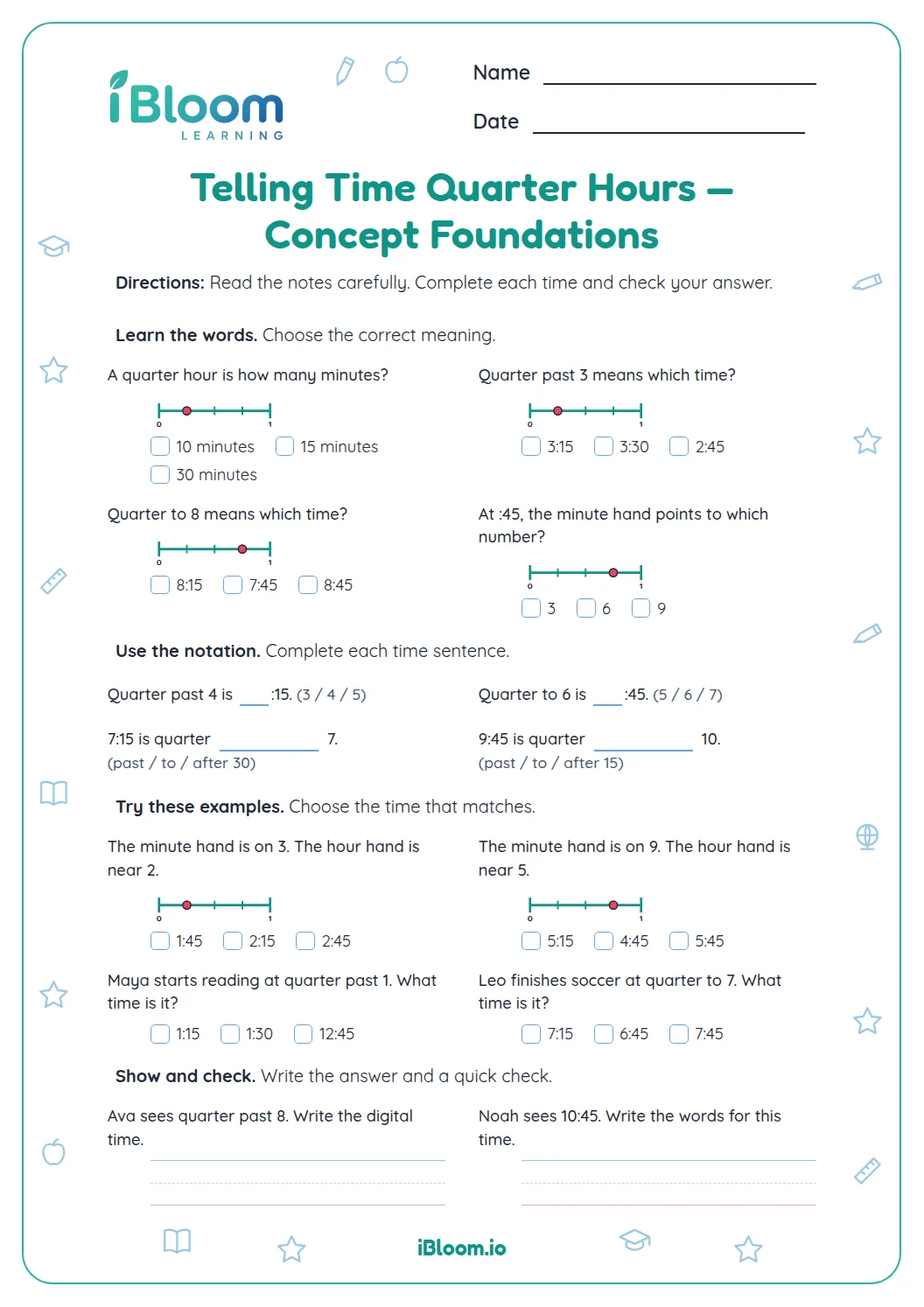
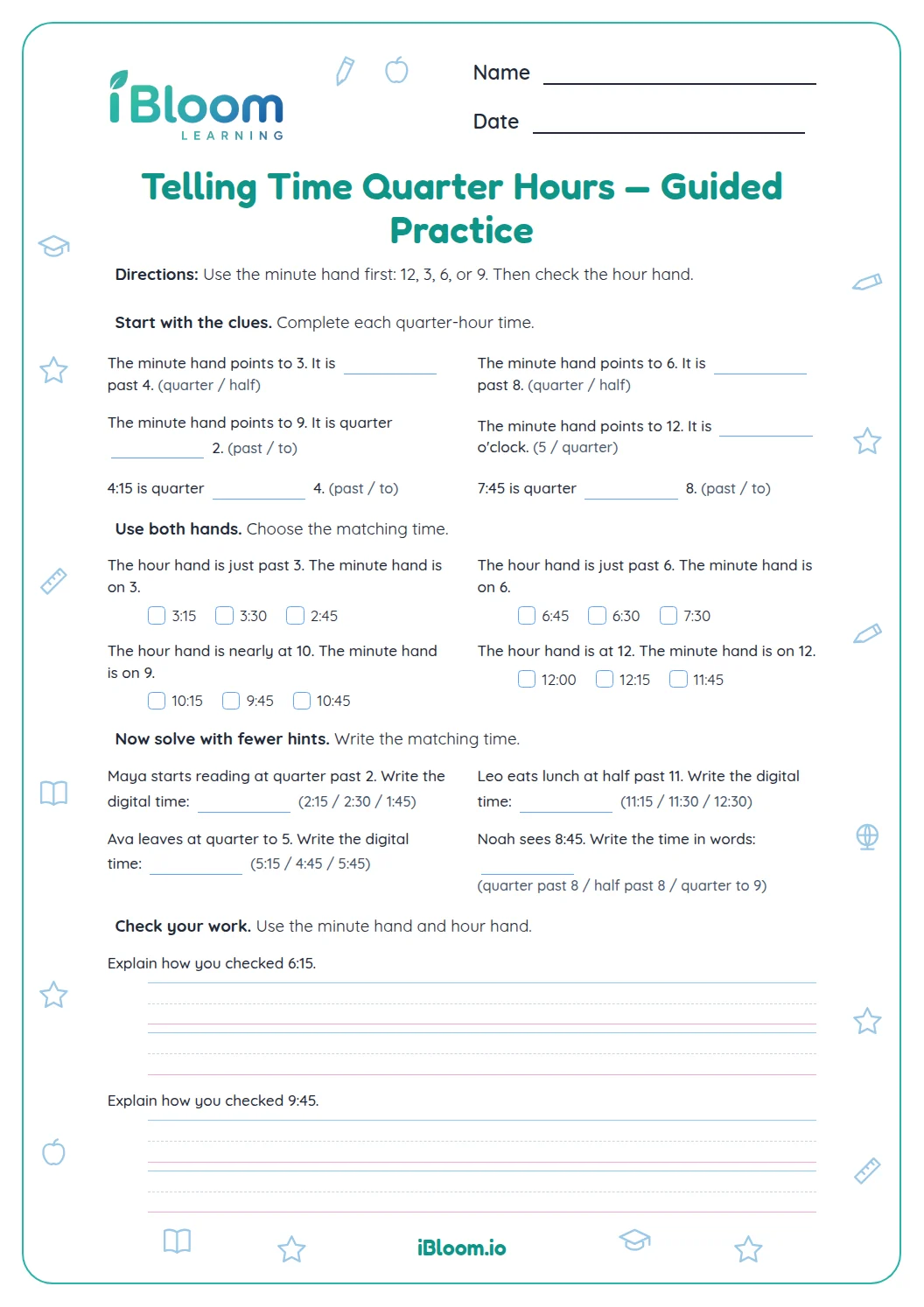
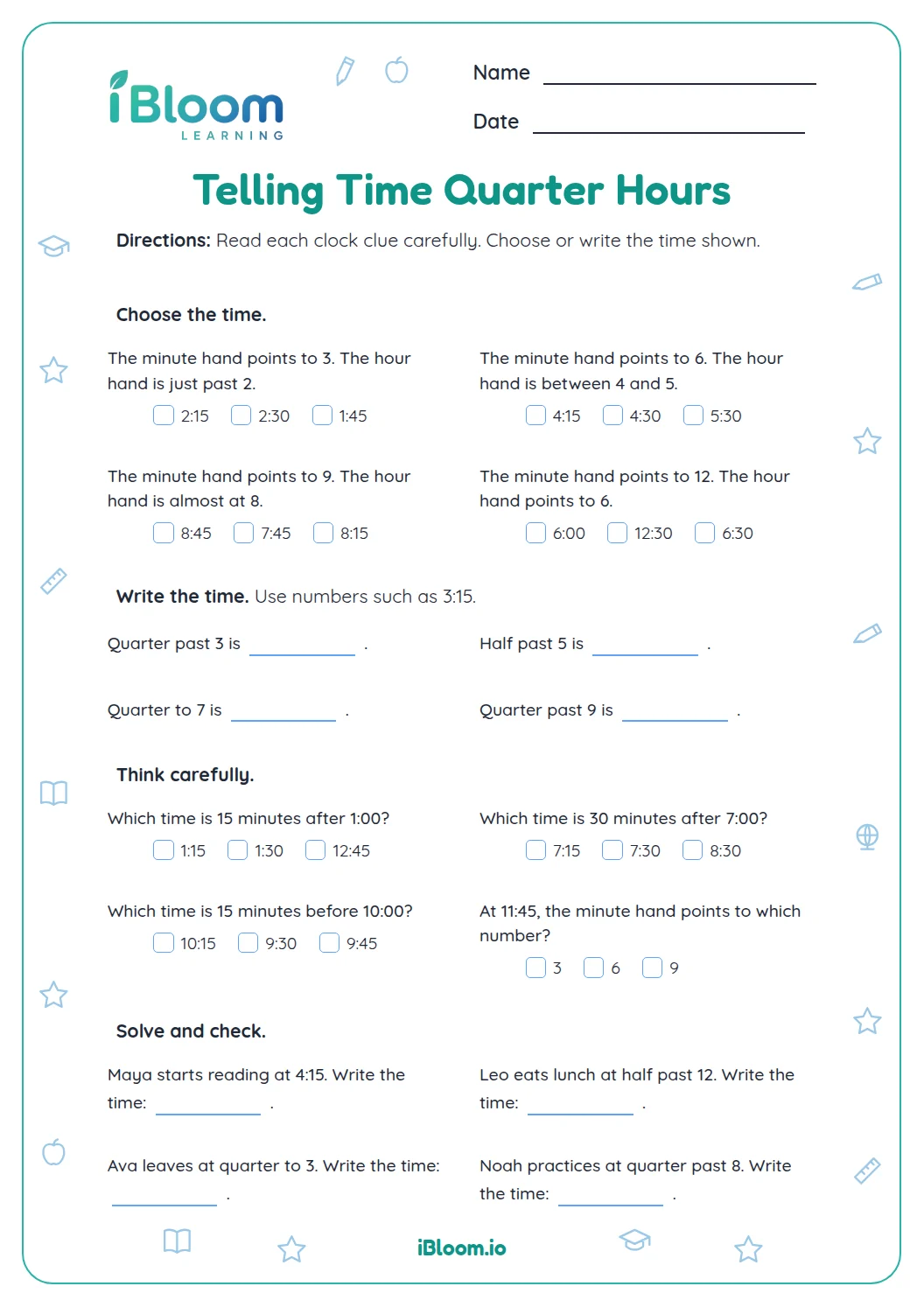
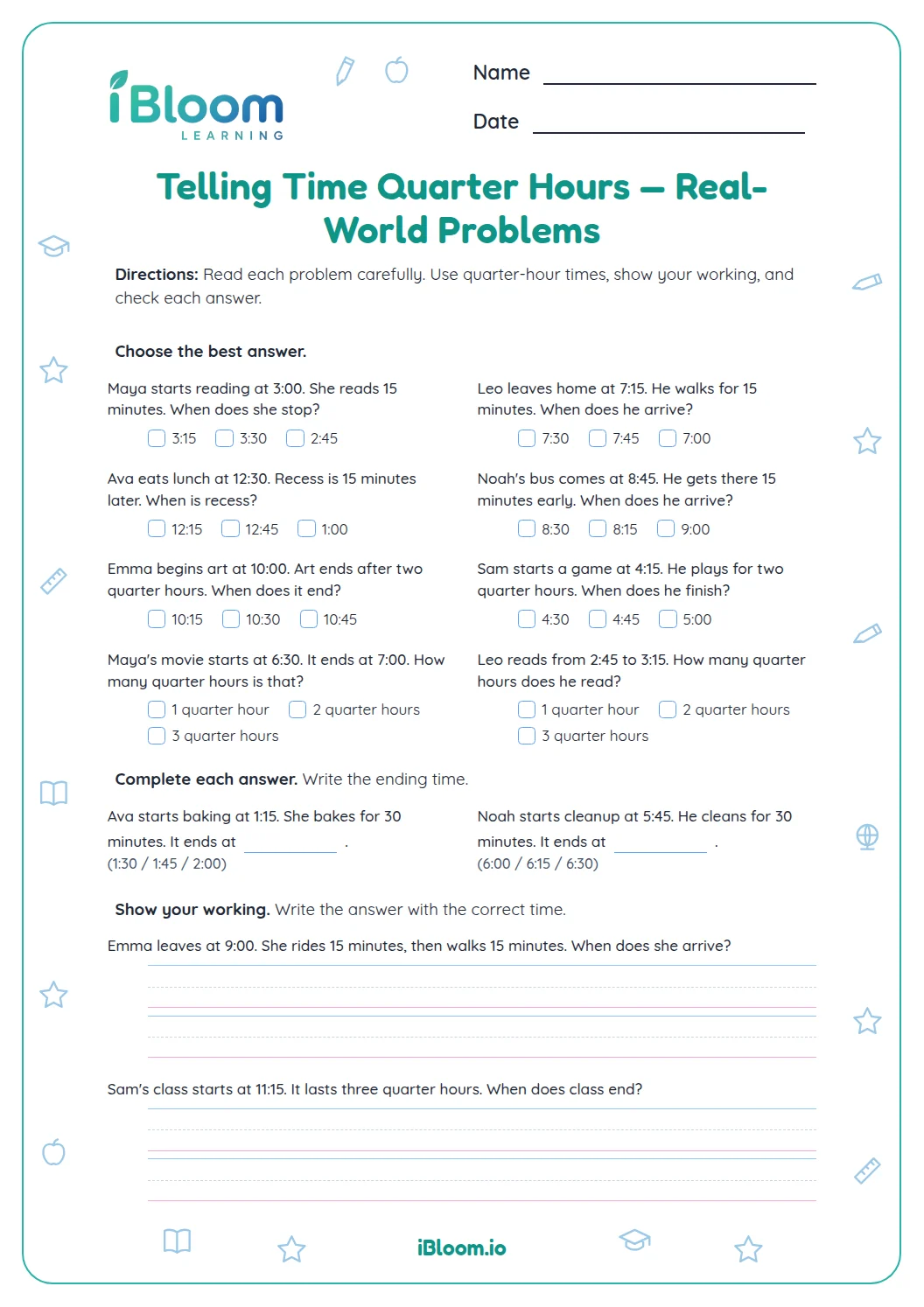
This Grade 1 printable builds quarter-hour reasoning with analog clocks. Students read four clock faces and solve ten questions about 15-minute steps and clock language. A separate answer key lists the time or response for each item. The practice connects quarter-hour intervals to reading and writing times on analog clocks.
Aligned to 2.MD.C.7
What do the clock hands tell us?
The long minute hand shows how many minutes have passed in the hour. At 3 it is 15 minutes, at 6 it is 30, and at 9 it is 45. The short hour hand moves toward the next number as the minutes pass.
How can students read a quarter-hour clock?
Read the long hand first, then use the short hand to settle the hour. At quarter to 6, the minute hand points to 9 and the short hand is close to 6.
- 1Clock time: 5:45
- 2Minute hand at 9 means 45 minutes past 5.
- 3The hour hand is moving toward 6.
- 4Answer: 5:45
How do quarter-hour steps help with reasoning?
A quarter hour is 15 minutes. Counting by quarter-hour steps helps students compare times such as 6:00, 6:15, 6:30, and 6:45, then recognize when the next hour begins.
How to use this worksheet
- 1Look at the long hand first and decide whether it points to 3, 6, or 9.
- 2Read the short hand to find the current hour or the one coming next.
- 3Write times with a colon, as in 3:15.
- 4For the reasoning items, count by 15-minute steps.
- 5Use the key to check both the hand position and the written time.
Common mistakes and quick fixes
The mistake
Reading the long hand as the hour hand.
The fix
Find the longer hand first; it marks minutes.
The mistake
Calling 5:45 “quarter after 5.”
The fix
At 45 minutes, the minute hand is on 9 and the next hour is near.
The mistake
Stopping the short hand exactly on a number at :30.
The fix
Notice that the short hand has moved partway toward the next hour.
Common Core alignment
Students read analog clocks and write times at quarter-hour points.
Read quarter-hour times on analog clocks and write the matching time.
On this sheet: Students read and write quarter-hour times, which are marked at five-minute intervals on analog and digital clocks.
Show the official wordingHide the official wording
Tell and write time from analog and digital clocks to the nearest five minutes, using a.m. and p.m.
What to practice next
Make more practice
Further reading
Questions parents and teachers ask
What is a quarter hour?
A quarter hour is 15 minutes, one of four equal parts of an hour. On a clock, the minute hand points to 3 at :15, 6 at :30, and 9 at :45; the short hand shows which hour is underway or coming next.
How many questions are on this sheet?
There are 14 questions: four clock readings and ten items about quarter-hour steps and time language. The separate key lists the time or response for each question. Ask the student to point to a specific detail, explain how it supports the answer, and check the response against the separate key.
What should a child look at first on an analog clock?
Begin with the long minute hand. Its position at 3, 6, or 9 gives :15, :30, or :45; then read the short hand to determine the hour. Ask the student to point to a specific detail, explain how it supports the answer, and check the response against the separate key.
Why does the hour hand sit between numbers?
The hour hand moves gradually as minutes pass. At 5:30 it is halfway from 5 toward 6; at 5:45 it is closer to 6, though the time is still in the 5 o’clock hour. Ask the student to point to a specific detail, explain how it supports the answer, and check the response against the separate key.
Is there an answer key?
Yes. The separate key gives the answer for each of the 14 questions, including the times shown on the four clock faces and the quarter-hour reasoning responses. Ask the student to point to a specific detail, explain how it supports the answer, and check the response against the separate key.
How long might this practice take?
About 15 to 20 minutes is a reasonable estimate. Students read four clocks, then complete short questions about quarter-hour steps and time language. Ask the student to point to a specific detail, explain how it supports the answer, and check the response against the separate key.