



About this worksheet
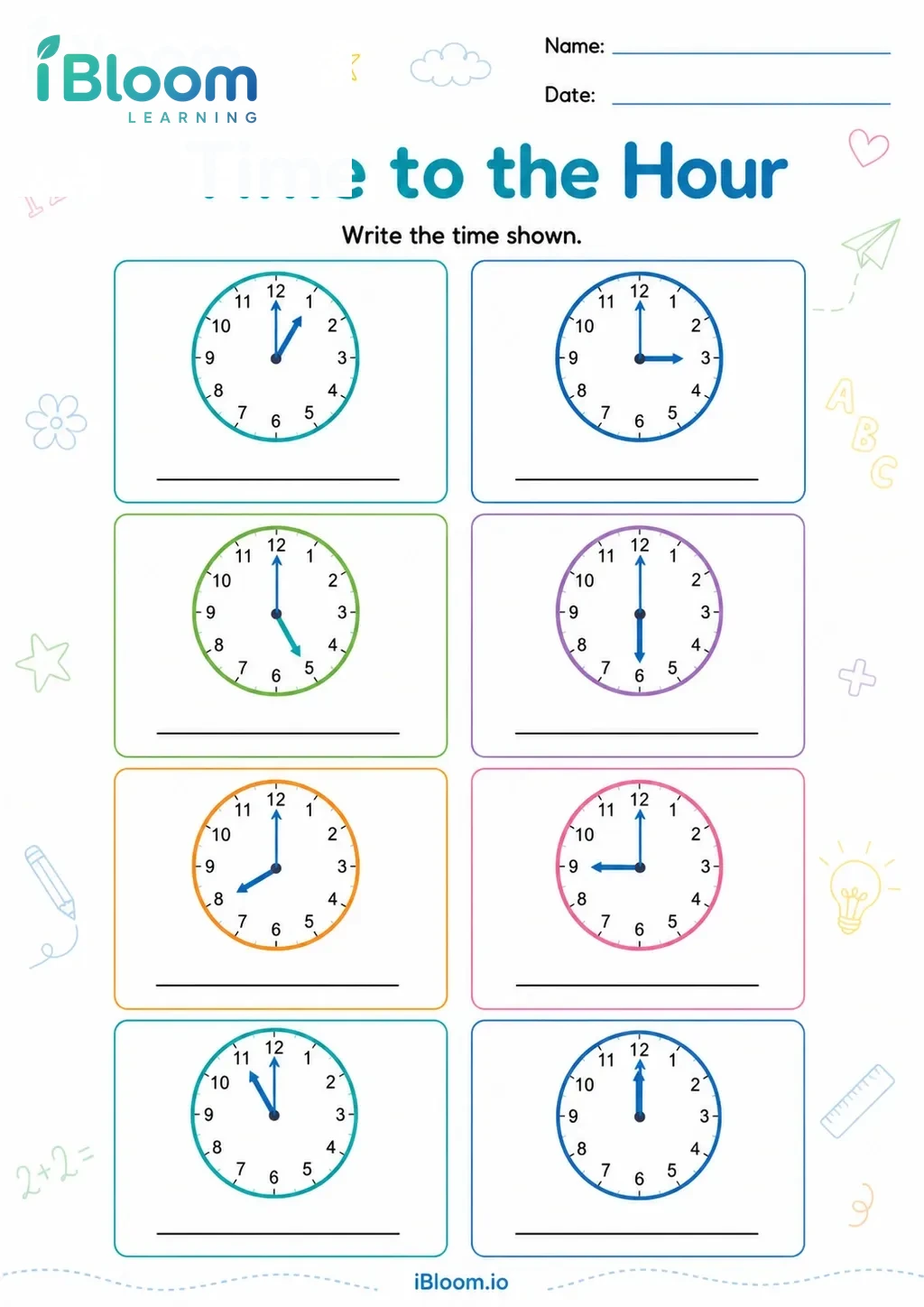
This Grade 1 printable uses drawn analog clocks to practice whole-hour hand positions. Children read all 12 whole hours and write each digital time, then answer two questions about the hands. A separate answer key shows the clock readings. This guided practice supports telling and writing time under Common Core 1.MD.B.3.
Aligned to 1.MD.B.3
How do children read a whole-hour clock?
Find the short hand first and read the number it points to. Check that the long hand points to 12, then write the hour followed by :00.
- 1On the first clock, the short hand points to 3.
- 2The long hand points to 12, so write 3:00.
What does each part practice?
Part A presents all 12 whole-hour clock readings in mixed order. Part B asks children to identify the jobs of the short and long hands.
How can you use the answer key?
Compare the written time with the clock reading. At 12:00 the hands overlap at the top. Read any missed clock again before moving to the next one.
How to practice whole-hour clocks
- 1Locate the short hand on each clock.
- 2Read the number at its tip.
- 3Check that the long hand points to 12.
- 4Write the hour followed by :00.
- 5Choose the two hand answers in Part B and check the key.
Common mistakes and quick fixes
The mistake
Writing 12:00 for every clock.
The fix
Read the short hand for the hour, rather than the long hand.
The mistake
Writing :12 for the minutes.
The fix
A minute hand at 12 means zero minutes past the hour; write :00.
The mistake
Missing the overlapping hands at noon or midnight.
The fix
At 12:00 both hands point to 12.
Common Core alignment
The prompts practice telling and writing whole-hour times.
Tell and write whole-hour times by identifying the clock hands.
On this sheet: The prompts focus on identifying hand positions at whole-hour times.
Show the official wordingHide the official wording
Tell and write time in hours and half-hours using analog and digital clocks.
What to practice next
Make more practice
Further reading
Questions parents and teachers ask
What does a clock show at a whole hour?
At a whole hour, the long minute hand points to 12 and the short hour hand points to the hour number. Read the short hand and write that number followed by :00. The first clock shows 3:00, with its short hand pointing to 3.
How many clocks are included?
There are 12 illustrated clocks, one for each whole hour from 1:00 through 12:00, in mixed order. Two final questions ask about the jobs of the clock hands. Children write the times in Part A and select one answer for each question in Part B.
How does this practice clock-hand positions?
Children inspect the hands on each drawn clock and translate their positions into a digital time. The short hand identifies the hour, and the long hand confirms a whole hour. This reading activity gives children a visible model of the hand positions for all 12 hours.
Does it include a separate answer key?
Yes, the separate answer key pairs each clock with its correct time and marks the two hand answers. Check one clock at a time, asking the child to point to the short hand before comparing answers. This helps reveal whether the hands were confused during reading.
Why do the hands overlap at 12:00?
Both hands point to 12 at 12:00, so the shorter hand lies along the same direction as the longer one. Ask the child to compare this clock with another whole-hour clock. The long hand stays at 12 while the short hand gives the different hour.