

About this worksheet
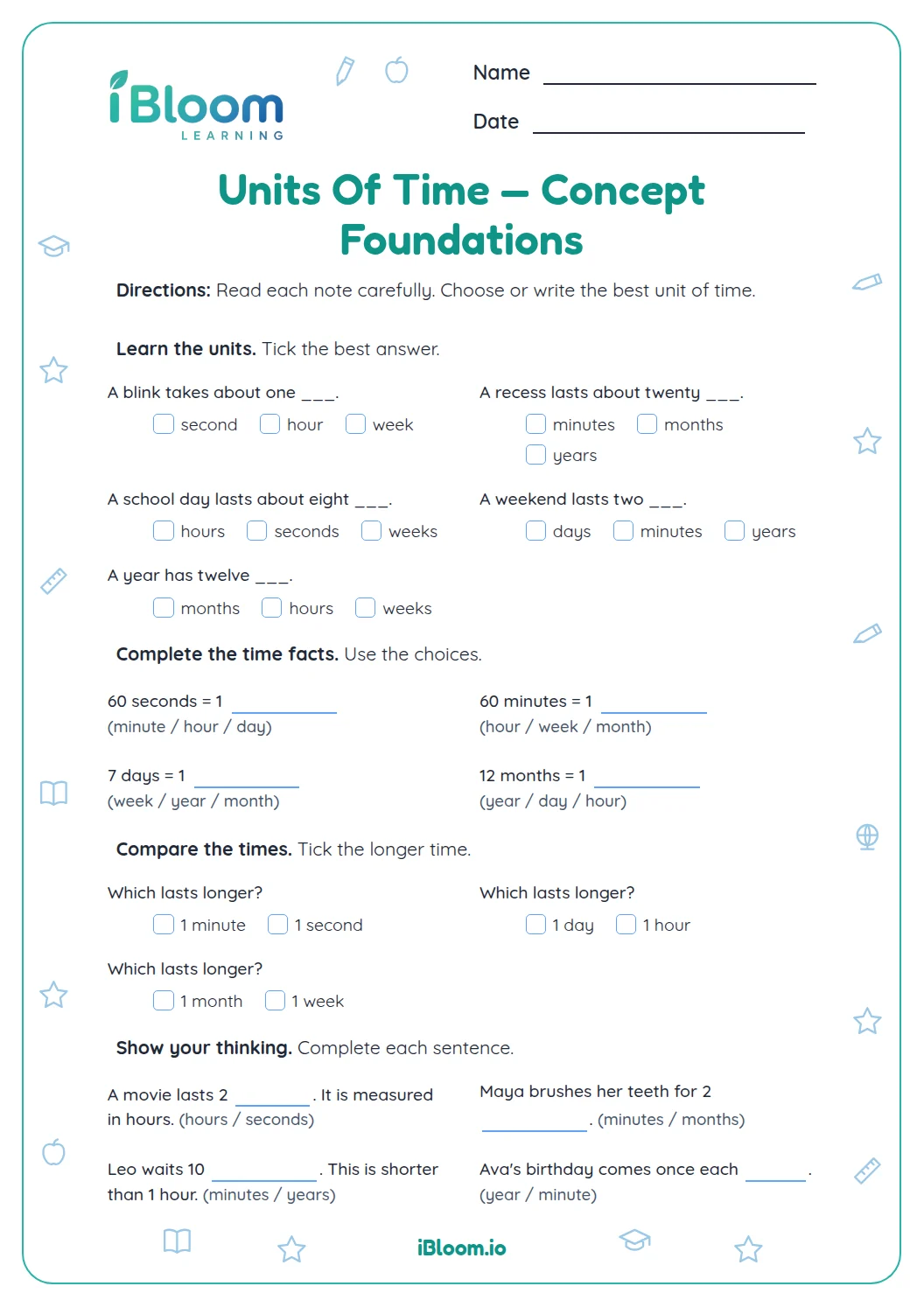
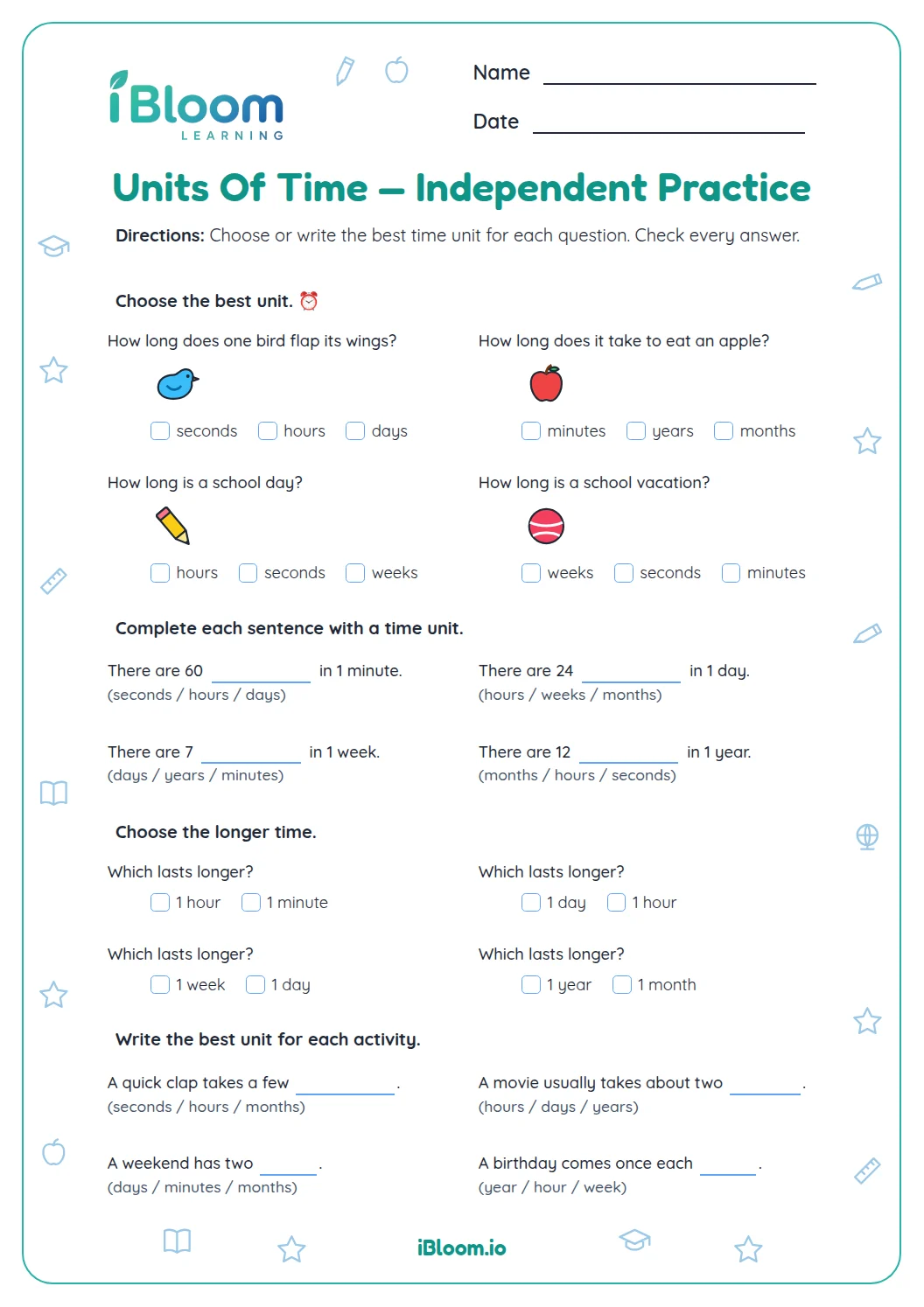
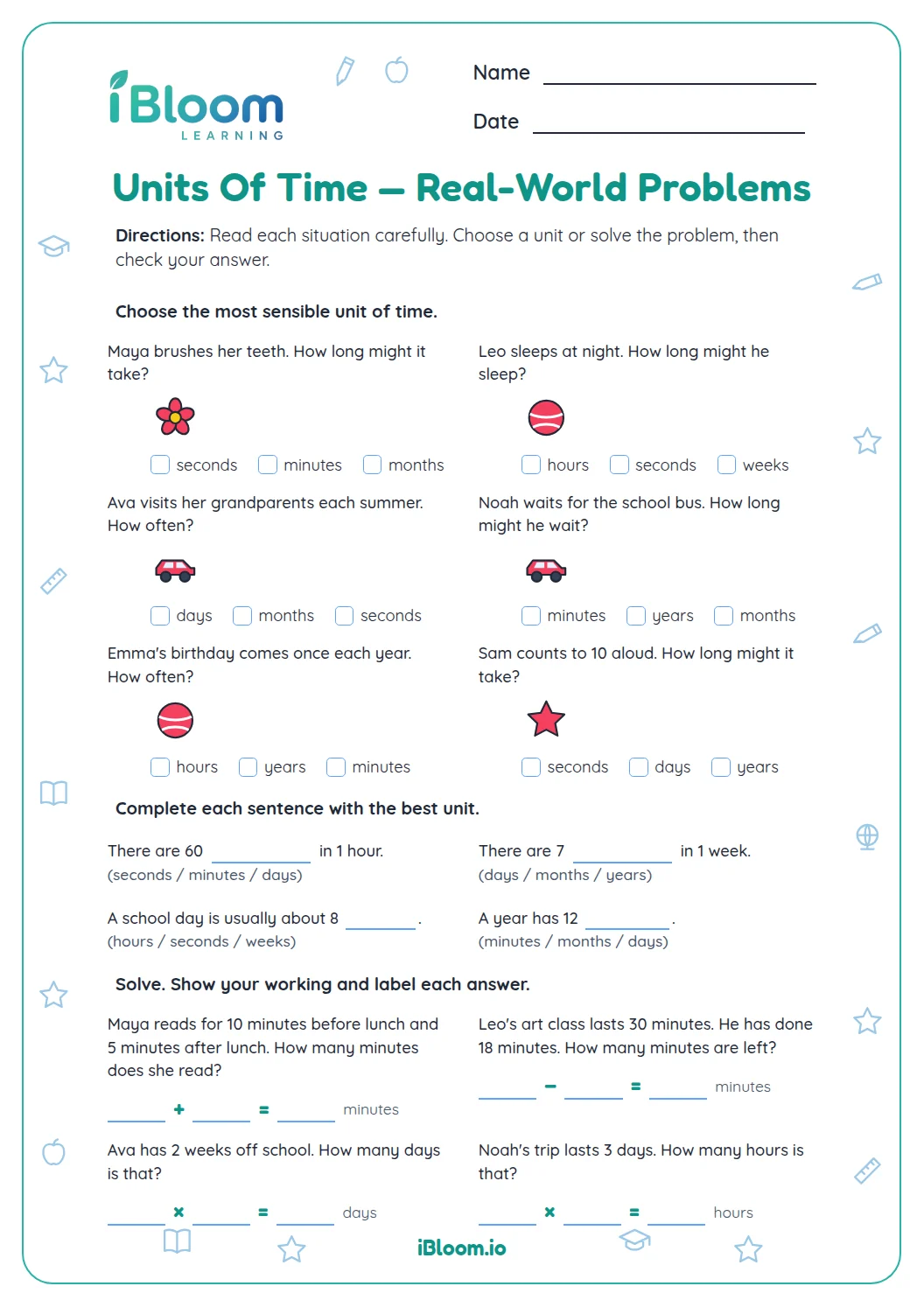
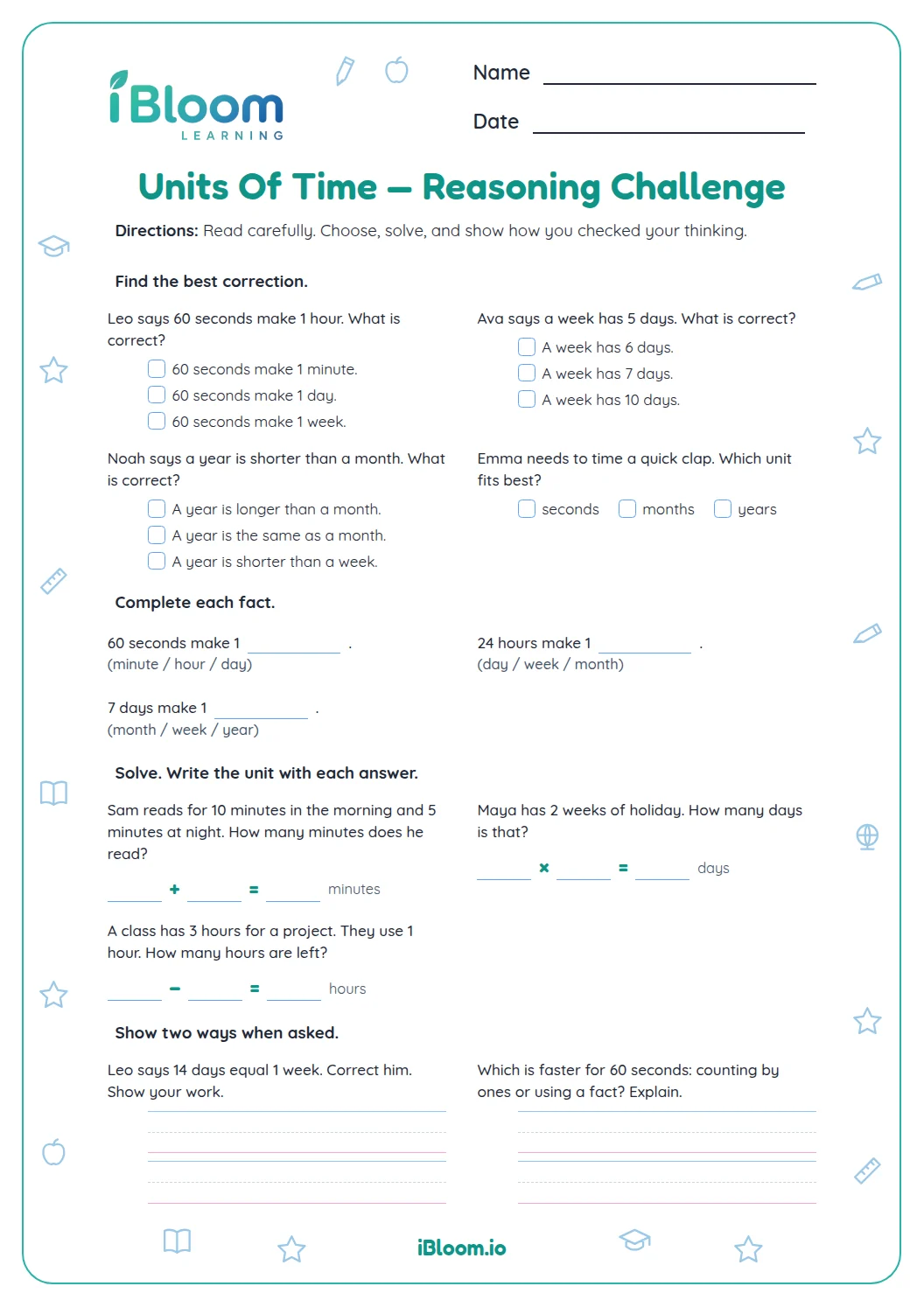
This Grade 1 guided practice introduces familiar units of time through everyday examples. Children compare minutes, hours, days, weeks, months, and years, choose sensible units for events, and order parts of a day on a drawn timeline. The answer key supports checking each response.
How can children compare time units?
Connect each unit to a familiar duration. A minute is shorter than an hour, and a day is longer than an hour. A week contains seven days, while a year contains twelve months.
Ask which unit fits an event and whether the event takes less or more time than another familiar activity.
What does the guided practice include?
The sheet has 16 items: 12 choices, one ordering response, one written response, and one drawing. Prompts connect units such as minutes, hours, days, weeks, months, and years with familiar events.
One item asks children to order a minute, an hour, and a day from shortest to longest.
How can a child use the time examples?
Read each event and consider how long it usually lasts. Choose a unit that makes sense, then compare units by their size. For the timeline, place morning before afternoon and night.
Work through the time examples
- 1Read the event or comparison.
- 2Name the units being compared.
- 3Use a familiar example to decide which unit fits.
- 4Order units from shorter to longer when asked.
- 5Draw morning, afternoon, and night in sequence.
Time unit checks
The mistake
Mixing up weeks and months
The fix
Remember that a week has seven days and a year has twelve months.
The mistake
Choosing seconds for a long event
The fix
Compare the event with a minute, hour, or day.
The mistake
Putting night before afternoon on the timeline
The fix
Follow the order of a typical day.
What to practice next
Questions parents and teachers ask
Which time units appear on this worksheet?
The questions use minutes, hours, days, weeks, months, and years. Children compare these familiar units and connect them with events such as a short song, a school day, or a birthday. The examples help them choose a sensible unit for each situation.
Does this worksheet ask children to read clocks?
No. The page practices time-unit words and familiar duration comparisons. Children choose units for events, compare how long units last, order a few units, and draw parts of a day. There are no clock faces or clock-reading questions on this practice sheet.
What time facts do learners use?
Learners use familiar groupings such as seven days in a week, twelve months in a year, and twenty-four hours in a day. These relationships help children compare the units and choose a sensible answer for each event or duration prompt.
How can I help a child compare the units?
Connect each unit to an event the child knows. A song may last minutes, a school day lasts hours, and a birthday returns each year. Ask the child to explain why the chosen unit fits the event, then compare it with a shorter or longer unit.