
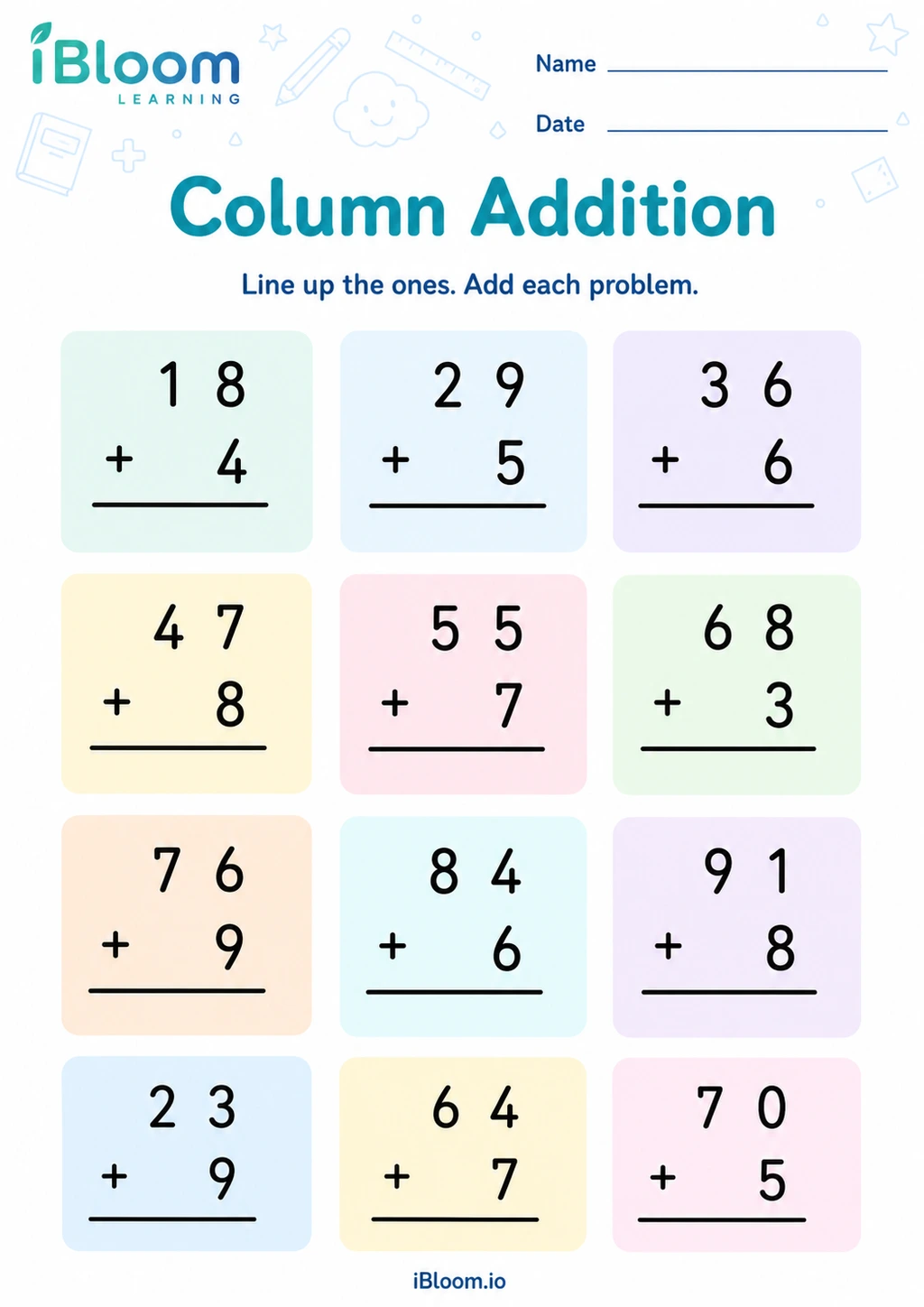
About this worksheet
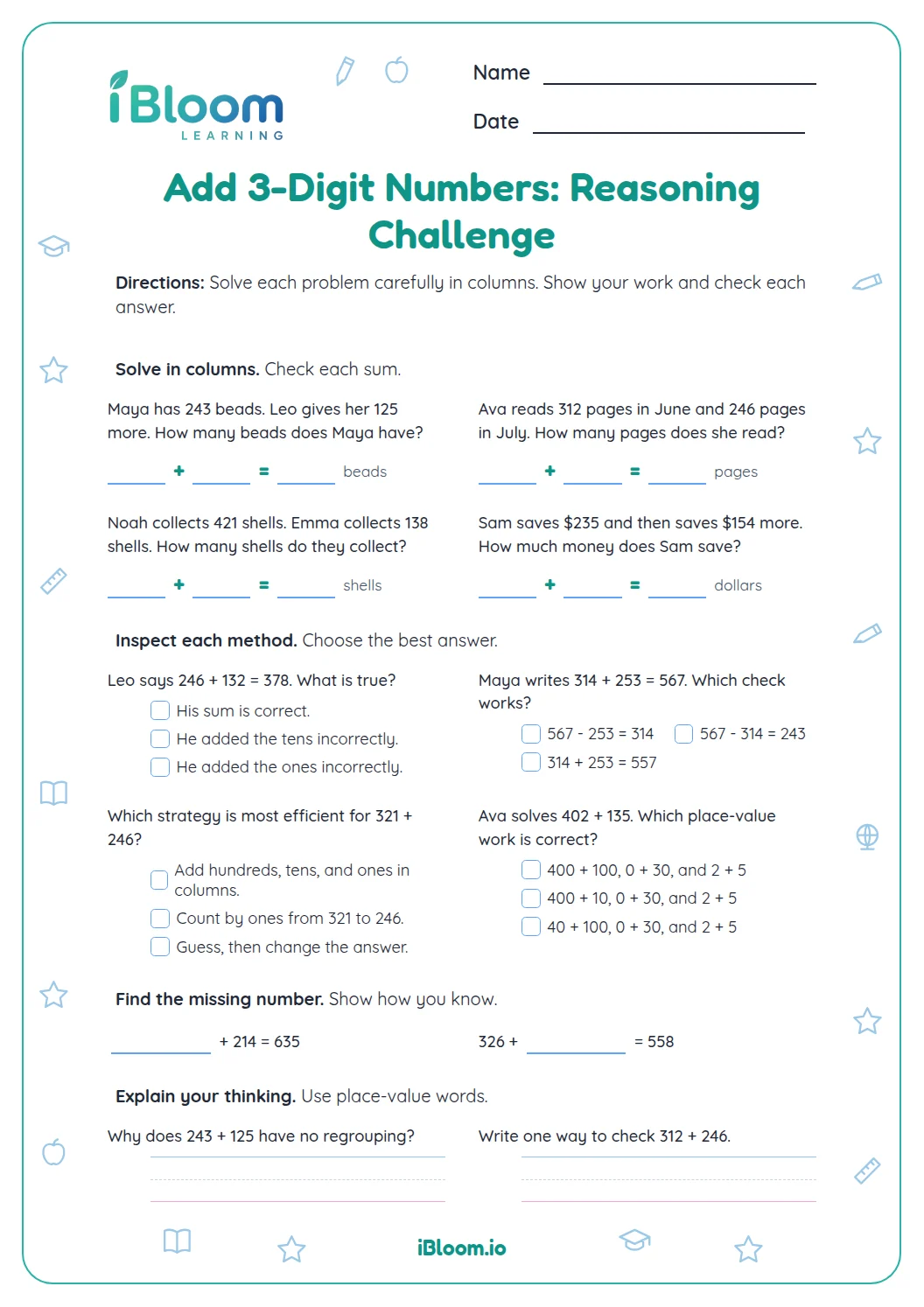
This Grade 2 printable gives students practice adding three-digit numbers without regrouping. Part A uses eight short stories about books, apples, visitors, and collections. Part B provides eight addition equations for vertical place-value practice. Students add ones, tens, and hundreds in their matching columns and can check with an estimate. An answer key is included. The page practices Common Core 2.NBT.B.5, adding within 1,000 using place-value strategies.
Aligned to 2.NBT.B.7
How do you add three-digit numbers in columns?
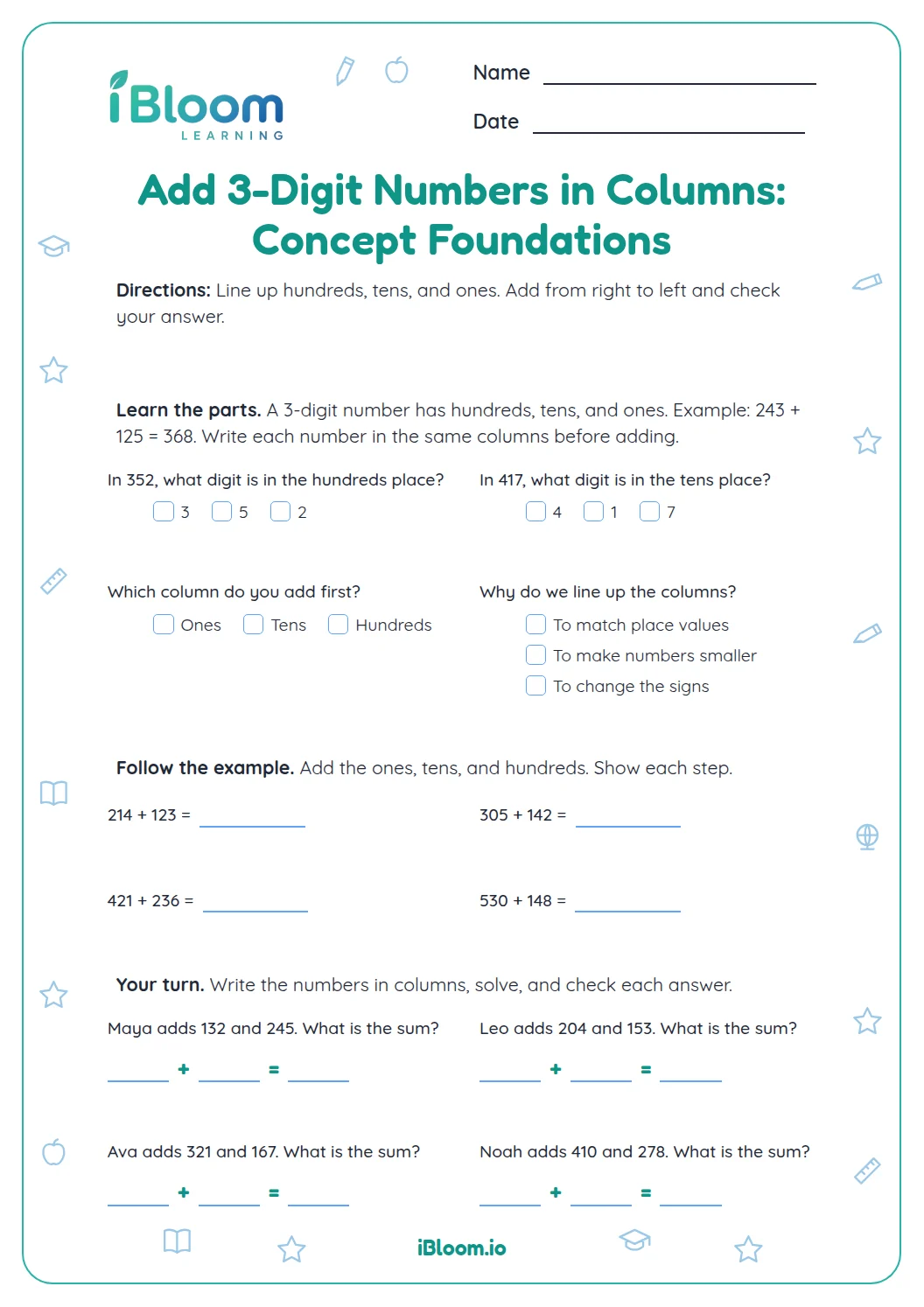
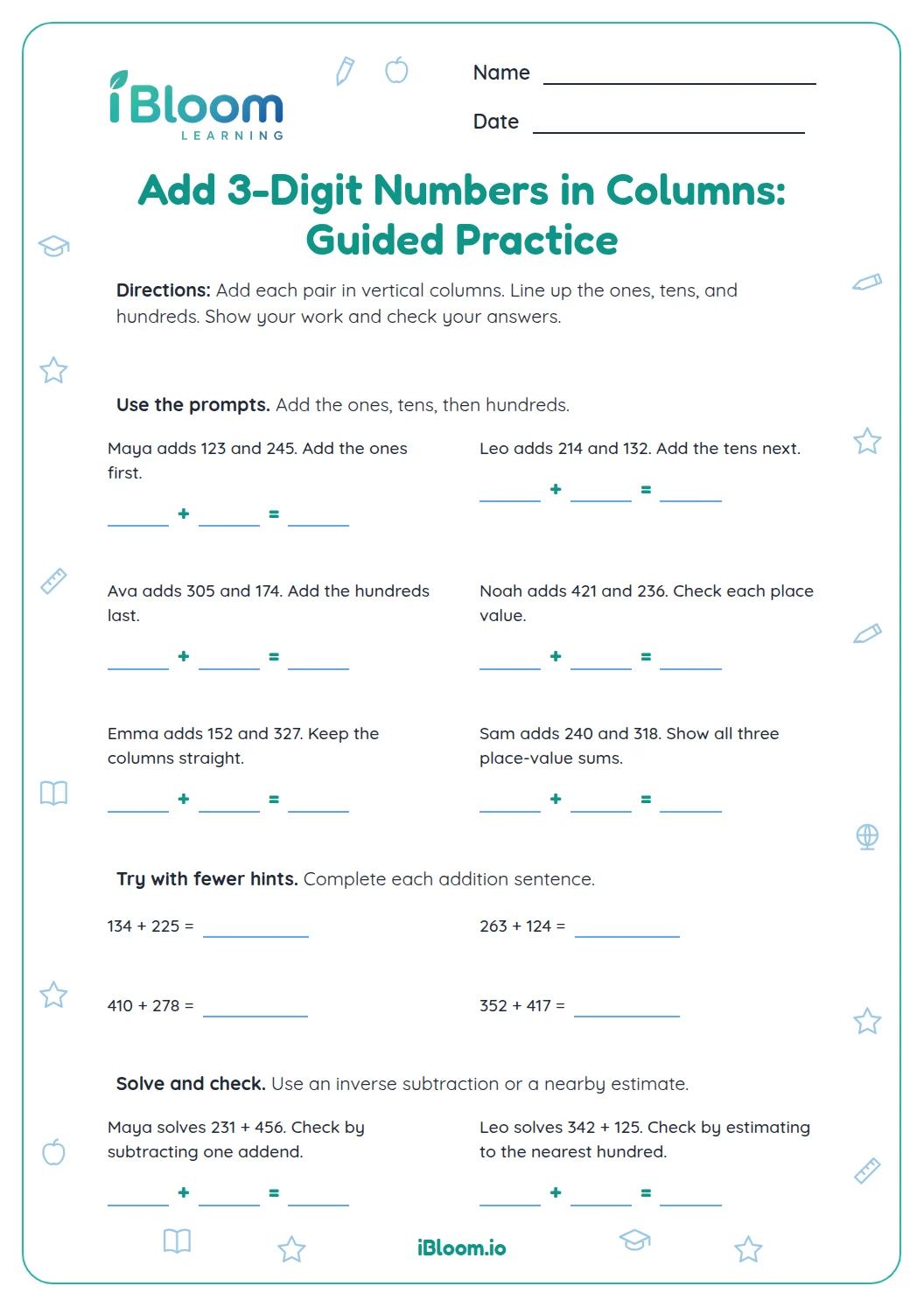
Write each number so hundreds, tens, and ones are in the same columns. Add the ones first, then the tens, then the hundreds. Keep each column total in its place.
A quick estimate helps check that the answer is a reasonable total.
- 1243 + 315
- 2Ones: 3 + 5 = 8
- 3Tens: 4 + 1 = 5
- 4Hundreds: 2 + 3 = 5
- 5Total: 558
What kinds of stories are on the sheet?
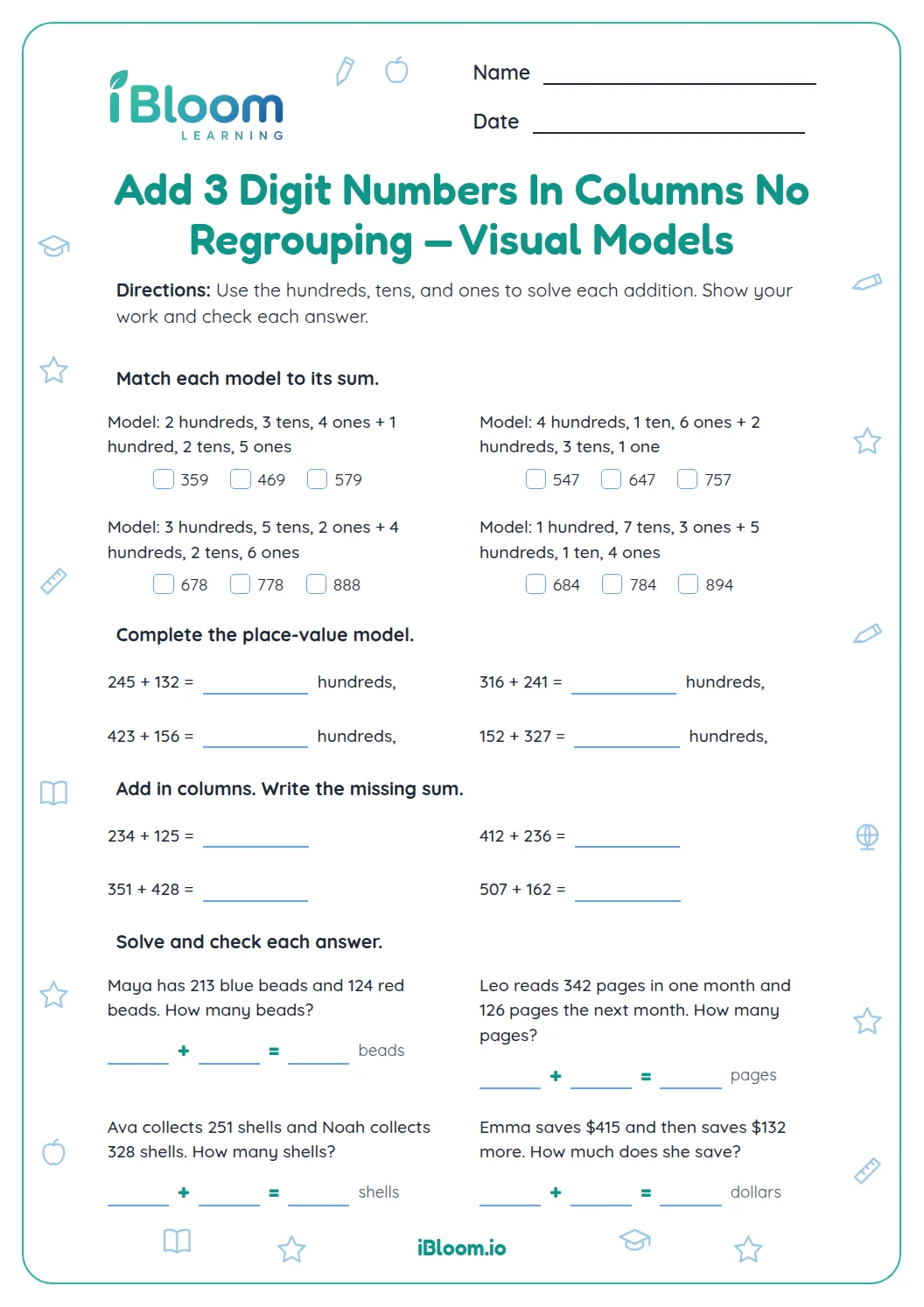
Part A asks for totals in settings such as a library, a farm, a museum, and a classroom. Part B gives eight number sentences for independent column practice.
How to use this worksheet
- 1Read the story and find both amounts being combined.
- 2Write an addition equation.
- 3Line up the ones, tens, and hundreds.
- 4Add each column from right to left.
- 5Write the total with the correct unit when the story gives one.
- 6Estimate or add in a different order to check.
Common mistakes and quick fixes
The mistake
Starting to add with digits that are not in matching columns.
The fix
Line up the final digits so ones sit below ones.
The mistake
Adding a digit from one place to the next column.
The fix
Keep each sum in its own place-value column.
The mistake
Reporting one group instead of the total.
The fix
Check that the equation combines both amounts.
Common Core alignment
Students use place value to add three-digit numbers within 1,000.
Add three-digit numbers by place value, keeping hundreds, tens, and ones in matching places.
On this sheet: Students add three-digit numbers by place value in stories and written equations, without composing a new ten or hundred.
Show the official wordingHide the official wording
Add and subtract within 1000, using concrete models or drawings and strategies based on place value, properties of operations, and/or the relationship between addition and subtraction; relate the strategy to a written method. Understand that in adding or subtracting three-digit numbers, one adds or subtracts hundreds and hundreds, tens and tens, ones and ones; and sometimes it is necessary to compose or decompose tens or hundreds.
What to practice next
Make more practice
Further reading
Questions parents and teachers ask
What does no regrouping mean on this sheet?
In every addition problem, the ones, tens, and hundreds can be added without making a group of ten in the next place. Students still line up the digits by place value and record each column total in its own place. A vertical setup makes it easier to keep each digit in the correct place.
How should students set up a three-digit addition problem?
Write one number above the other with ones under ones, tens under tens, and hundreds under hundreds. Add the ones first, then the tens and hundreds. The worksheet directions ask students to show the numbers in columns. The values stay in their original columns because no regrouping is needed.
Are the story problems all addition?
Yes. Each of the eight stories combines two amounts and asks for a total, such as books, apples, or visitors. Students can write an addition equation and solve it using the same place-value method as the equations in Part B. The stories use familiar amounts and name the unit to include in the answer.
How many questions and pages are included?
There are 16 questions: eight story problems and eight addition equations. The printable uses two worksheet pages and includes a separate two-page answer key with the totals. The key gives a total for every story and equation on the sheet.
How can a student check a sum?
Add the two addends in a different order or estimate the total before checking the exact answer. Then compare each place-value column and make sure the answer includes the unit named in a story, such as books or seats. For a quick estimate, round each addend to the nearest hundred first.