

About this worksheet
This free printable worksheet is a reasoning challenge on adding to make a whole thousand, for Grade 2. Children use base-ten blocks to find how much more makes 1,000, judge four pieces of other children's reasoning, such as Maya's claim that 347 + 653 = 900, solve two word problems and explain why 649 + 351 equals 1,000. It practices Common Core 2.NBT.B.7 and 2.NBT.B.9, adding within 1,000 and explaining why a strategy works with place value, and comes with a separate answer key.
Aligned to 2.NBT.B.7 and 2.NBT.B.9
What is on this worksheet?
Nine questions in four parts that move from blocks to explaining. Every sum is exactly 1,000, so children focus on the strategy rather than on a new number each time.
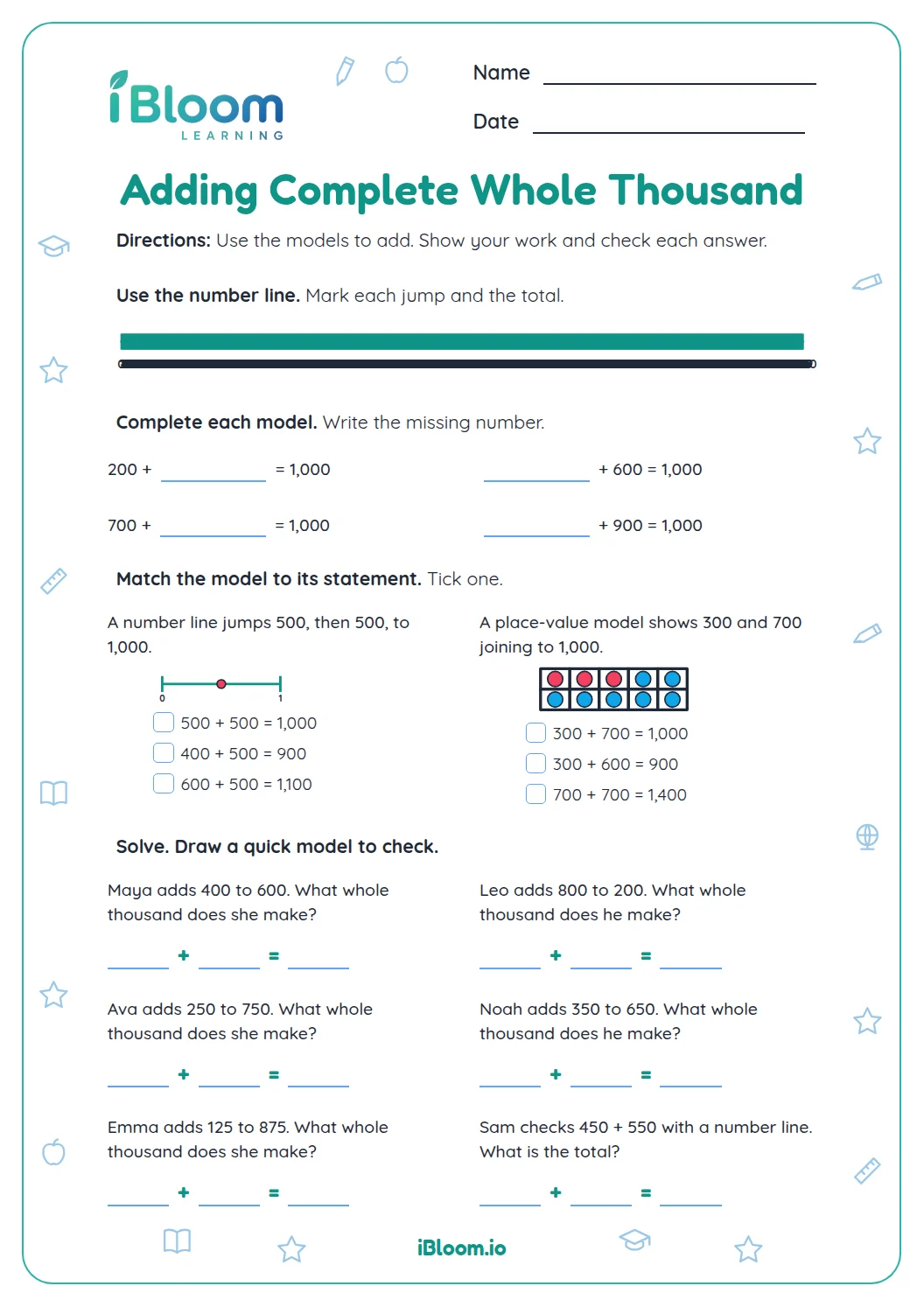
- Part A, Blocks that make 1,000: 2 missing-number sentences with base-ten blocks for 450 and 347 (questions 1 and 2)
- Part B, Check the reasoning: 4 multiple-choice questions about other children's work (questions 3 to 6)
- Part C, Solve and show: 2 word problems with space to write a number sentence (questions 7 and 8)
- Part D, Explain your thinking: 1 written explanation for 649 + 351 (question 9)
- A two-page answer key with a sample explanation
How do you add to make 1,000?
Start with the blocks. With 450, the 5 tens need 5 more tens to make a hundred, and then 5 more hundreds finish the thousand, so 550 is missing.
When ones are included, as in 347, the ones come first. Add 3 to make 350, add 50 to make 400, then add 600 to make 1,000. Written out, that is 3 + 50 + 600 = 653.
- 1347 + ___ = 1,000
- 2347 + 3 = 350
- 3350 + 50 = 400
- 4400 + 600 = 1,000
- 53 + 50 + 600 = 653, so 347 + 653 = 1,000
Why is this a reasoning challenge?
Questions 3 to 6 ask children to judge answers rather than find them. Leo says 428 + 572 = 1,000, and he is right: 8 + 2 makes 10 ones, so a ten is regrouped, 2 + 7 + 1 makes 10 tens, and 4 + 5 + 1 makes 10 hundreds.
Maya says 347 + 653 = 900, which is what happens when only the hundreds are added and the tens and ones are left out. Noah's pair checks that addition and subtraction undo each other, because 586 + 414 = 1,000 means both 1,000 − 586 = 414 and 1,000 − 414 = 586.
What does a good explanation sound like?
A strong answer mentions the places, one at a time. In 649 + 351, the 9 ones and 1 one make 10 ones, so a new ten appears. The 4 tens, 5 tens and the new ten make 10 tens, so a new hundred appears. Then 6, 3 and the new hundred make 10 hundreds, which is 1,000.
Accept any explanation that uses place value or that checks by subtracting, such as 1,000 − 649 = 351.
How to use this worksheet at home or in class
- 1Build 450 with base-ten blocks, or draw it, and ask how many more tens make a hundred. Then do question 1 together.
- 2Count up in steps for question 2: ones first, then tens, then hundreds. Write each step on scrap paper.
- 3Read each claim in Part B aloud and ask “Do you believe it?” before your child looks at the choices.
- 4In Part C, ask for a number sentence first, such as 438 + ___ = 1,000, then the answer with its unit.
- 5For Part D, have your child say the explanation out loud before writing it, one place at a time.
- 6Mark with the answer key and have your child check each word problem by subtracting from 1,000.
Common mistakes and quick fixes
The mistake
Adding only the hundreds, so 347 + 653 comes out as 900.
The fix
Put the tens and ones back in. 7 + 3 = 10 ones and 4 + 5 = 9 tens, plus the regrouped ten, make another hundred.
The mistake
Stopping at the next hundred: answering 62 for 438 + ___ = 1,000, because 438 + 62 = 500.
The fix
Keep counting up to 1,000. 62 more reaches 500, and 500 more reaches 1,000, so the missing number is 62 + 500 = 562.
The mistake
Stopping at 9 hundreds, so 450 + 550 looks like 900.
The fix
Add 5 tens + 5 tens first. That makes 10 tens, which is 1 hundred, and brings the total to 10 hundreds, or 1,000.
Common Core alignment
Most US states use the Common Core math standards or a close state version.
Add within 1,000 using place-value models and strategies, composing tens and hundreds.
On this sheet: Every question adds three-digit numbers to a total of 1,000, using blocks and regrouping ones, tens and hundreds.
Show the official wordingHide the official wording
Add and subtract within 1000, using concrete models or drawings and strategies based on place value, properties of operations, and/or the relationship between addition and subtraction; relate the strategy to a written method. Understand that in adding or subtracting three-digit numbers, one adds or subtracts hundreds and hundreds, tens and tens, ones and ones; and sometimes it is necessary to compose or decompose tens or hundreds.
Explain why an addition strategy works, using place value.
On this sheet: Part B judges other children's reasoning and Part D asks for a written place-value explanation.
Show the official wordingHide the official wording
Explain why addition and subtraction strategies work, using place value and the properties of operations.
What to practice next
Make more practice
Further reading
Questions parents and teachers ask
What does “adding to make a whole thousand” mean?
It means finding the number that, added to a given number, makes exactly 1,000. For 347, the missing number is 653, because 347 + 653 = 1,000. Children use place value to count up: ones first, then tens, then hundreds, which builds the regrouping skill behind column addition.
What grade is this worksheet for?
It is written for Grade 2, where Common Core 2.NBT.B.7 asks children to add within 1,000 using place value and regrouping. Part A uses blocks to help children who still need a picture, and Parts B and D challenge children who are ready to explain their thinking.
Why does the worksheet ask children to check other children's answers?
Judging someone else's claim makes children think about why an answer is right, not only how to get it. Maya's answer of 900 shows what happens when tens and ones are skipped, and Noah's question shows that subtracting from 1,000 checks an addition. Both match the explaining skill in 2.NBT.B.9.
How can my child check a missing-number answer?
Subtract the answer from 1,000 or add the two numbers and see whether they reach 1,000. If 347 + 653 gives 1,000, the answer is right. Counting up in steps, 347 to 350, then 400, then 1,000, also shows every part of the 653 that was added.
How long does the worksheet take, and is there an answer key?
Most Grade 2 children need about 20 minutes, because the word problems and the explanation ask for working and writing. The two-page answer key matches the worksheet page for page, with every answer and a sample explanation, so you can print the worksheet alone and check it together later.
What should my child do if the explanation is hard to write?
Let them say it out loud first, one place at a time: ones, tens, then hundreds. Then they can write only the numbers, such as 9 + 1 = 10. Another good answer uses subtraction: 1,000 − 649 = 351. Short, correct explanations are enough at this age.