
About this worksheet
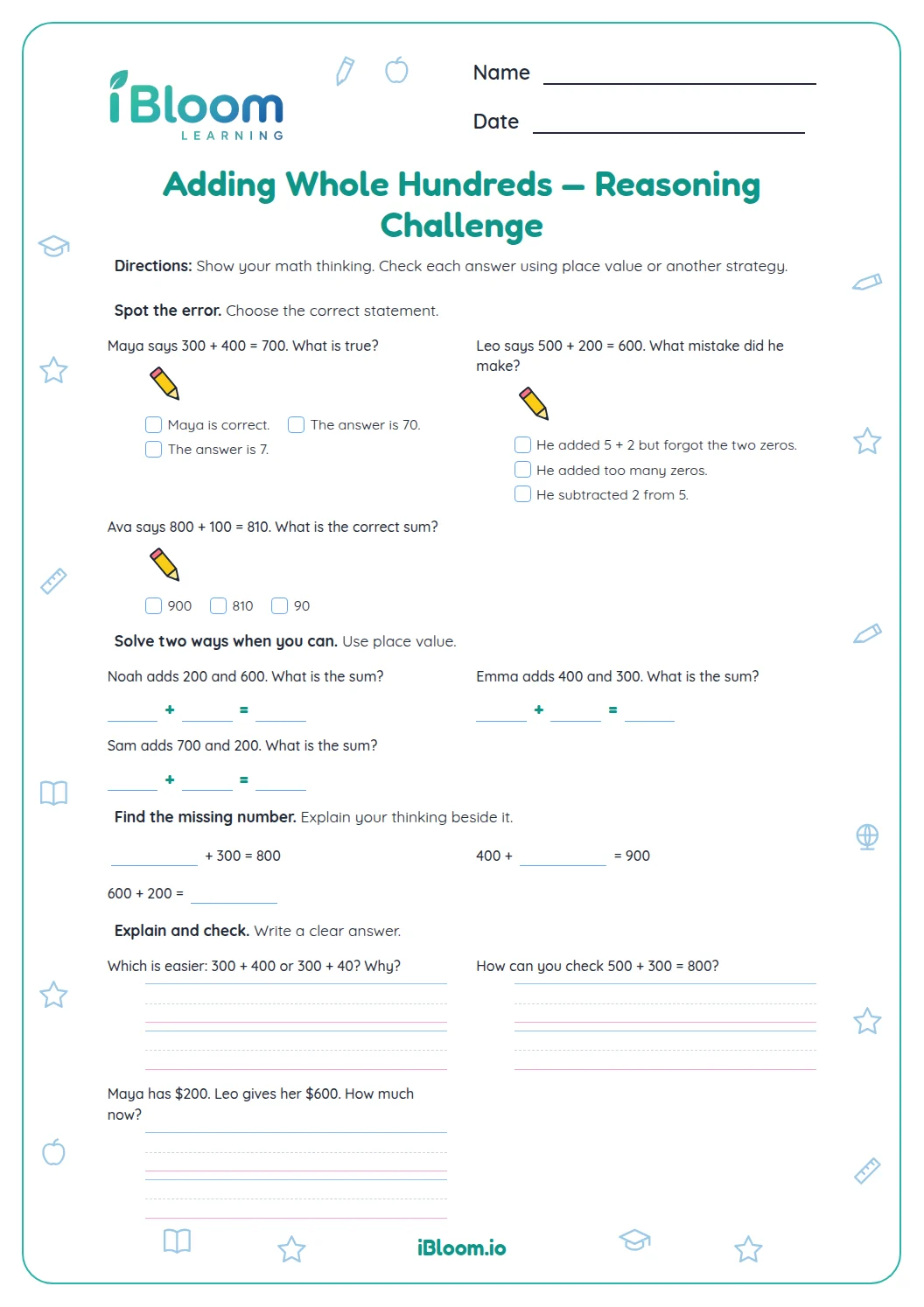
This Grade 2 worksheet moves from recognizing when a story calls for addition to adding whole hundreds and solving real-world problems. Students combine amounts up to 1,000, check a mistaken sum, and label totals in context. This practices place-value addition described in CCSS 2.NBT.B.7.
Aligned to 2.NBT.B.7
How can you add whole hundreds?
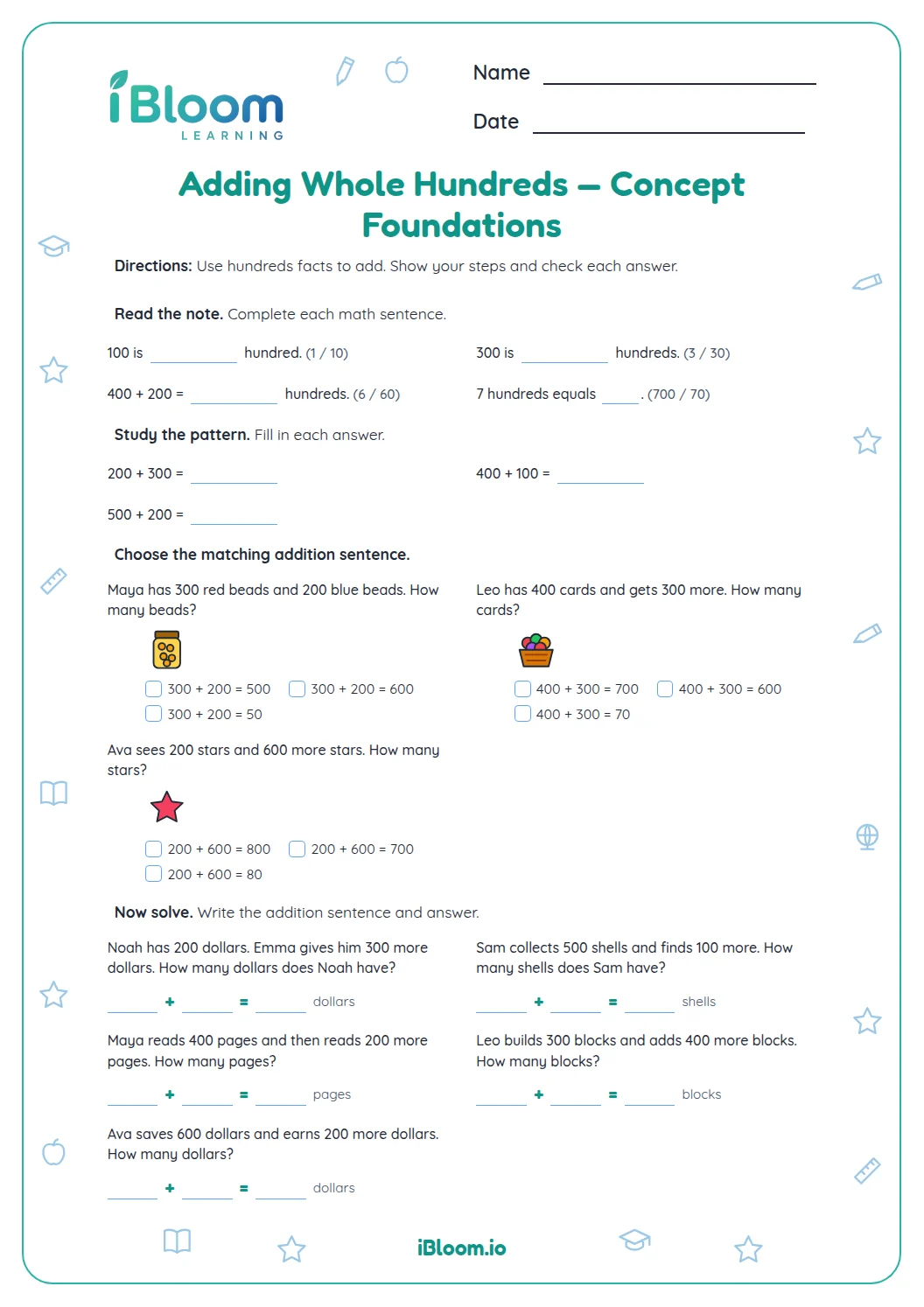
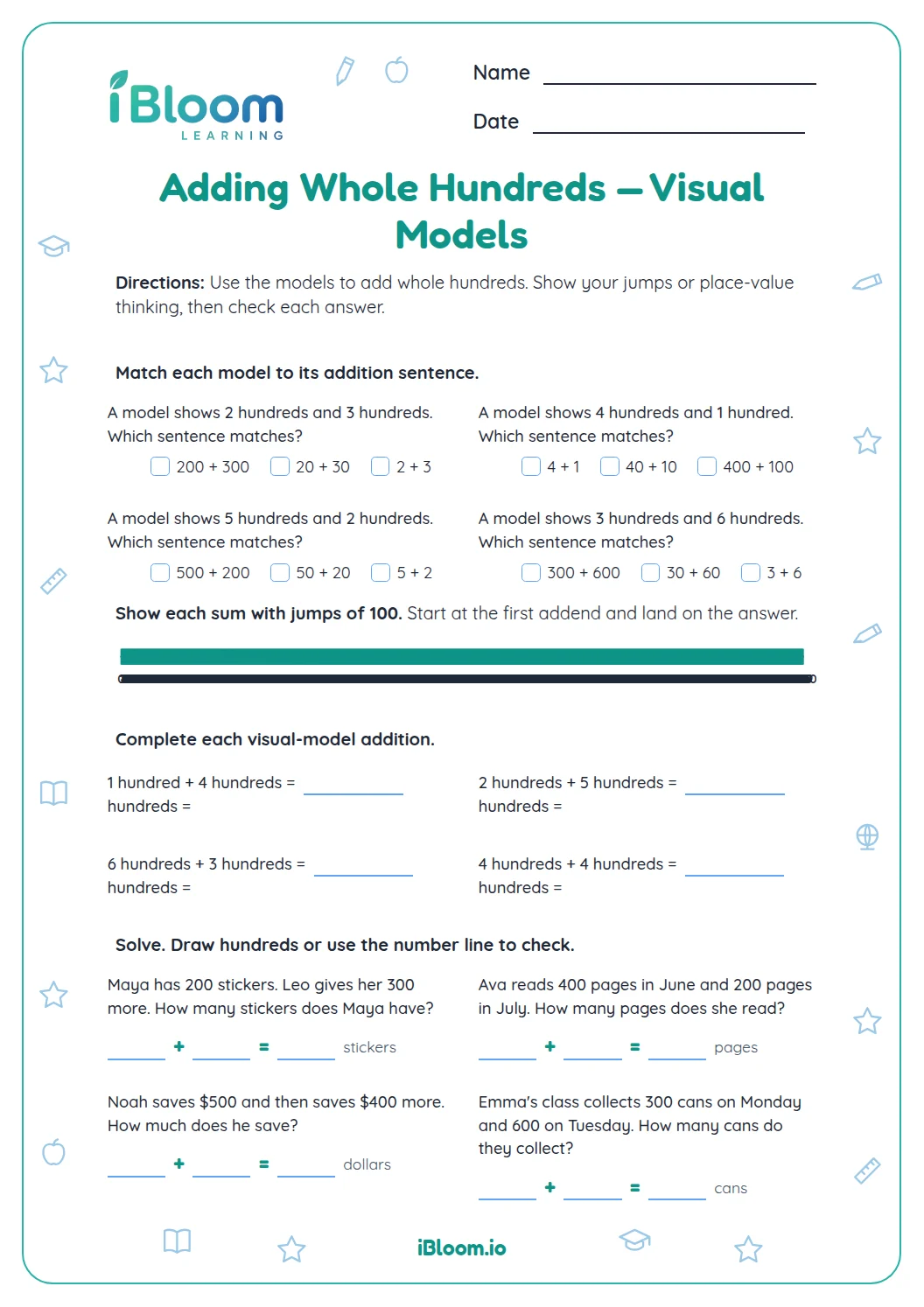
Think of each hundred as one group: 300 is 3 hundreds and 400 is 4 hundreds. Combine the groups, then write the total as 700. The same idea works in each story on this page.
- 1300 + 200 = 500
- 23 hundreds + 2 hundreds = 5 hundreds
How do you choose an addition equation?
Look for two amounts being joined, then combine their hundreds. For 300 + 200, add 3 hundreds and 2 hundreds to get 5 hundreds, or 500. Part A asks students to recognize when this operation fits.
How can you check a total?
A story problem also needs an answer that fits its situation. If 400 apples are packed and then 400 more, 800 apples are packed altogether. Include the unit so the reader knows what the total counts.
How to use this worksheet
- 1Read the story and identify the amounts.
- 2In Part A, choose the operation that answers the question.
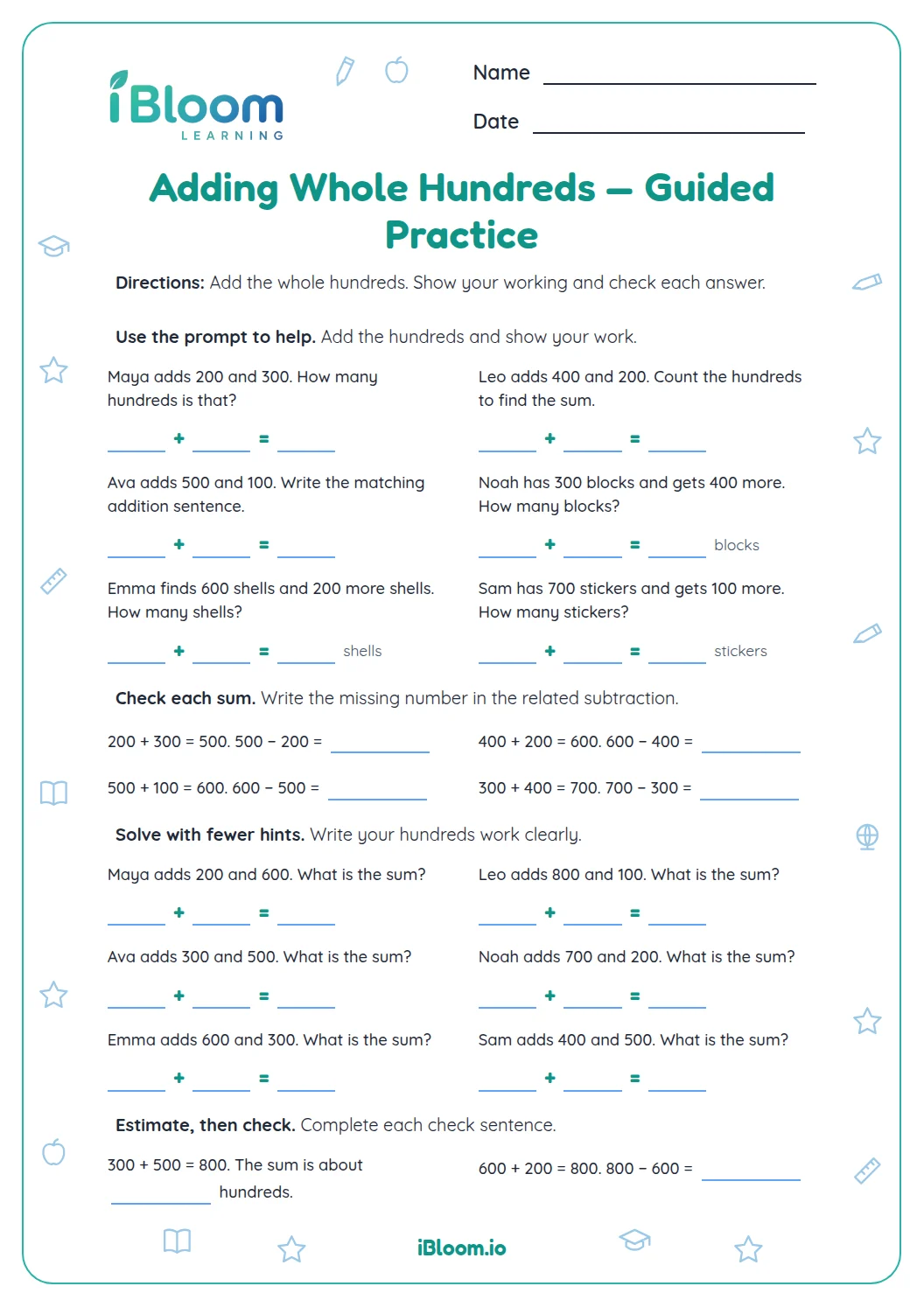
- 3In Part B, combine the hundreds and write the sum.
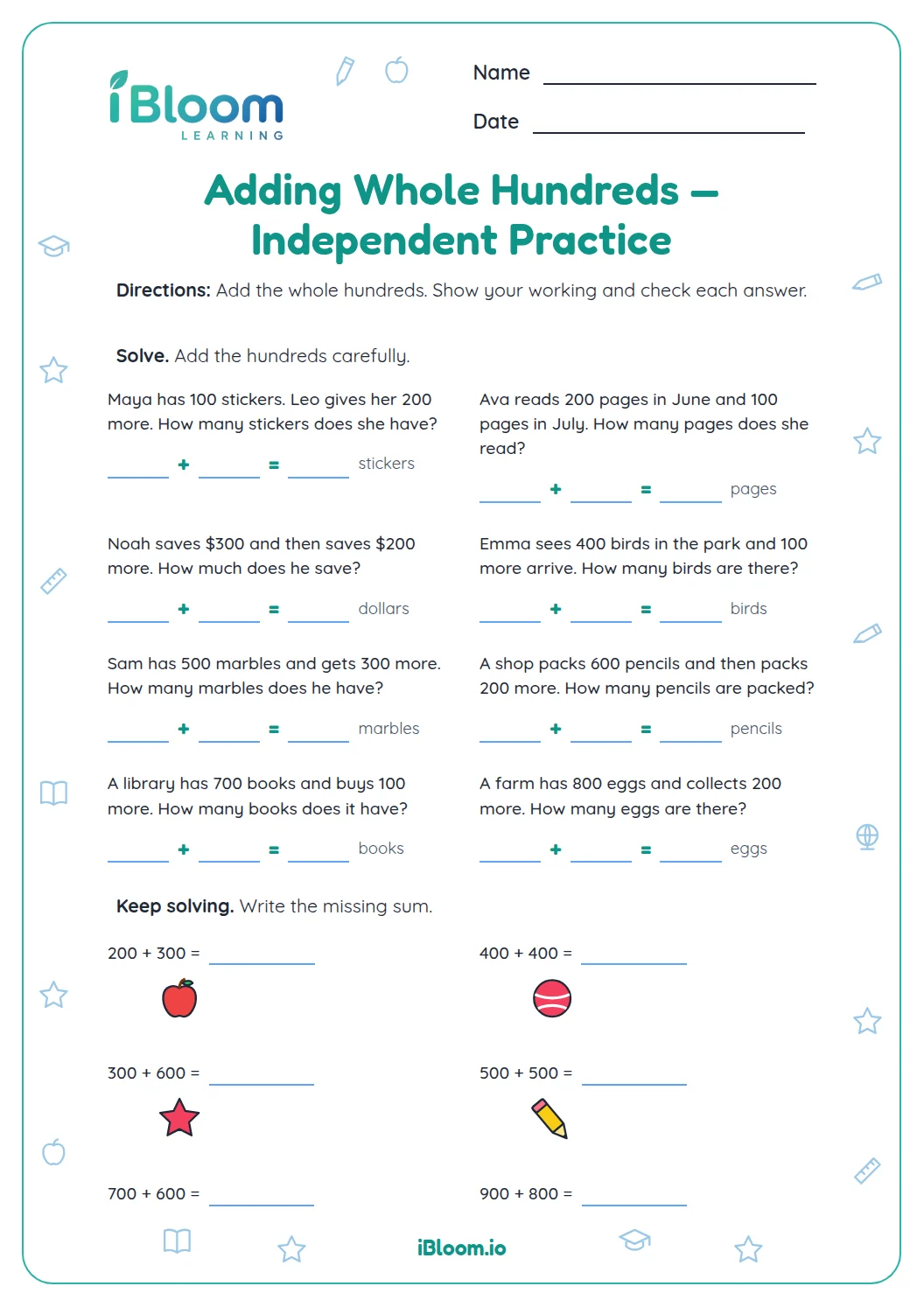
- 4In Part C, show an equation and label the total.
- 5Check the place-value sum and its unit.
Common mistakes and quick fixes
The mistake
Adding only one number of hundreds
The fix
Combine both groups: 300 + 200 means 3 hundreds plus 2 hundreds.
The mistake
Dropping a zero in the total
The fix
Say the number in hundreds first, then write all three digits: 5 hundreds is 500.
The mistake
Choosing subtraction when amounts are joined
The fix
Ask whether the story puts two groups together or takes one away. These situations join groups.
Common Core alignment
This worksheet gives students focused practice with a grade-level skill.
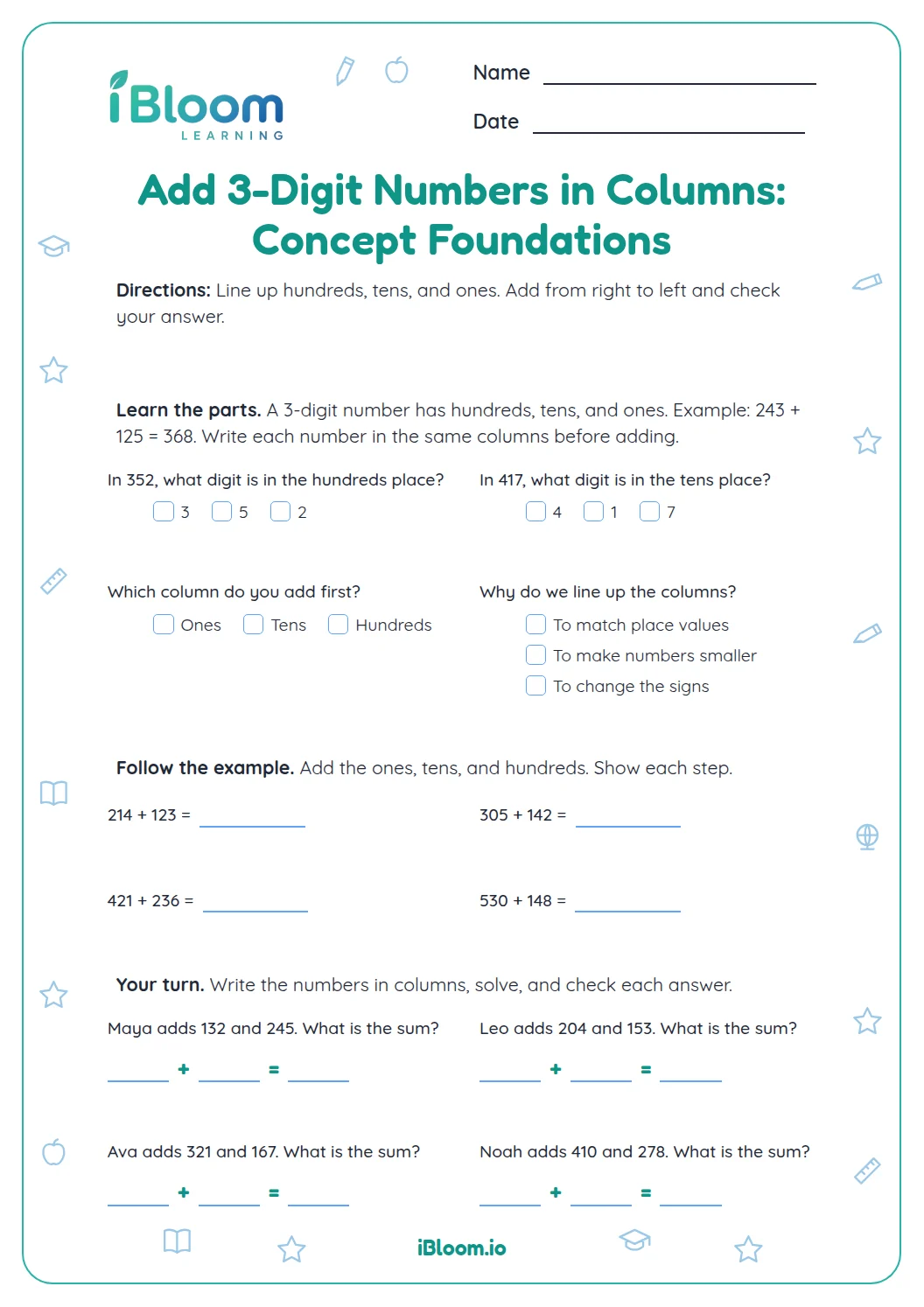
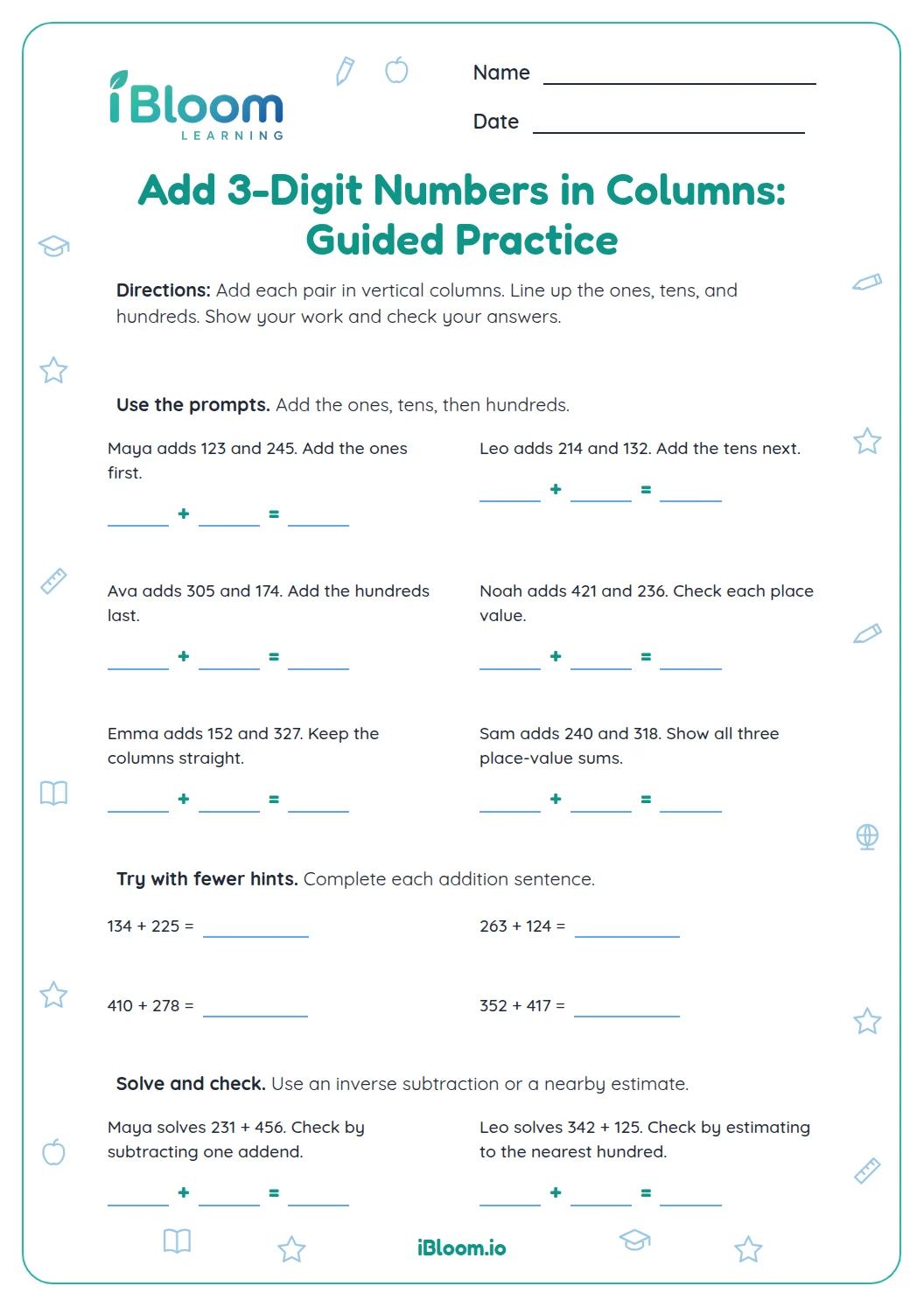
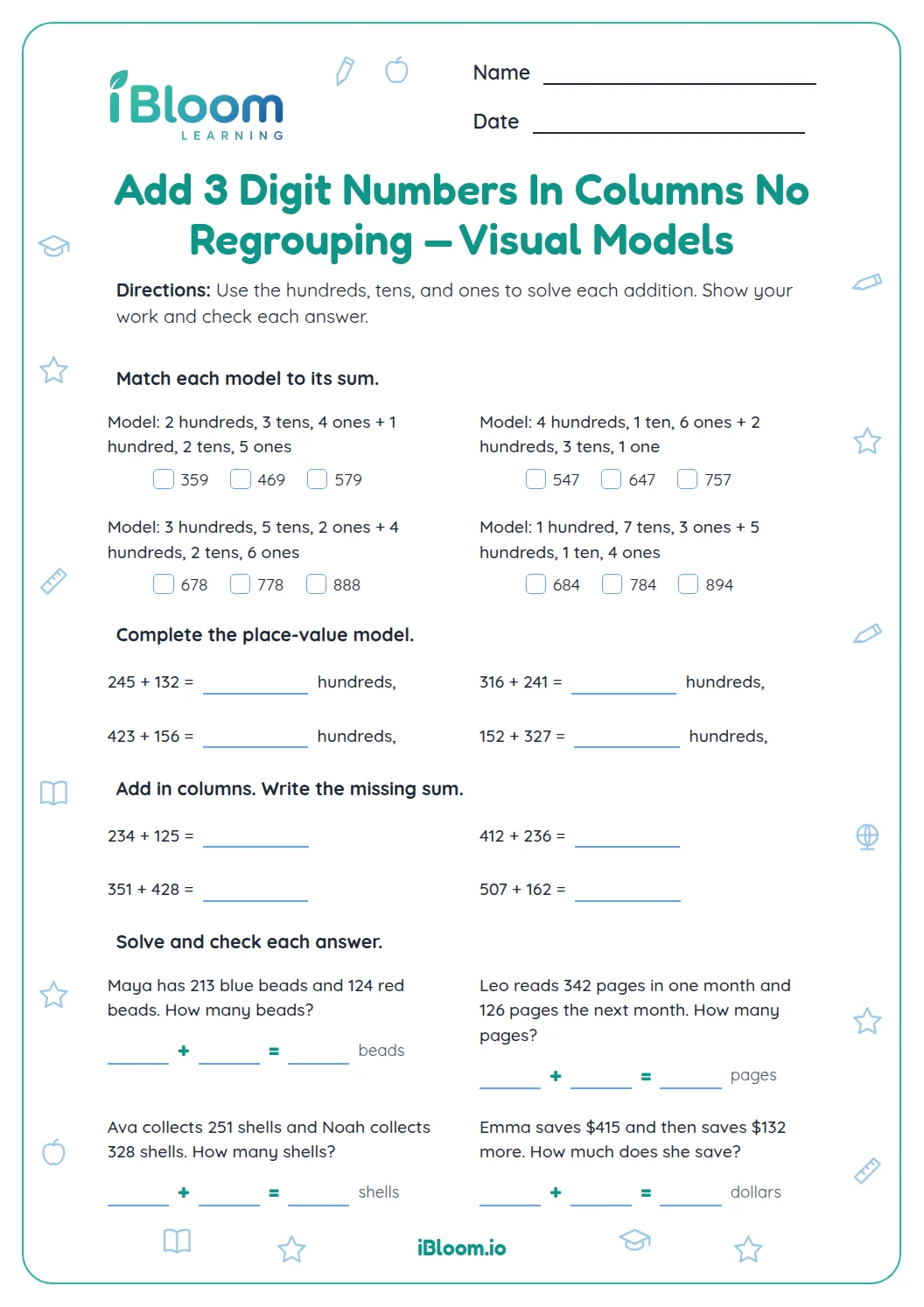
Add within 1,000 by combining hundreds, tens, and ones.
On this sheet: Add within 1,000 by combining hundreds, tens, and ones.
Show the official wordingHide the official wording
Add and subtract within 1000, using concrete models or drawings and strategies based on place value, properties of operations, and/or the relationship between addition and subtraction; relate the strategy to a written method. Understand that in adding or subtracting three-digit numbers, one adds or subtracts hundreds and hundreds, tens and tens, ones and ones; and sometimes it is necessary to compose or decompose tens or hundreds.
What to practice next
Make more practice
Further reading
Questions parents and teachers ask
How does a student know to add in Part A?
Addition fits when the story asks for a total made by joining two amounts. For example, books on two shelves can be counted together. Have the student name both groups before choosing the operation. This first choice prepares students to solve the story problems that follow.
How can children add 300 and 200?
Think of 300 as 3 hundreds and 200 as 2 hundreds. Three hundreds plus two hundreds equals five hundreds, or 500. This place-value approach is used in the computation section. Students can say the number of hundreds aloud before writing the three-digit sum.
What happens in the story problems?
Students add whole-hundreds amounts in situations about apples, visitors, money, travel, and tents. The answer should include the unit named in the story, such as miles or visitors. The examples use familiar countable groups and keep both addends in whole hundreds.
Why does one question ask whether a sum is correct?
Checking a claim helps students compare an answer with the place-value calculation. Since 400 plus 200 is 600, the statement that it equals 700 is not correct. Recomputing by counting hundreds helps catch the incorrect total. This reinforces checking place value.
What should a student write in the answer space?
For a story problem, write an equation and the total with its unit. The key gives one concise answer for each item, including the dollar sign for the fundraising total. Include the dollar sign when recording money, and name the object or unit in other stories.