


About this worksheet
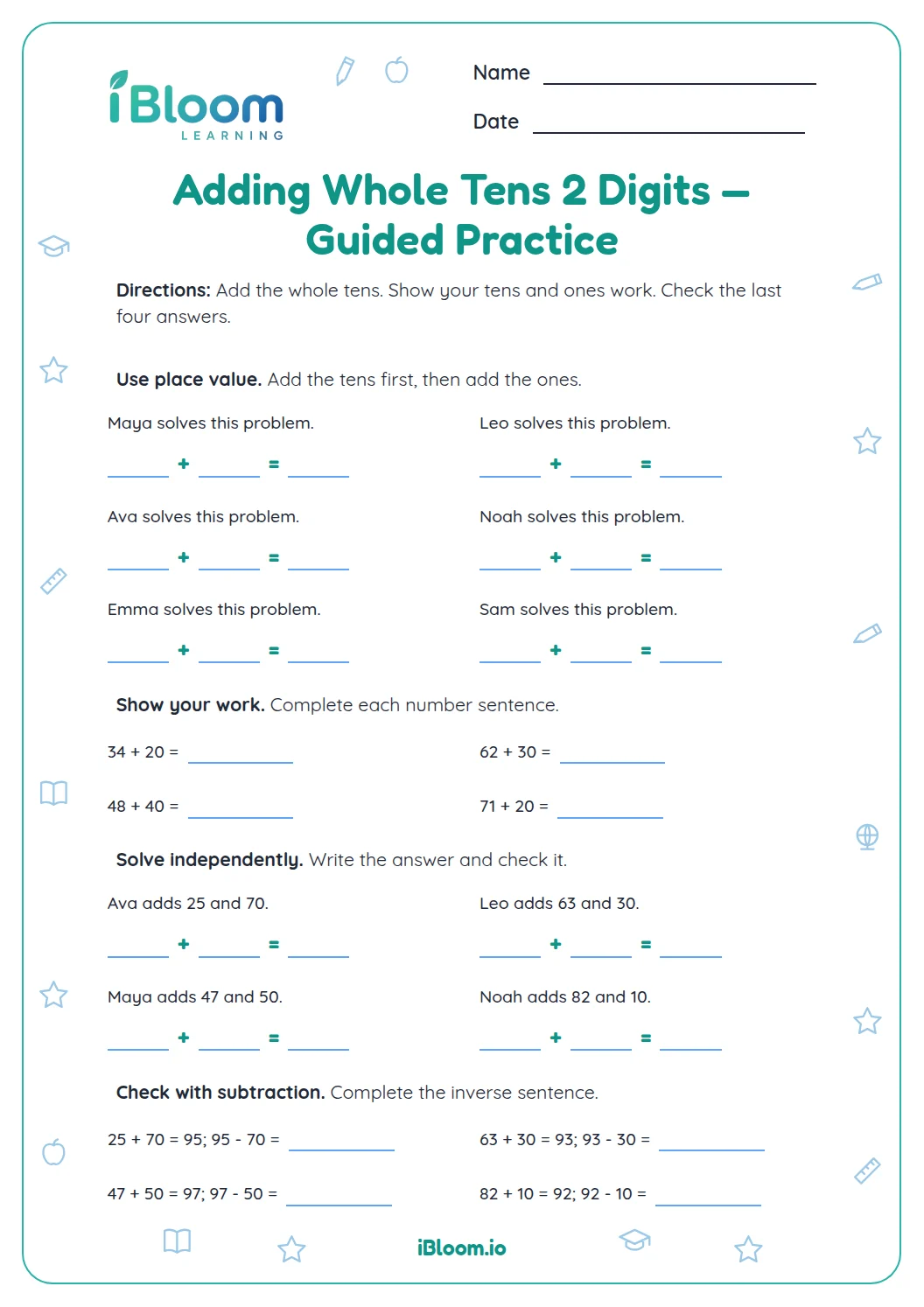
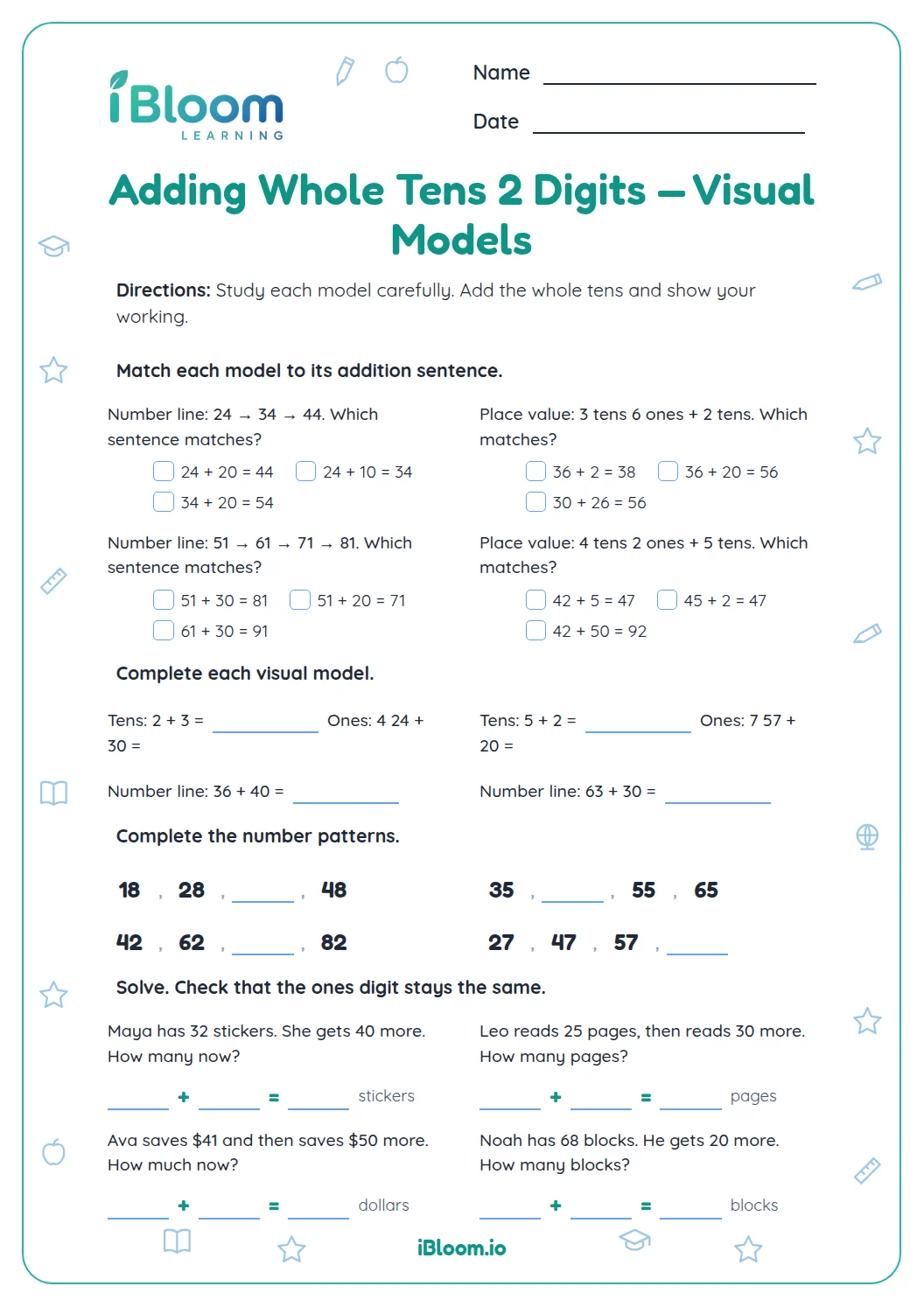
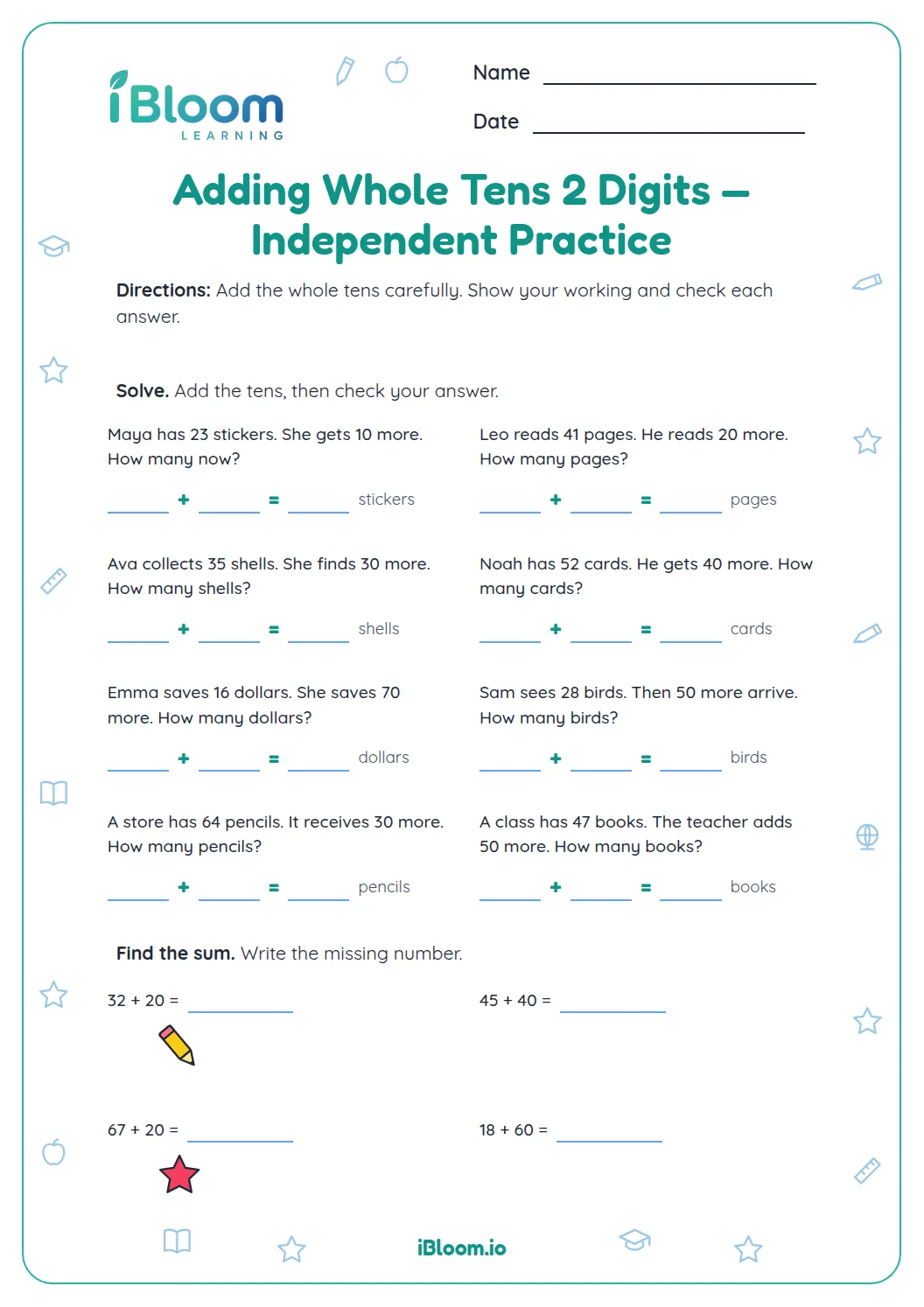
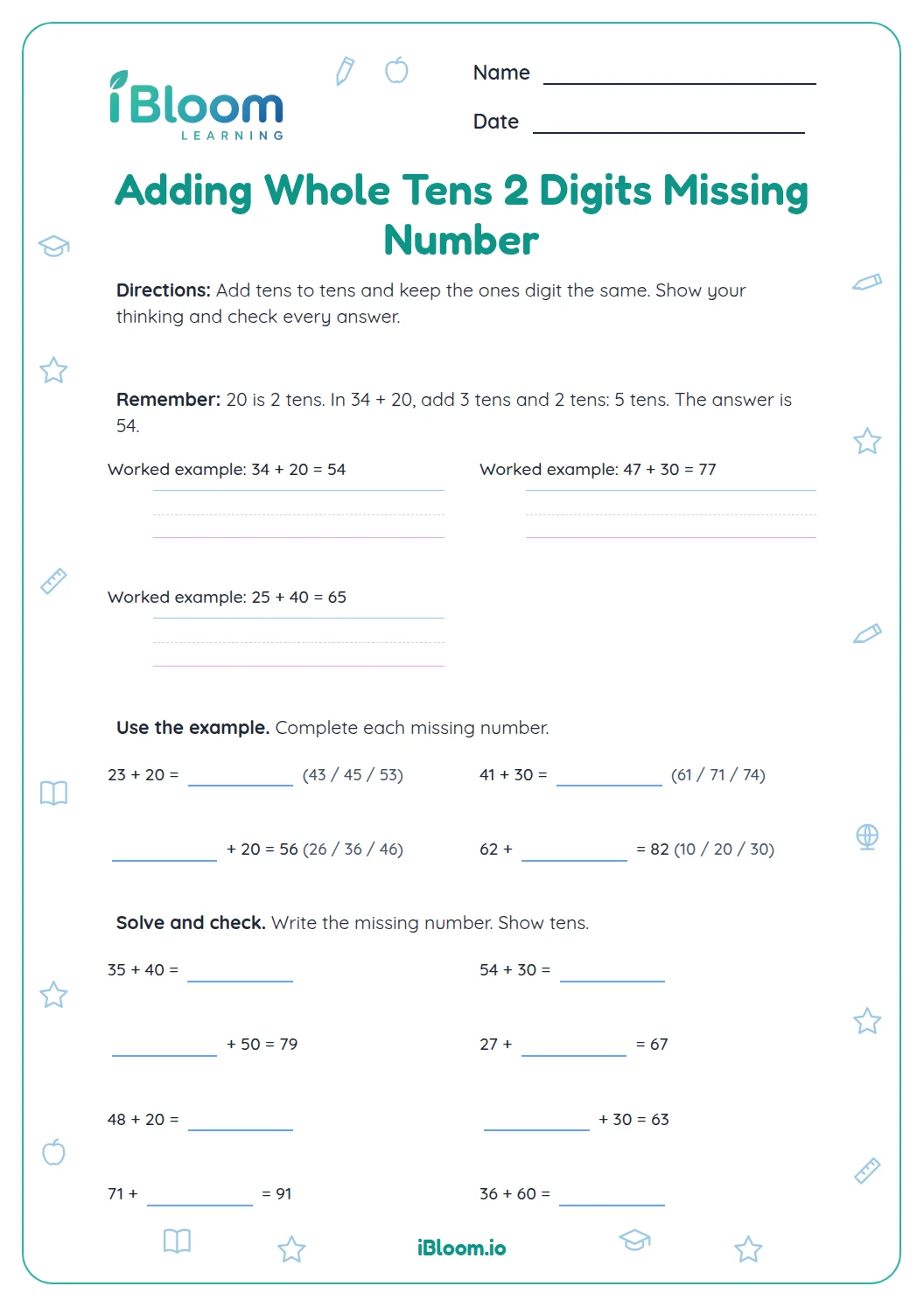
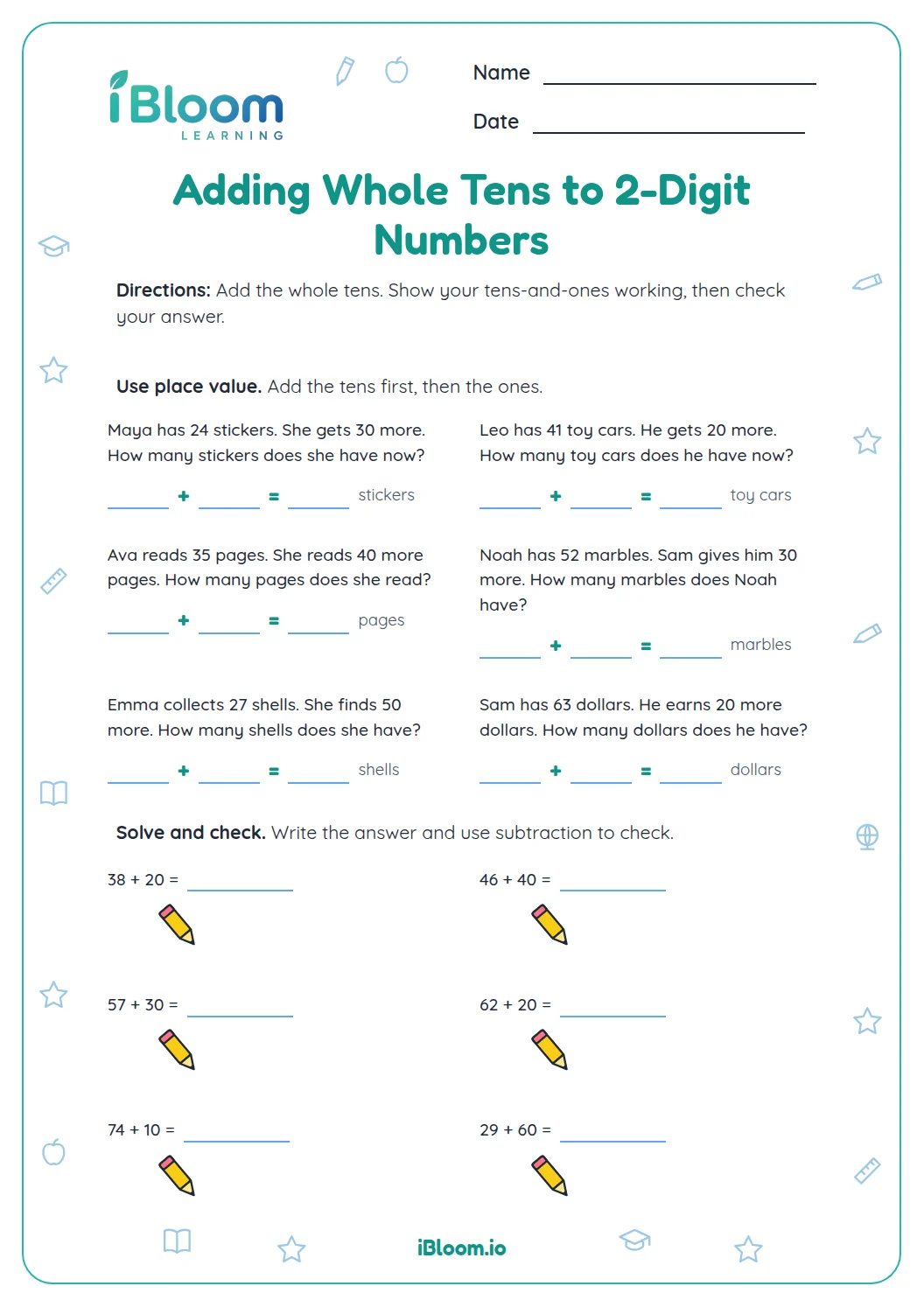
This free Grade 2 worksheet shows how to add whole tens to a two-digit number while keeping its ones. Part A has six additions with base-ten blocks showing the combined amount. Part B breaks each number into tens and ones before adding. Part C checks sums and place-value reasoning, and Part D has two stories with working space. For example, 34 + 20 combines 3 tens and 2 tens while keeping 4 ones, giving 54. All sums are below 100. The sheet practices the place-value addition strategies in Common Core 2.NBT.B.5, with a separate answer key for every question.
Aligned to 2.NBT.B.5
How do the blocks show what changes?
Each long rod represents ten ones, and each small block represents one. The blocks in Part A show the sum. For 34 + 20, identify the 3 starting tens and 4 ones, then add 2 tens.
Only the number of rods changes when whole tens are added. Count all the rods and keep the small blocks to read the total.
- 134 is 3 tens and 4 ones.
- 220 is 2 tens and 0 ones.
- 33 tens + 2 tens = 5 tens.
- 45 tens and 4 ones = 54.
Why does the ones digit stay the same?
Part B writes each starting number as tens and ones before adding the new tens. In question 7, 32 + 20 becomes 30 + 20 + 2: combine the tens to get 50, then keep the 2 ones for 52.
Part B removes the blocks but keeps the place-value steps. Ask the child to say the tens and ones before writing each sum, then check that the answer has the same ones digit as the starting number.
How do the stories use the same method?
Part D has two stories. The pencil story starts with 32 pencils and adds 40. Combine 3 tens and 4 tens, then keep 2 ones: 72 pencils. The bead story combines 35 blue beads and 20 red beads to make 55 beads.
Children write an equation in the working area and record the total with its object name. A quick sketch of rods and dots can help them explain why the ones stay the same.
How can you check a tens addition?
Part C asks children to choose a correct addition equation, identify the unchanged ones digit and judge a completed sum. For example, 42 + 30 equals 72; in 58 + 20, the ones digit remains 8. Children also decide whether 36 + 40 = 76 is correct. These checks reinforce the place-value steps before children apply them in Part D.
How to use this worksheet
- 1Point to one rod and one small block; name their values as 10 and 1.
- 2For 34 + 20, find the 3 starting tens, 4 ones and 2 added tens.
- 3Count all 5 tens and keep the 4 ones; write 54.
- 4In Part B, break each starting number into tens and ones before combining the tens.
- 5Use Part C to check the sum and unchanged ones digit, then write an equation for each story in Part D.
Mistakes to notice and fix
The mistake
Adding 2 instead of 20 and writing 36 for 34 + 20.
The fix
20 means 2 tens. Add two rods, not two small blocks.
The mistake
Writing 50 for 34 + 20 and losing the 4 ones.
The fix
Keep the four small blocks beside the five rods: 5 tens and 4 ones is 54.
The mistake
Writing 705 for 45 + 30 by joining 70 and 5.
The fix
7 tens and 5 ones make the two-digit number 75. Put each digit in its place.
Common Core alignment
Add a multiple of ten to a two-digit number by combining tens and keeping ones.
On this sheet: Block models, equations and two stories practice adding tens to numbers with nonzero ones.
Show the official wordingHide the official wording
Fluently add and subtract within 100 using strategies based on place value, properties of operations, and/or the relationship between addition and subtraction.
What to practice next
Make more practice
Further reading
Questions parents and teachers ask
Are both addends always whole tens?
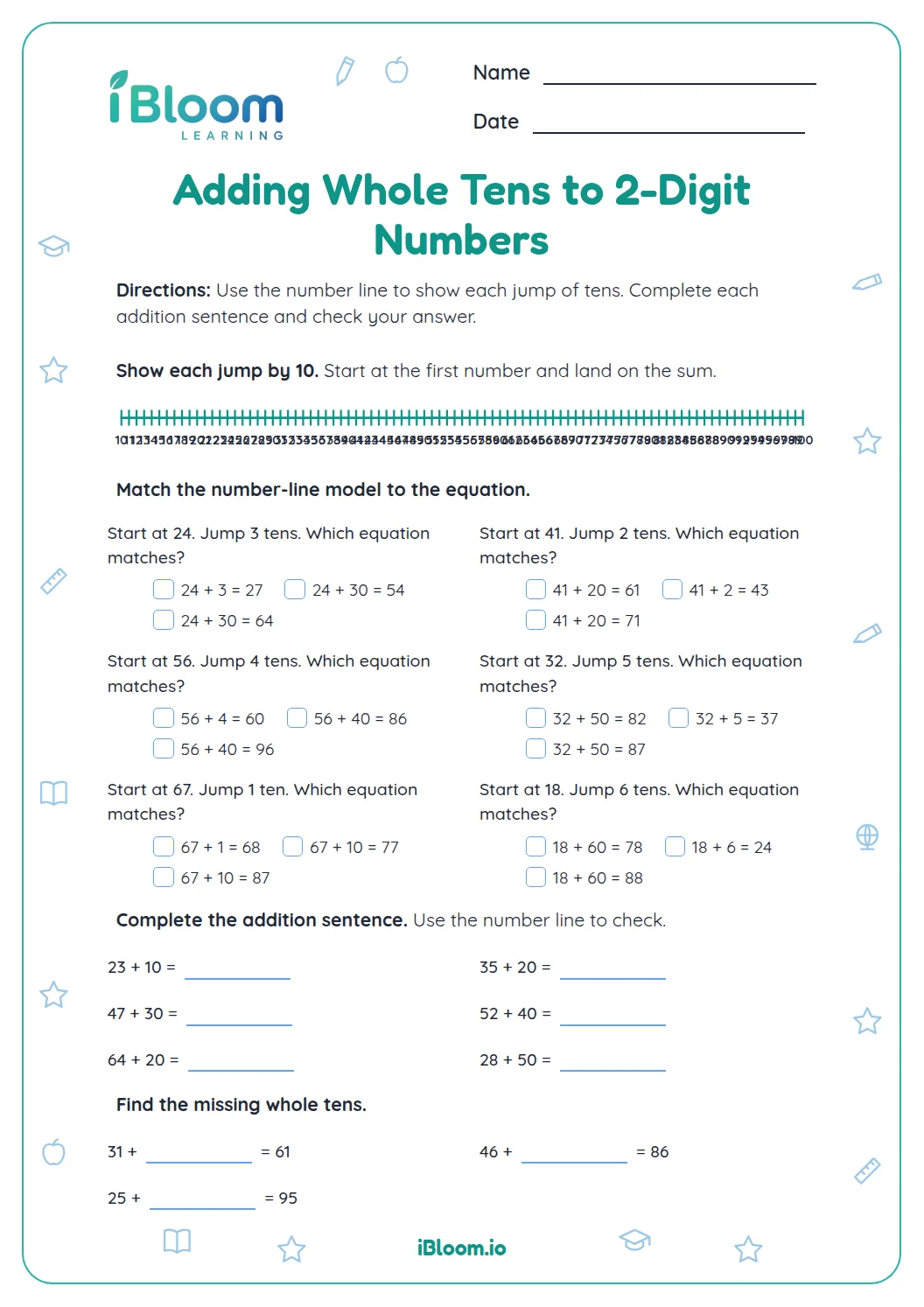
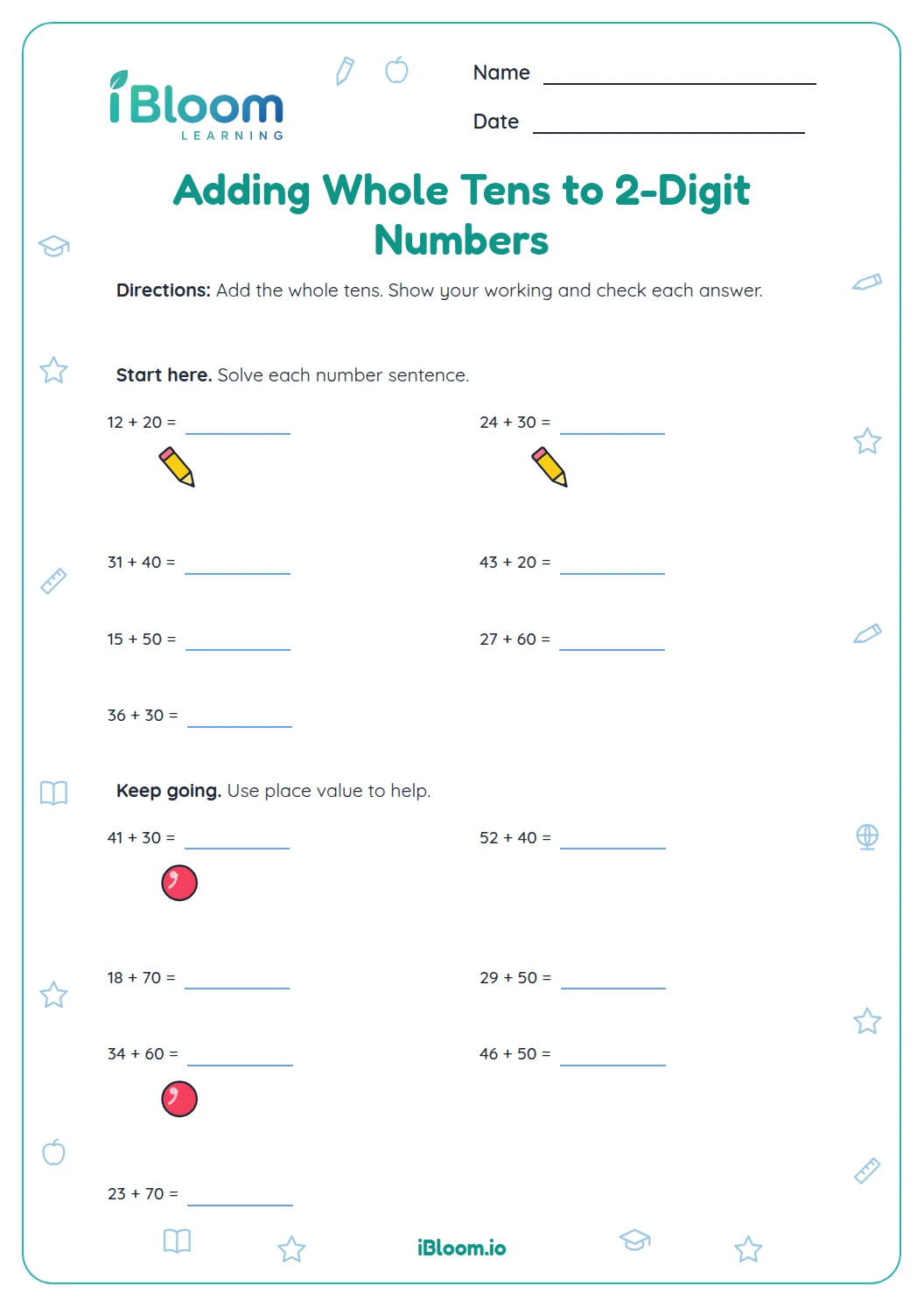
One addend is a whole ten, such as 20 or 30; the other has a nonzero ones digit. For example, 34 + 20 keeps the 4 ones from 34. The sheet practices this with block models, expanded place-value equations, answer checks and stories.
What do the block models show?
The six models show the combined amount for each Part A addition. For 34 + 20, the drawing has five rods and four small blocks. Ask your child to identify three starting rods, four ones and two added rods before counting the total value.
Why does the ones digit stay the same?
The added whole ten has zero ones, so no new ones join the starting number. In 58 + 20, add 5 tens and 2 tens to get 7 tens, then keep the 8 ones. The result is 78, with the same ones digit as 58.
Can children solve the equations mentally?
Yes, children can add the tens mentally once they understand the blocks. For 42 + 30, think 4 tens plus 3 tens makes 7 tens, then keep 2 ones to get 72. Ask for that explanation when checking a few equations in Part B.
What should my child write for the pencil story?
Write 32 + 40 = 72 pencils in the working space. The story adds four tens to three tens and keeps two ones. Children can sketch rods and dots to check that the total still includes the two ones.