



About this worksheet
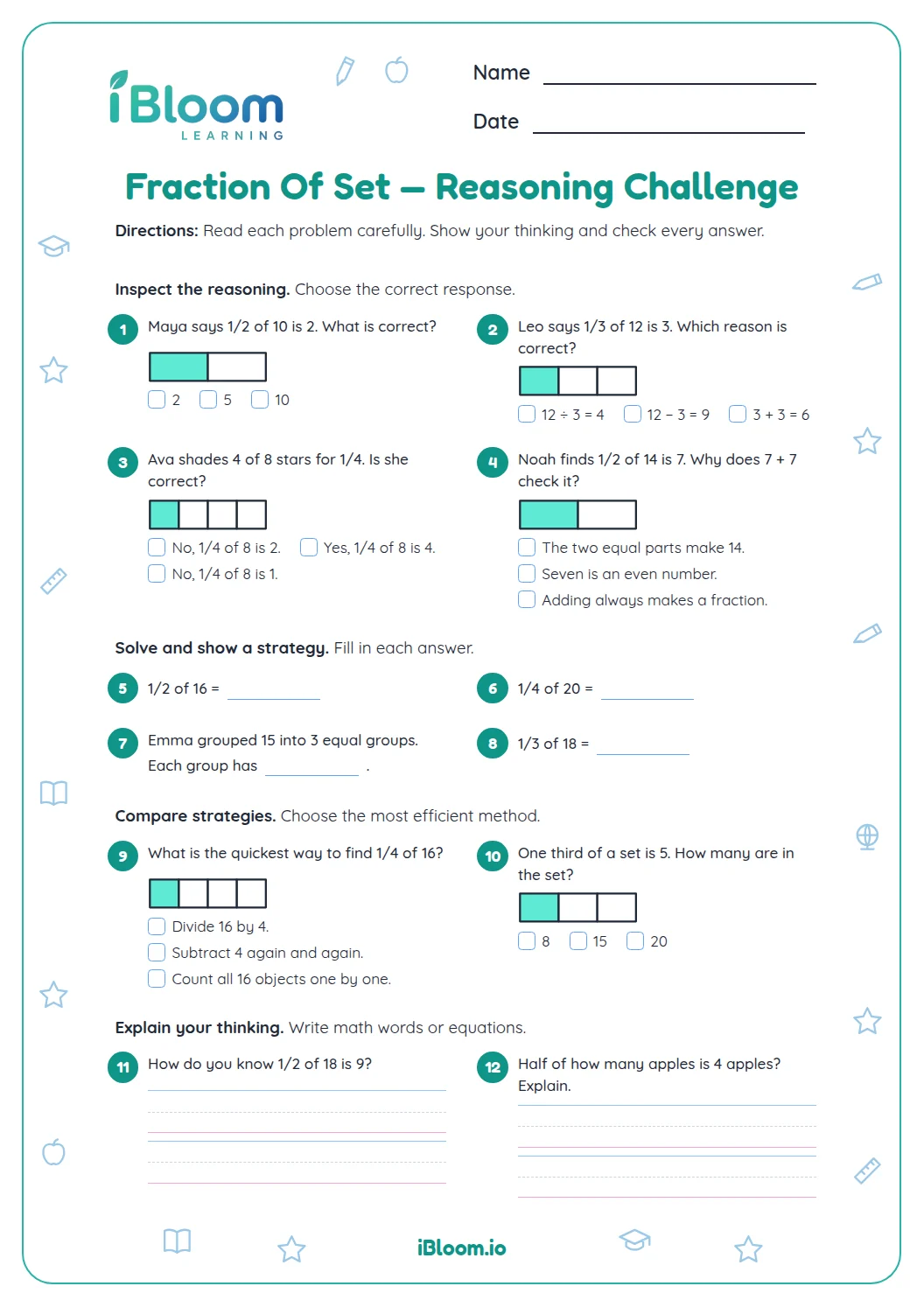
This free Grade 2 worksheet uses halves, thirds, fourths, and fifths to share sets of whole objects. Part A has four questions about the whole set, the fraction, and the number of equal groups. Parts B and C contain eight stories about stickers, marbles, flowers, pencils, pages, cars, apples, and buttons. Children write a division fact to find one equal share, then check by multiplying. These equal-group word problems practice Common Core 3.OA.A.3. A separate answer key gives all 12 answers, including the division and multiplication equations.
Aligned to 3.OA.A.3
Which number is the whole set?
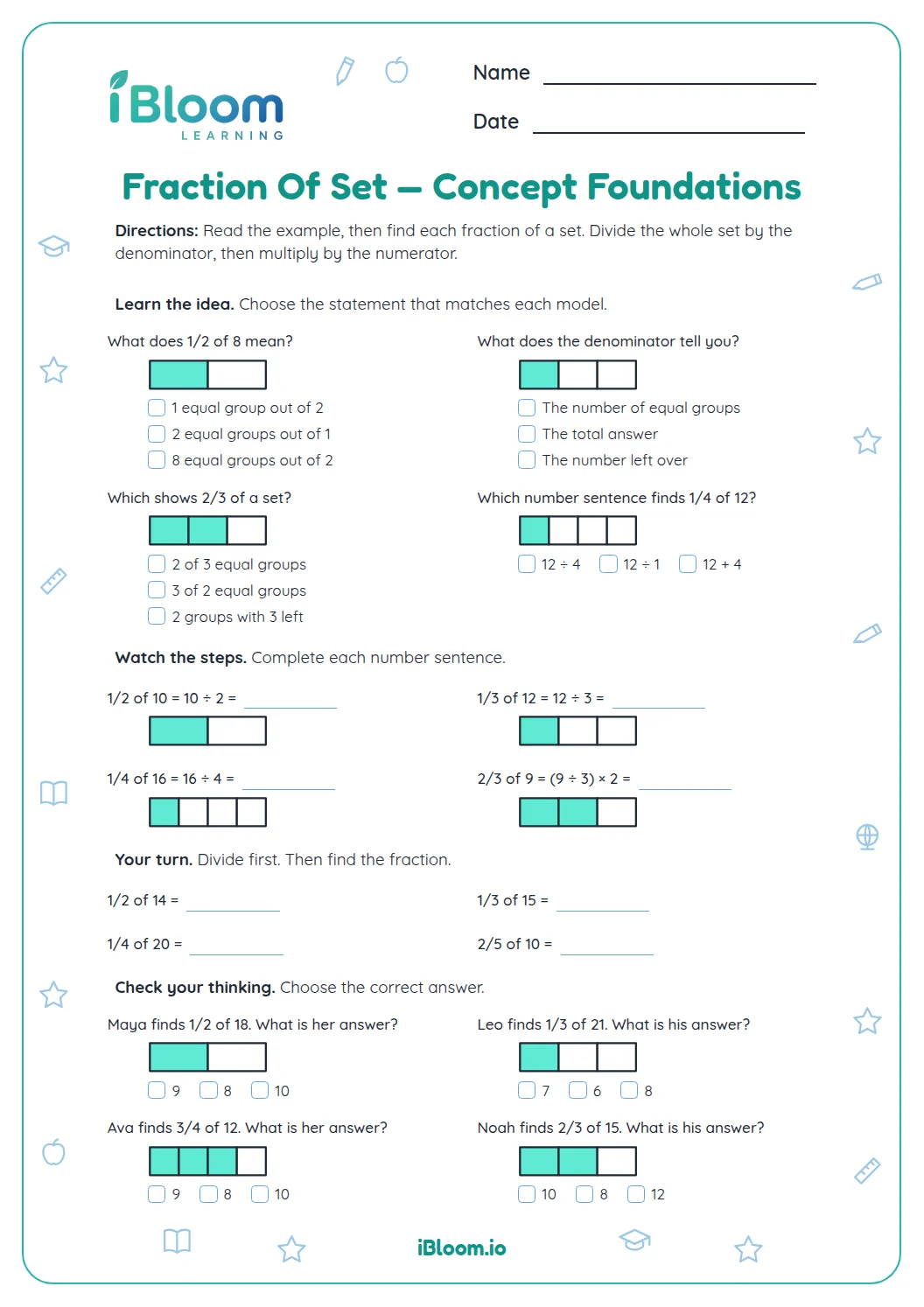
The whole is the total collection before it is shared. In 1/2 of 10 stars, the whole set has 10 stars. The 2 tells how many equal groups to make, and the 1 tells us to take one group.
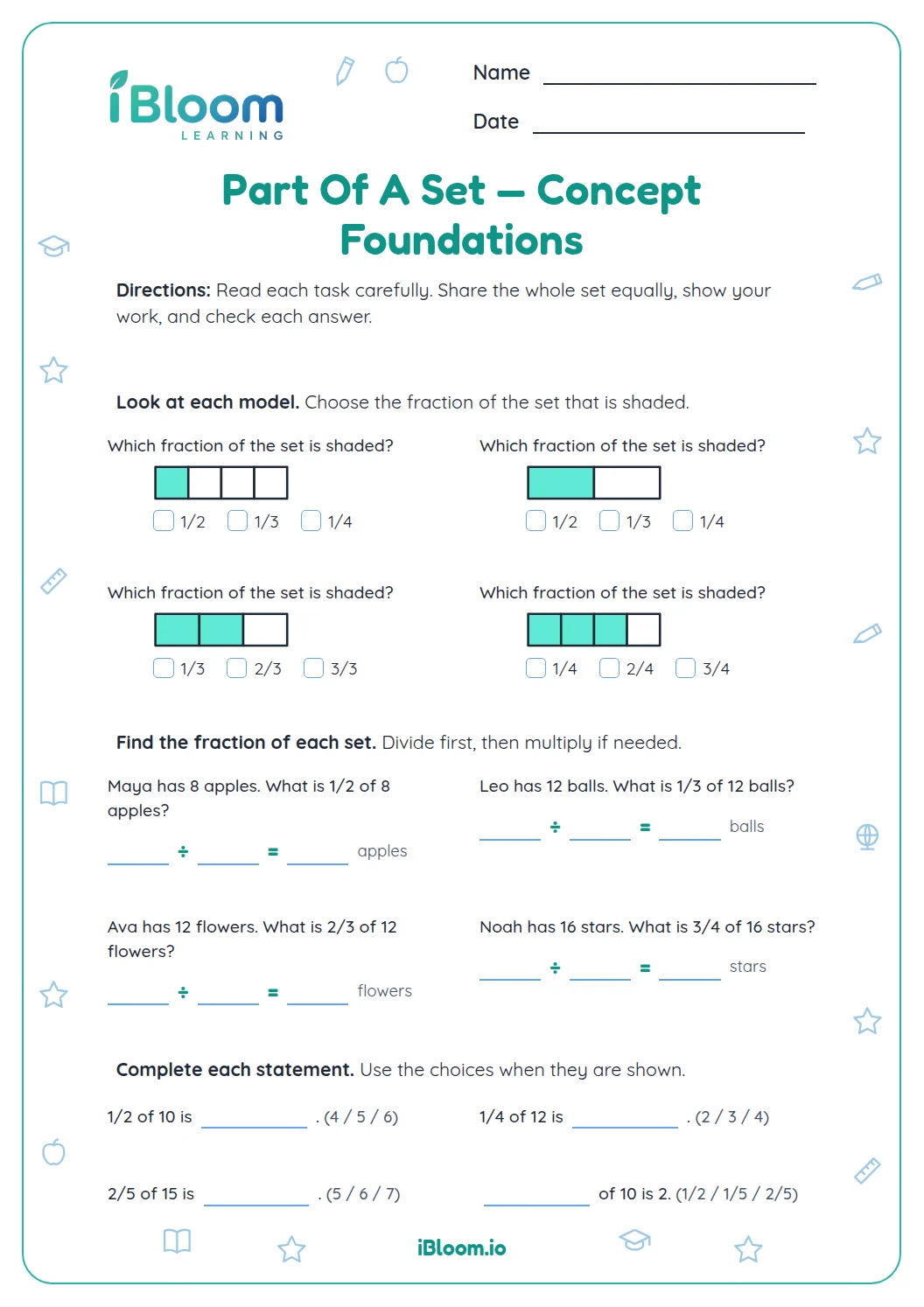
Part A separates these jobs: children identify a whole set, a fraction, four equal groups, and another whole set. The pictures name the objects; they do not show the full collections.
How does division find one equal share?
The bottom number names the number of equal groups. For halves, use two groups; for thirds, use three; for fourths, use four; for fifths, use five. Share every object equally, then count one group.
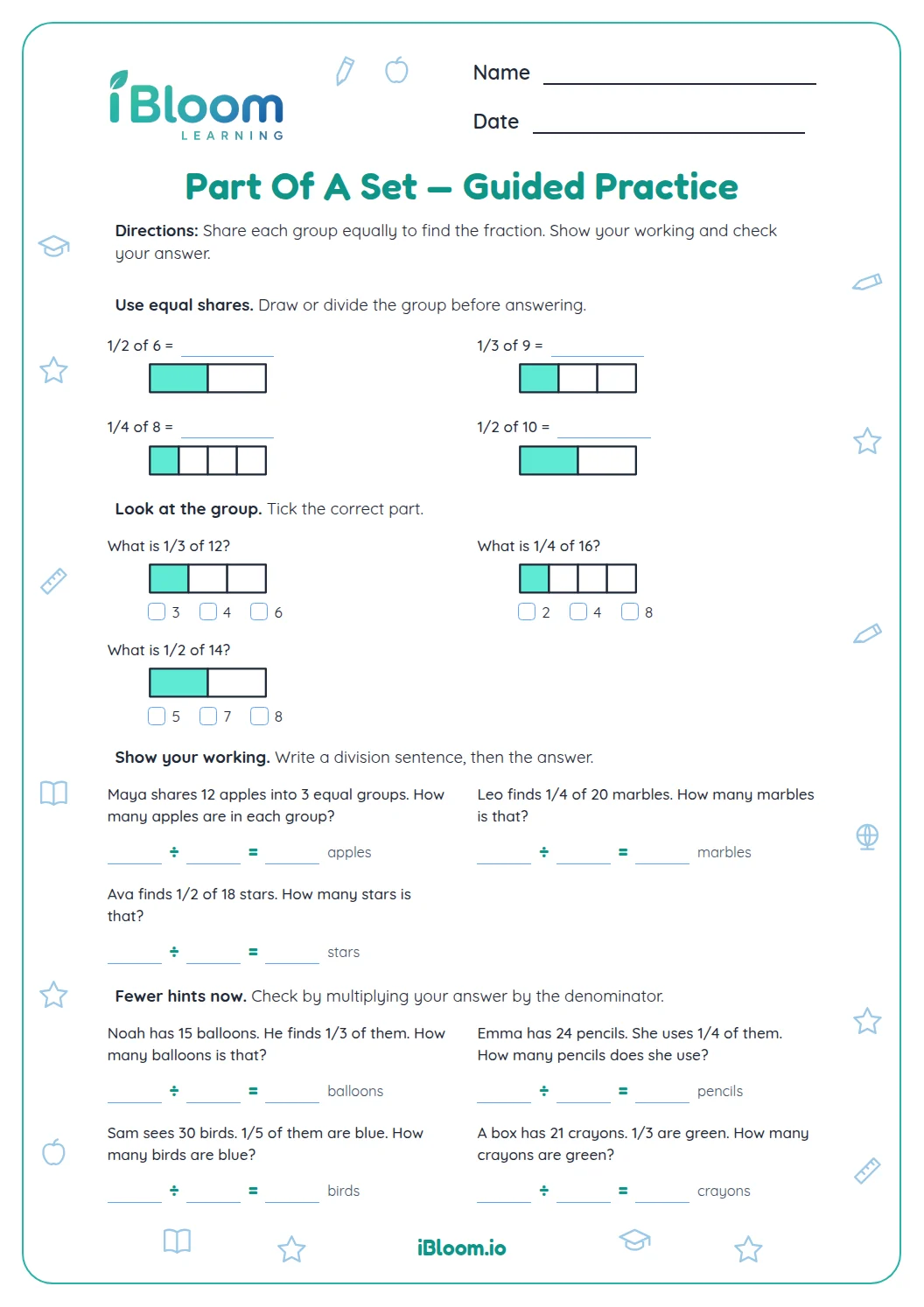
Use counters to make equal groups when helpful. Write the division equation and multiplication check together on the answer line.
- 1Maya has 12 stickers and uses 1/3 of them.
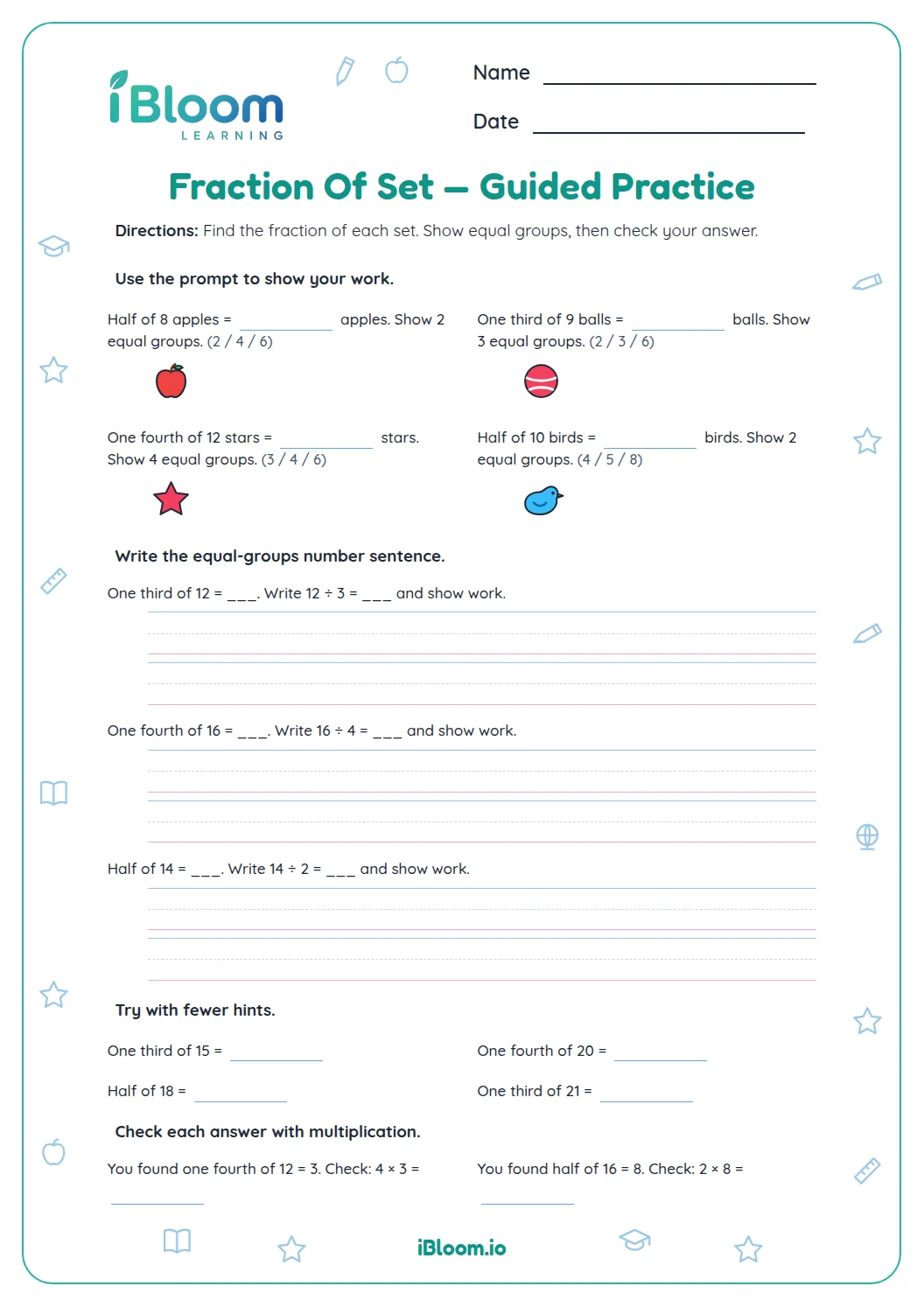
- 2Make 3 equal groups from 12 stickers.
- 312 ÷ 3 = 4, so Maya uses 4 stickers.
- 4Check: 4 × 3 = 12 stickers in the whole set.
How does multiplication check the answer?
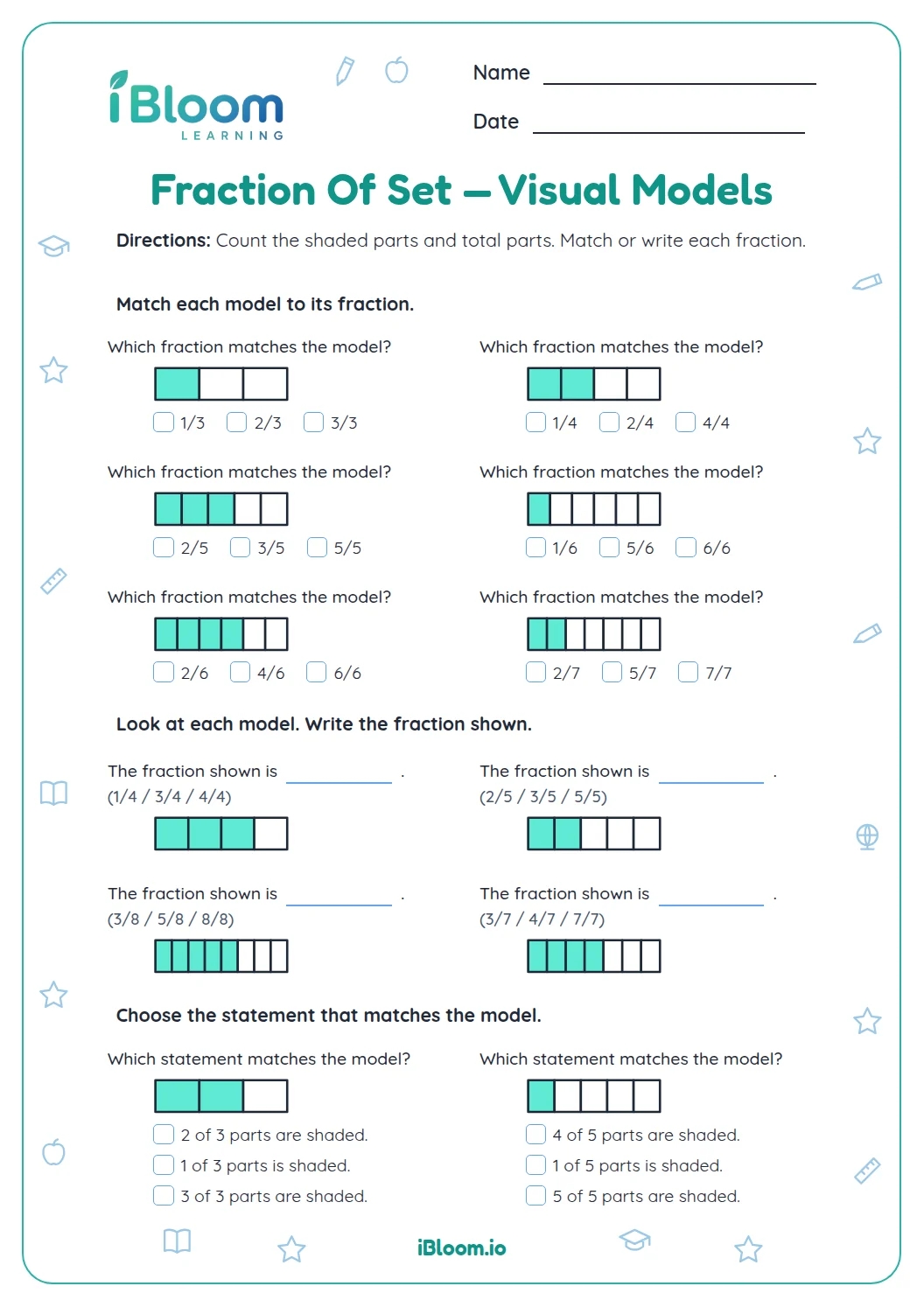
Multiply the number in one group by the number of groups. The product must equal the original set size. For 1/4 of 16 flowers, four groups of 4 give 4 × 4 = 16.
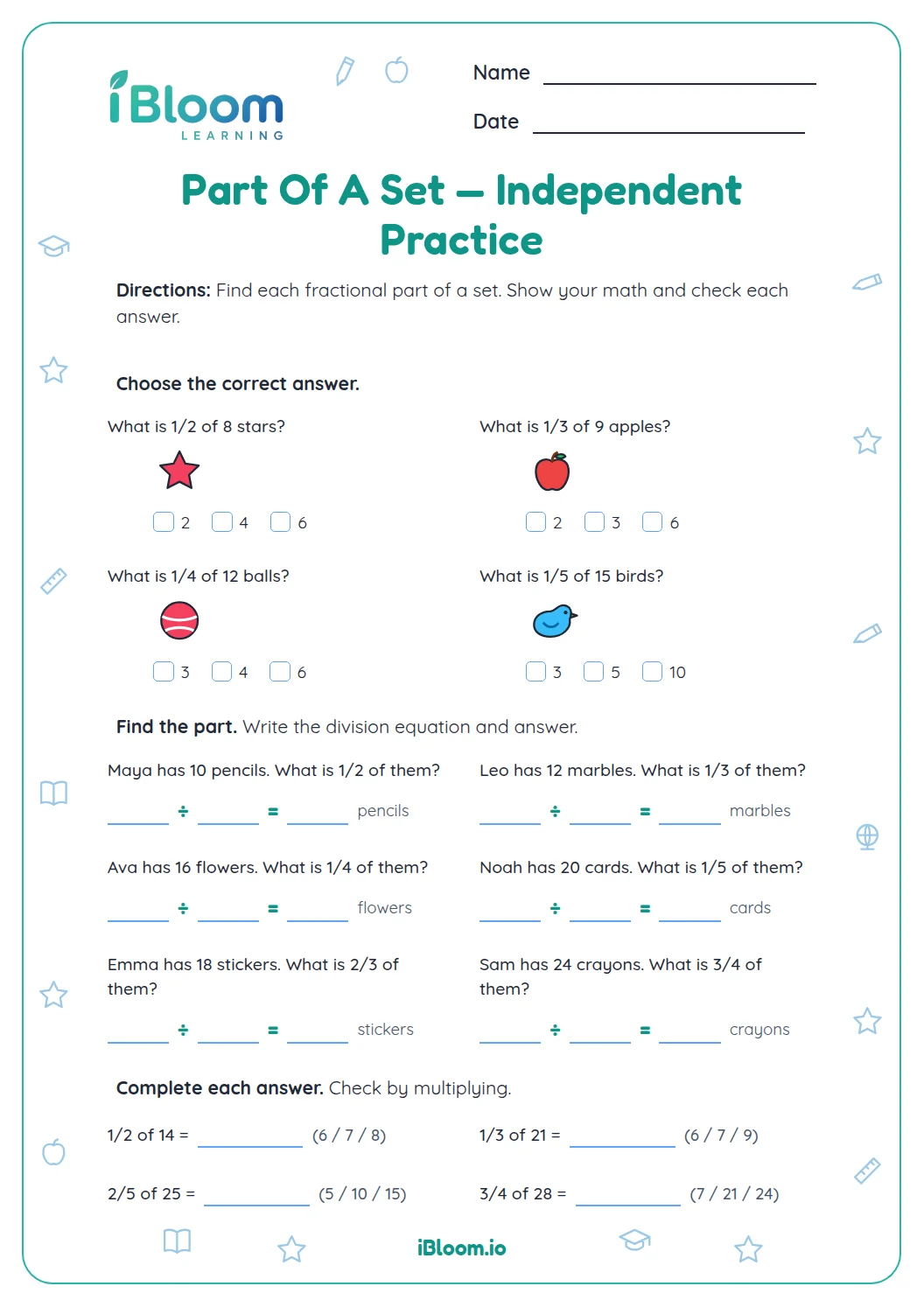
Parts B and C each contain one story for each fraction. Part C includes 14 pages, 18 toy cars, 24 apples, and 25 buttons, so children apply the same method to different totals.
How to use this worksheet
- 1Read Part A and distinguish the whole set from the fraction.
- 2Model question 5 with 12 counters shared into 3 equal groups.
- 3Write 12 ÷ 3 = 4 and label the answer as 4 stickers.
- 4Solve the remaining stories, using a drawing when helpful.
- 5Multiply each share by the number of groups to check the total.
Mistakes to notice and fix
The mistake
Answering 3 for 1/3 of 12 because the bottom number is 3.
The fix
Three is the number of groups. Share all 12 objects among those groups; each gets 4.
The mistake
Subtracting 4 from 16 to find 1/4 of 16.
The fix
The 4 means four equal groups. Divide 16 by 4 to find 4 in each group.
The mistake
Multiplying a share by the top number, 1, to check it.
The fix
Multiply by the number of equal groups. For 1/5 of 25, use 5 × 5 = 25.
Common Core alignment
Use division and multiplication to solve and check equal-group word problems.
On this sheet: Parts B and C divide sets into equal groups and use multiplication to check each share.
Show the official wordingHide the official wording
Use multiplication and division within 100 to solve word problems in situations involving equal groups, arrays, and measurement quantities, e.g., by using drawings and equations with a symbol for the unknown number to represent the problem.
What to practice next
Make more practice
Further reading
Questions parents and teachers ask
Which fractions does this worksheet practice?
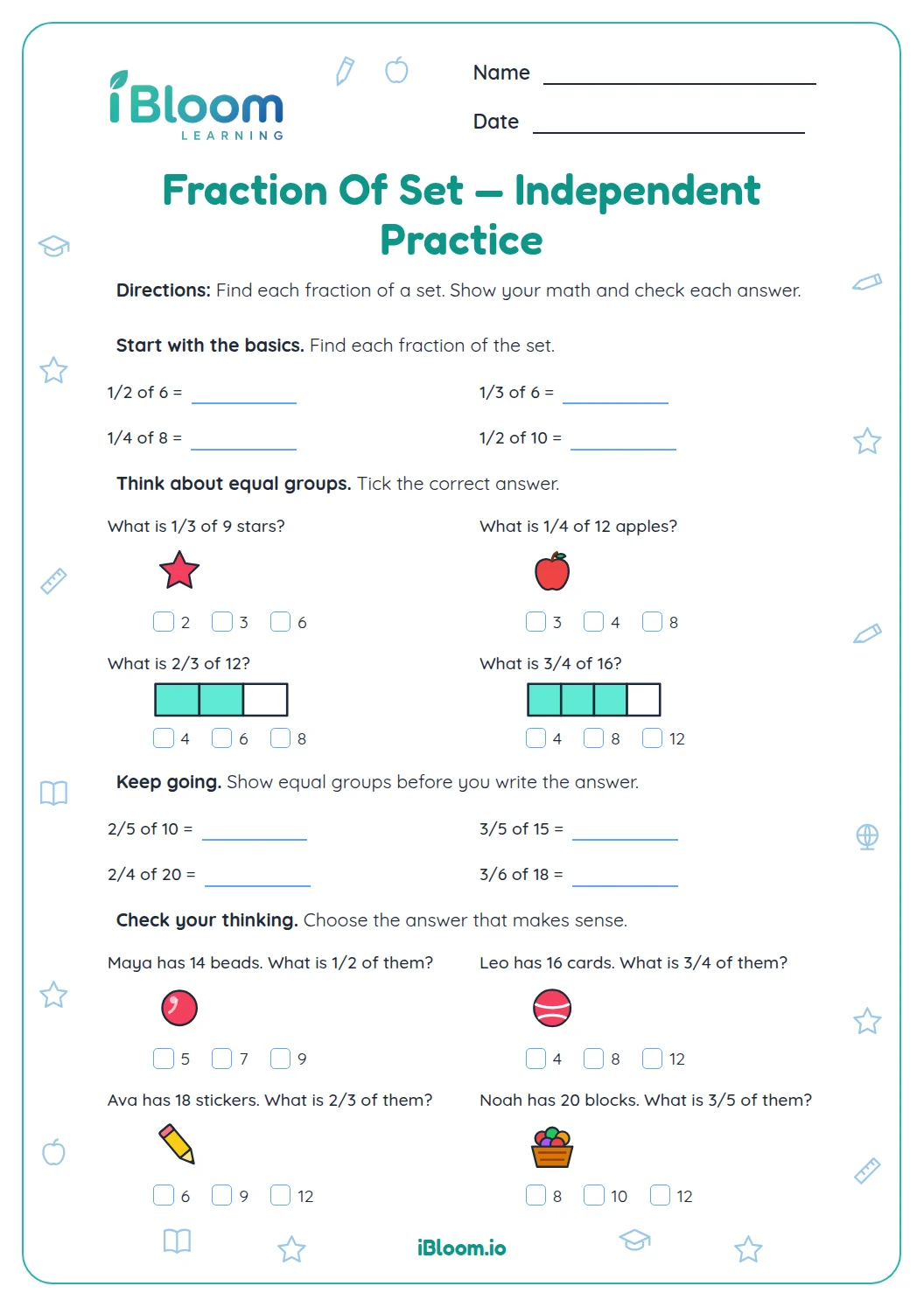
The sheet practices one half, one third, one fourth, and one fifth of a set. Four introductory questions identify the whole, fraction, or number of groups. Eight stories then give two opportunities to calculate each fraction, using division to find a share and multiplication to check it.
Do children need to cut objects into pieces?
No, all the collections can be shared into equal groups of whole objects. For example, one fourth of 16 flowers means making four equal groups with four flowers in each. Children can use counters or small drawings to represent the groups before writing a division fact.
What should children write on the answer lines?
Write the division equation and a multiplication check together on the line. For question 5, write 12 ÷ 3 = 4 and 4 × 3 = 12; Maya uses four stickers. The key gives both equations for every story so you can check each step.
How can I explain the bottom number of the fraction?
The bottom number tells how many equal groups to make from the whole collection. In one fifth of 20 pencils, make five groups, with four pencils in each. The top number is one, so the answer counts just one of those five groups: four pencils.
How does the worksheet connect to Common Core?
The eight word problems practice CCSS 3.OA.A.3 through division in equal-group situations and multiplication checks. Children identify a whole collection, split it into the specified number of equal groups, and find one group’s size. Drawing the groups can connect the story to the written equation.