



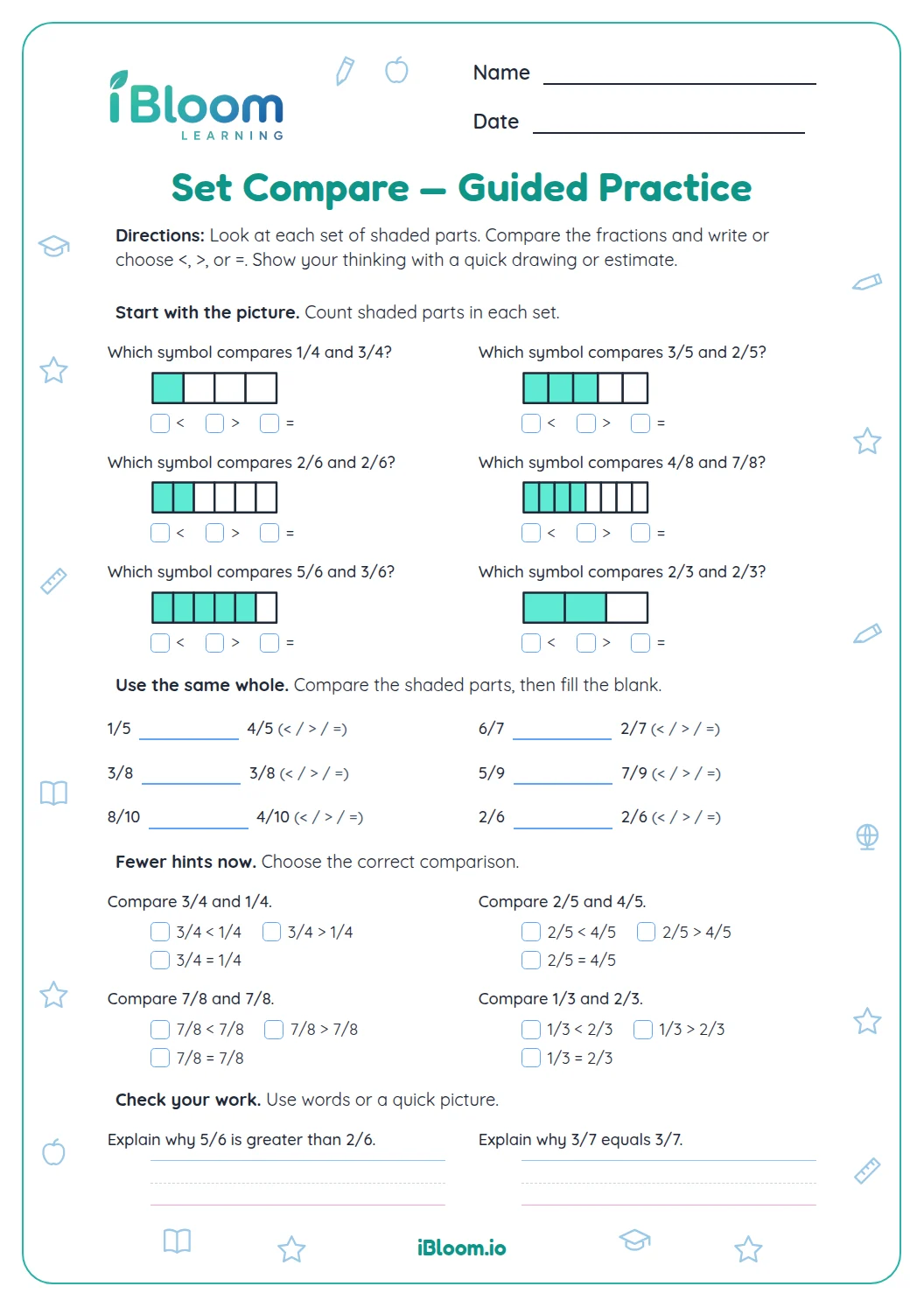
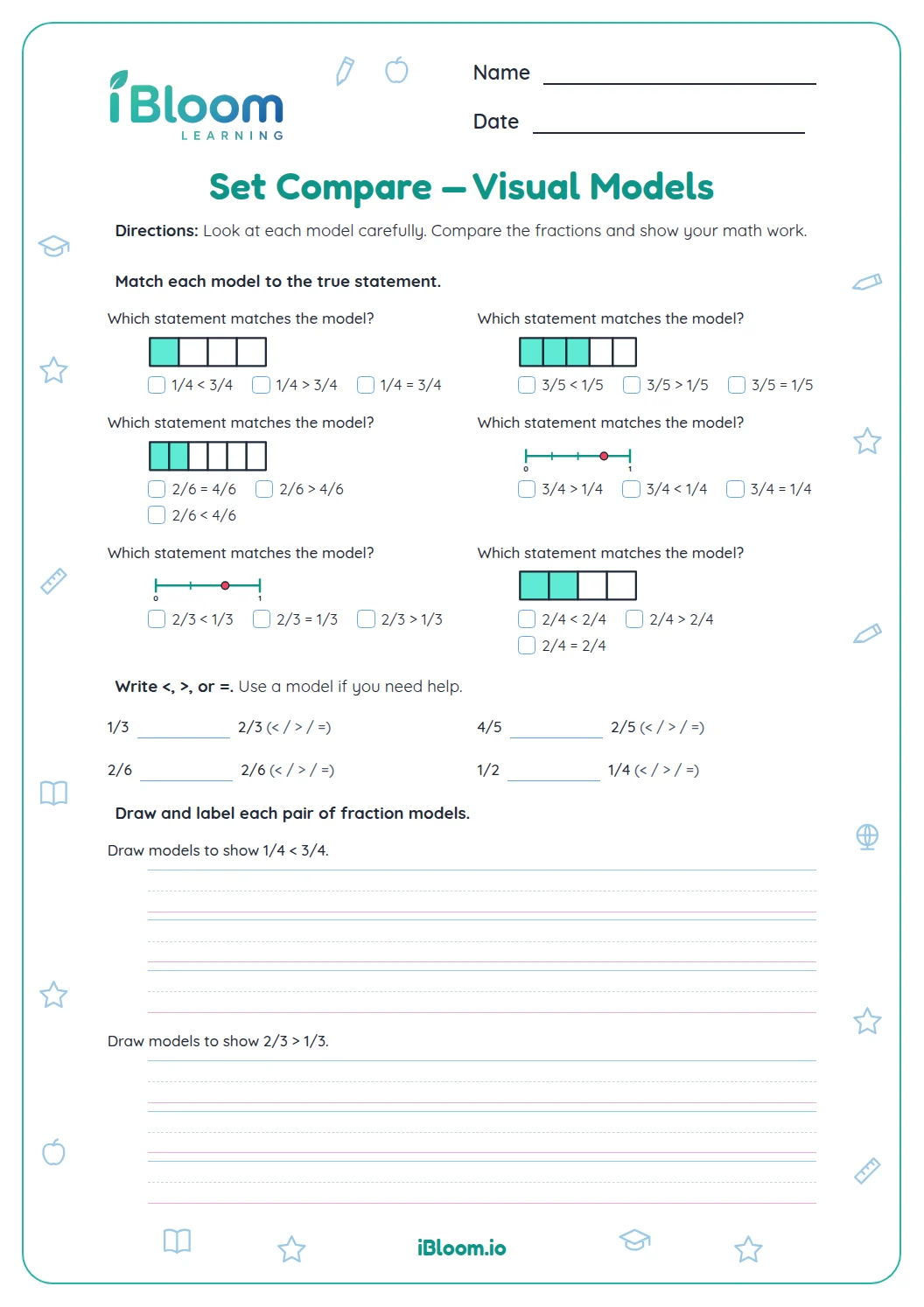
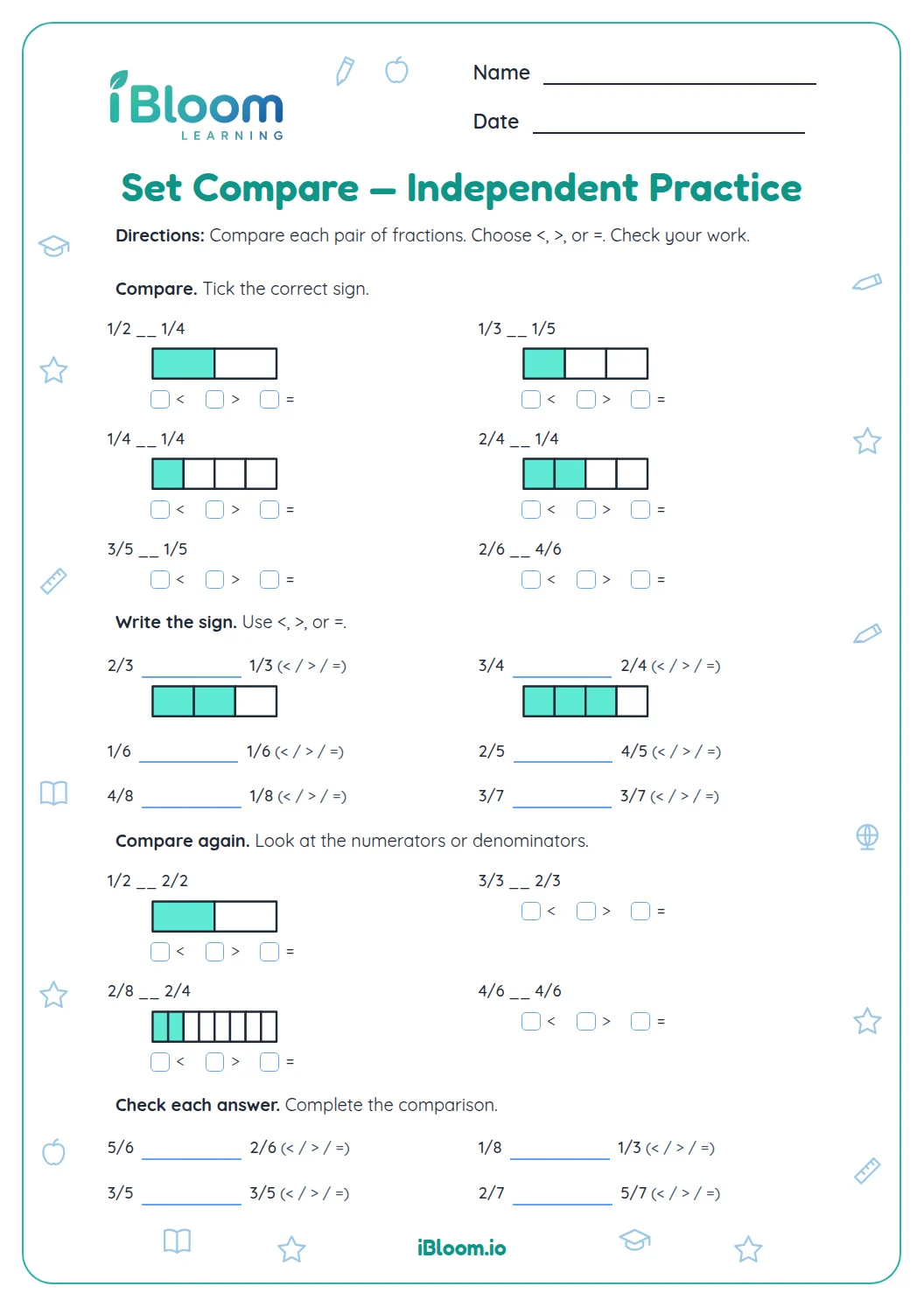
About this worksheet
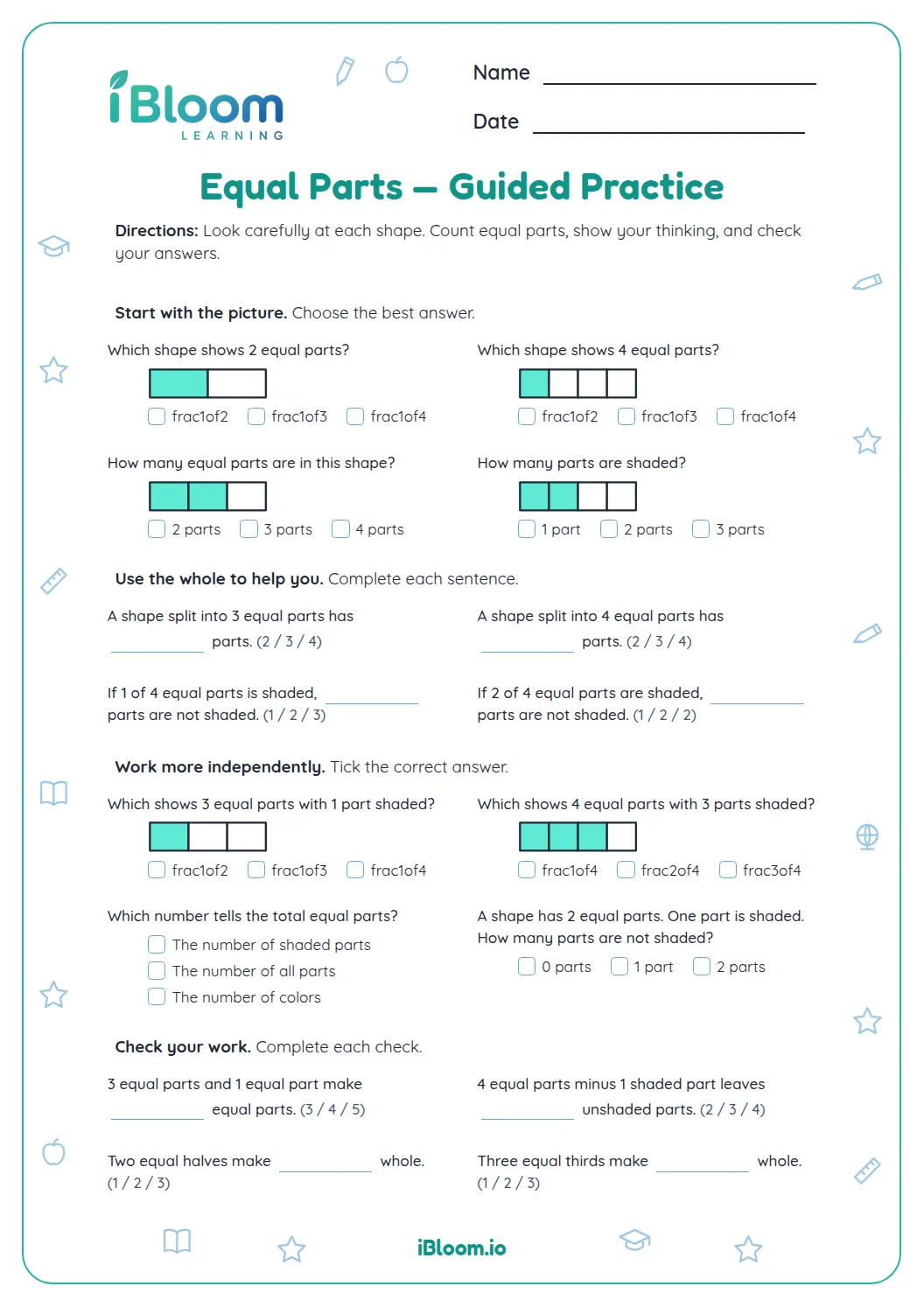
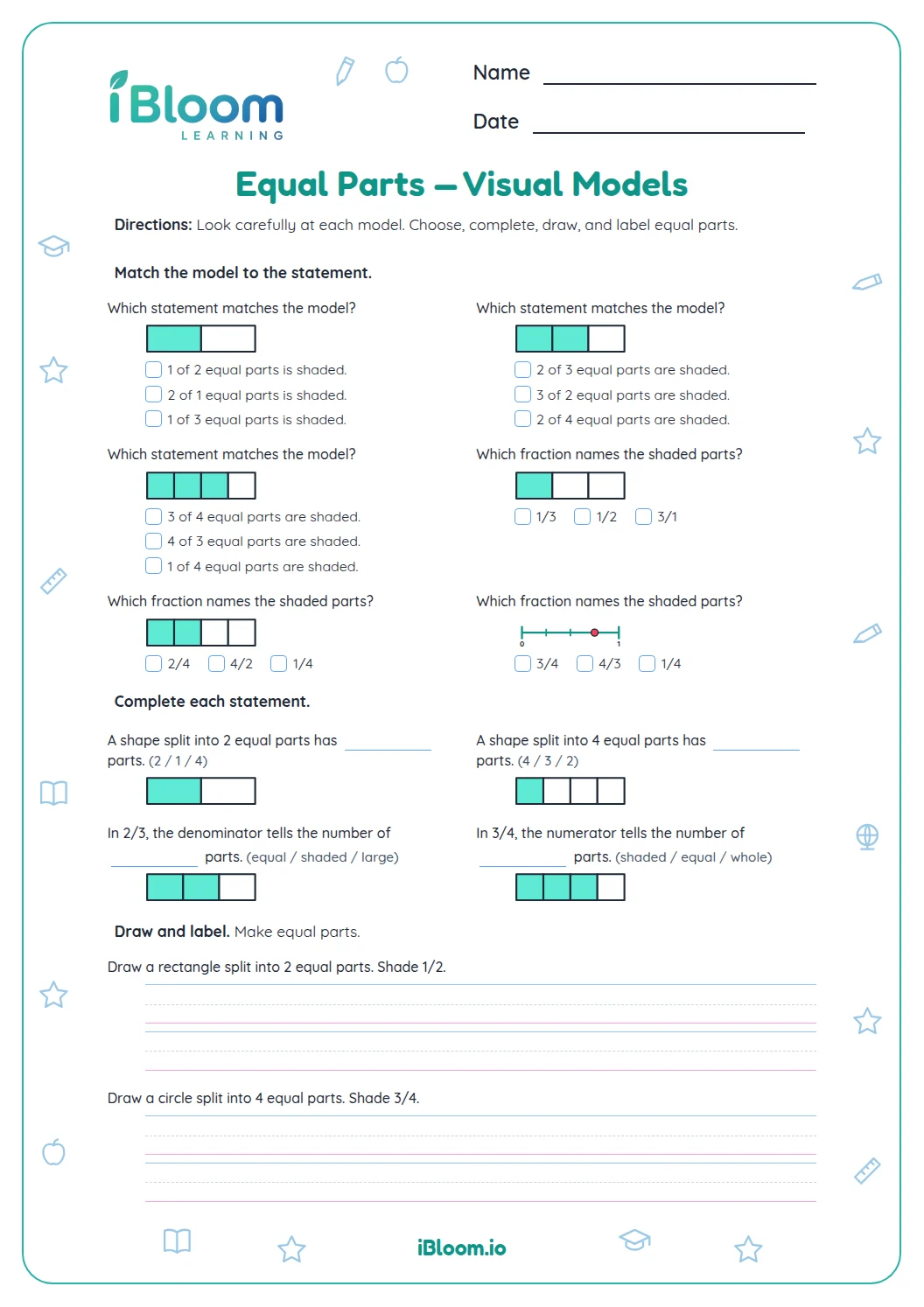
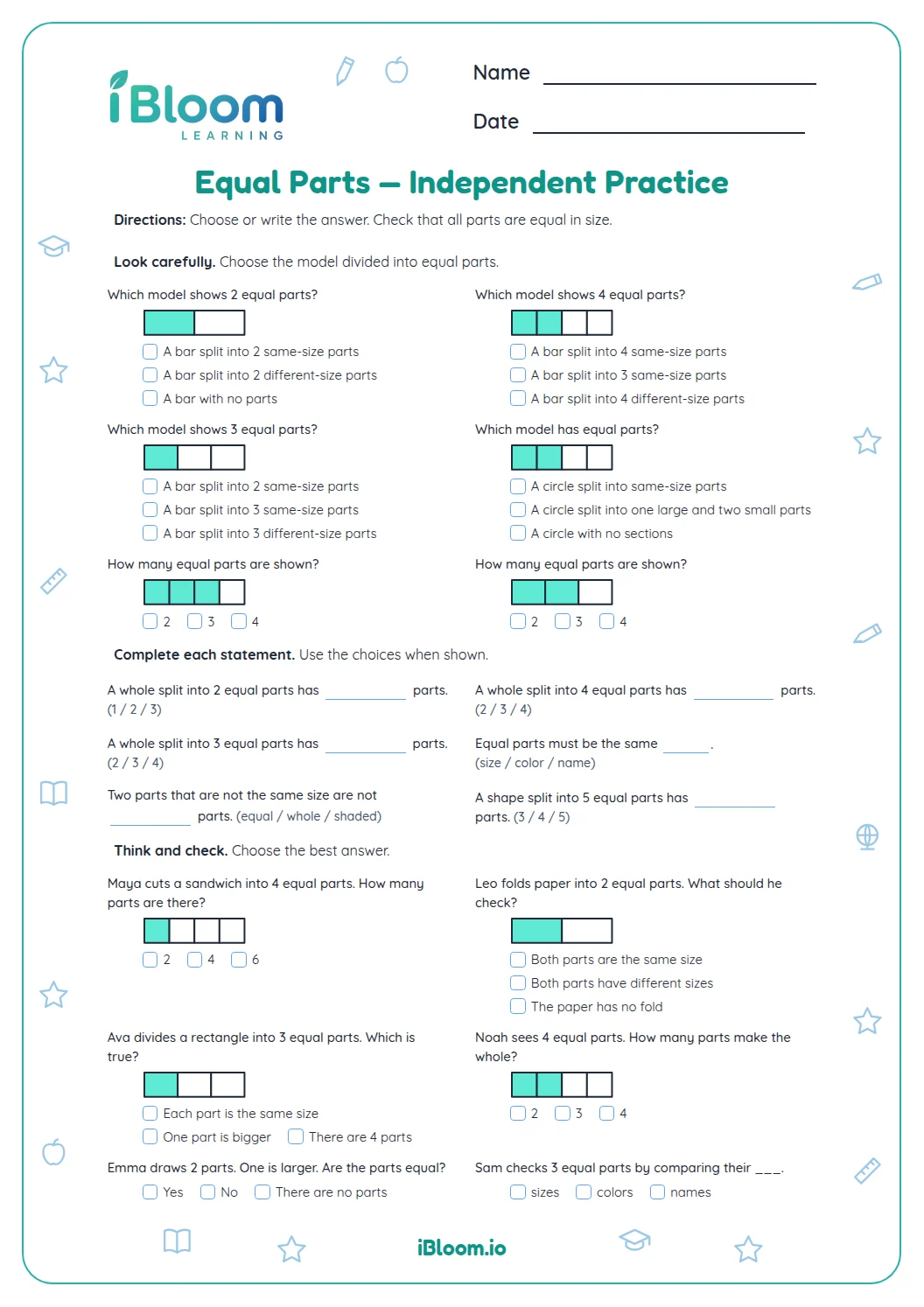
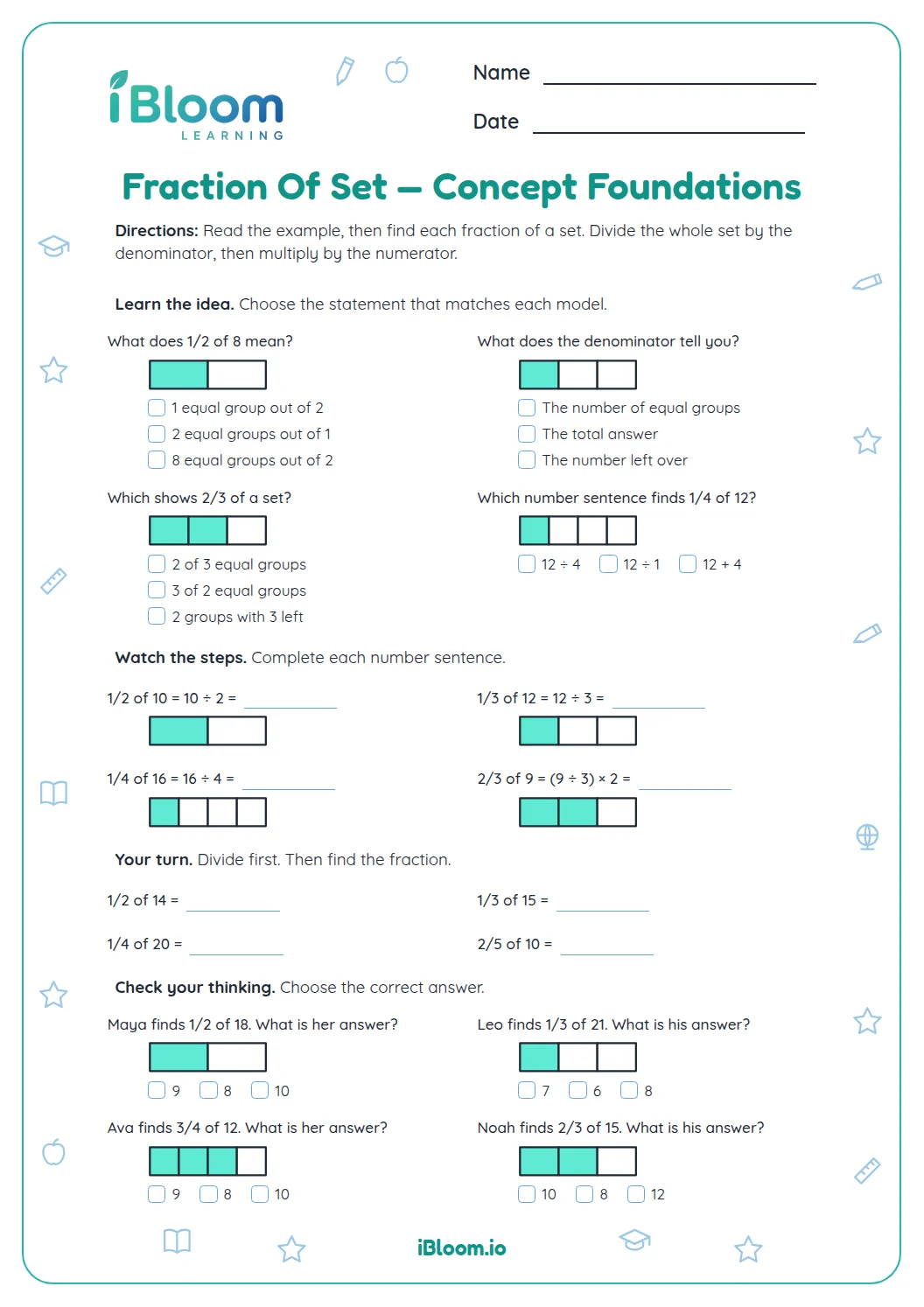
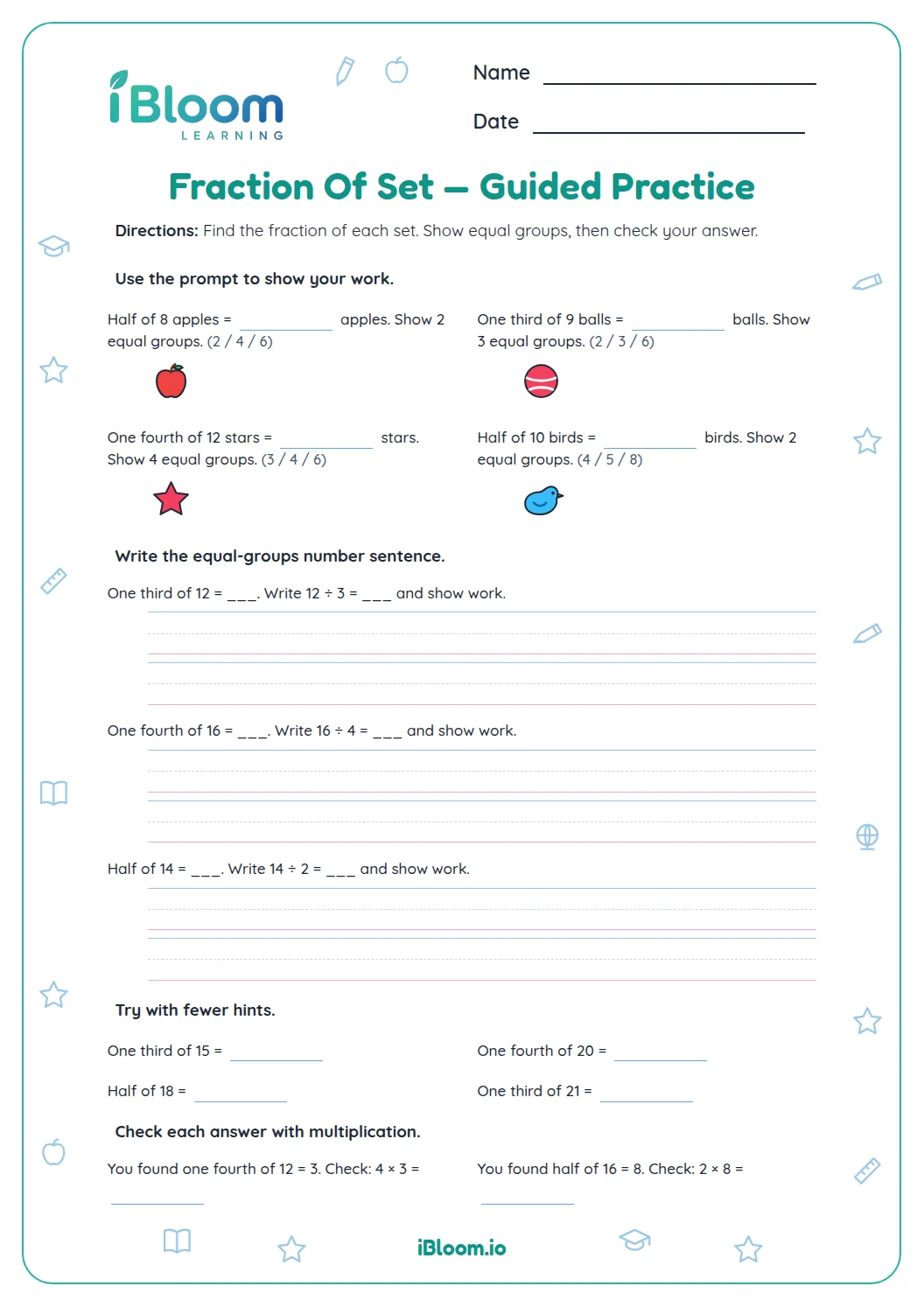
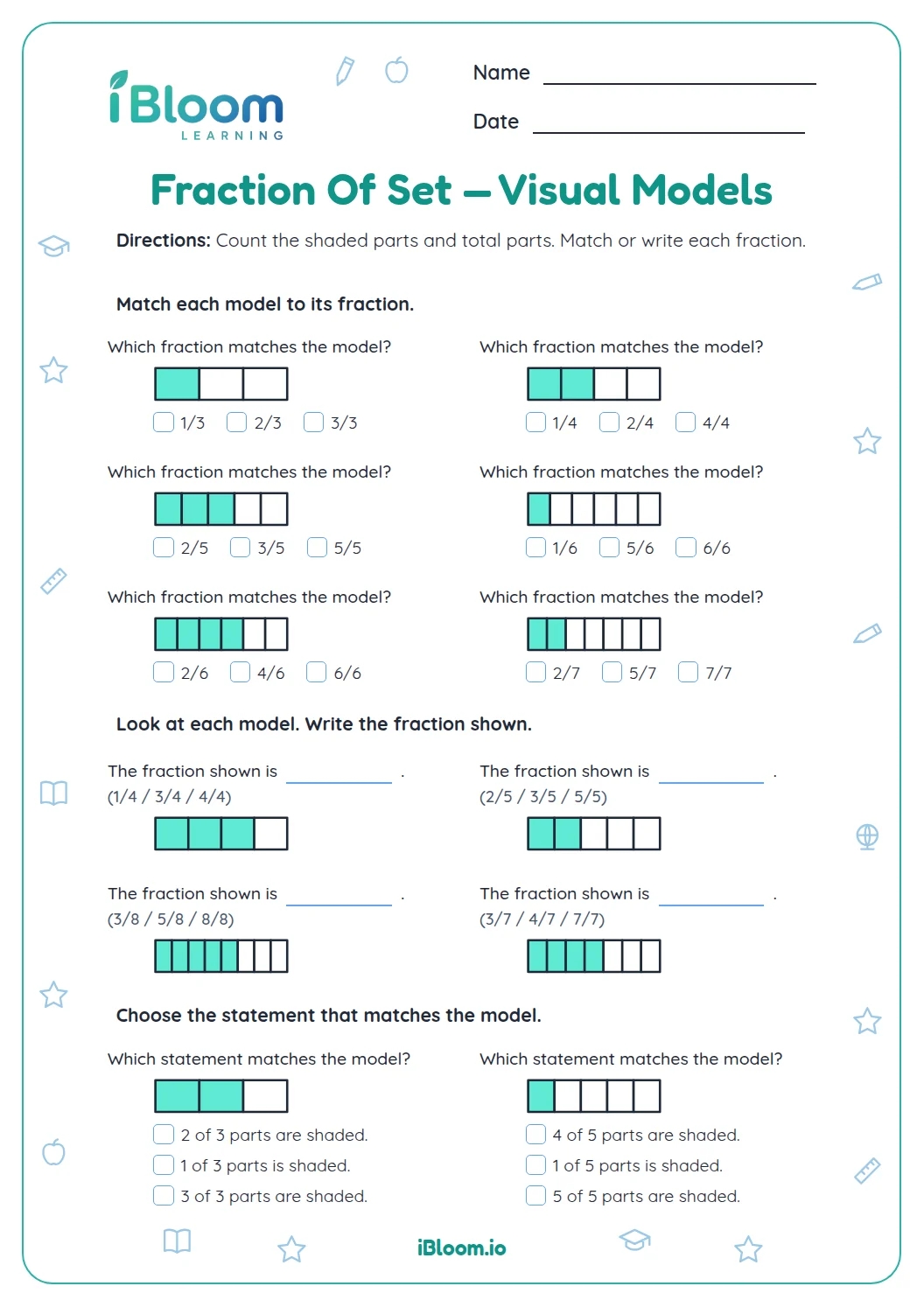
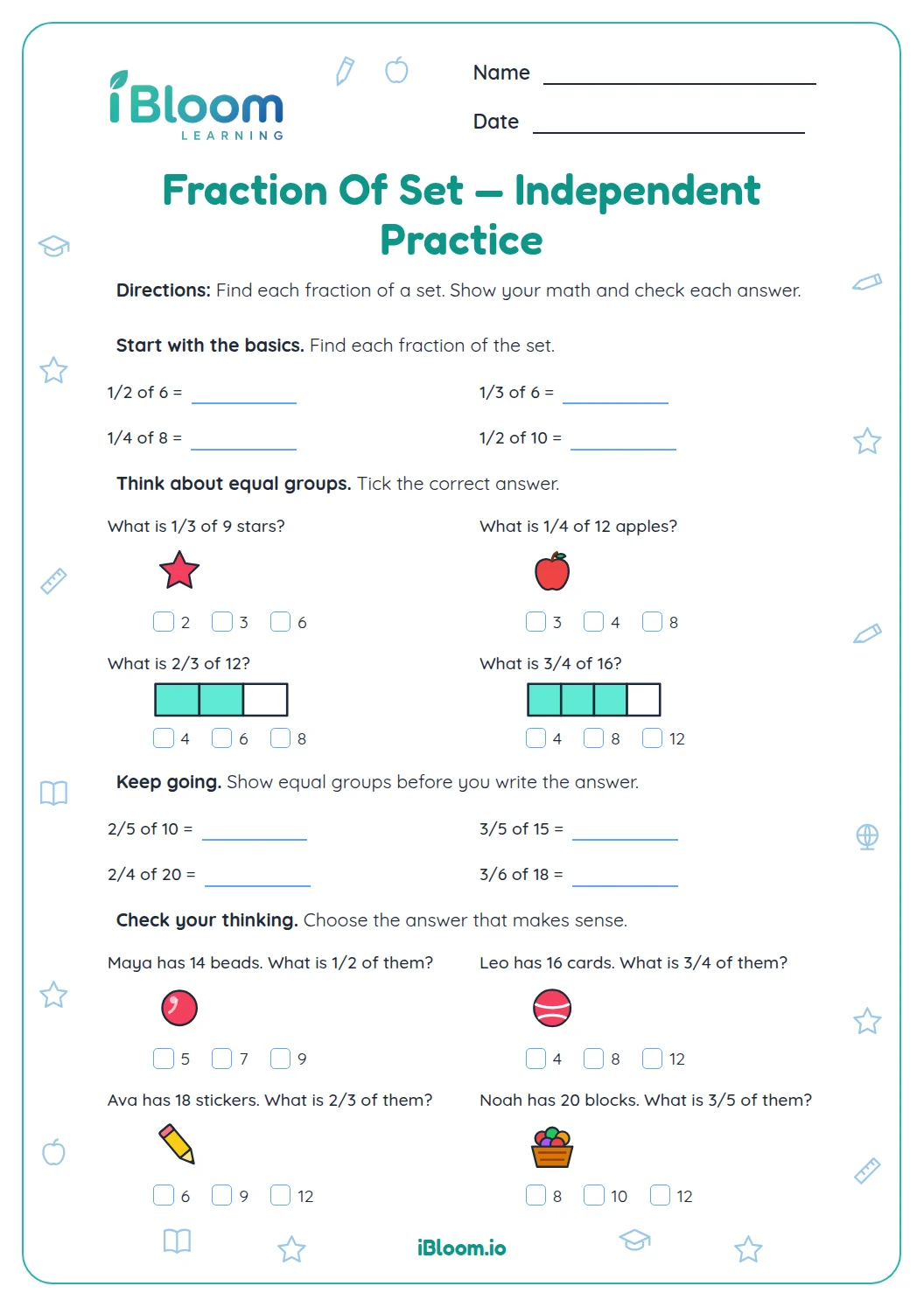
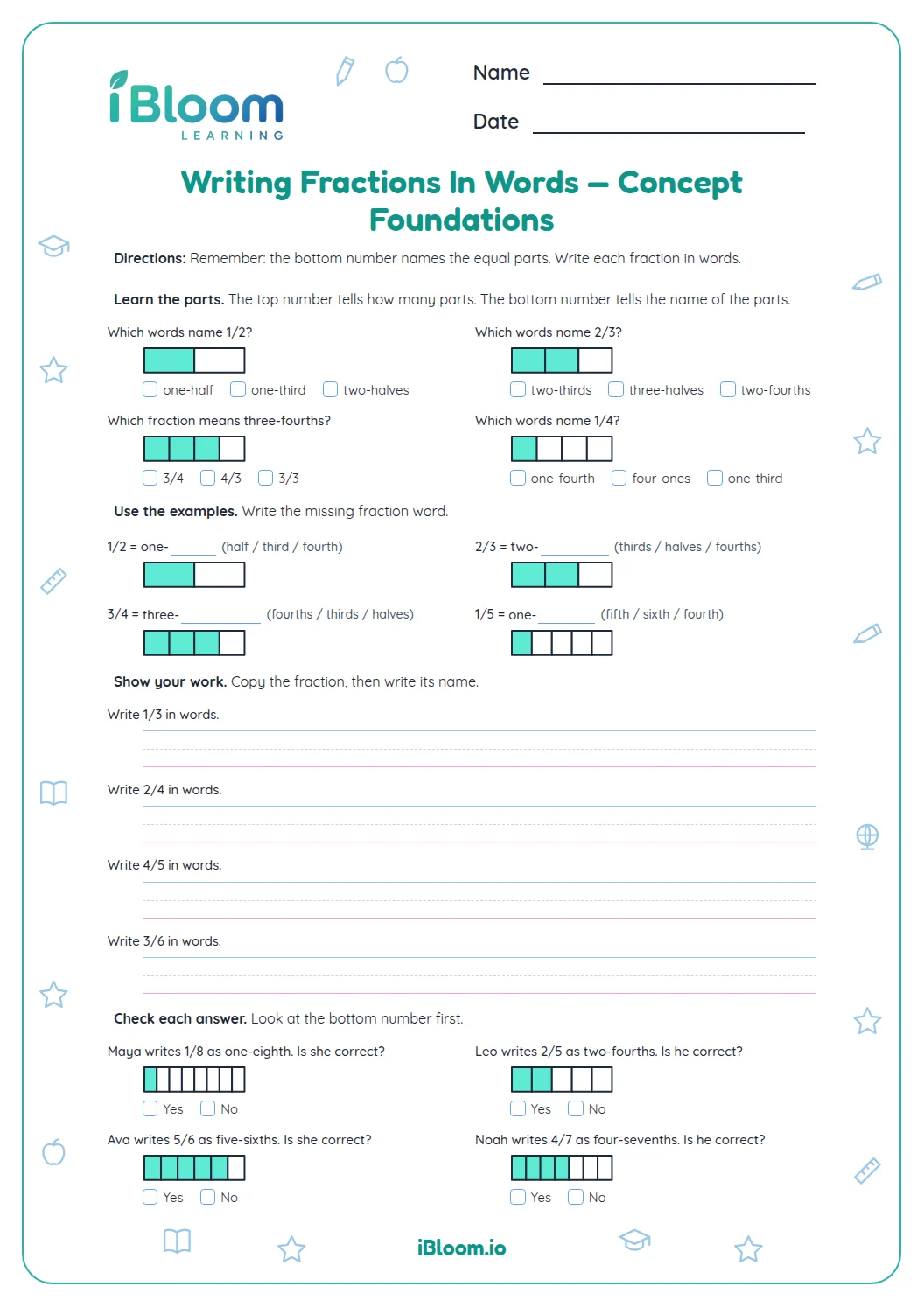
This Grade 2 worksheet asks children to describe selected parts of sets with fraction symbols and words. A set picture shows the whole collection, while each prompt states how many objects are selected. Later questions connect equal groups, part counts, and fraction names. The printable has 14 questions in two parts and a separate answer key. It practices fractions as equal parts of a whole, as described in CCSS 3.NF.A.1.
Aligned to 3.NF.A.1
How do you write a fraction for a set?
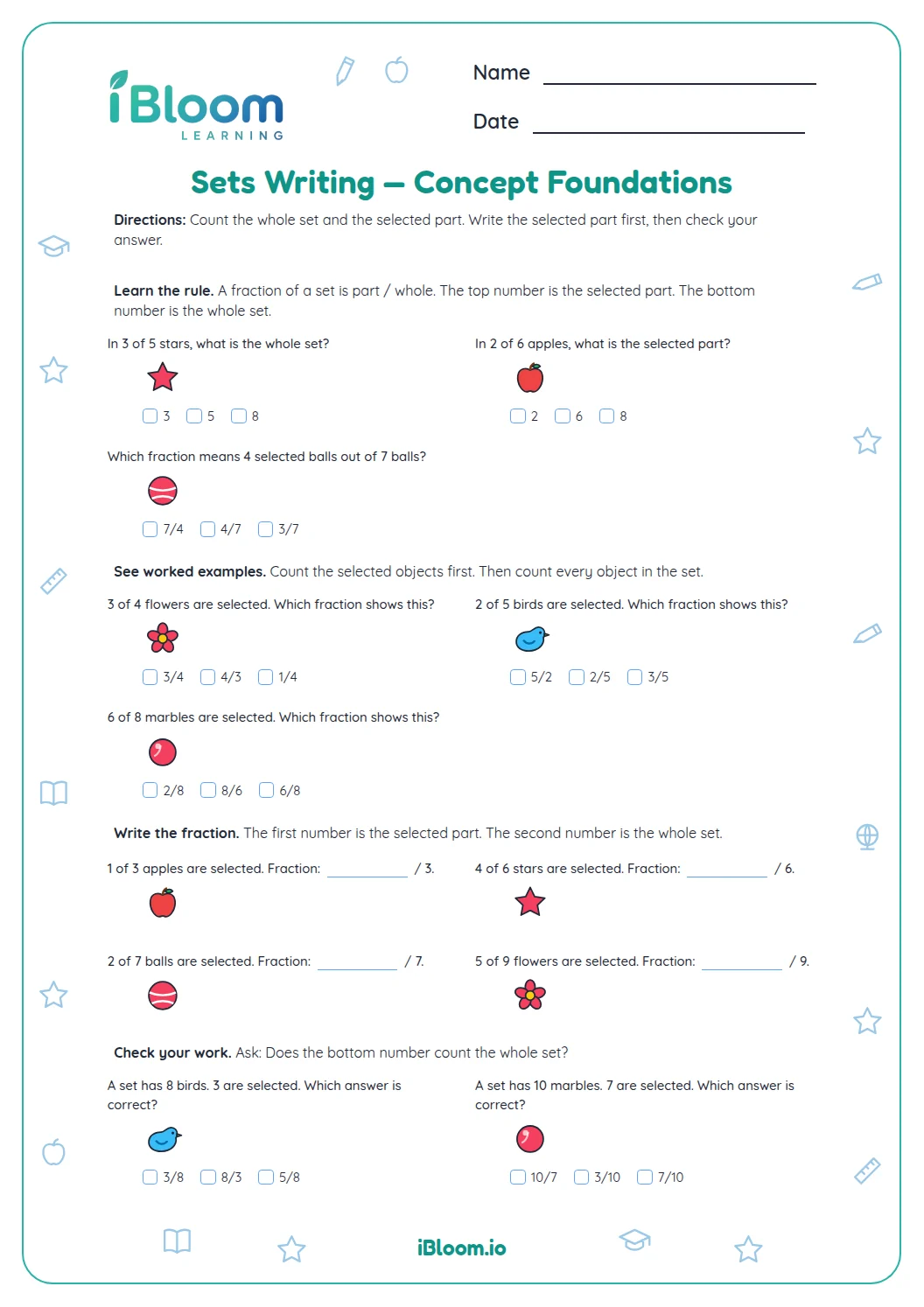
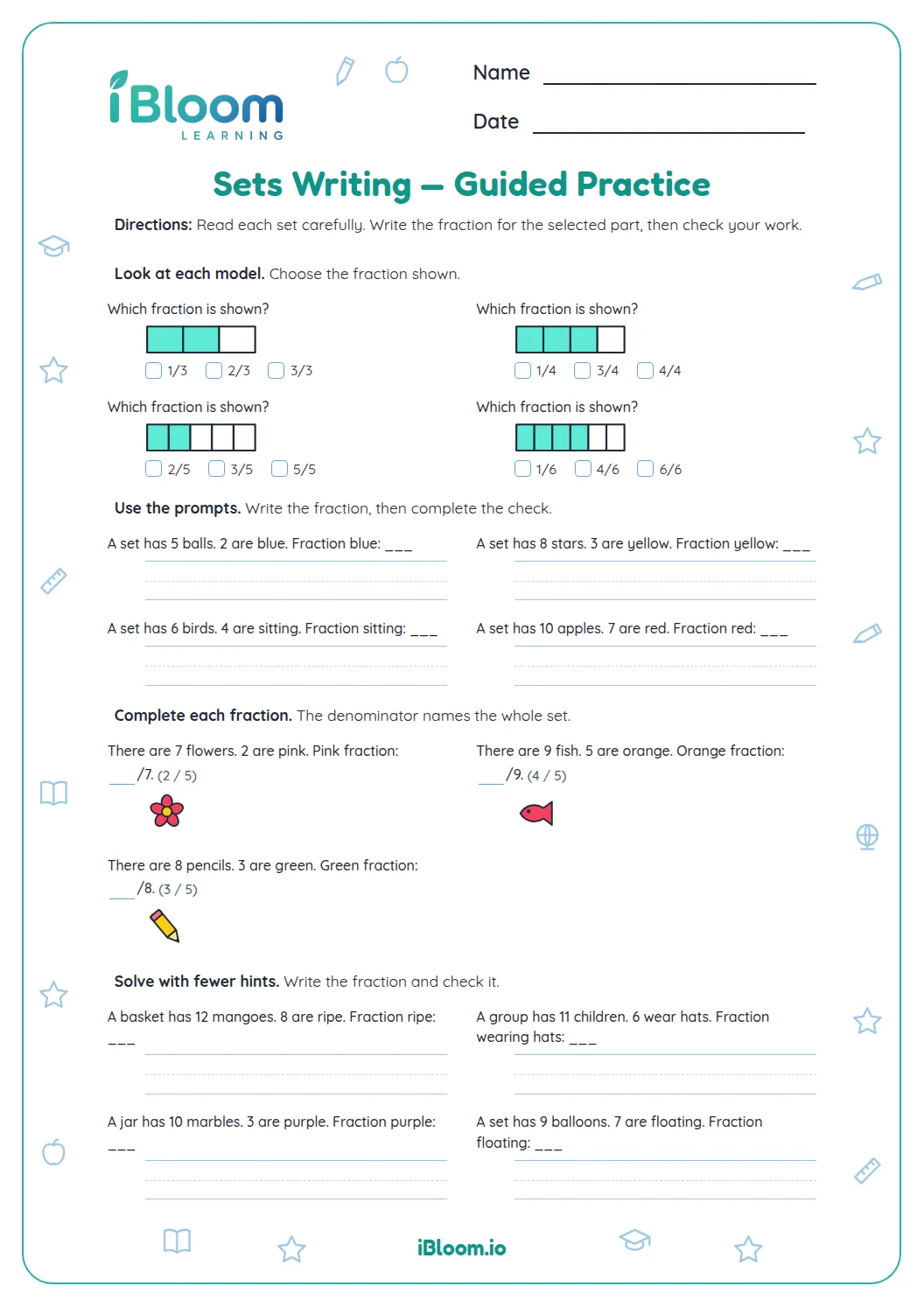
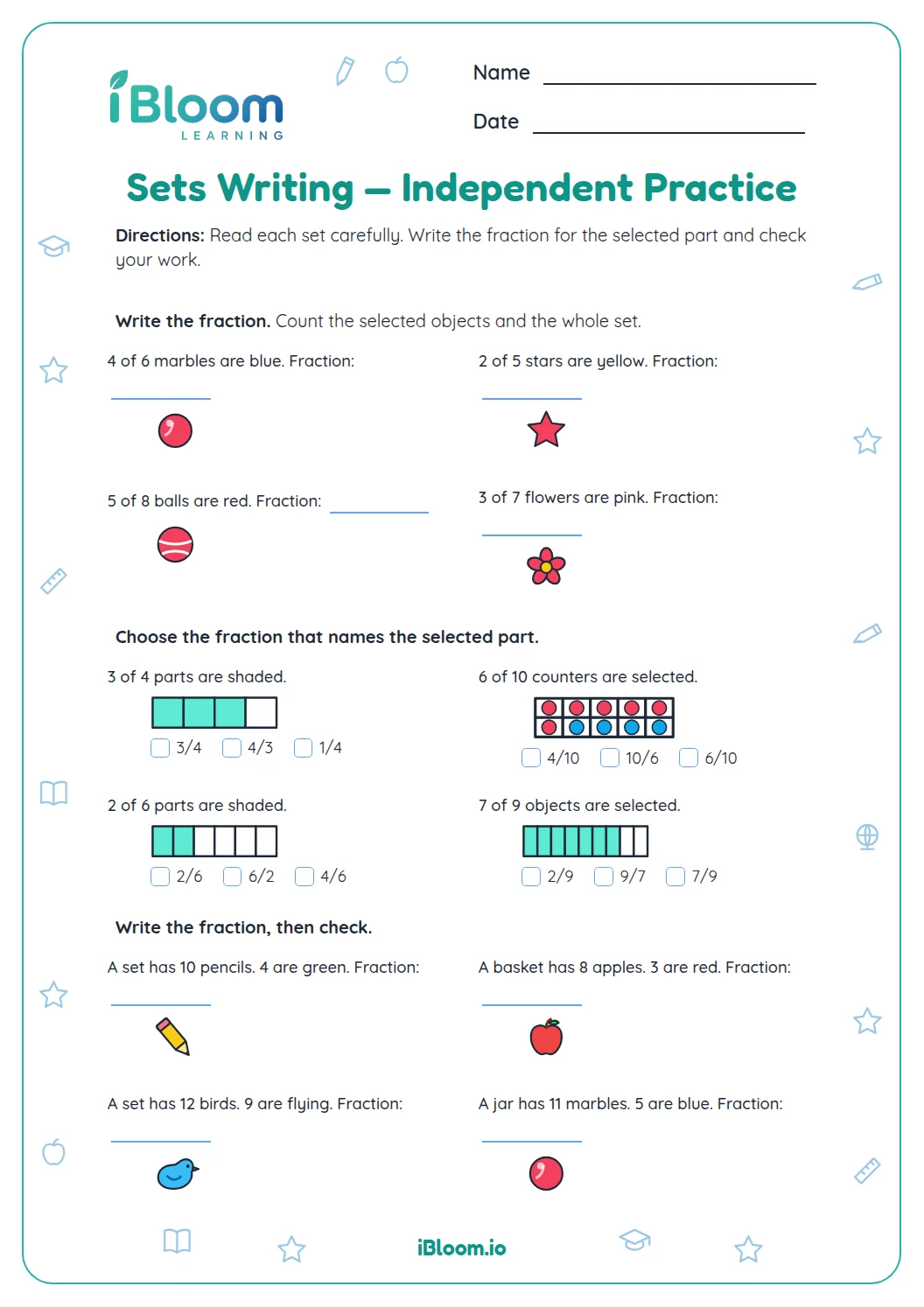
Count the objects in the selected group and the objects in the entire set. In q1, 4 of 8 stars are selected, so the fraction is 4/8. The numerator names the selected count and the denominator names the full set.
- 14 stars selected
- 28 stars altogether
- 3Fraction: 4/8
How do fraction symbols connect to words?
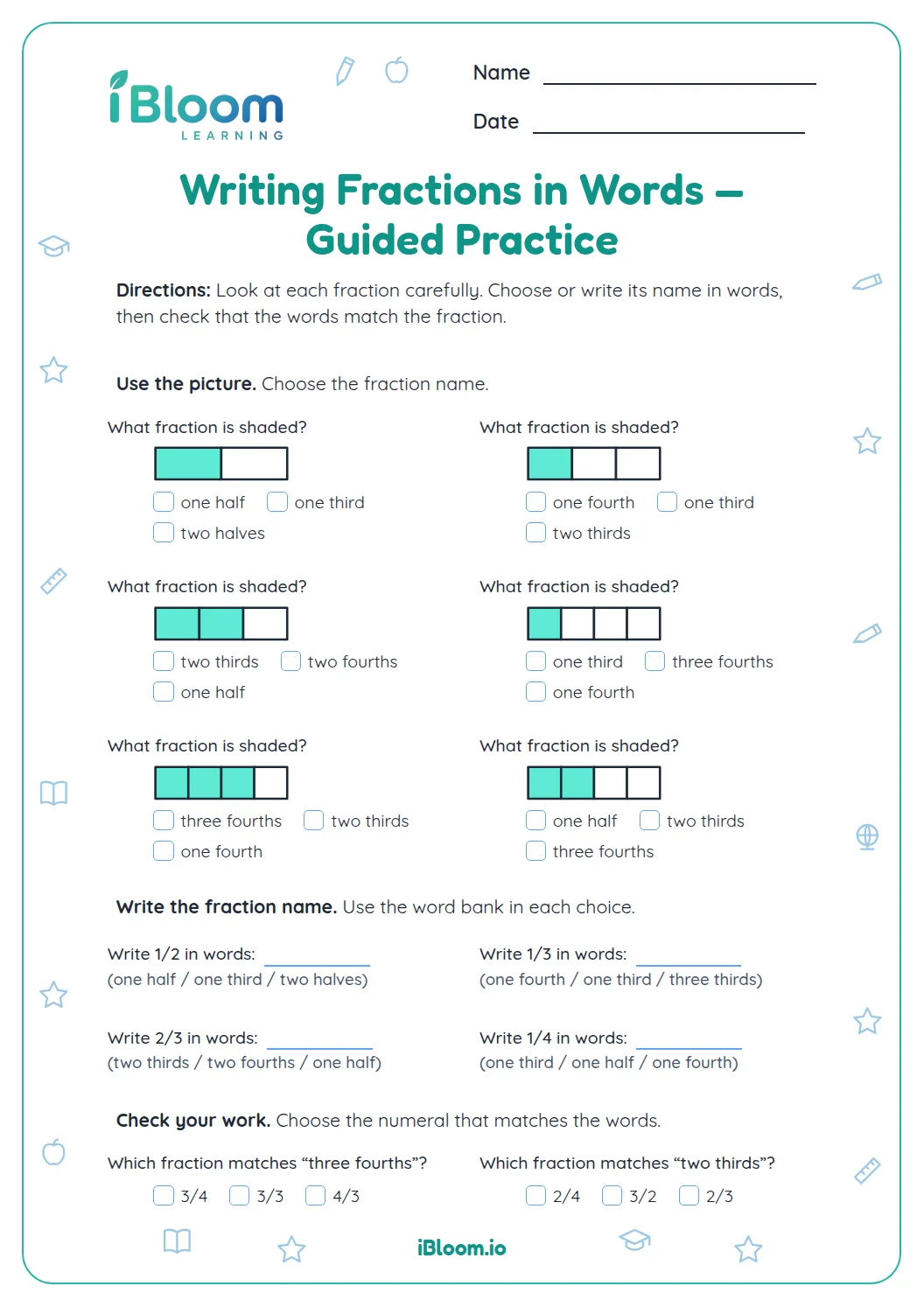
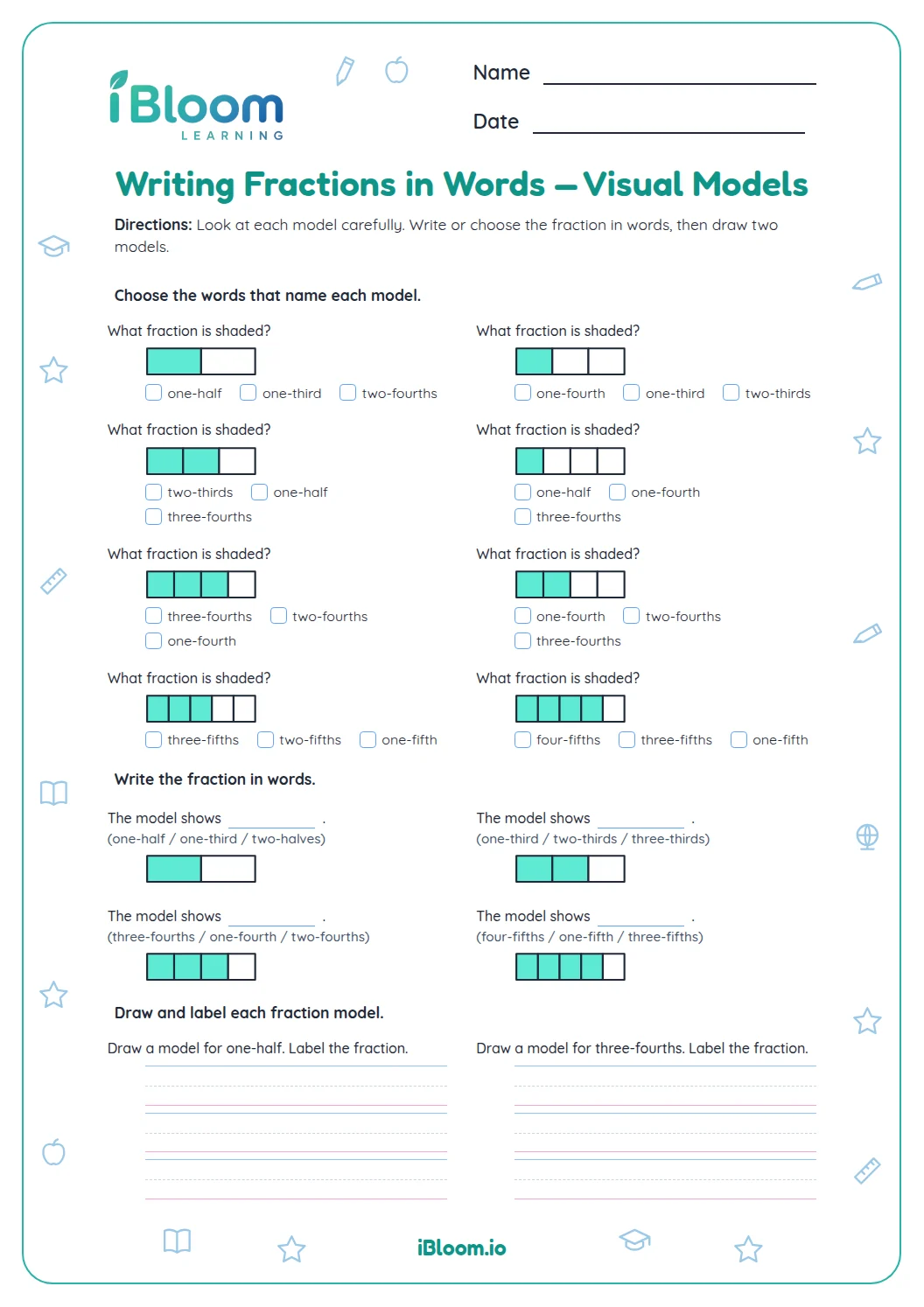
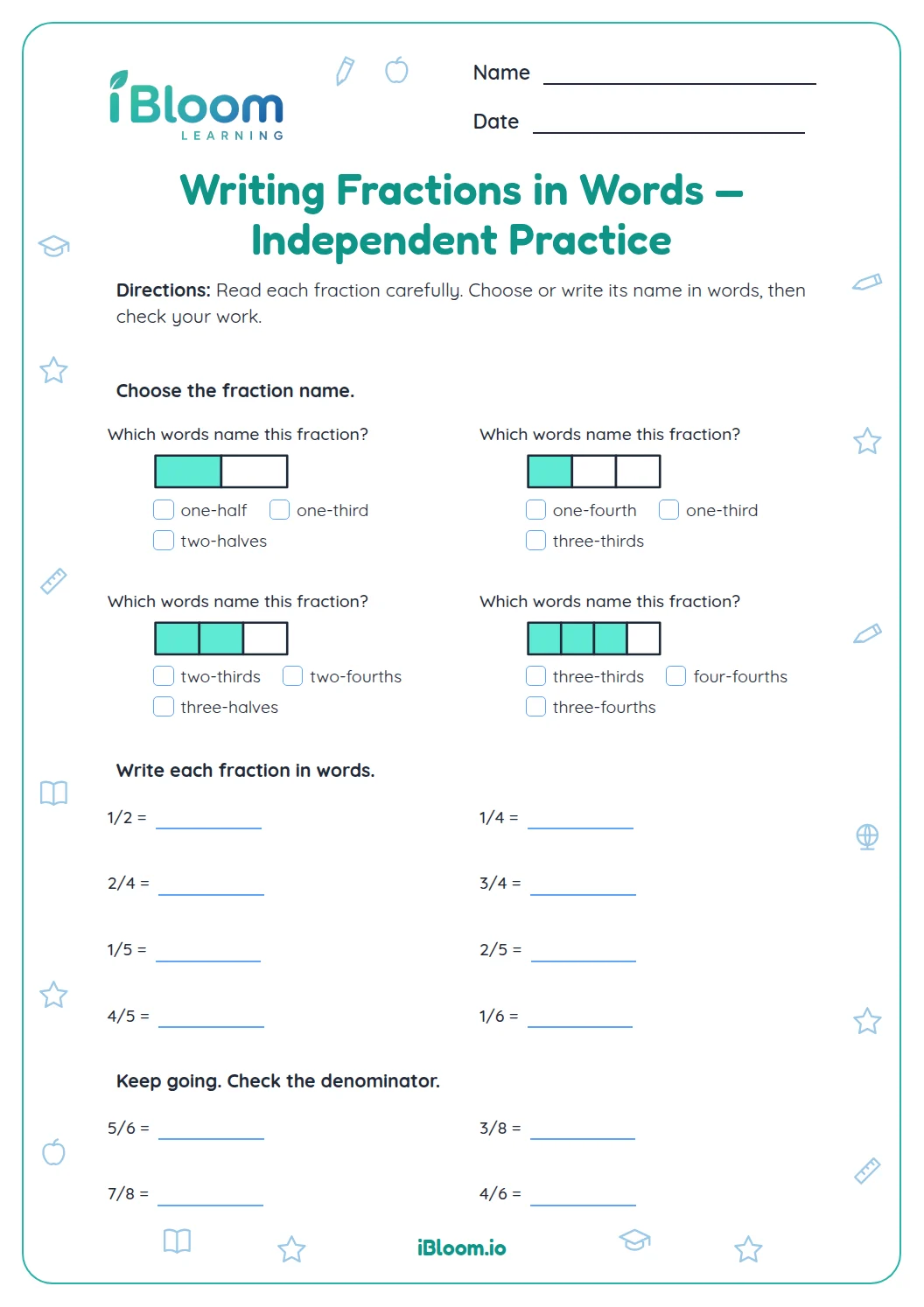
The numerator names how many parts are selected; the denominator names the total equal parts. For example, 3/4 is read “three fourths.” Questions 4–6 ask children to write fraction names from symbols.
How can a child check a claim about a set?
Check that the part count matches the selected group and the total matches the whole set. Two of six is 2/6, or one third; it is not one half.
How to use this worksheet
- 1Count the whole set before naming a part.
- 2Count the selected objects to find the numerator.
- 3Write or say the fraction name carefully.
- 4When checking a claim, compare the selected count with the total.
- 5Check each fraction symbol against the counts and words in the prompt.
Common mistakes and quick fixes
The mistake
Using the part count as the denominator.
The fix
The denominator names the total number of equal parts in the whole set.
The mistake
Calling any two selected objects one half.
The fix
Compare the selected count with the total; 2 of 6 is 2/6.
The mistake
Writing “fourth” when the fraction has three selected parts.
The fix
Read the numerator first: 3/4 is three fourths.
Common Core alignment
This worksheet practices the following Common Core math skills.
Name one or more equal parts of a whole as a unit fraction.
On this sheet: Children name a part of an equal-part set and write the part count over the total count.
Show the official wordingHide the official wording
Understand a fraction 1/b as the quantity formed by 1 part when a whole is partitioned into b equal parts; understand a fraction a/b as the quantity formed by a parts of size 1/b.
What to practice next
Make more practice
Further reading
Questions parents and teachers ask
What is a fraction of a set?
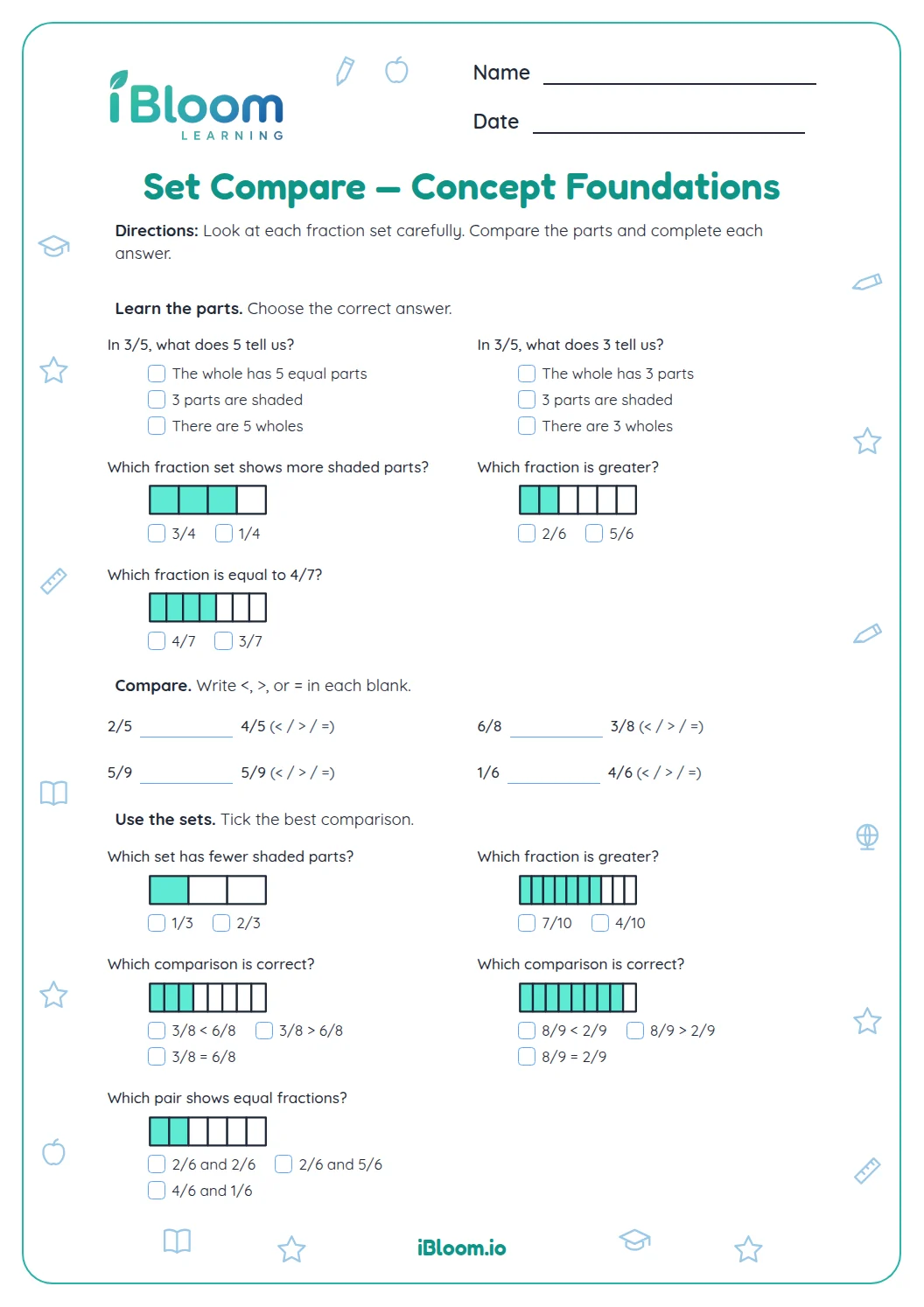
A fraction of a set compares the selected objects with the whole collection. If 2 of 6 apples are selected, the fraction is 2/6. The first questions state the full set size and the selected count so children can record both parts.
What does the denominator tell me?
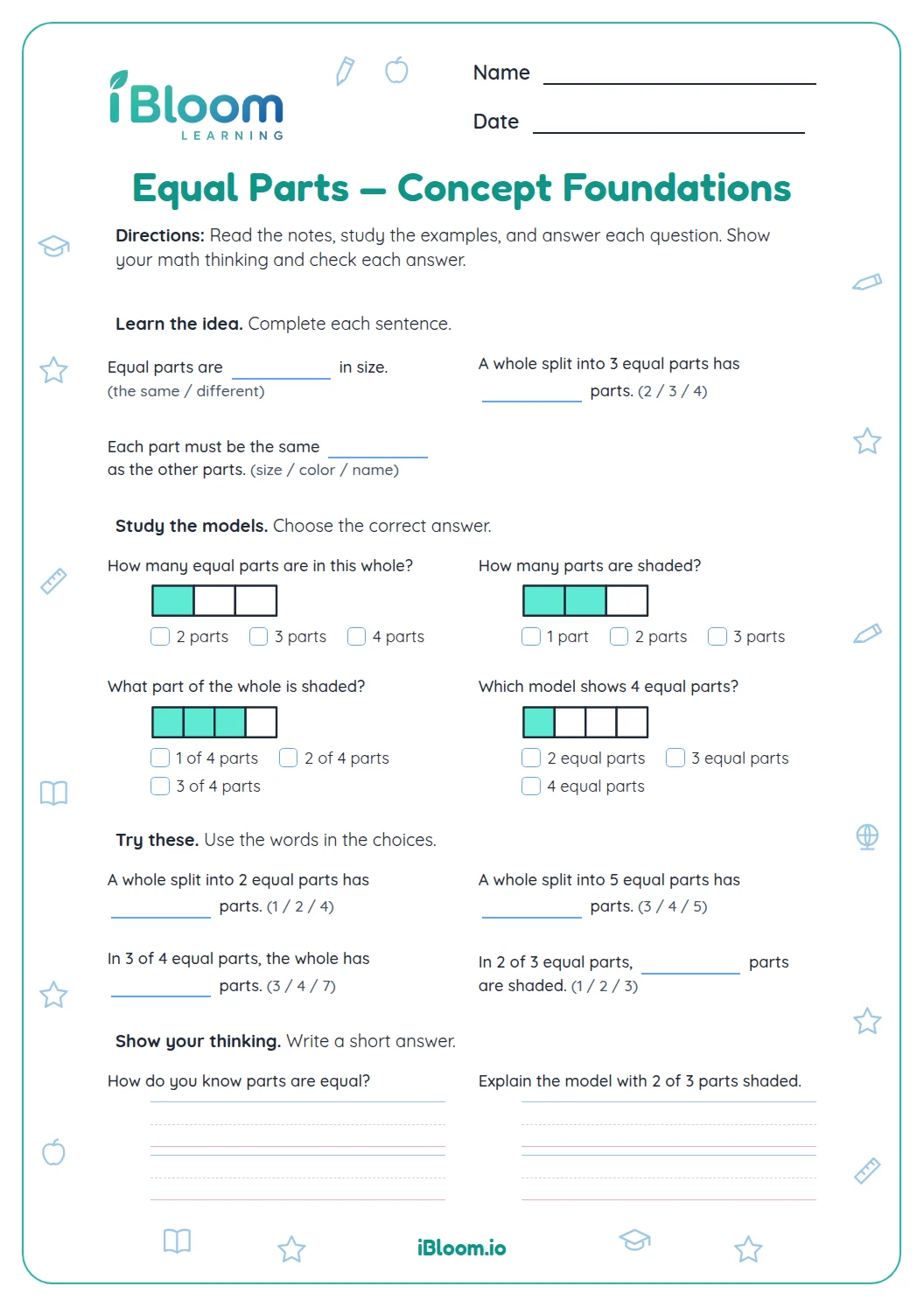
The denominator tells how many equal parts make up the whole. In a set divided into four equal groups, each group is one fourth. The numerator tells how many of those parts are being described in the question, as children practice with equal groups on this page.
How do I write a fraction in words?
Say the numerator as a counting number and the denominator as a part name. For example, 3/4 is “three fourths.” The worksheet asks children to read a symbol and write its matching name, then use set counts to name other fractions.
Why is 2 of 6 not one half?
Two out of six is 2/6, which is equivalent to one third. One half of six would be 3 of the 6 objects. The worksheet asks children to compare the selected amount with the full set and decide whether the statement is true.
Is an answer key included?
Yes. A separate answer key lists the fraction symbols and written names, and answers the true-or-false question. Some fractions such as 2/8 can be simplified, but the key keeps the part count over the total count shown in the problem.