
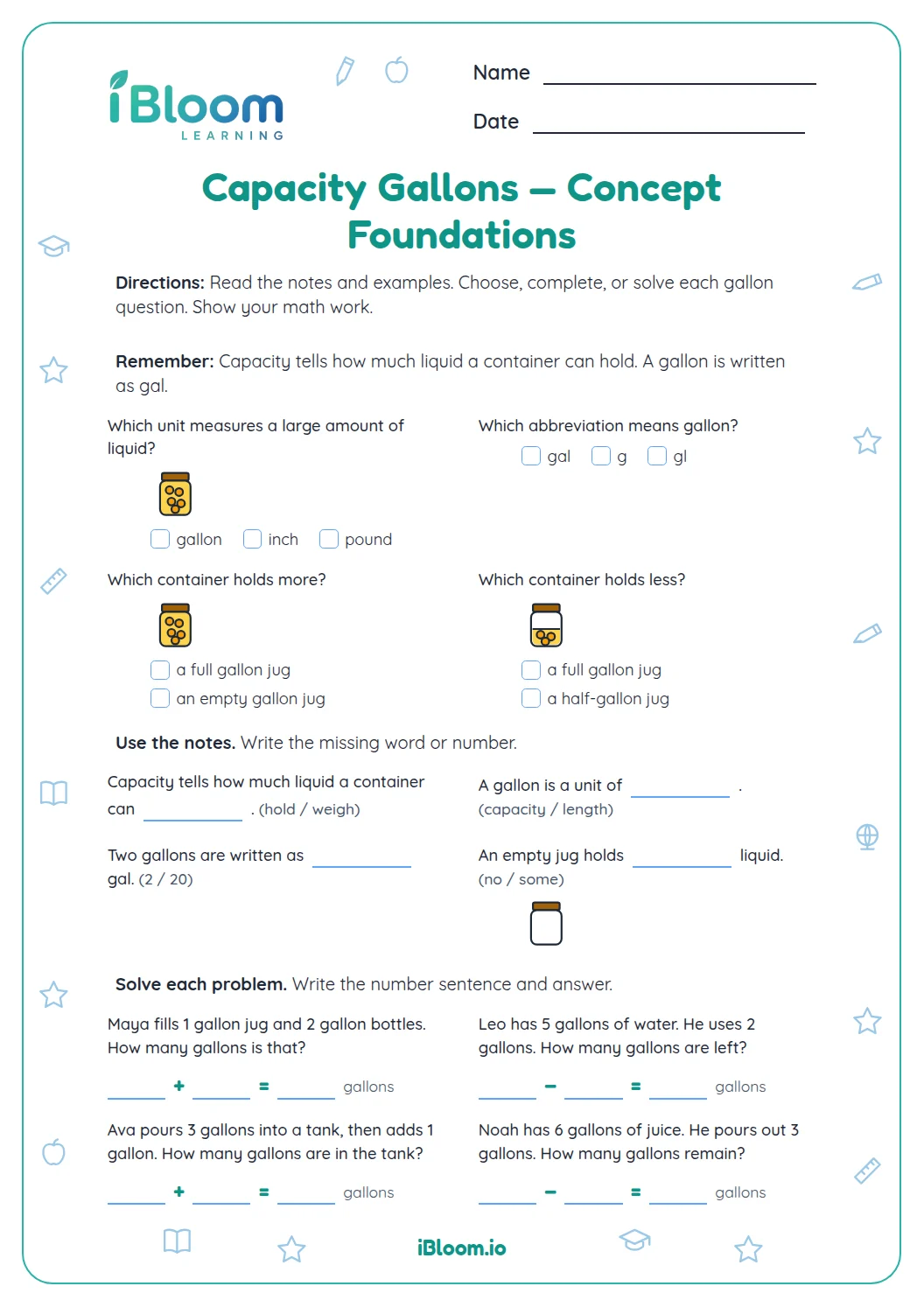
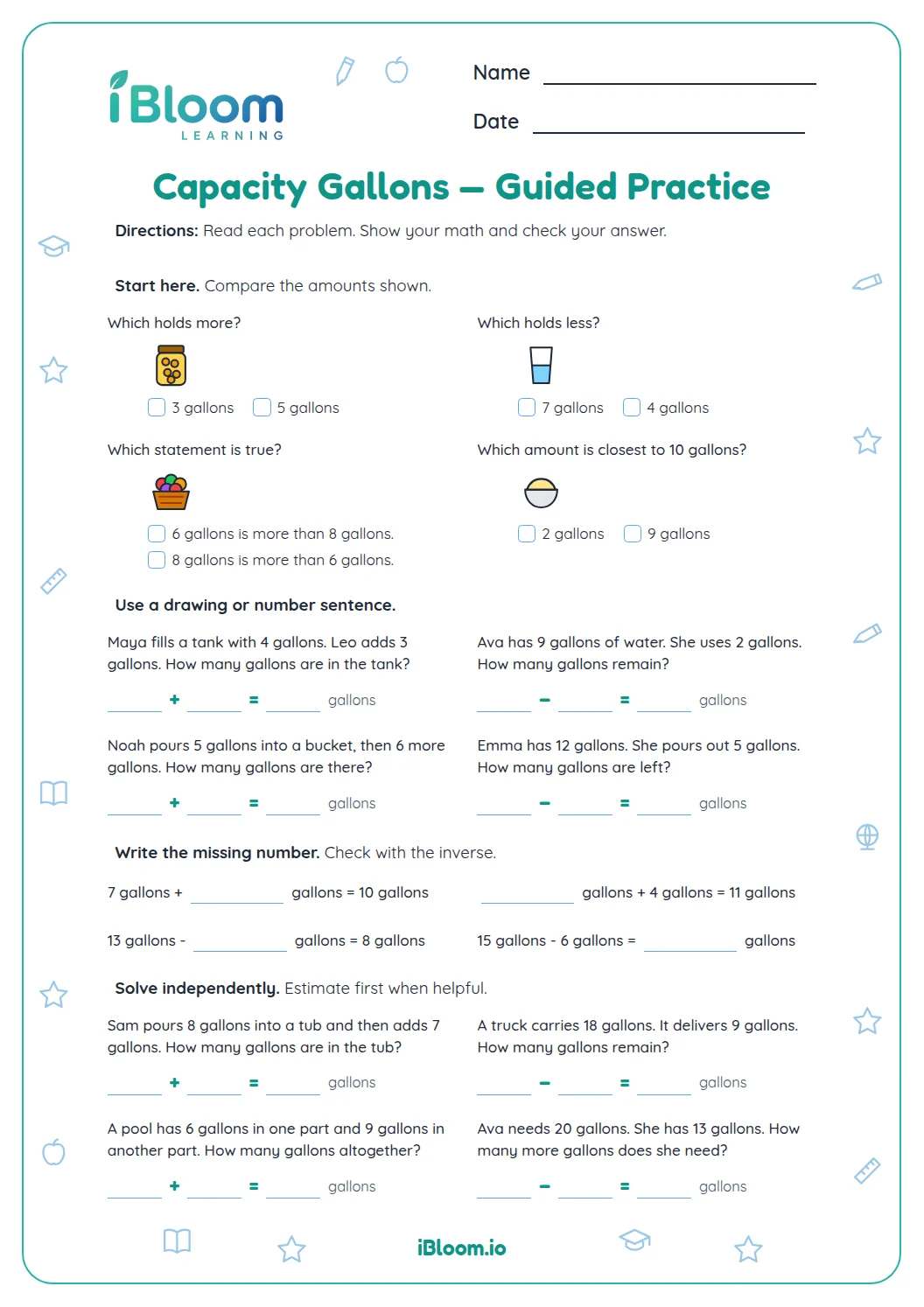
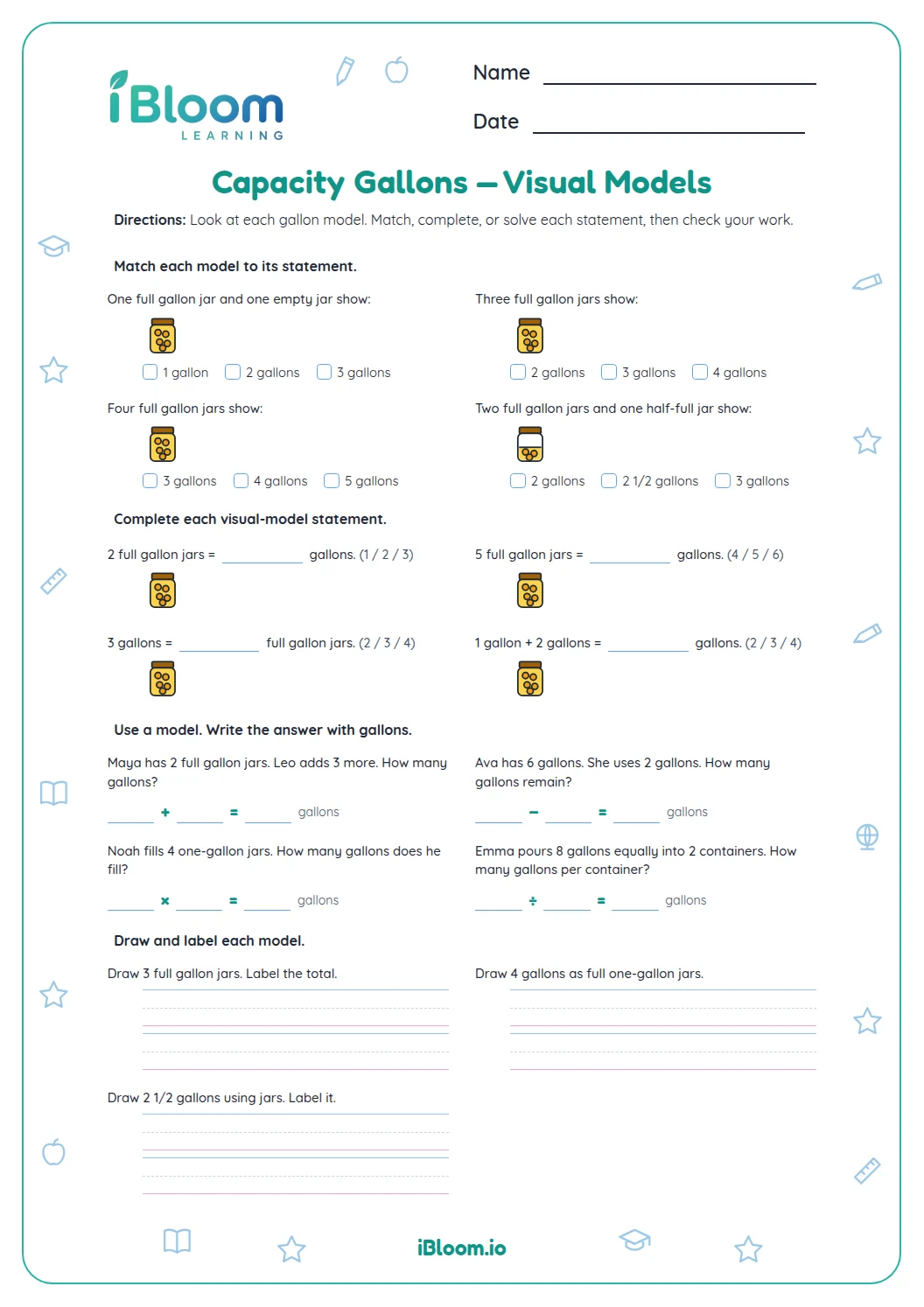
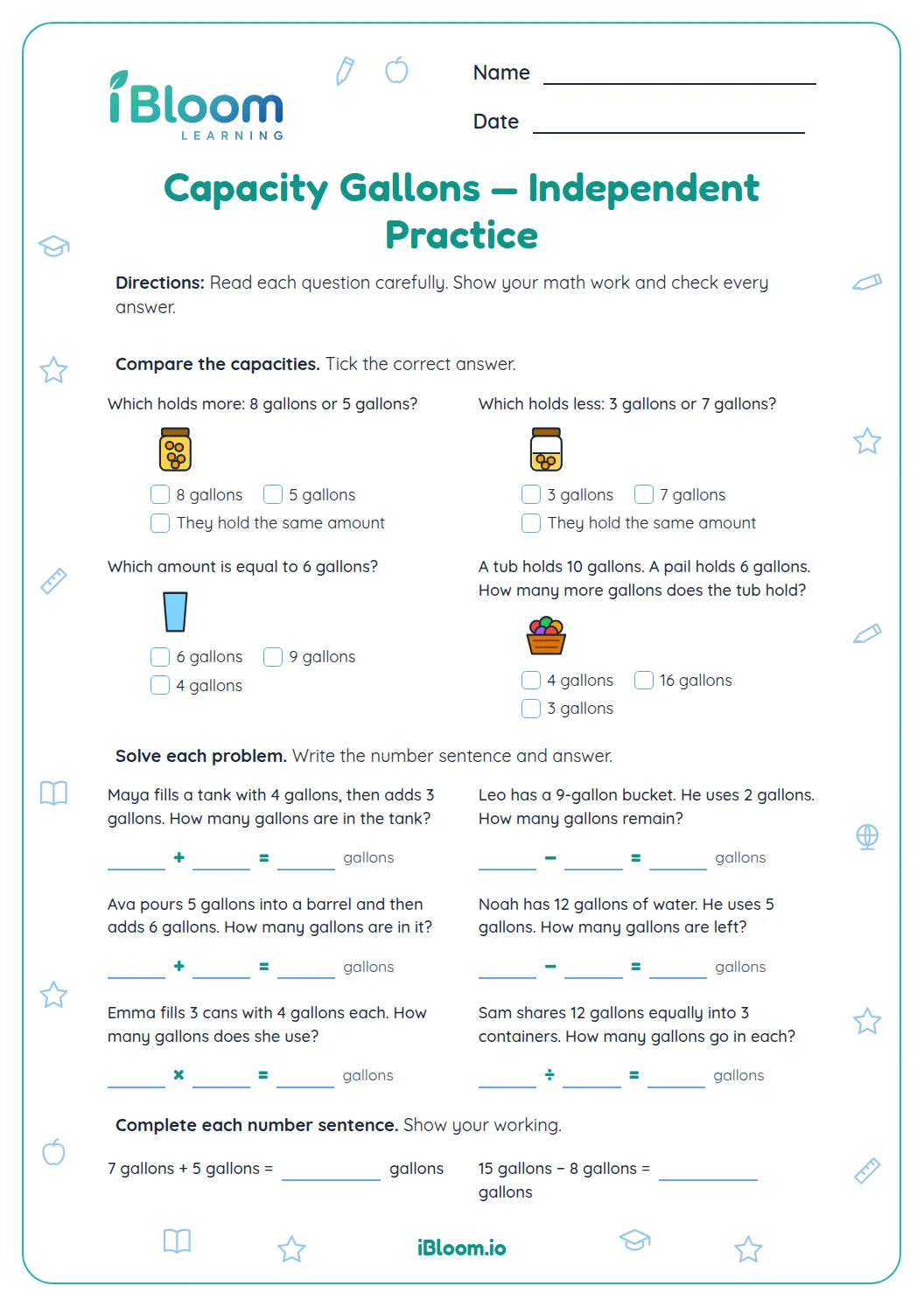
About this worksheet
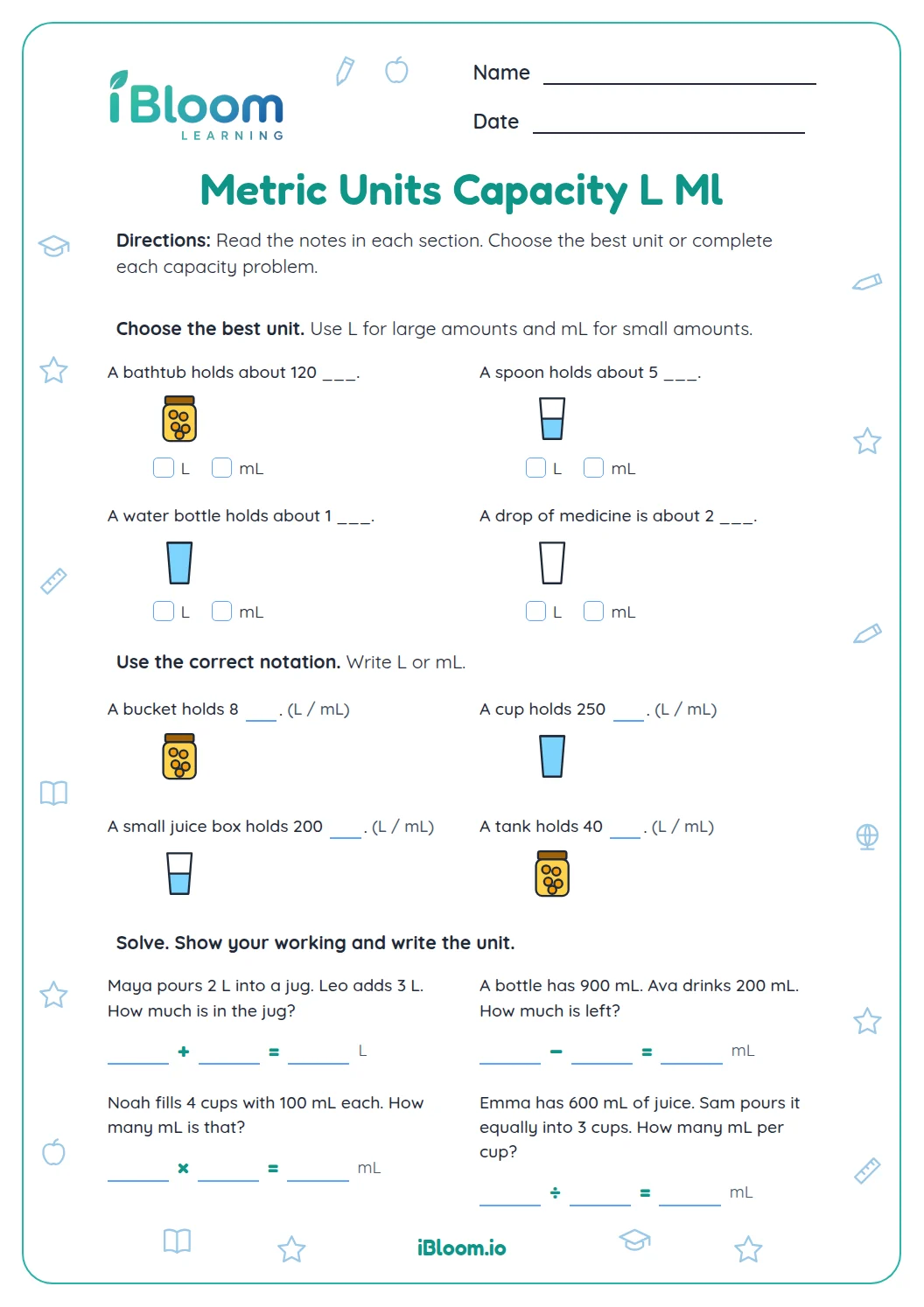
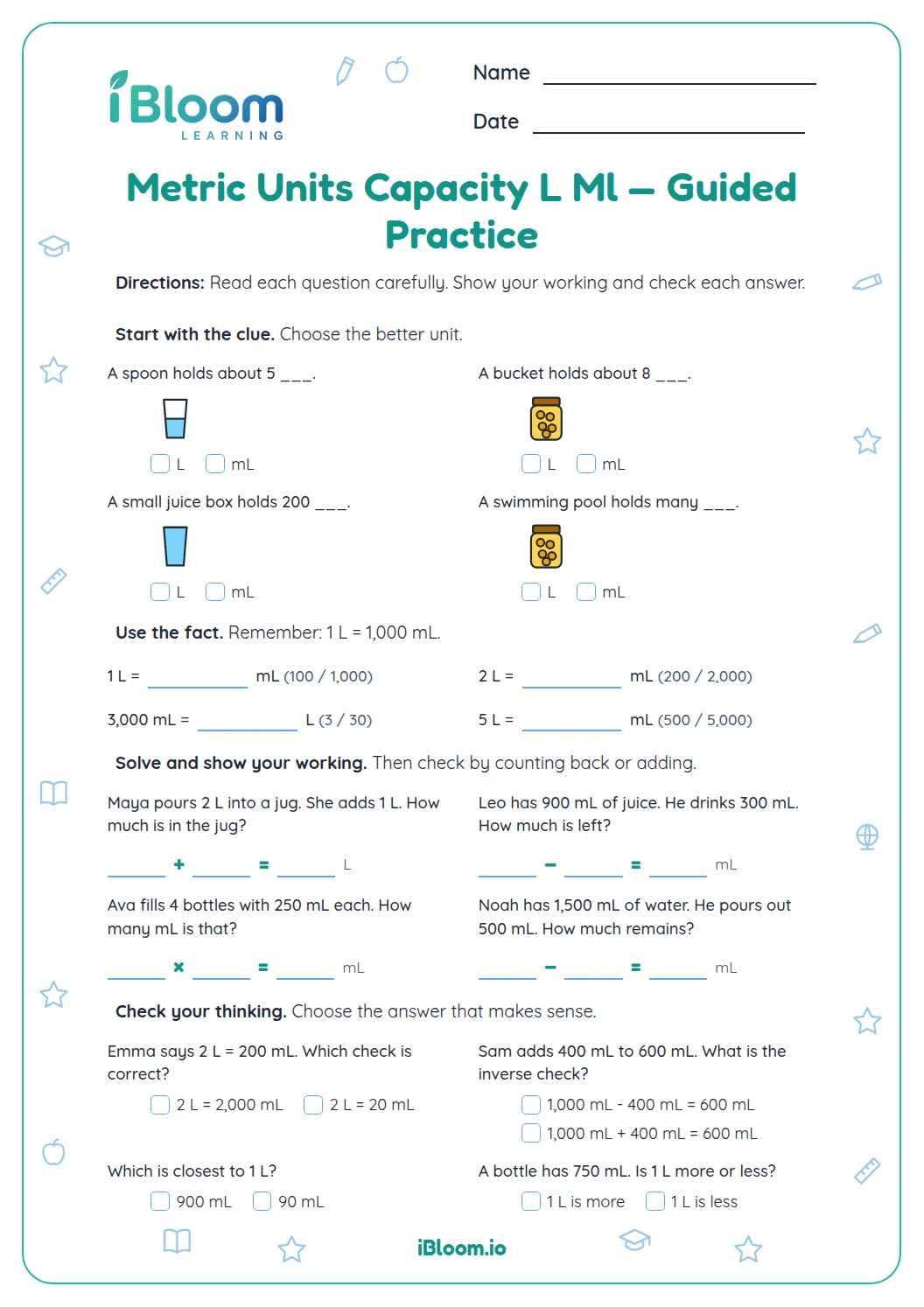
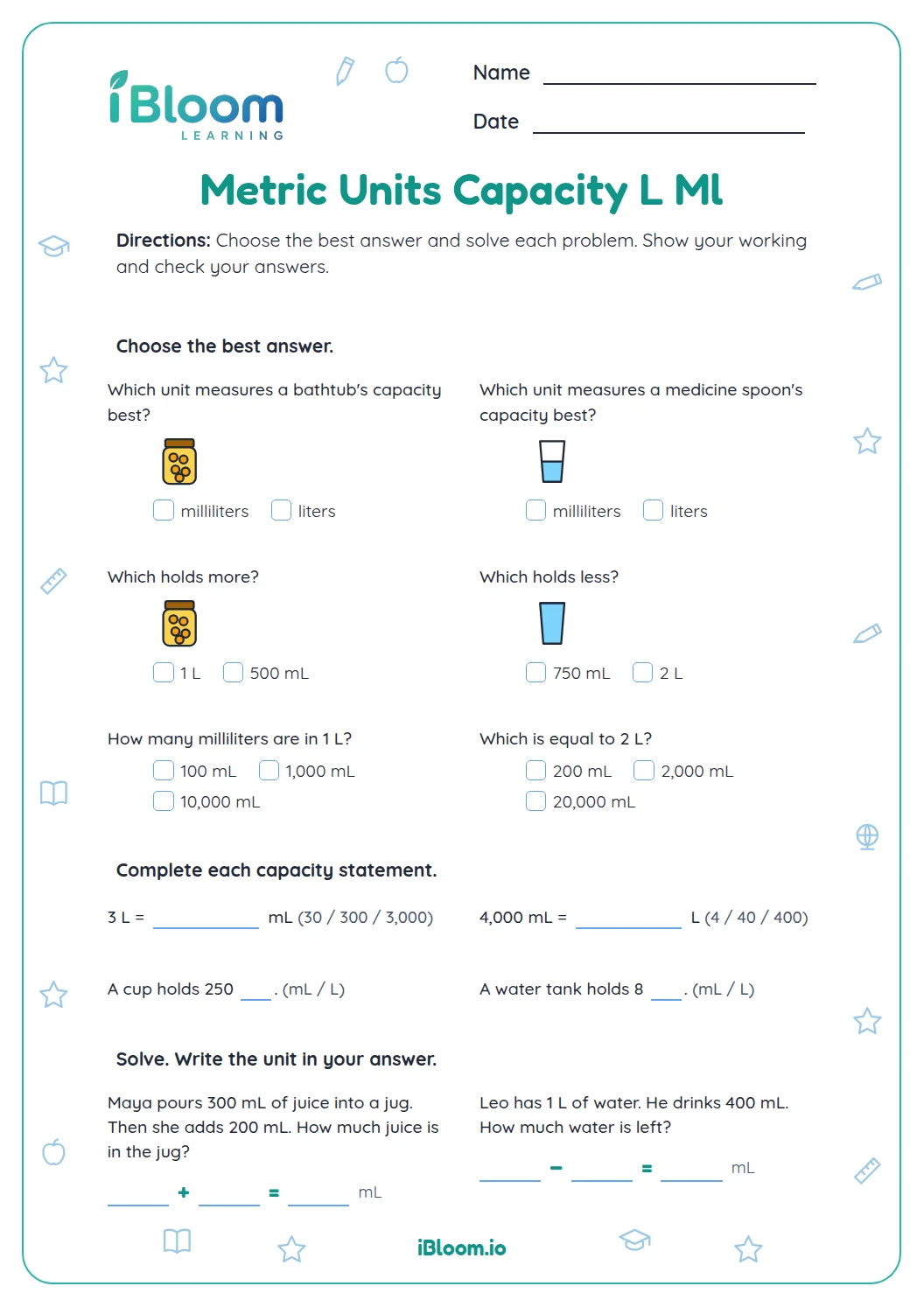
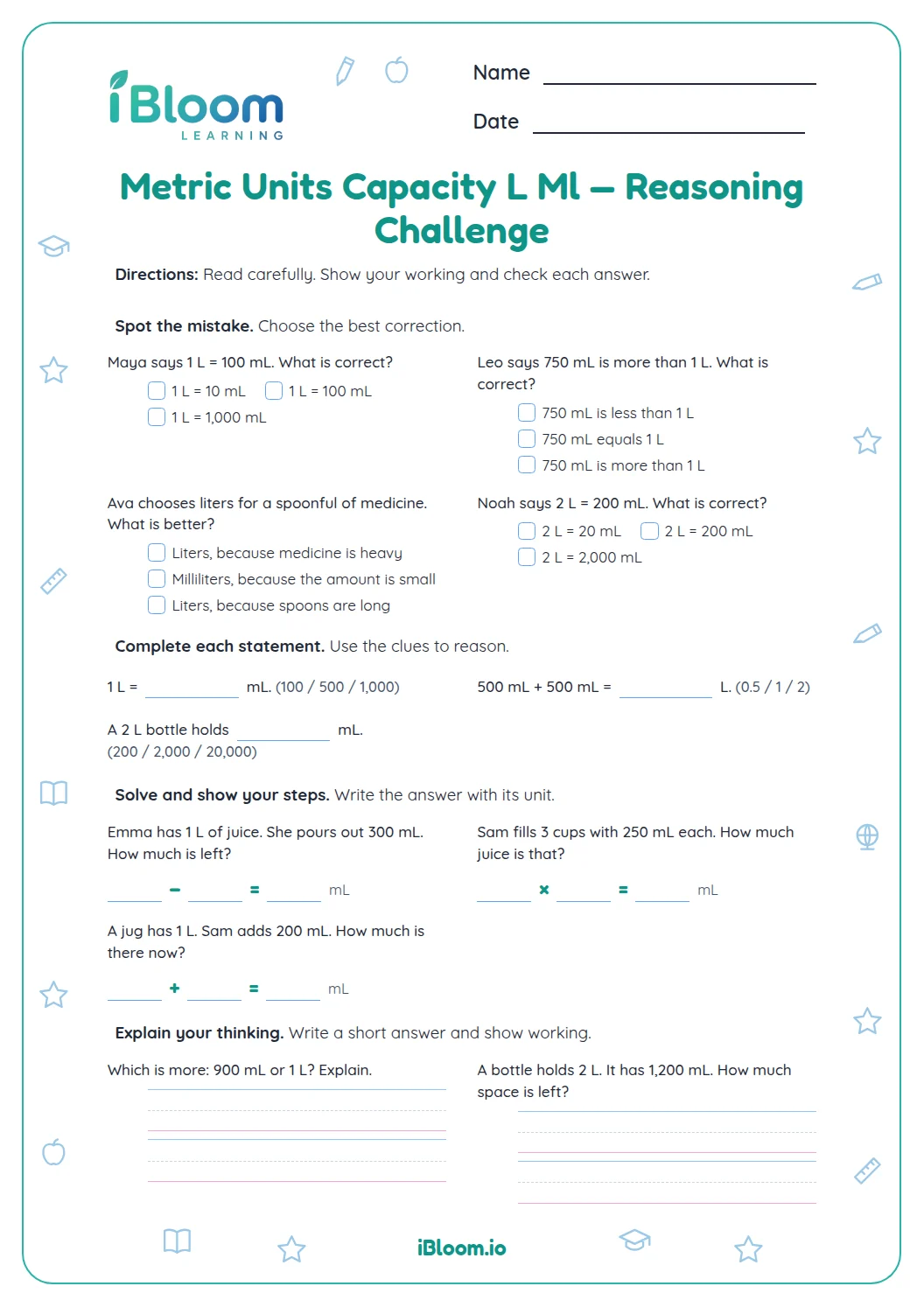
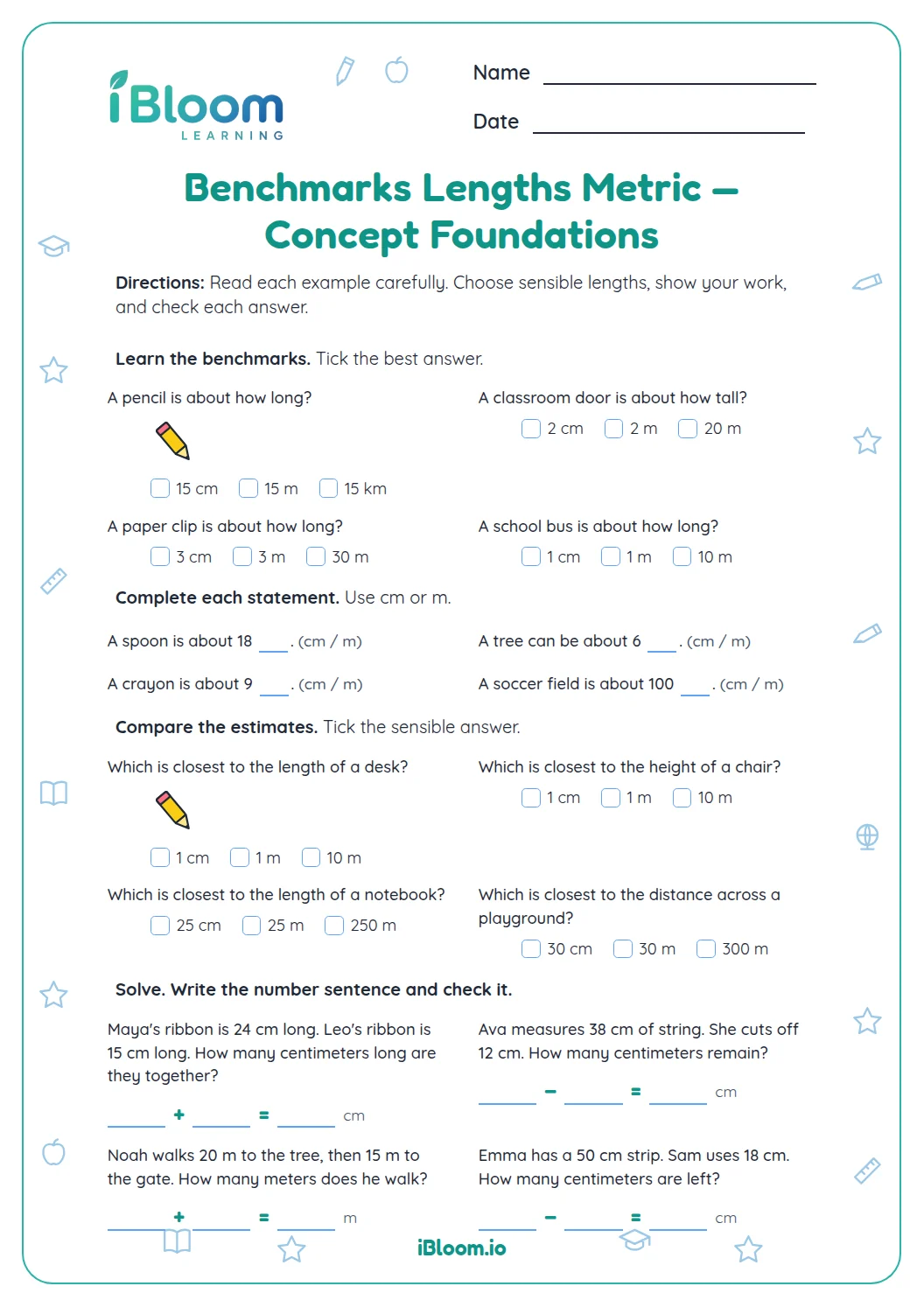
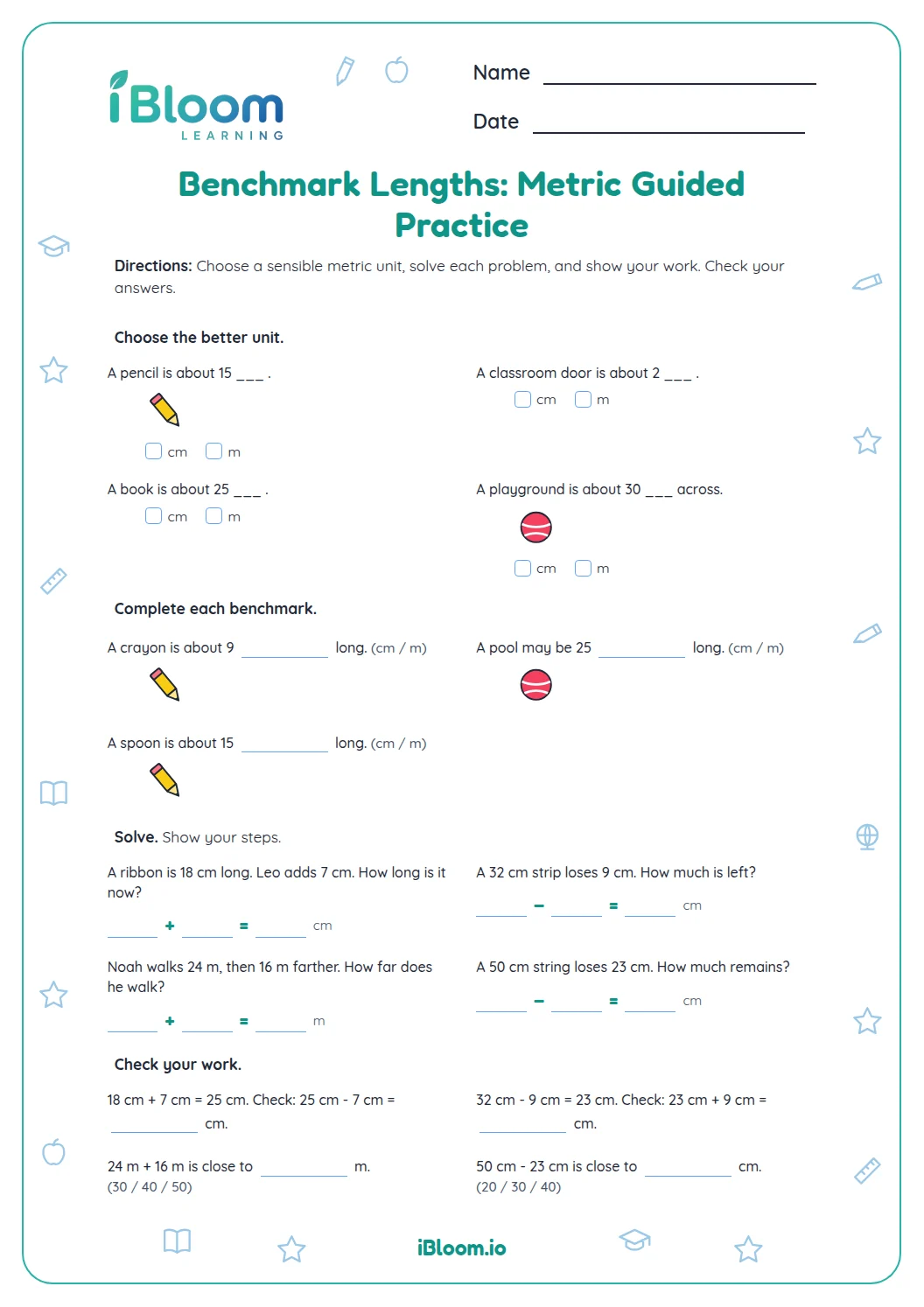
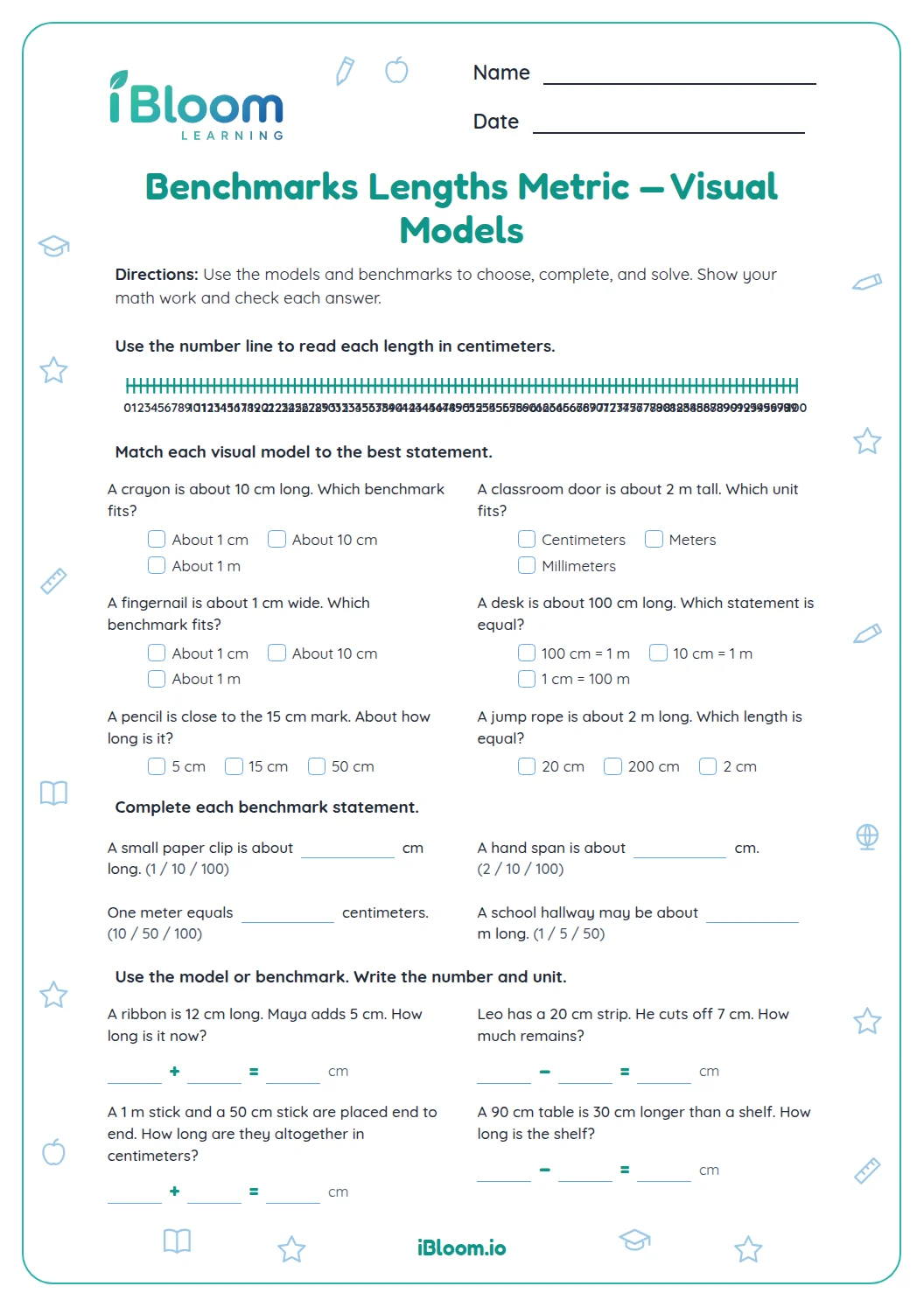
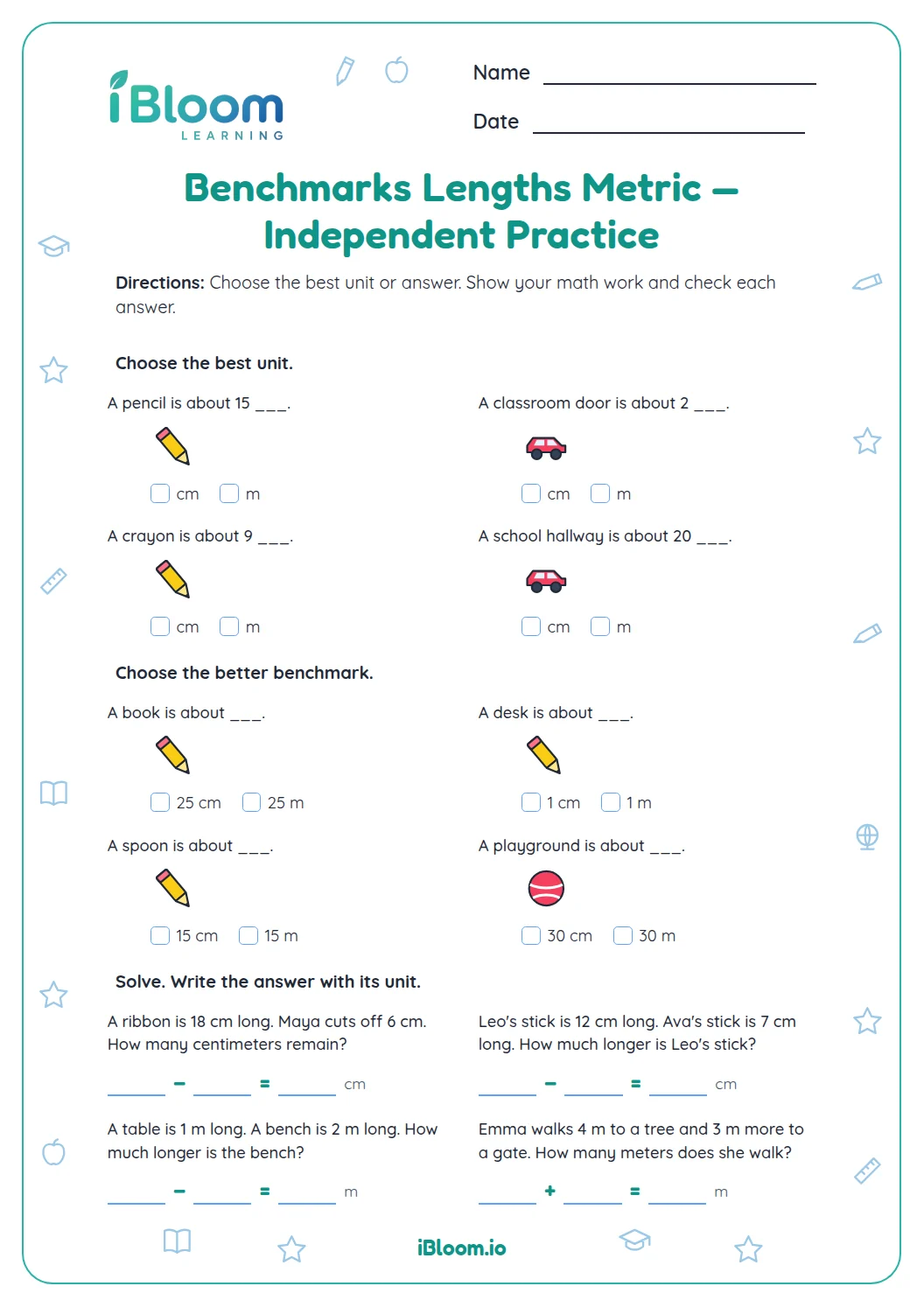
This printable Grade 2 worksheet introduces metric capacity with the relationship 1 liter = 1,000 milliliters. Students convert between units, combine amounts, compare quantities, and solve short capacity problems. Fourteen questions begin with a labeled container model and build toward calculations and comparisons, with a separate answer key.
How are liters and milliliters related?
A liter is the larger unit. One liter contains 1,000 milliliters, so 2 L is 2,000 mL.
- 12 L = 2,000 mL
How do you combine liters and milliliters?
Convert liters to milliliters, then add the remaining milliliters. To rewrite a milliliter amount, group each 1,000 mL as one liter.
- 11 L 250 mL = 1,250 mL
How can you compare amounts in different units?
Put both amounts in the same unit first. For example, 1 L is 1,000 mL, which is greater than 900 mL.
How to use this worksheet
- 1Remember that 1 L equals 1,000 mL.
- 2Convert liters to milliliters by multiplying by 1,000.
- 3For mixed amounts, add the extra milliliters after converting liters.
- 4Compare amounts in the same unit.
- 5Check whether your answer uses L, mL, or both.
Common mistakes and quick fixes
The mistake
Writing 100 mL for 1 L.
The fix
Remember there are 1,000 milliliters in one liter.
The mistake
Adding a liter amount directly to milliliters.
The fix
Convert the liters to milliliters first, then add.
The mistake
Comparing 1 L and 900 mL by looking only at the numeral.
The fix
Rewrite 1 L as 1,000 mL before comparing.
What to practice next
Questions parents and teachers ask
How many questions are on the page?
The worksheet has 14 questions in three parts. Part A practices the liter-to-milliliter fact, Part B converts and compares amounts, and Part C uses the same units in calculations and short problems. A separate answer key shows the expected values and comparison words.
What is the key fact students use?
One liter equals 1,000 milliliters. Students use that relationship to change liters into milliliters, such as 3 L = 3,000 mL, and to express mixed amounts like 1 L 250 mL as 1,250 mL. Comparing quantities is easier after they are written in the same unit.
What does the container model show?
The drawing labels three containers A, B, and C at full, half-full, and empty levels. The first question uses container A as a full 1-liter container and asks how many milliliters it holds. The remaining questions practice capacity with numbers and units.
Should students memorize conversions before starting?
They can use the reminder printed at the top of Part A: 1 L = 1,000 mL. The questions give practice applying that relationship to whole liters, mixed liter-and-milliliter amounts, and comparisons. If a conversion is difficult, revisit the reminder before checking the answer key.
How can students compare liters and milliliters?
Rewrite the liter amount in milliliters, then compare the numbers. For example, 1 L is 1,000 mL, so 900 mL is less than 1 L. Part B uses this kind of comparison, and Part C asks students to order 650 mL, 1 L, and 1,200 mL.