
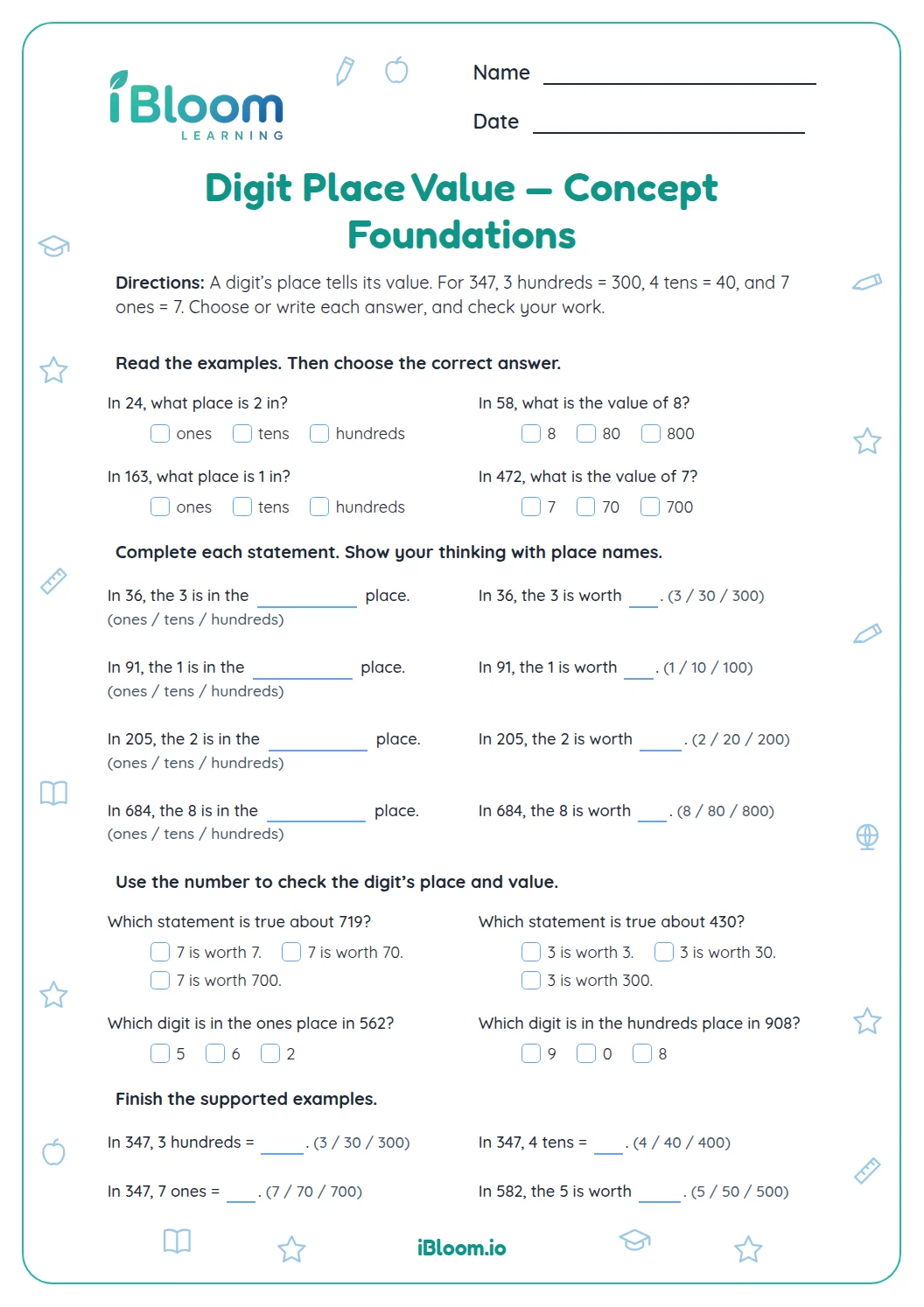
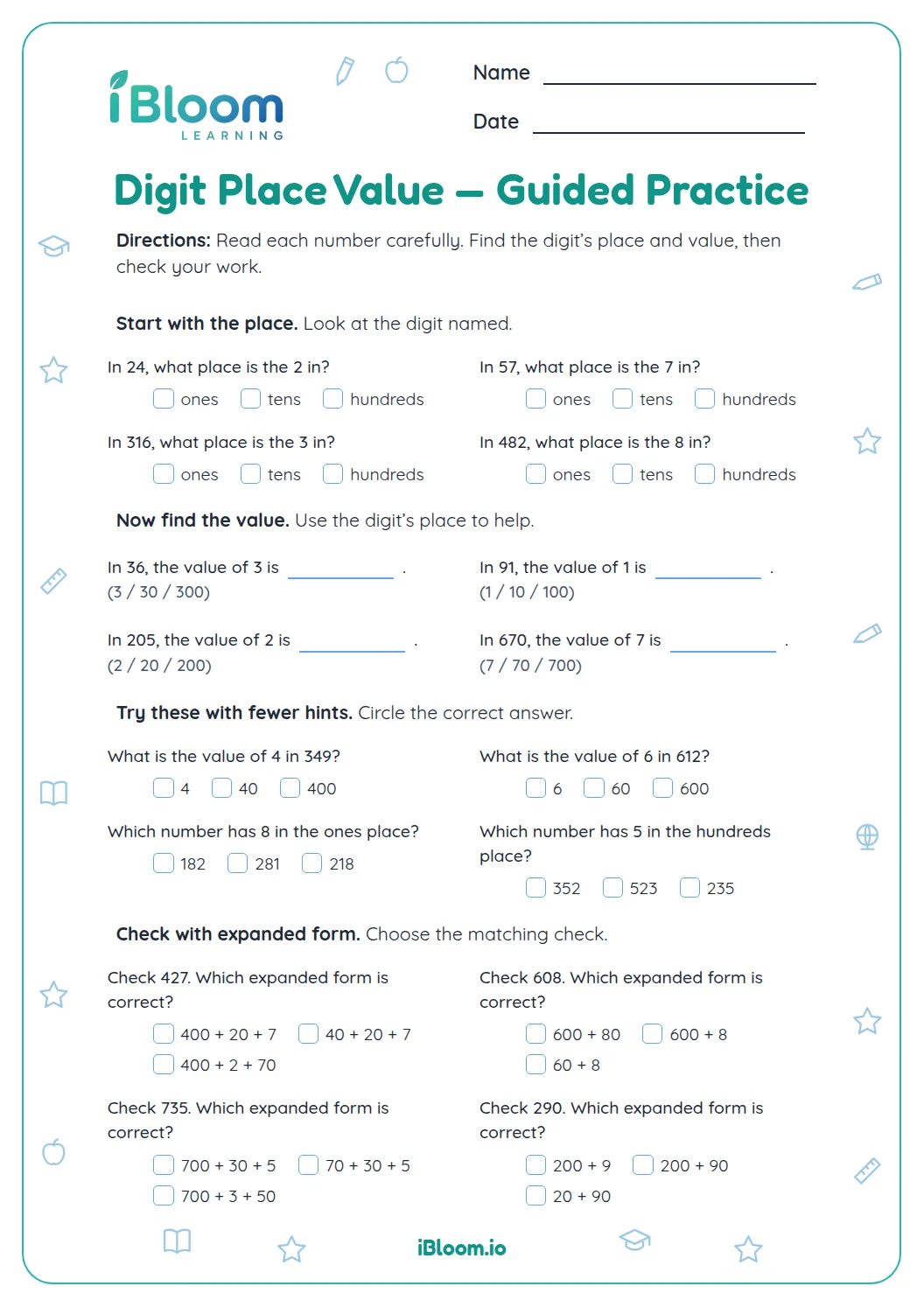
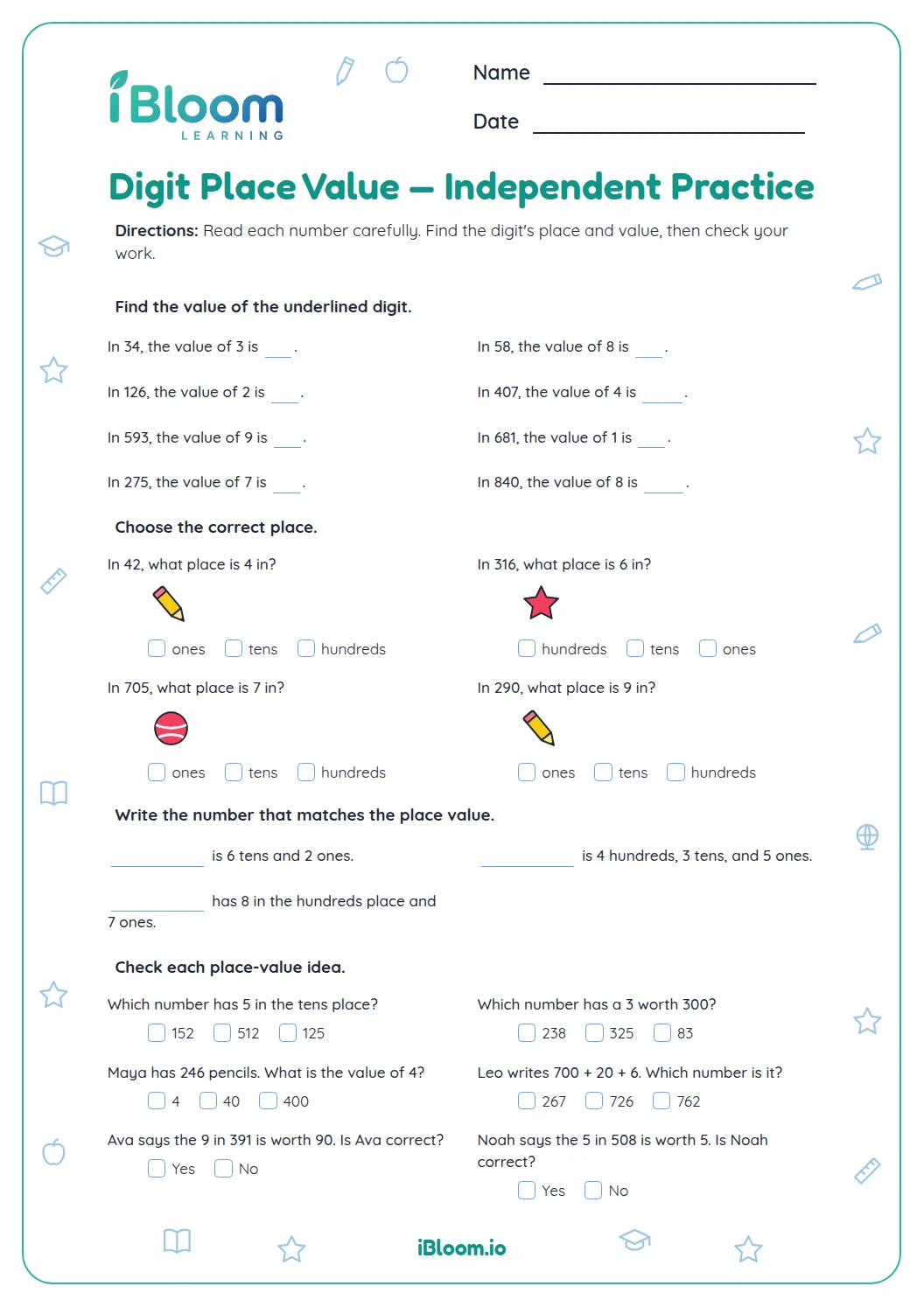
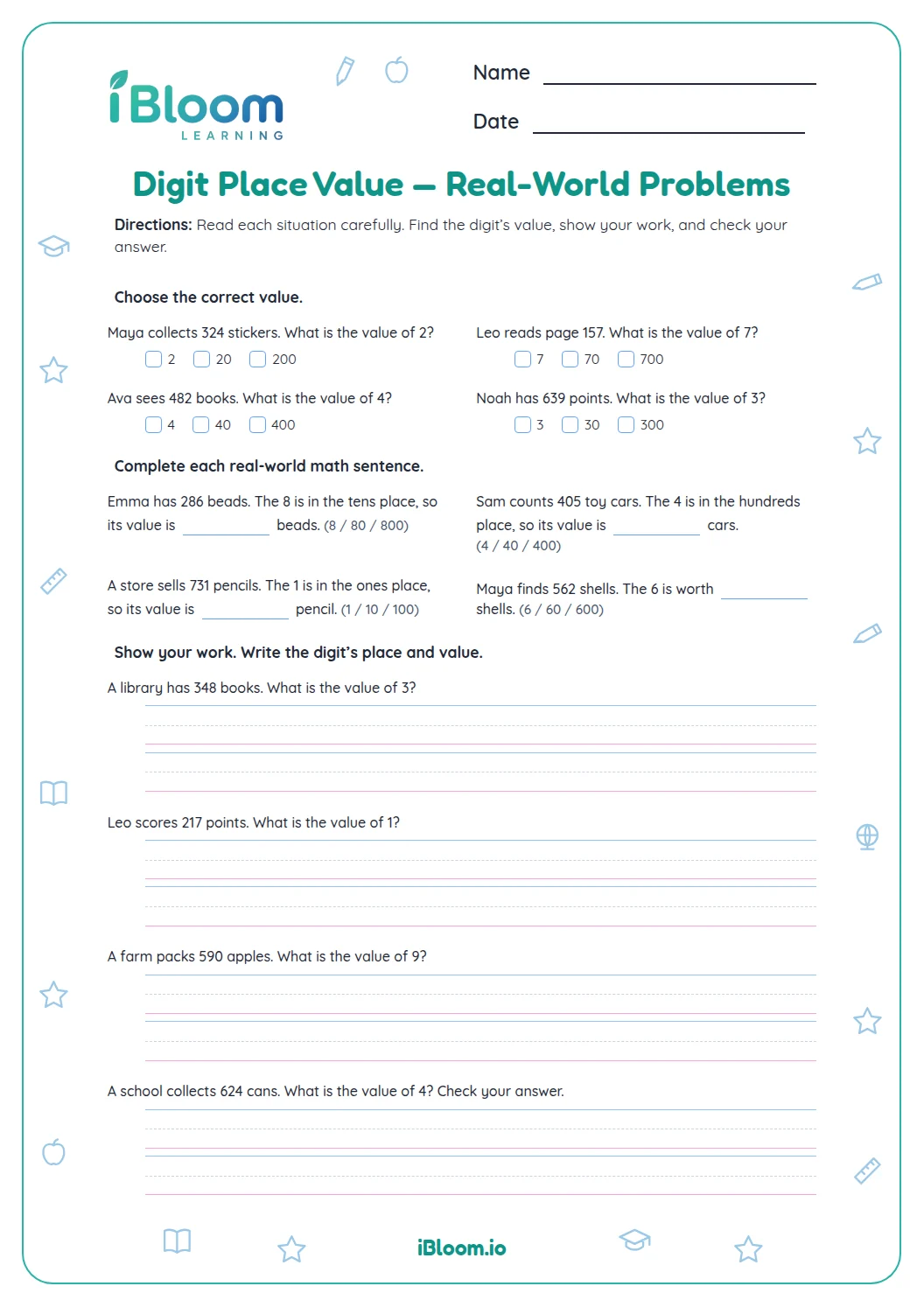
About this worksheet
This free two-page Grade 2 worksheet builds three-digit place-value understanding with base-ten blocks, expanded form, and rounding. Students read hundreds, tens, and ones, compare numbers, and round to the nearest ten or hundred. The questions connect the blocks to number sentences and digit values, practicing CCSS 2.NBT.A.1 and 3.NBT.A.1. A separate answer key makes it easy to check all 16 responses.
Aligned to 2.NBT.A.1 and 3.NBT.A.1
How do base-ten blocks show a number?
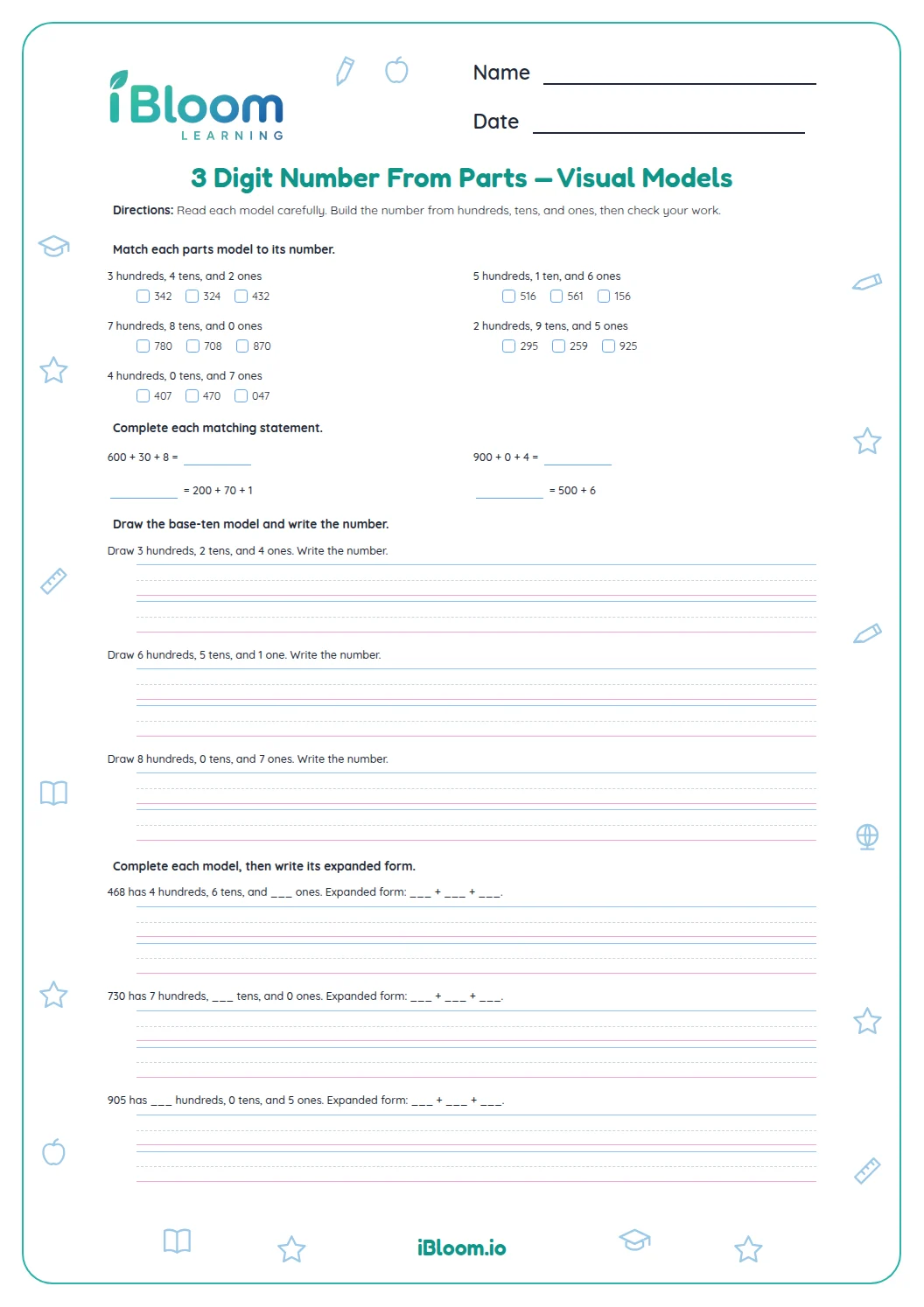
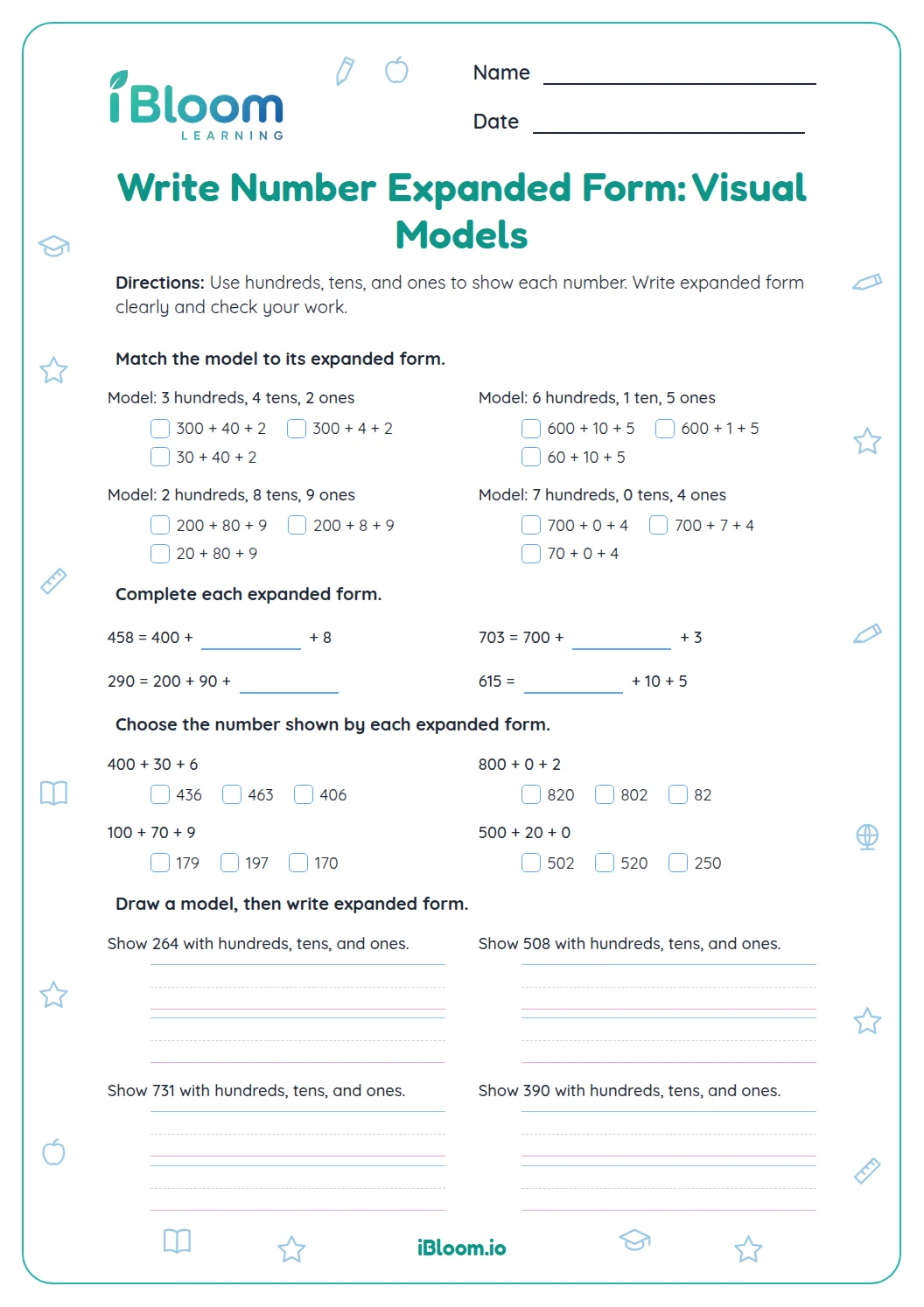
A large square represents one hundred, a long rod represents ten, and a small cube represents one. Count each kind, then combine the values to name the whole number. In question 1, two hundreds, four tens, and six ones make 246.
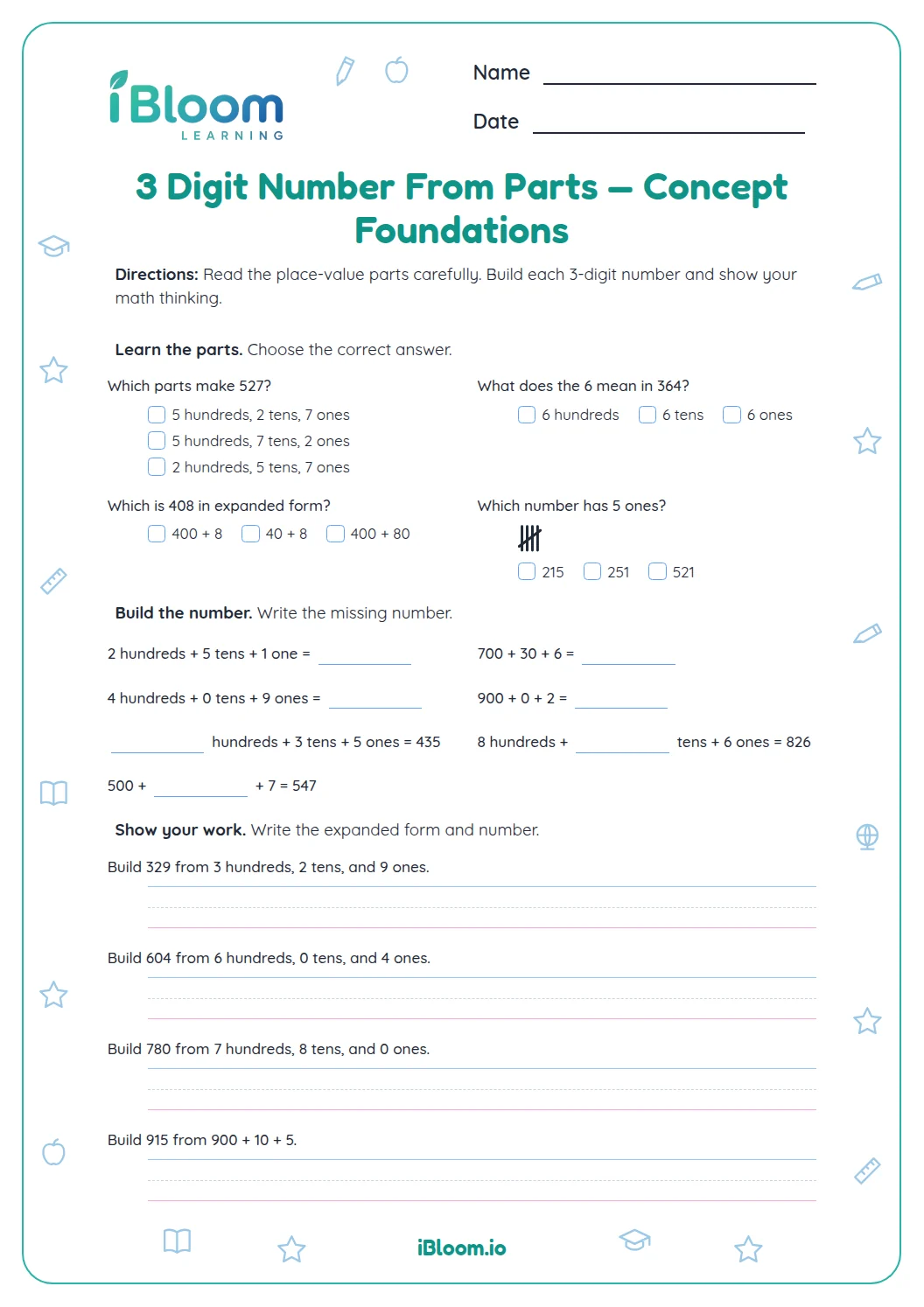
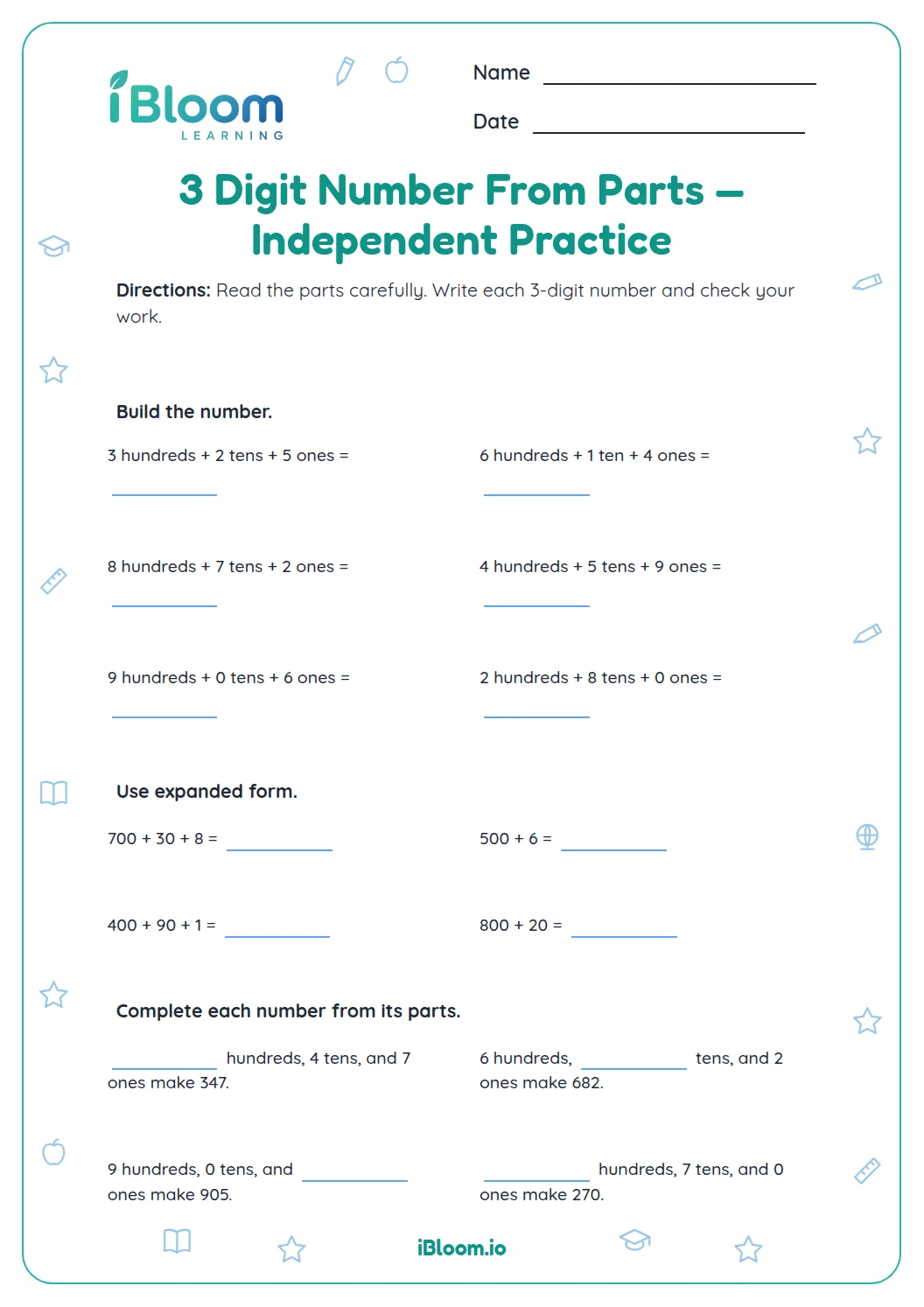
The zero place matters too: 6 hundreds, 0 tens, and 9 ones make 609. Read every group, including an empty place, before writing the number.
- 12 hundreds + 4 tens + 6 ones
- 2200 + 40 + 6 = 246
How does place value help with rounding?
For the nearest ten, look at the ones digit. In 347, the 7 means round up to 350. For the nearest hundred, look at the tens digit: 621 is closer to 600 than to 700.
The place named in the question tells you which digit to inspect. Keep the hundreds or tens that stay the same, and change the digits to the right to zero.
What kinds of questions are on the two pages?
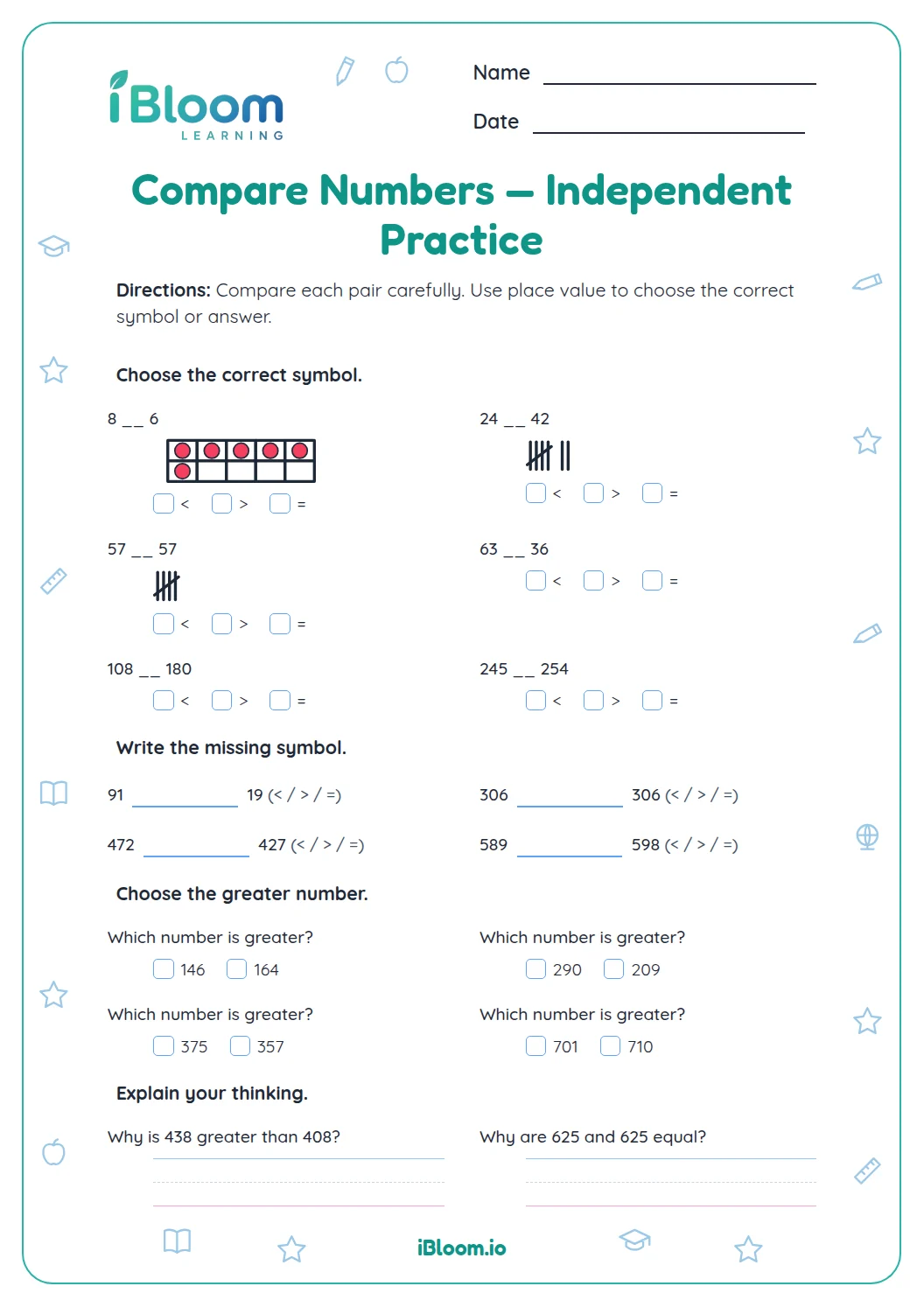
Across four parts, students read a base-ten model, identify digit values, write expanded form, compare numbers, and round three-digit numbers. The 16 questions use short number prompts so attention stays on the place-value idea.
The separate key lists the expected value or comparison symbol for every item. After checking, revisit any answer by rebuilding the number from hundreds, tens, and ones.
How to work through the sheet
- 1Name the value of each block before combining the groups.
- 2Read the place named in the prompt: hundreds, tens, ones, nearest ten, or nearest hundred.
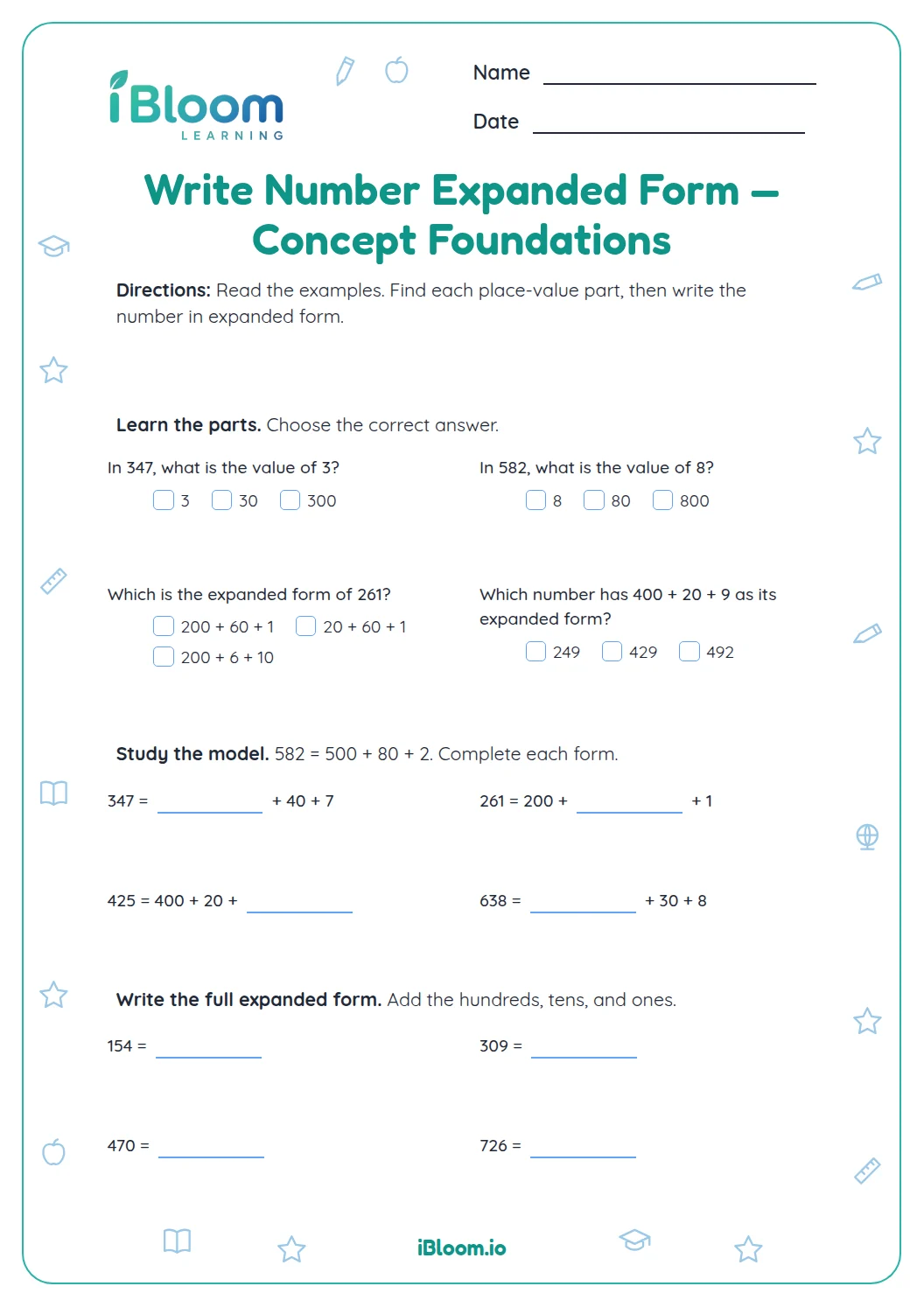
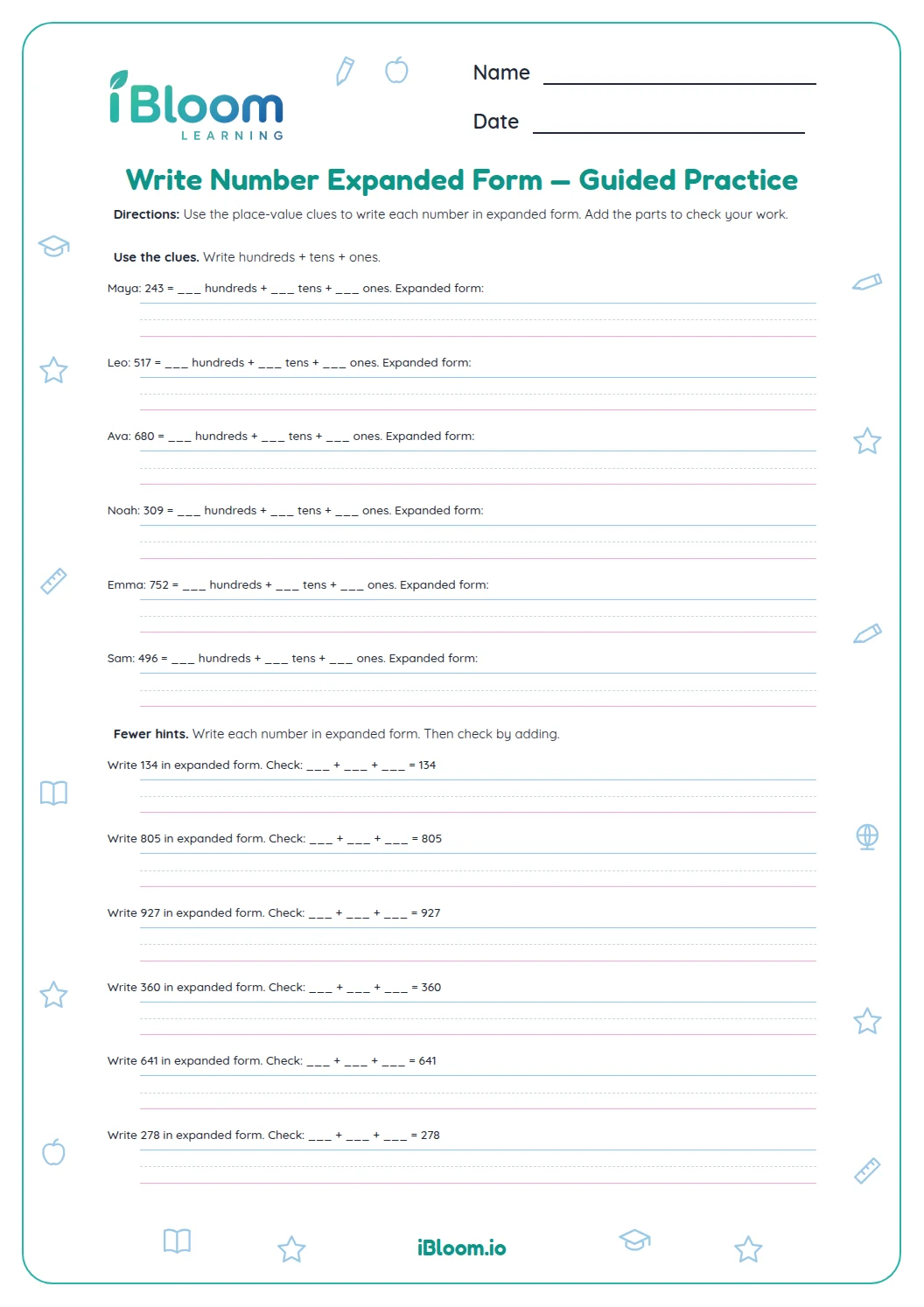
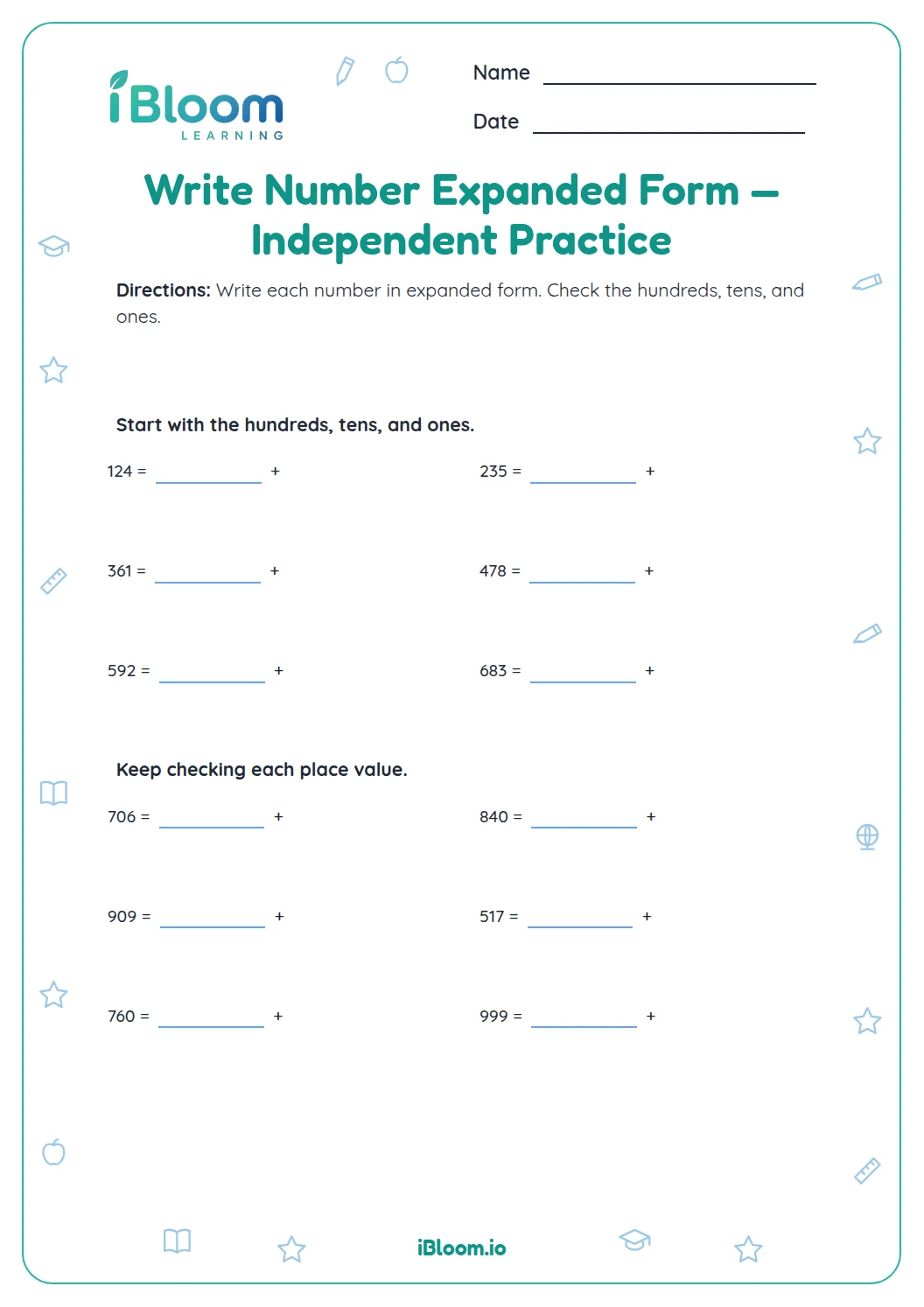
- 3For expanded form, write each nonzero place value in its own blank.
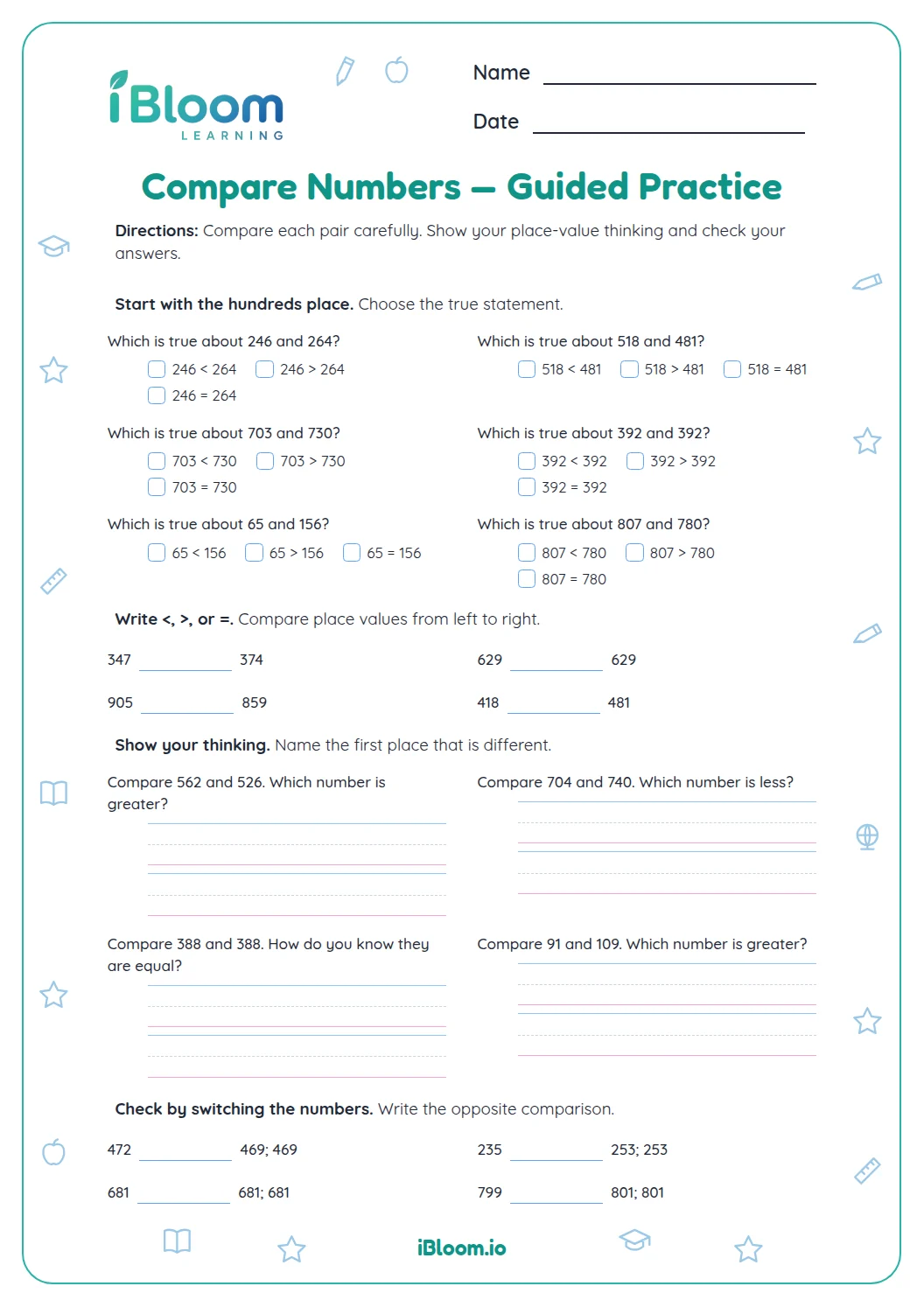
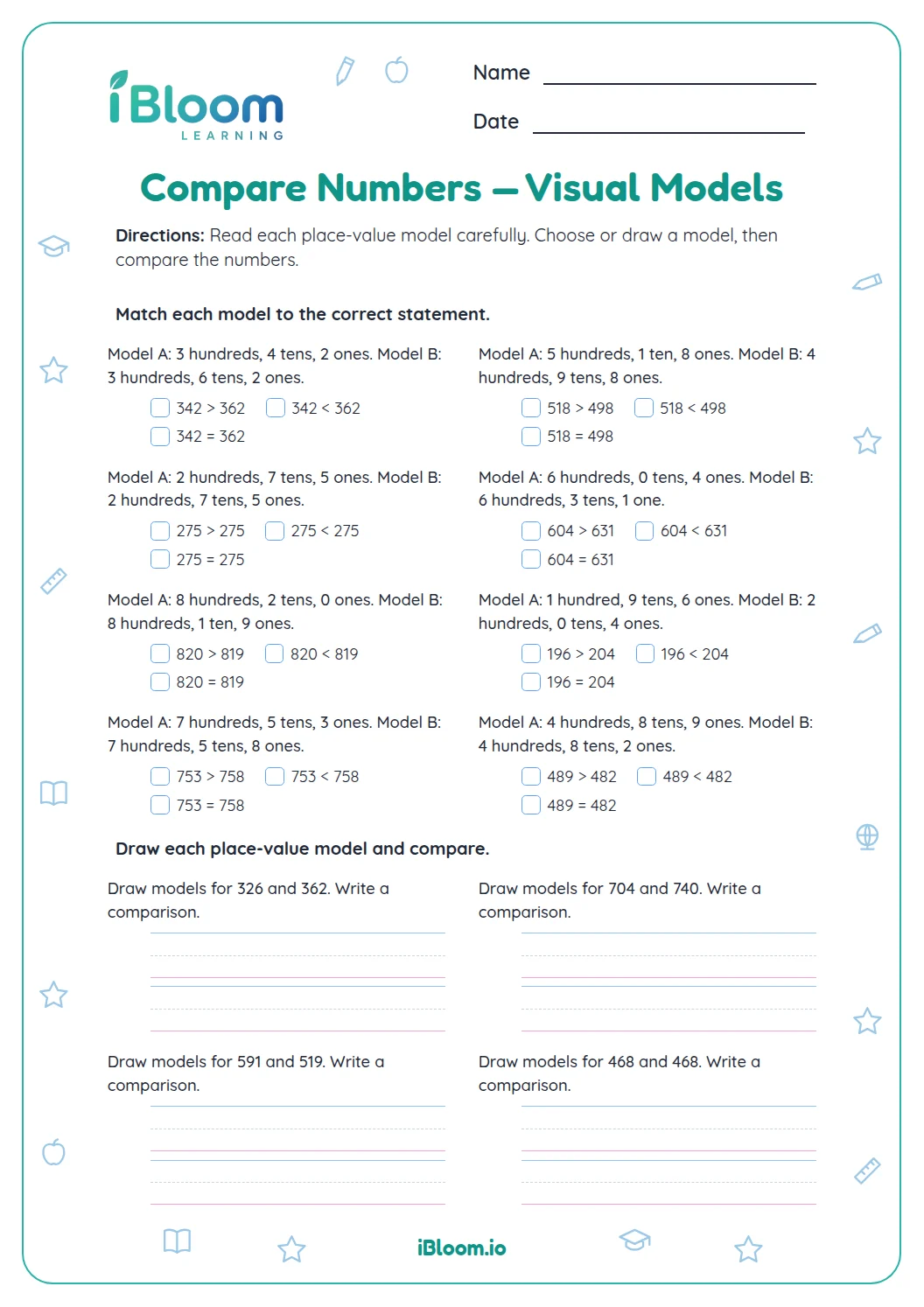
- 4Compare hundreds first, then tens, then ones if the hundreds match.
- 5Check rounding by locating the number between the two neighboring tens or hundreds.
- 6Use the answer key after completing the questions and correct any place-value mix-up.
Place-value slips to watch for
The mistake
Writing 46 for 2 hundreds, 4 tens, and 6 ones.
The fix
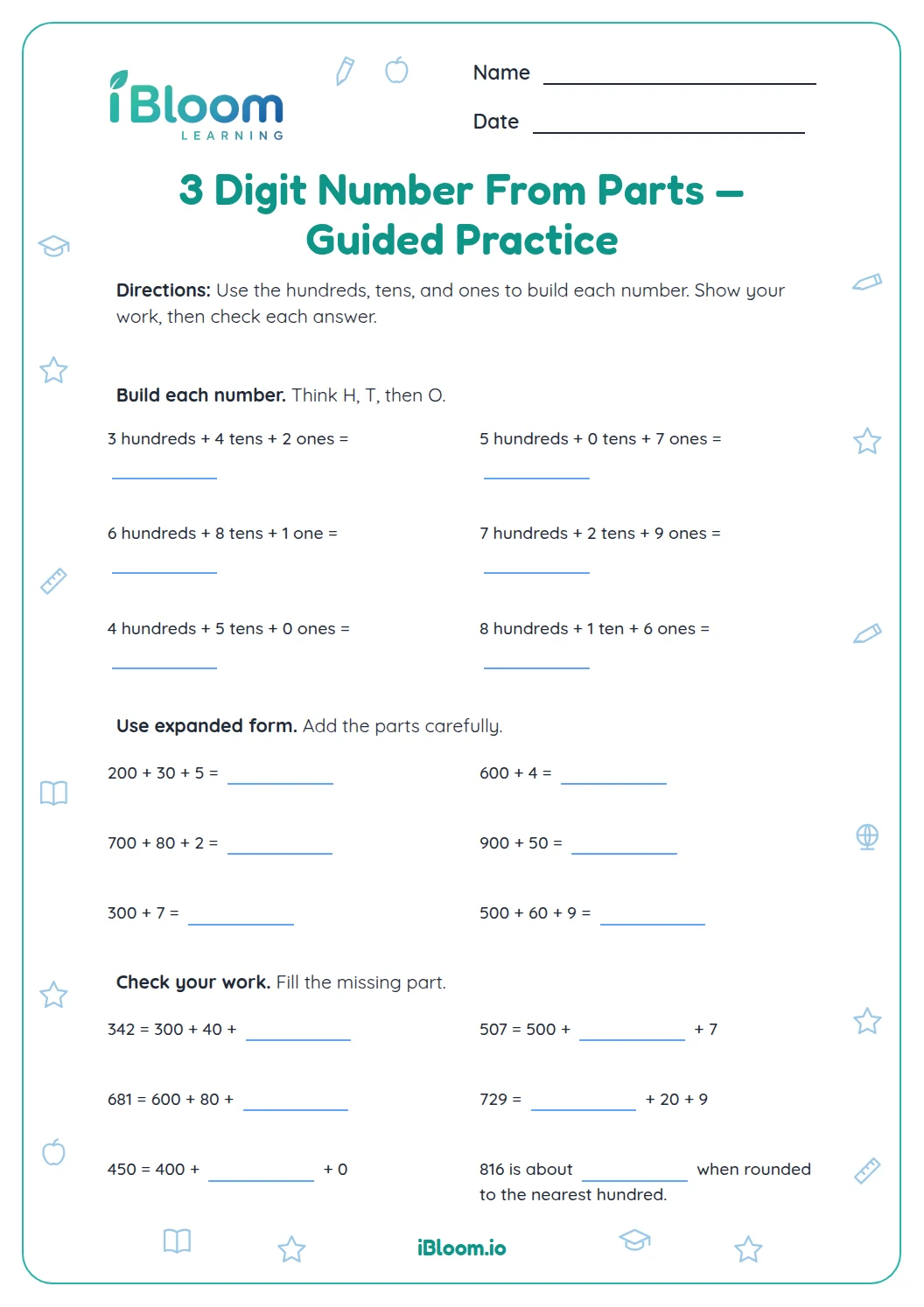
Say the value of each group: 200 + 40 + 6 = 246.
The mistake
Calling the 8 in 583 worth 8.
The fix
It is in the tens place, so its value is 80.
The mistake
Rounding 347 down because the tens digit is 4.
The fix
For nearest ten, inspect the ones digit, 7, and round up to 350.
Common Core alignment
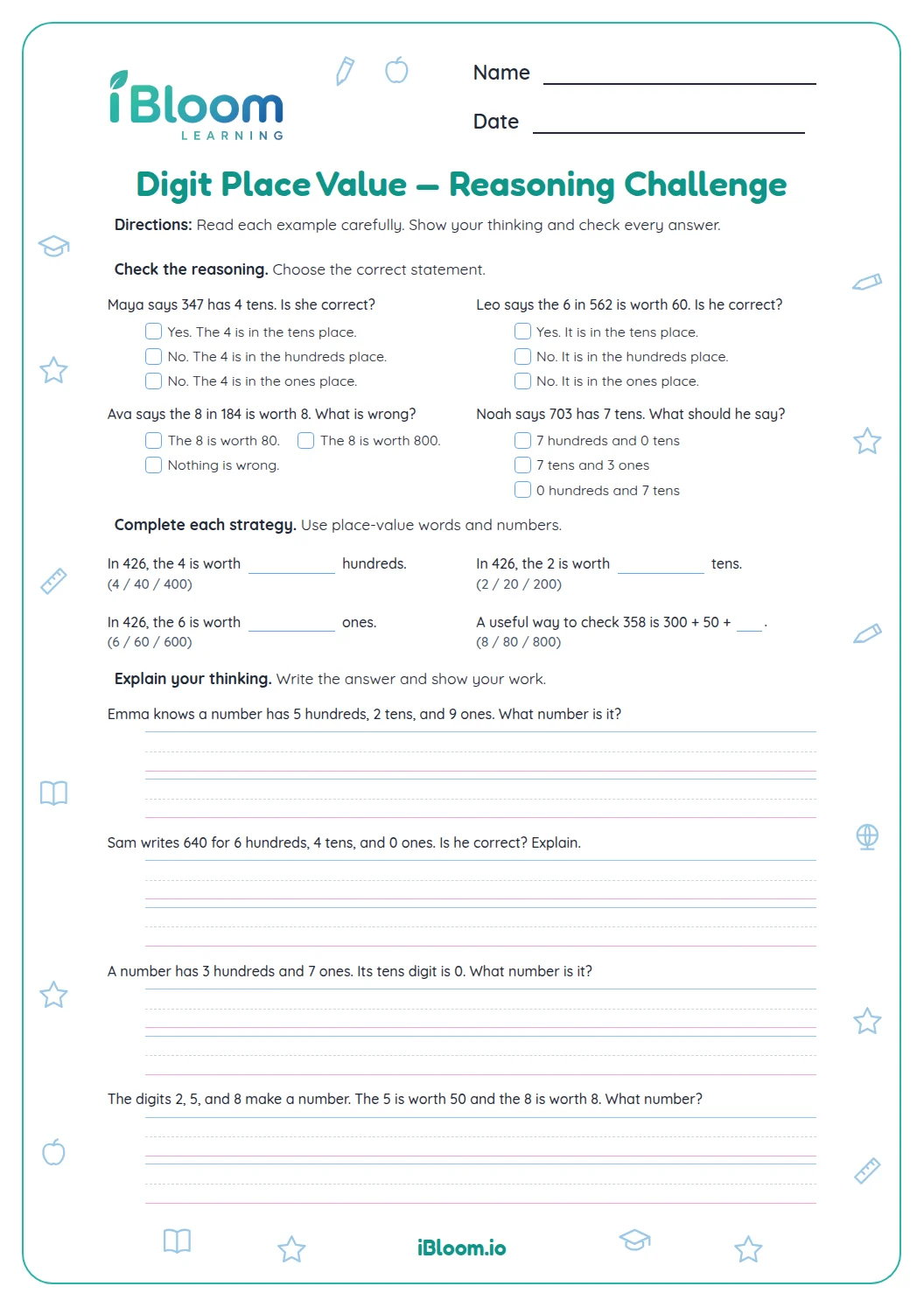
The questions use three-digit numbers to connect each digit with its place value.
Understand that hundreds, tens, and ones combine to make a three-digit number.
On this sheet: Students read hundreds, tens, and ones in models and number statements.
Show the official wordingHide the official wording
Understand that the three digits of a three-digit number represent amounts of hundreds, tens, and ones; e.g., 706 equals 7 hundreds, 0 tens, and 6 ones. Understand the following as special cases:
Use place value to round whole numbers to the nearest 10 or 100.
On this sheet: Students round three-digit numbers to the nearest ten or hundred.
Show the official wordingHide the official wording
Use place value understanding to round whole numbers to the nearest 10 or 100.
What to practice next
Make more practice
Further reading
Questions parents and teachers ask
What is place value?
Place value tells how much a digit represents based on its position in a number. In 583, the 8 is in the tens place, so it represents 80. This worksheet asks students to identify place values and use them to build, compare, and round three-digit numbers.
How do base-ten blocks represent 246?
Two hundred-flats, four ten-rods, and six one-cubes represent 246. The blocks can be renamed as 200 + 40 + 6, which is the expanded form. The first question asks students to read this kind of model and enter the whole number.
How many questions and pages are included?
There are 16 questions in four parts. The printable worksheet spans two pages, and the answer key is a separate answer key. The practice moves through model reading, place-value statements, comparison, and rounding. Start with the digit named in the prompt, not the digit that looks largest.
What should children look at when rounding to the nearest ten?
Look at the ones digit, because it tells whether the number is closer to the lower or higher ten. For 347, the ones digit is 7, so the number rounds up to 350. To round to the nearest hundred, check the tens digit instead.
Is an answer key included?
Yes. A separate answer-key page gives the expected answer for each of the 16 questions. Children can try the problems first, then use the key to spot a misplaced digit or a rounding choice that needs another look. The key is intended for checking completed work, not as another question page.
Which skill should come next?
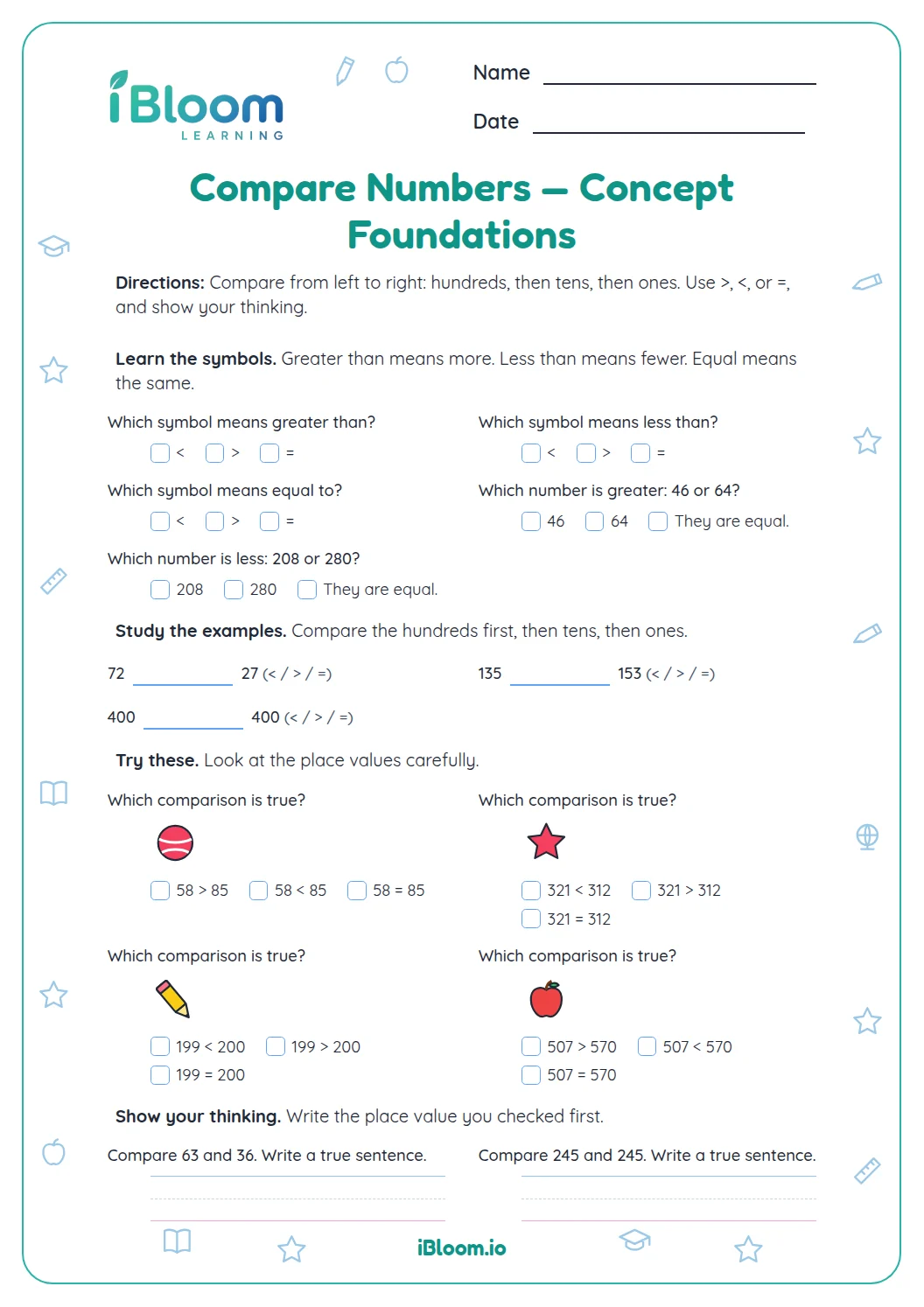
Comparing three-digit numbers is a useful next step because students use hundreds, tens, and ones to decide which number is greater. Expanded-form practice also reinforces how each part of a number contributes to its total. These skills support the next round of three-digit number work.