

About this worksheet
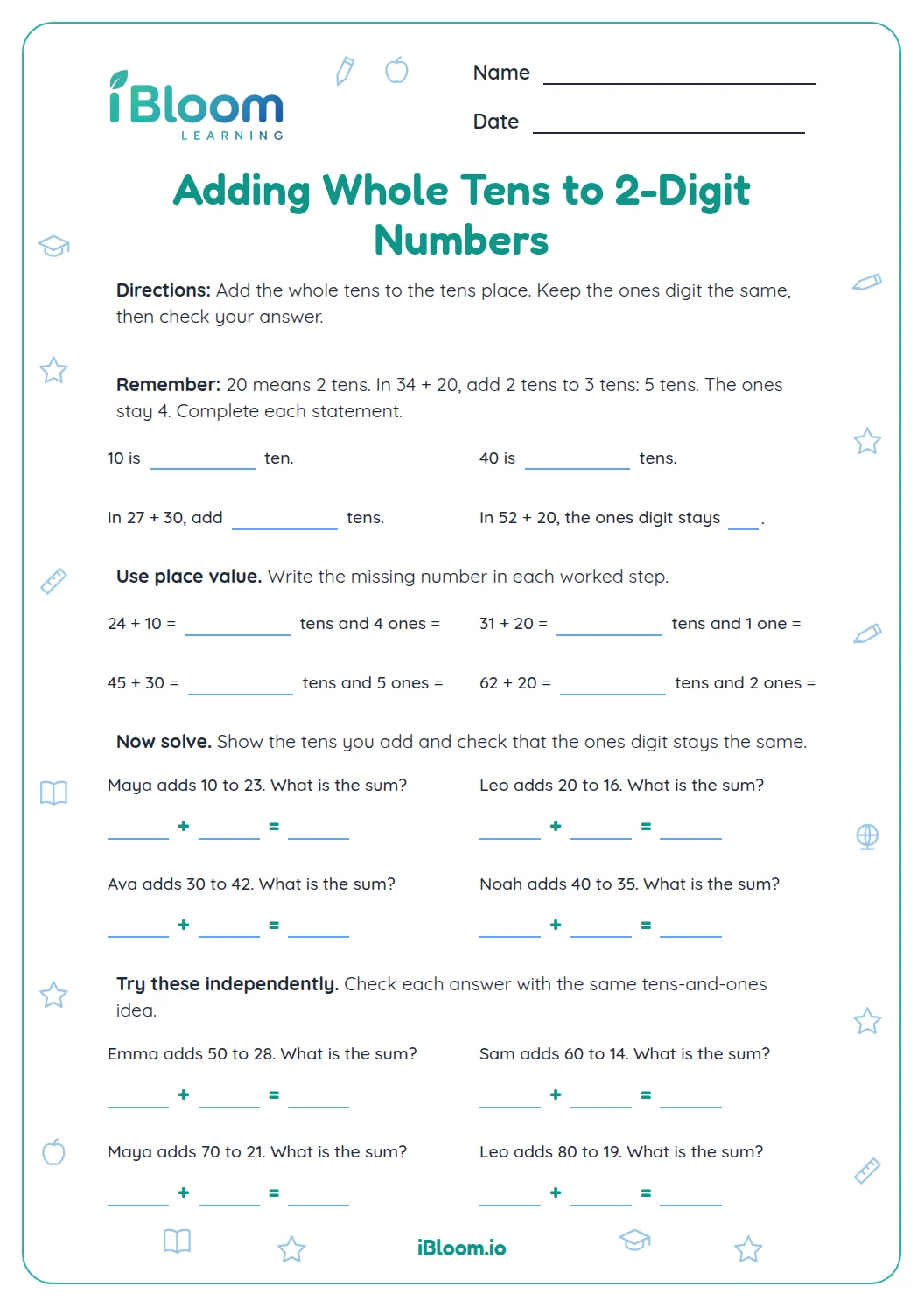
This independent practice page focuses on a useful mental strategy: add the tens, then keep the ones digit unchanged. The first set gives quick sums for practice. The second set invites students to show how they combine tens, especially when the total crosses a hundred. Every sum is different, and the answer key is included.
Aligned to 3.NBT.A.2
What is on this worksheet?
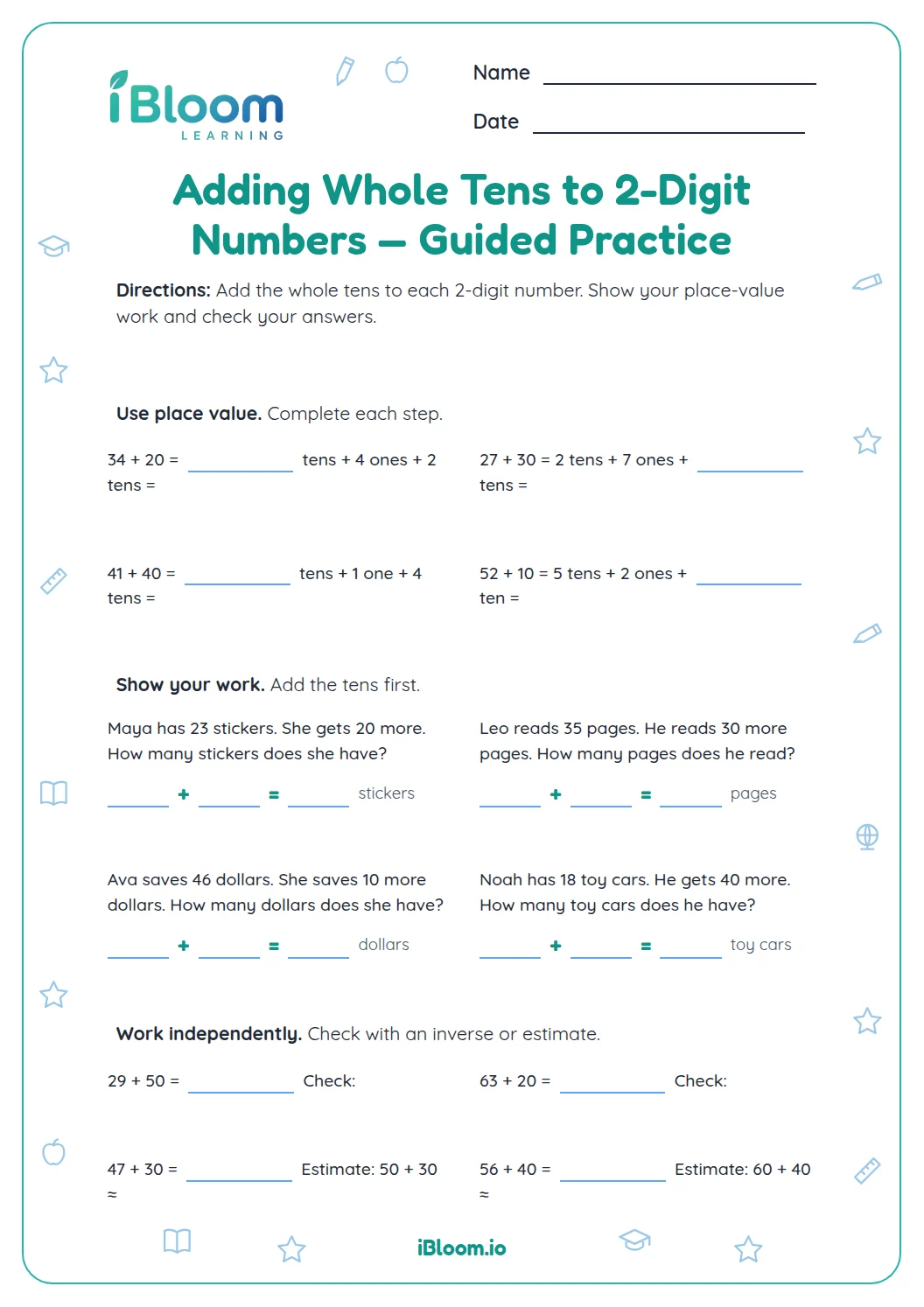
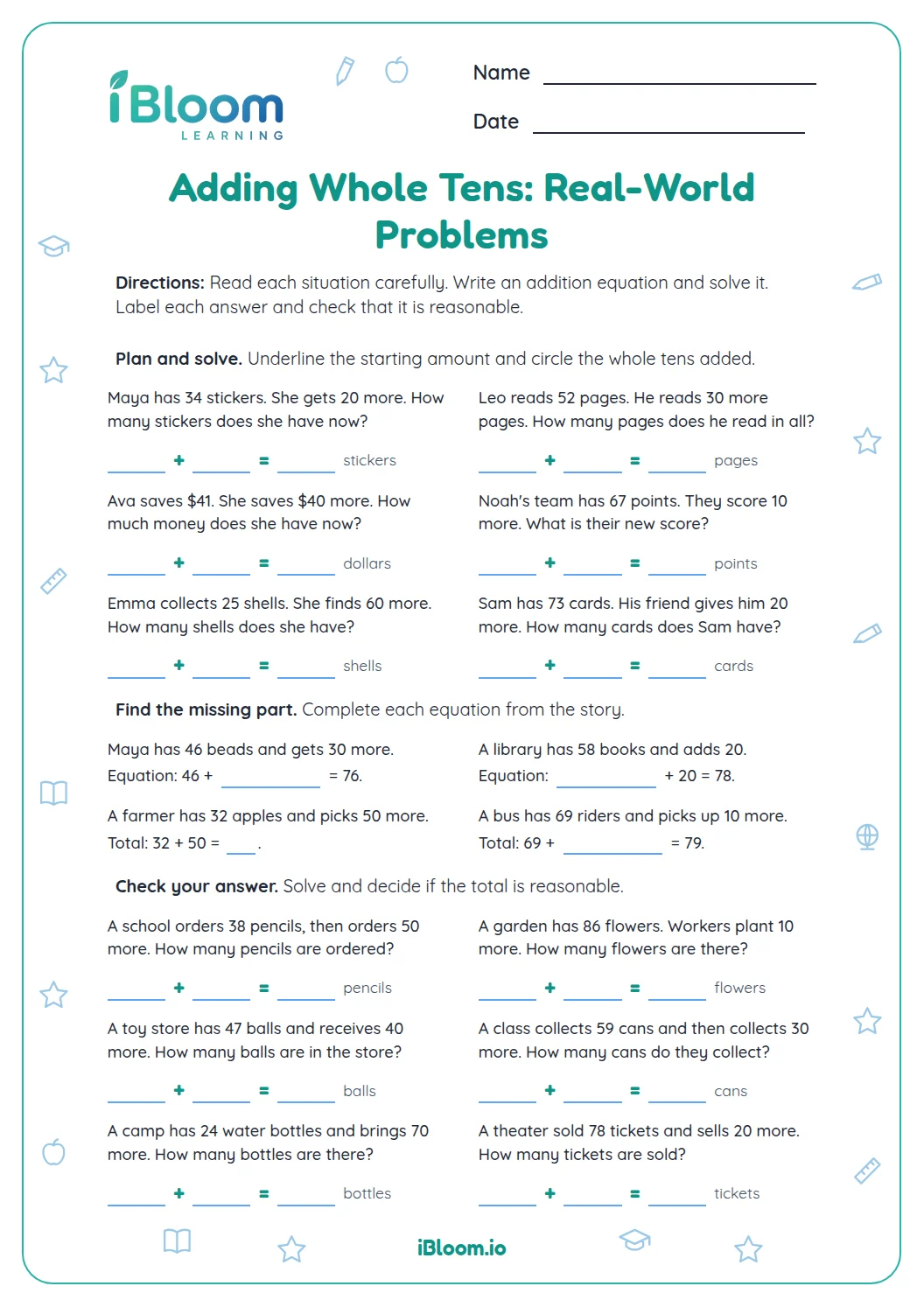
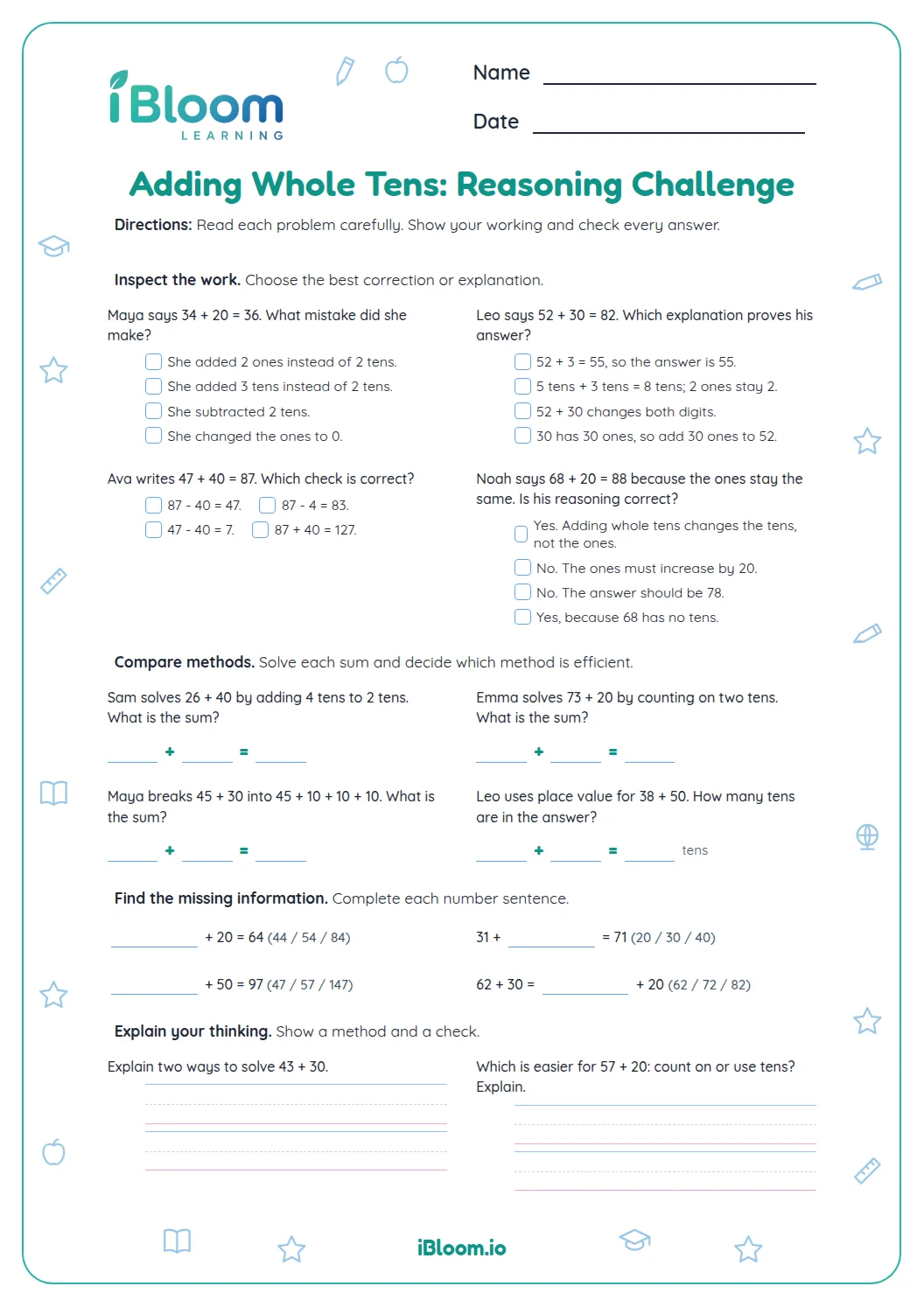
Sixteen sums provide practice adding a two-digit number and a multiple of ten. Students can use place value to add the tens while the ones digit stays the same. Later sums cross a hundred, which is a chance to check that the tens were combined carefully.
- Part A: solve eight sums using place value
- Part B: solve eight more sums and show a strategy
- The answer key lists each total
How can students add whole tens?
For 46 + 40, think of 46 as 4 tens and 6 ones. Adding 4 tens gives 8 tens and 6 ones, or 86. The ones digit stays 6 because the added number has no ones. For a total past 100, combine the tens and hundreds as usual: 89 + 20 is 109.
How do you add tens when a sum passes 100?
Combine the tens, then regroup ten tens as one hundred. For example, 89 + 20 has 8 tens plus 2 tens, which make 10 tens, and 9 ones. The total is 109.
How to use this worksheet
- 1Read the two addends and notice that the second is a whole number of tens.
- 2Add the tens to the tens in the two-digit number.
- 3Keep the ones digit, since the added number has zero ones.
- 4Regroup ten tens as one hundred when needed.
- 5Check the total with the answer key.
Common mistakes and quick fixes
The mistake
Changing the ones digit
The fix
A whole number of tens has zero ones. In 46 + 40, the 6 ones stay, while 4 tens are added to 4 tens.
The mistake
Stopping at 99 when tens make a hundred
The fix
In 89 + 20, 8 tens plus 2 tens make 10 tens, or 100; add the 9 ones to get 109.
The mistake
Adding the tens as if they were ones
The fix
In 52 + 20, add 2 tens to 5 tens. The result is 72, not 54.
Common Core alignment
This worksheet gives focused Grade 3 practice with the skill named in its title.
Add within 1,000 using place-value strategies.
On this sheet: The questions ask students to apply this skill in short, checkable steps.
Show the official wordingHide the official wording
Fluently add and subtract within 1000 using strategies and algorithms based on place value, properties of operations, and/or the relationship between addition and subtraction.
What to practice next
Make more practice
Questions parents and teachers ask
Why does the ones digit stay the same?
A whole number of tens has zero ones. Adding zero ones does not change the amount in the ones place, so 46 + 30 is 76 and the 6 remains in the ones place. Ask the student to explain the clue aloud and point to the detail that supports the answer.
What if a sum is greater than 100?
Combine the tens and make a new hundred when needed. For example, 89 + 20 is 109 because 8 tens and 2 more tens make 10 tens, with 9 ones left over. Ask the student to explain the clue aloud and point to the detail that supports the answer.
What strategy can a student use to solve each sum?
Students can break the two-digit number into tens and ones, add the new tens, then put the ones back. They can also use an open number line or add the tens in jumps. Ask the student to explain the clue aloud and point to the detail that supports the answer.
How can students check an answer?
They can subtract the added tens from the total to see if they return to the starting number. Estimating also helps: adding 40 should make the number about four tens greater. Ask the student to explain the clue aloud and point to the detail that supports the answer.
What does regrouping mean in these sums?
Regrouping means exchanging ten tens for one hundred. In 89 + 20, the tens make 10 tens and the 9 ones remain, so the total is 109. The second part includes sums that cross 100 so students can apply the same place-value idea.