





About this worksheet
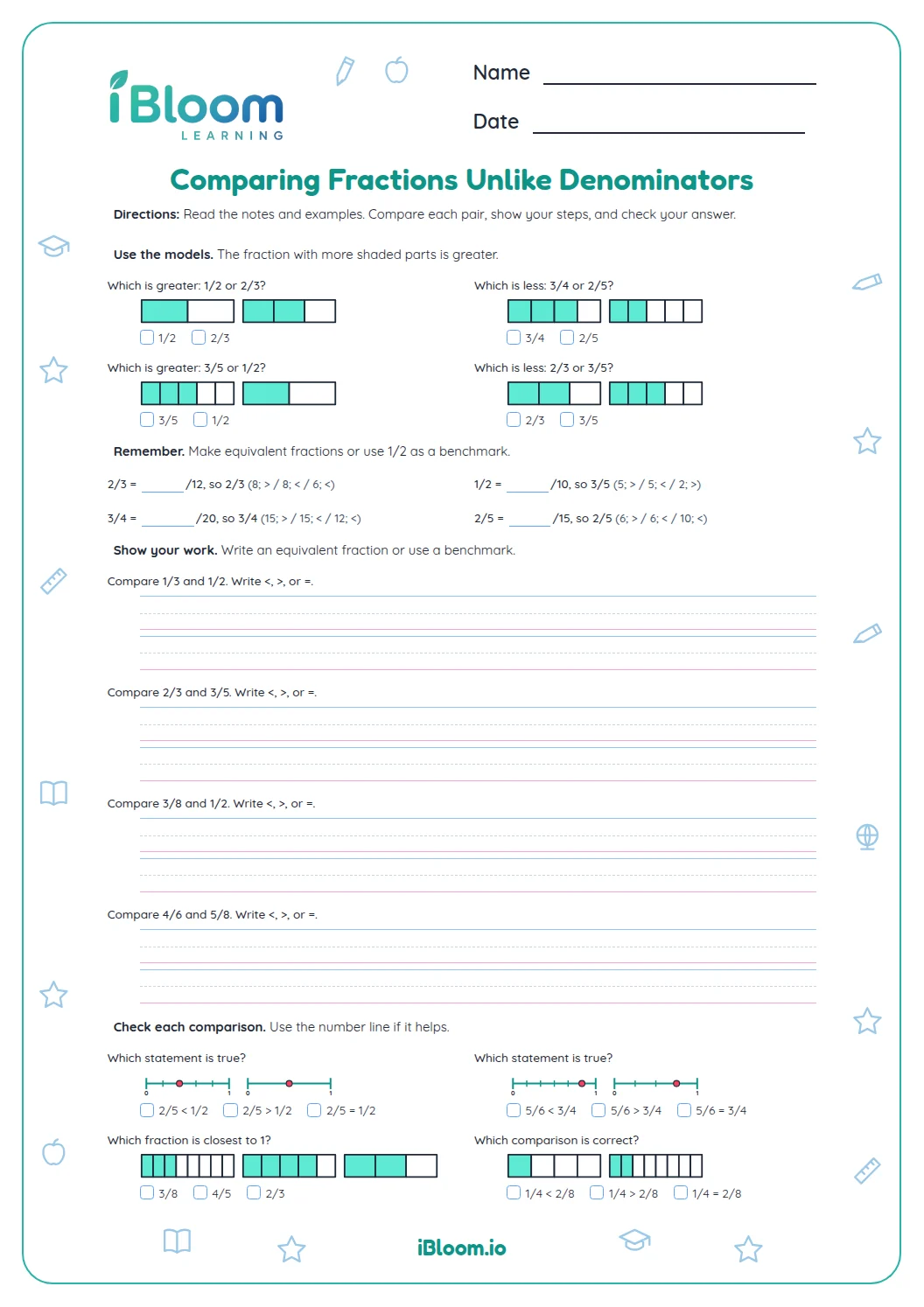
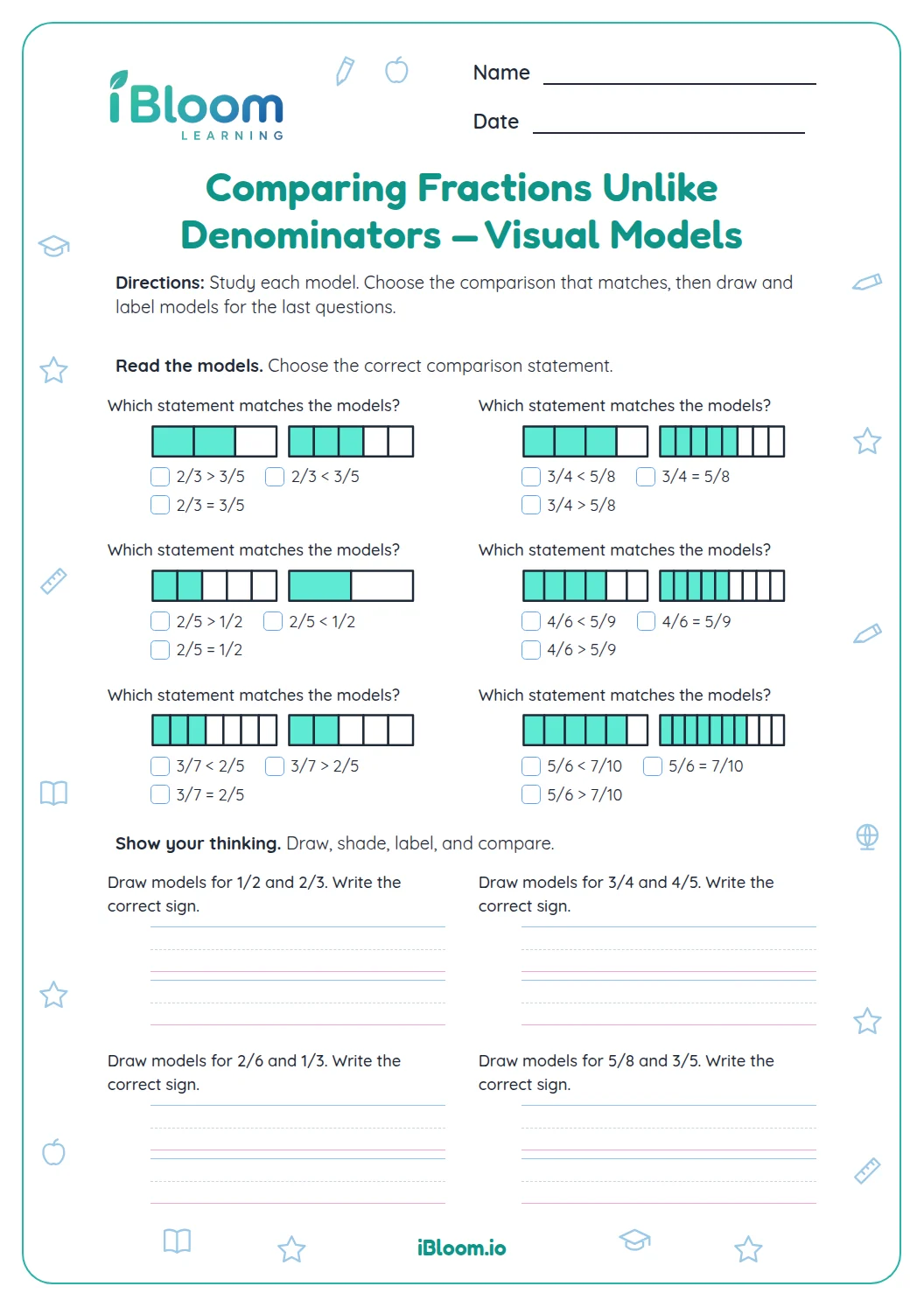
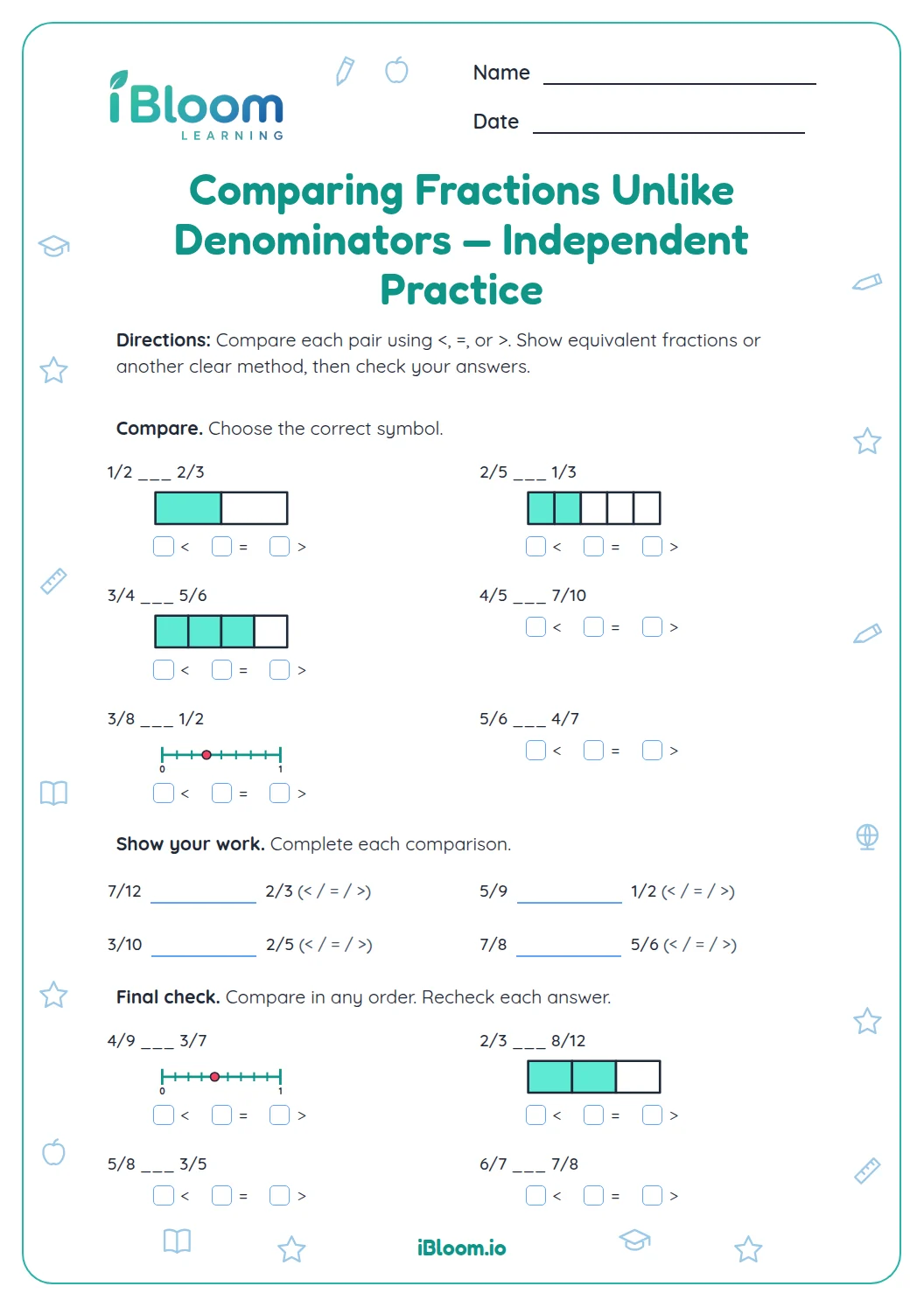
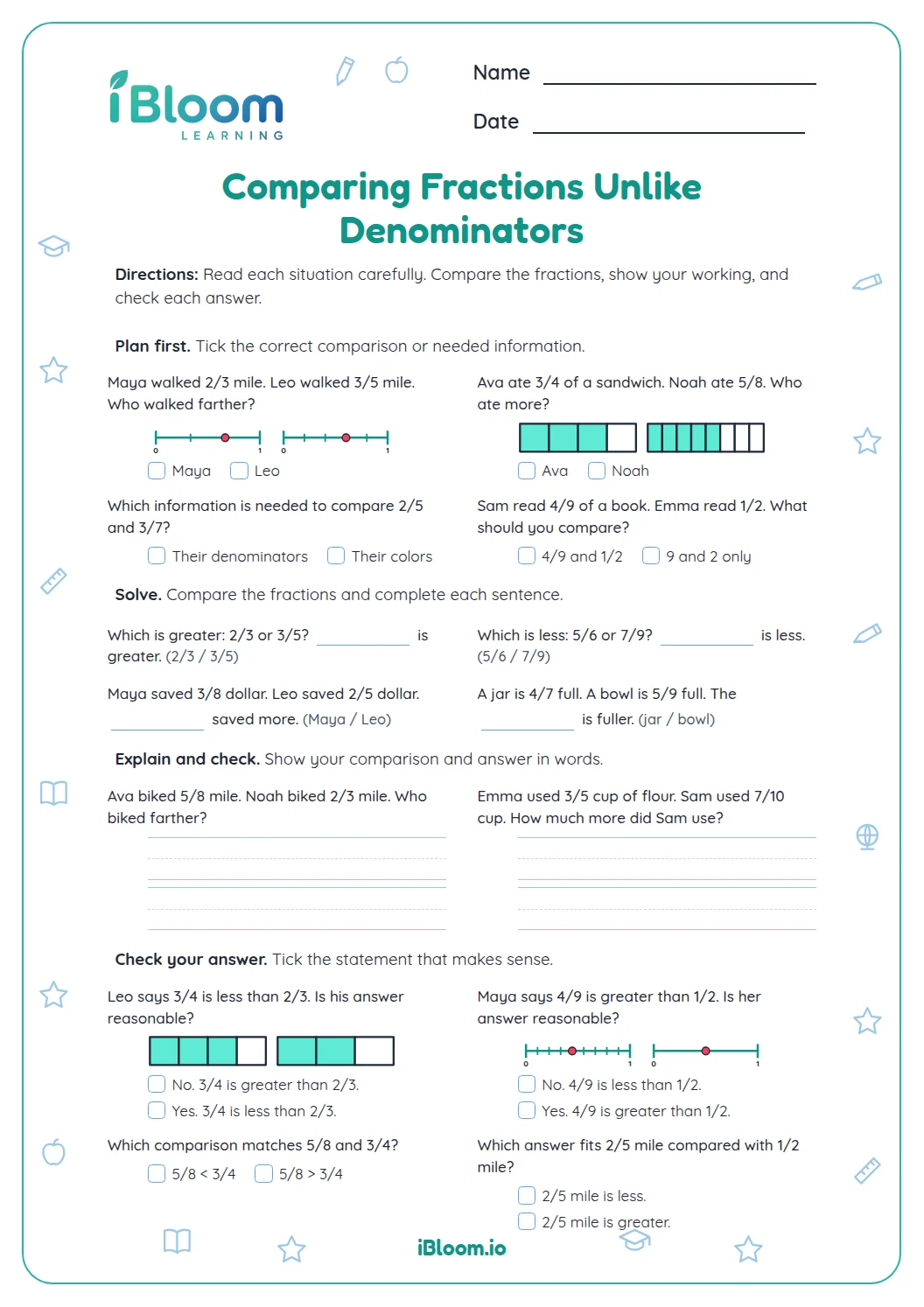
This Grade 3 guided-practice page builds the reasoning needed to compare fractions with unlike denominators, a skill named in the worksheet title. Children use familiar benchmarks, generate simple equivalent fractions, and compare independently. The 14 questions use fraction denominators suited to Grade 3 models, and the key shows each result.
Aligned to 4.NF.A.2
How can a benchmark help compare fractions?
A benchmark is a fraction that is easy to picture, especially 0, 1/2, and 1. If one fraction is below one half and another is above it, their order is clear without making common denominators.
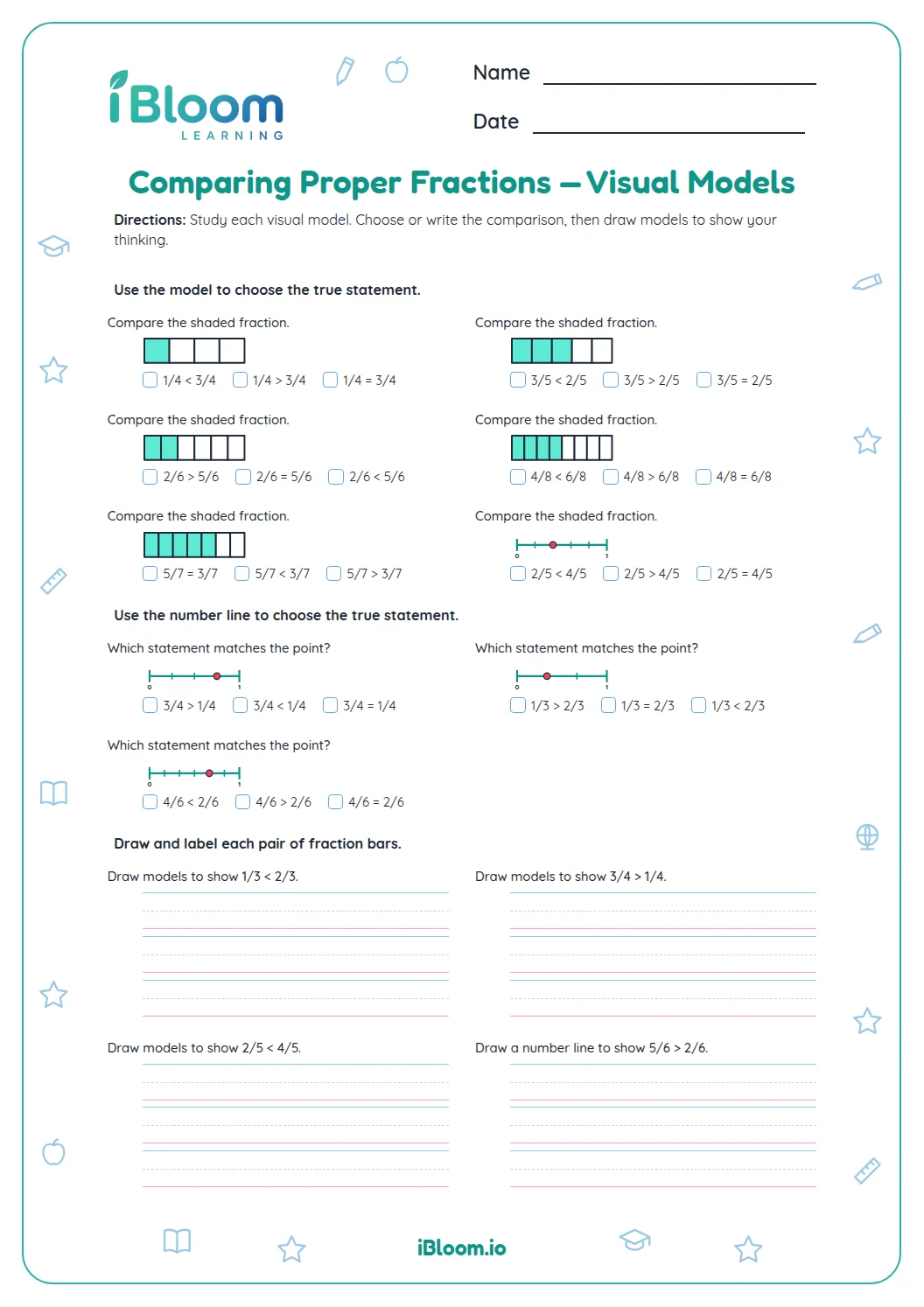
A bar divided into equal parts makes the size visible. The whole must be the same size in both models.
When are equivalent fractions useful?
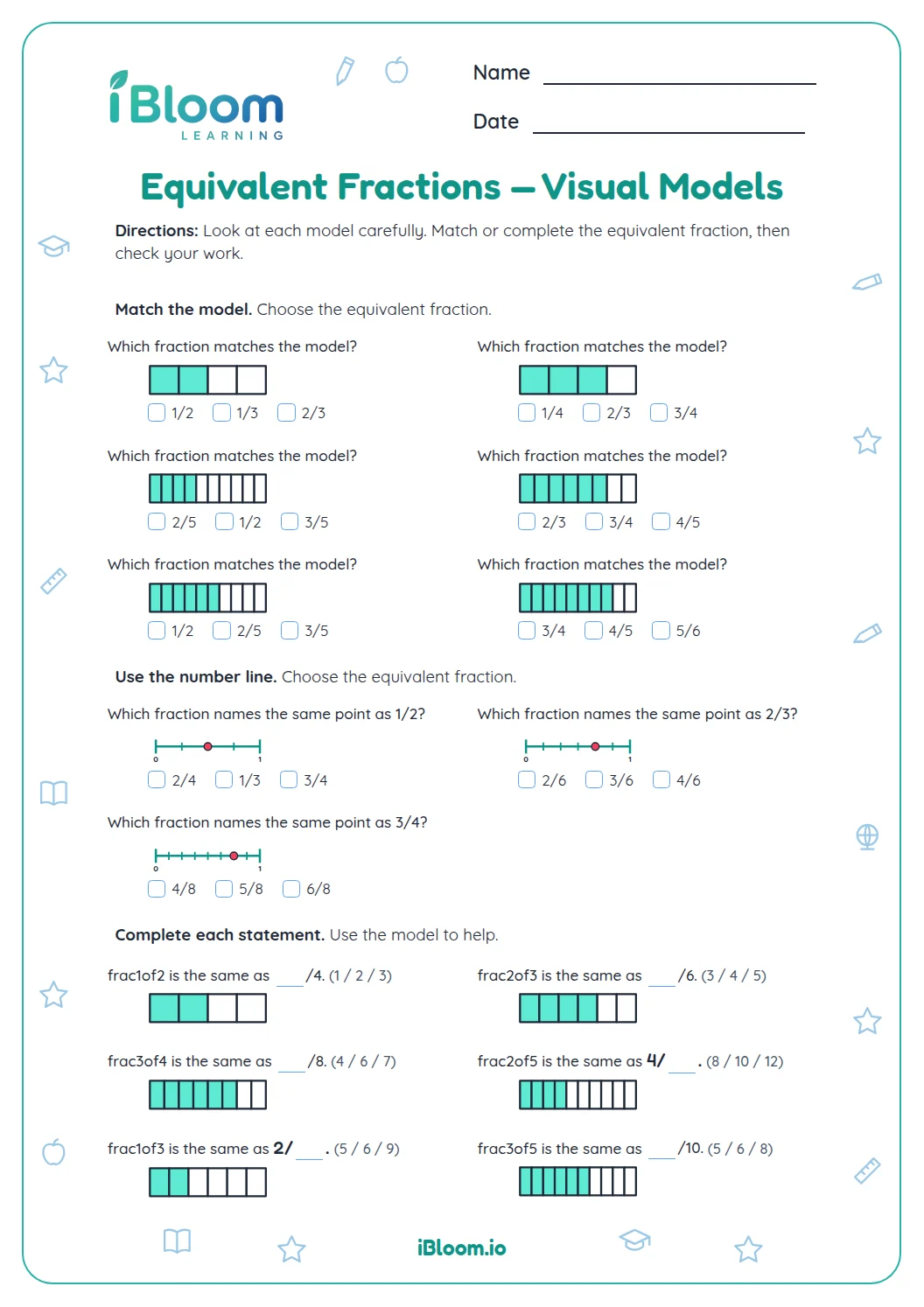
Equivalent fractions name the same amount with different-sized parts. For example, 1/2 and 2/4 cover the same part of a whole. Renaming both fractions with a shared denominator makes a comparison direct.
How to use this worksheet
- 1Start by comparing each shaded bar with one half.
- 2Choose the comparison that matches the two fractions.
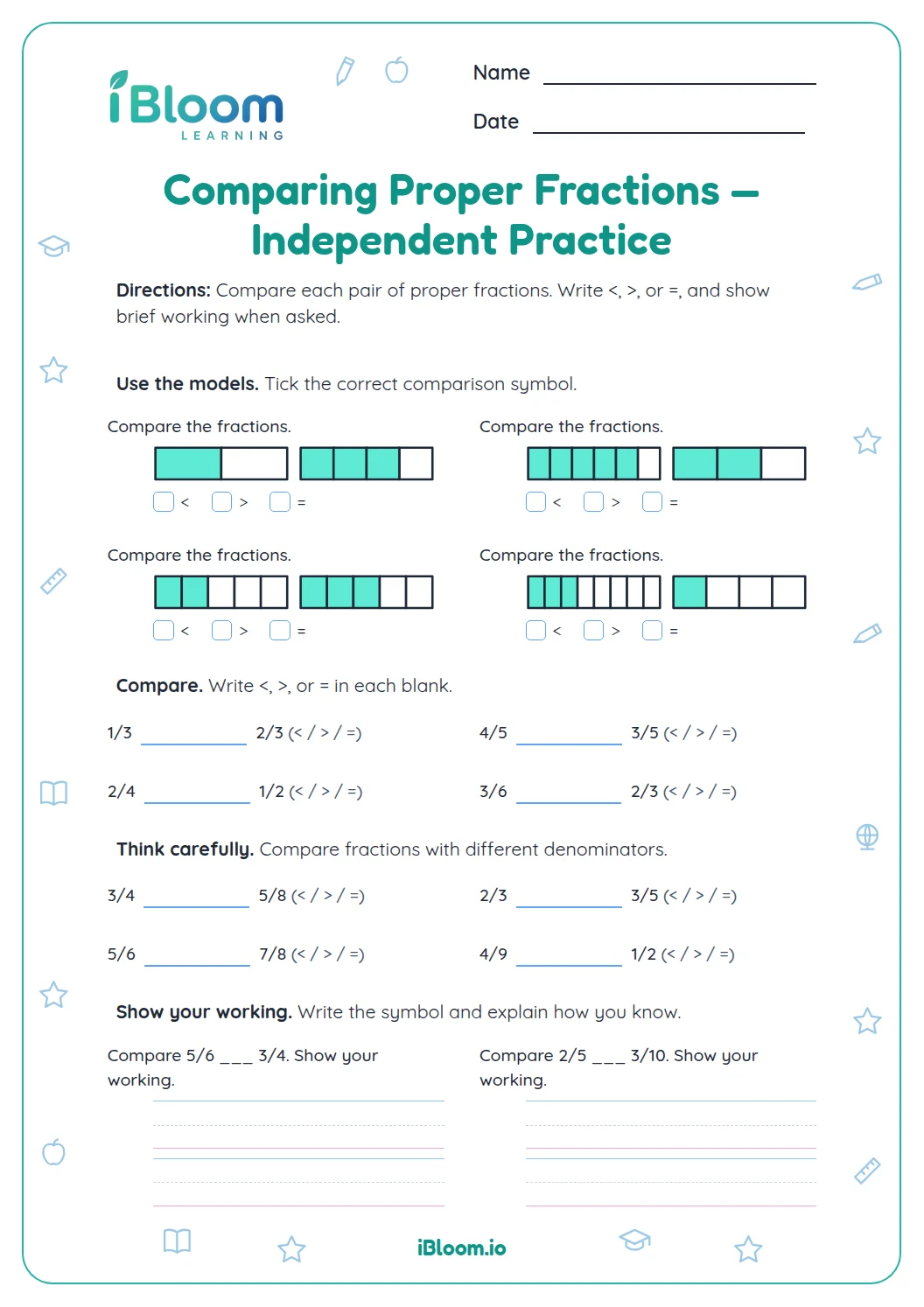
- 3For the blank questions, multiply the numerator and denominator by the same number.
- 4For the last comparisons, rename the fractions or use a benchmark.
- 5Check the answer key and explain one comparison aloud.
Common mistakes and quick fixes
The mistake
Thinking the fraction with the larger denominator is always larger.
The fix
Compare the size of each part: eighths are smaller than halves.
The mistake
Changing only the numerator when making an equivalent fraction.
The fix
Multiply the numerator and denominator by the same factor.
The mistake
Rushing past a zero or a repeated letter pattern.
The fix
Read the completed answer carefully and check each place or letter.
The mistake
Rushing past a zero or a repeated letter pattern.
The fix
Read the completed answer carefully and check each place or letter.
The mistake
Rushing past a zero or a repeated letter pattern.
The fix
Read the completed answer carefully and check each place or letter.
Common Core alignment
Children compare fractions with unlike denominators by using benchmarks and equivalent fractions.
Compare fractions with different numerators and denominators.
On this sheet: The sheet compares unlike denominators using benchmarks and equivalent fractions.
Show the official wordingHide the official wording
Compare two fractions with different numerators and different denominators, e.g., by creating common denominators or numerators, or by comparing to a benchmark fraction such as 1/2. Recognize that comparisons are valid only when the two fractions refer to the same whole. Record the results of comparisons with symbols >, =, or <, and justify the conclusions, e.g., by using a visual fraction model.
What to practice next
Make more practice
Further reading
Questions parents and teachers ask
What is a useful first step for comparing unlike fractions?
Check whether a familiar benchmark, especially one half, helps. For example, 1/3 is below one half and 3/4 is above it, so 1/3 is smaller. If the benchmark does not settle the comparison, rename the fractions with a common denominator.
Why do equivalent fractions help?
Equivalent fractions name the same amount with different-sized parts. For 3/4 and 5/8, rewrite 3/4 as 6/8, then compare 6/8 with 5/8. The worksheet also asks children to complete four simple equivalent-fraction equations. Compare the numerators after renaming. For equal-sized wholes, this renaming preserves the fraction value.
Does the worksheet include an answer key?
Yes. The answer key has the correct comparison or missing numerator for each of the 14 questions. It is useful to check the comparison symbol as well as the fraction, since reversing less than and greater than changes the claim.
What should children do when the fractions are equal?
Choose the equality statement when both fractions name the same amount. For instance, 2/4 and 3/6 are both one half. A common denominator or a visual model can make the equality easier to see. Invite your child to explain one answer aloud, then use the separate key to check the result.
How long should this practice take?
About 20 minutes is a reasonable starting point. The page moves from benchmark comparisons to equivalent-fraction blanks and then independent comparisons. Let your child explain one answer using a benchmark or an equivalent fraction. One clear explanation is enough to check the strategy.