
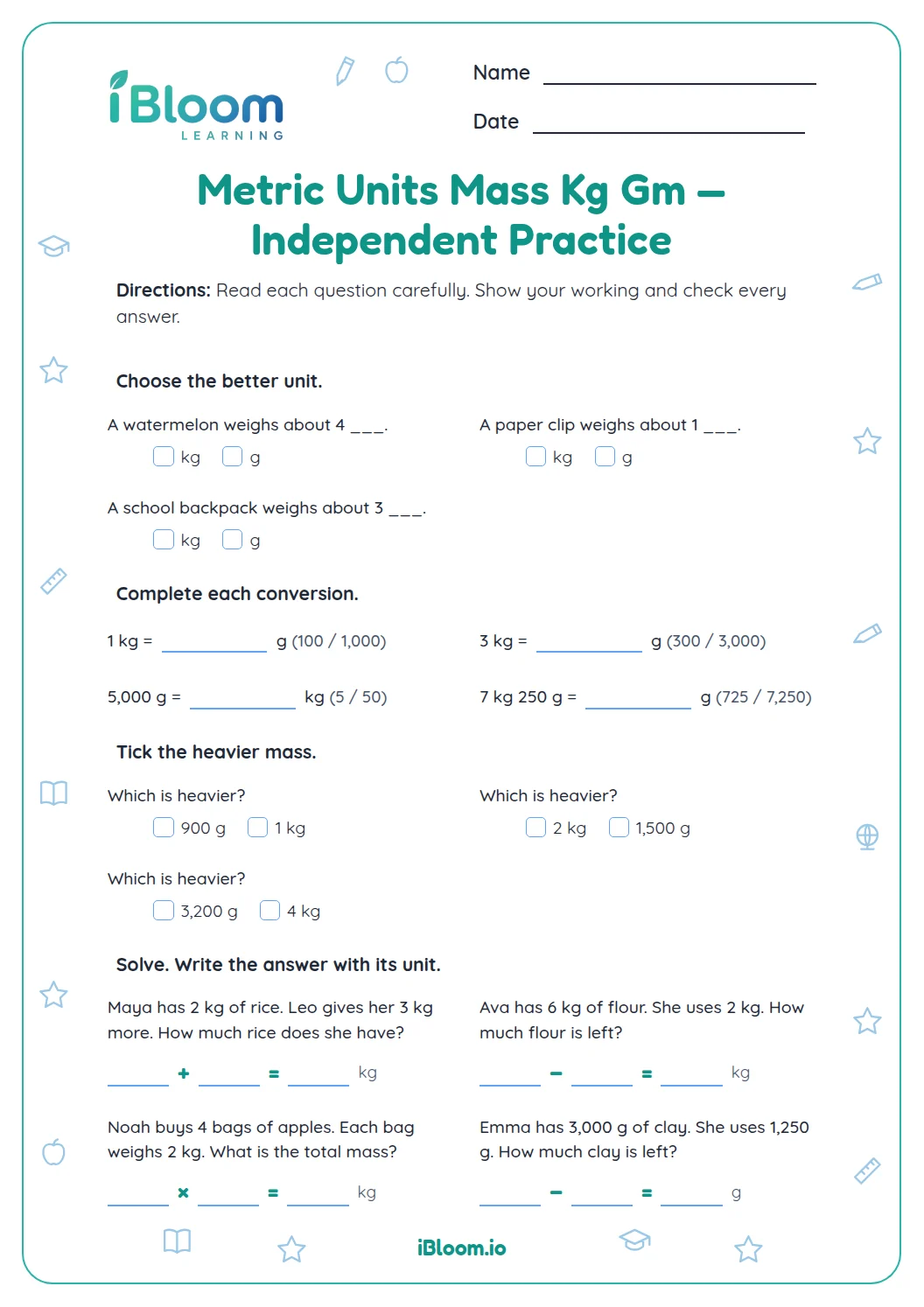
About this worksheet
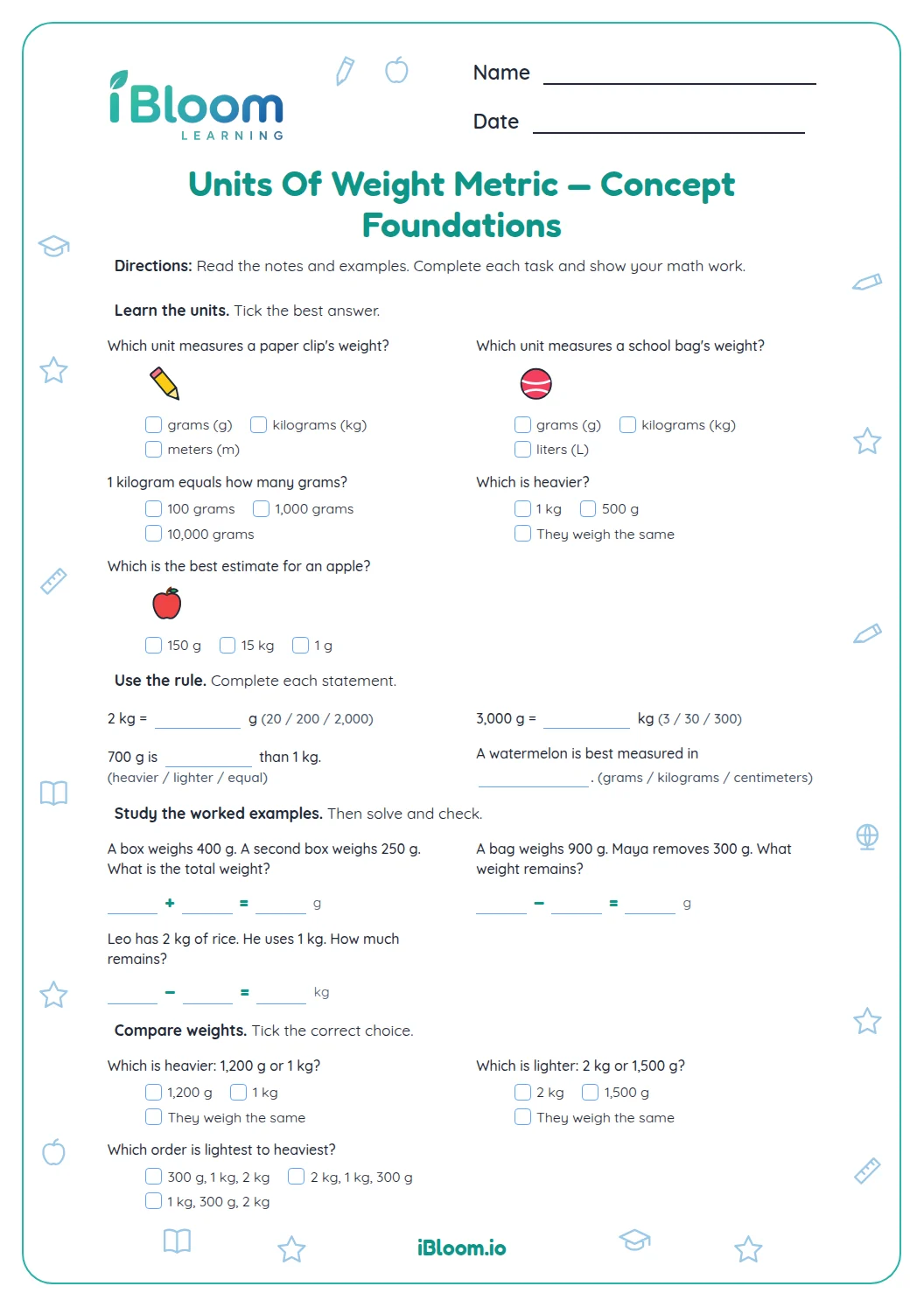
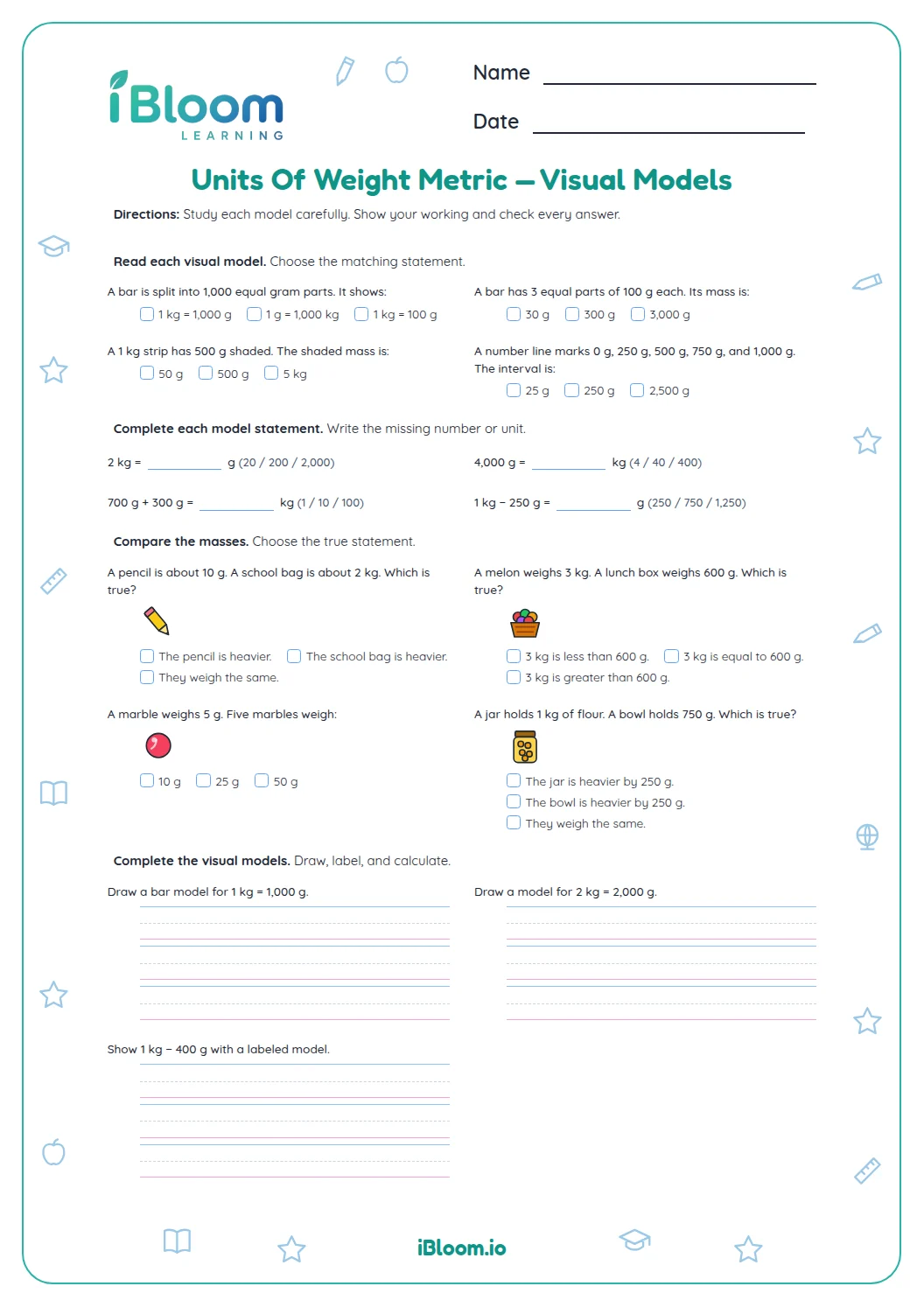
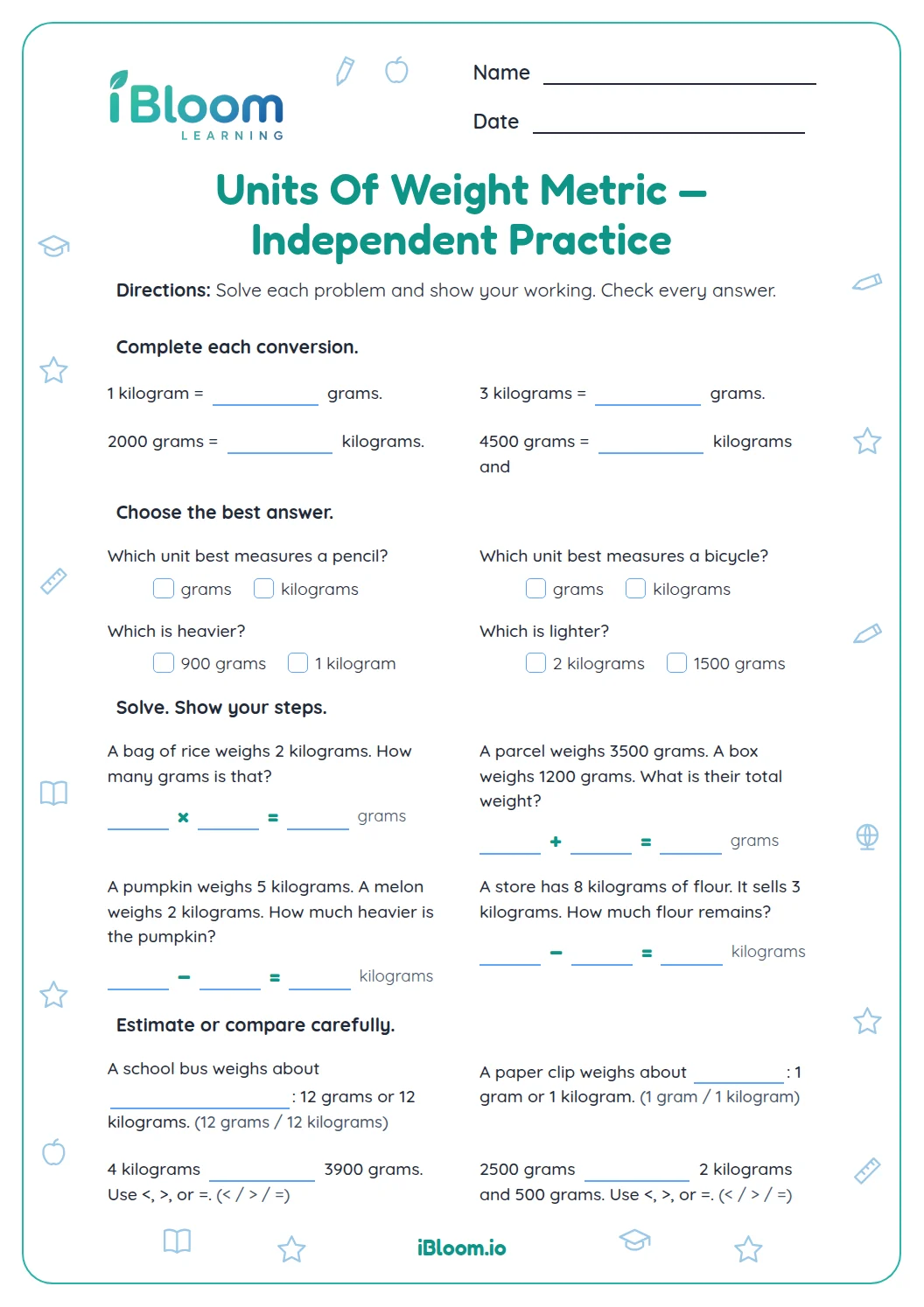
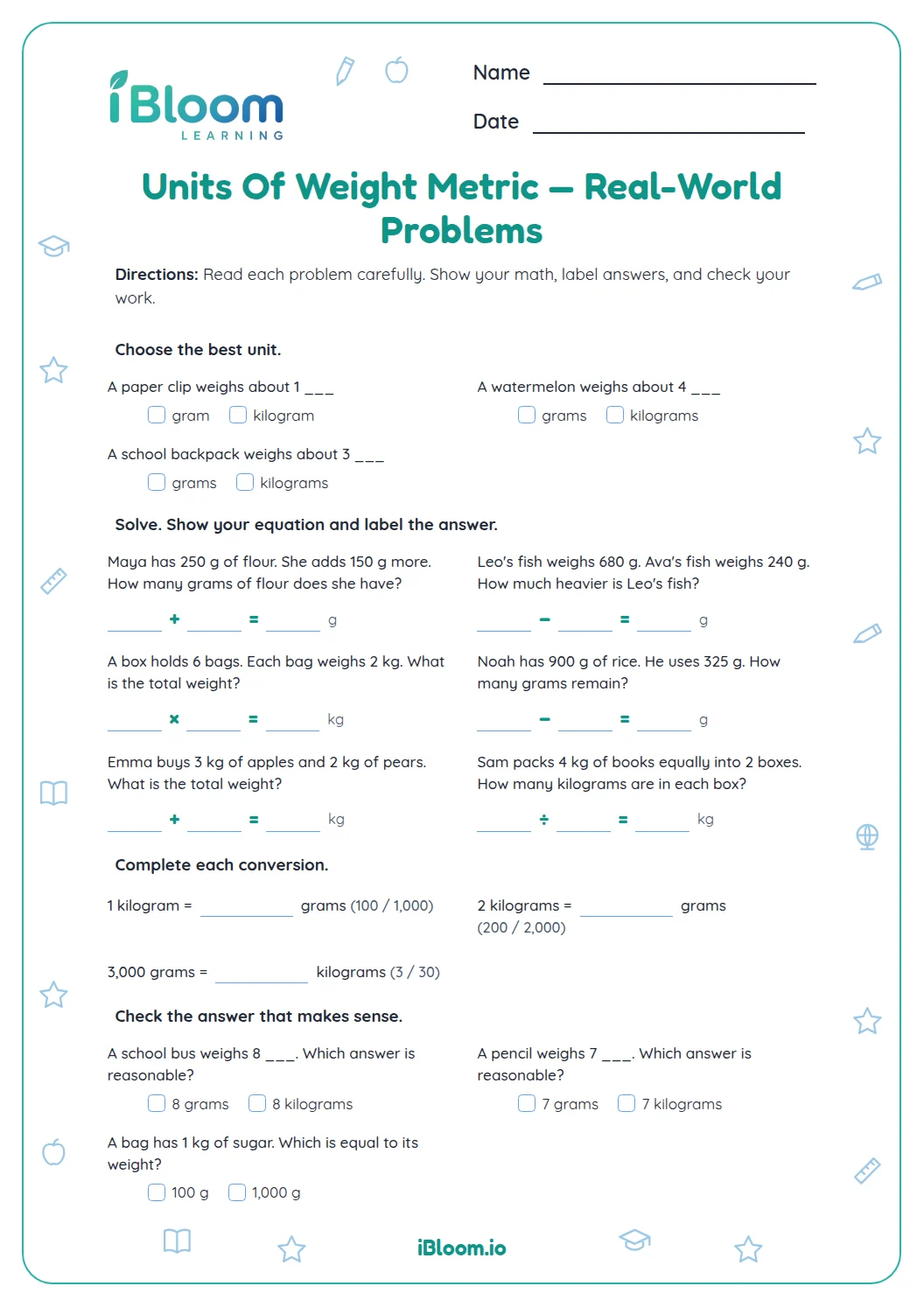
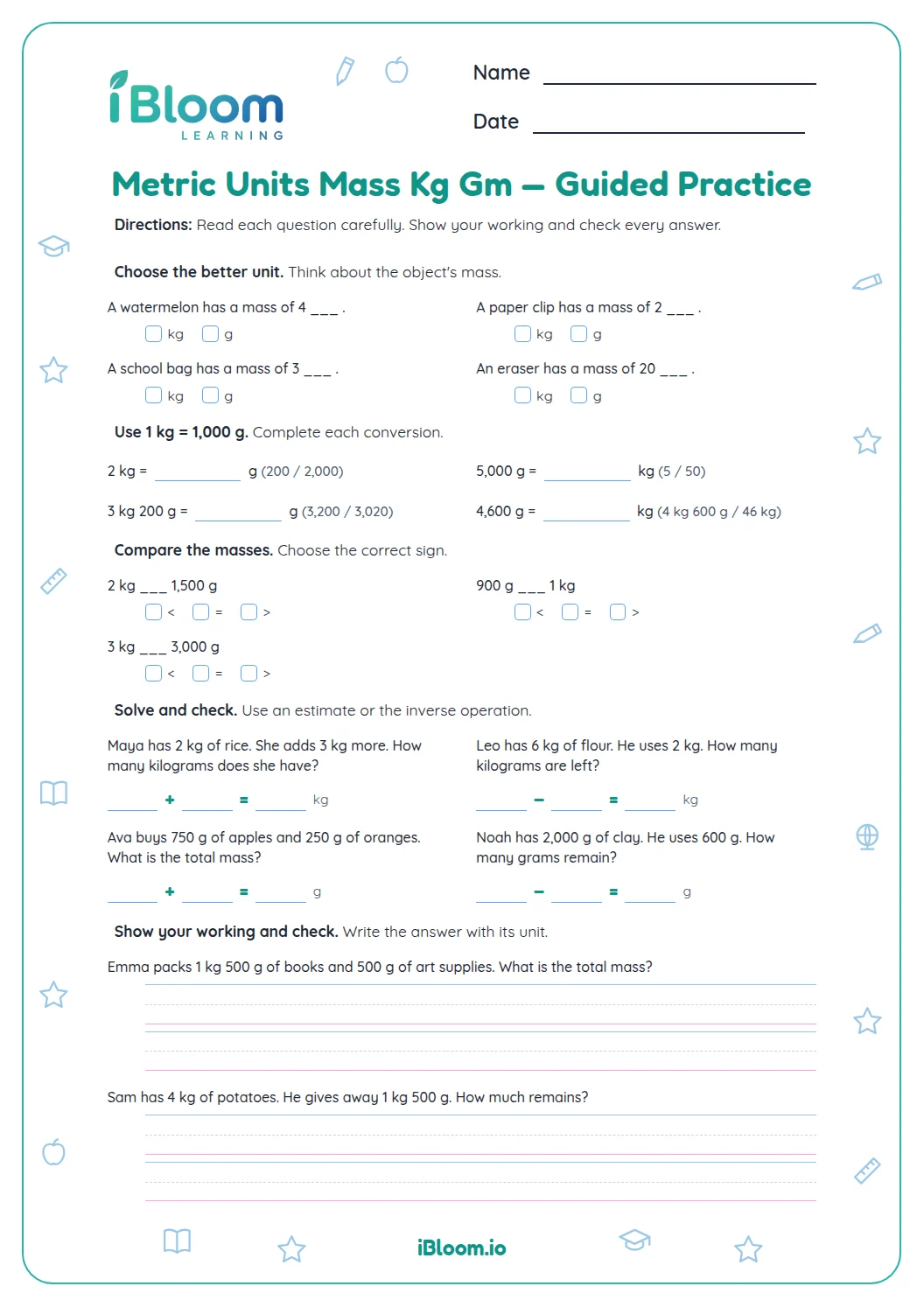
This Grade 3 guided practice builds the relationship 1 kilogram = 1,000 grams, then applies it to mixed-unit amounts, comparisons, and short mass problems. Students convert units before calculating so the units match. The 16 questions have a separate answer key and practice measuring and solving mass problems in CCSS 3.MD.A.2.
Aligned to 3.MD.A.2
How many grams are in a kilogram?
This Grade 3 guided practice builds the relationship 1 kilogram = 1,000 grams, then applies it to mixed-unit amounts, comparisons, and short mass problems. Students convert units before calculating so the units match. The 16 questions have a separate answer key and practice measuring and solving mass problems in CCSS 3.MD.A.2.
One kilogram equals 1,000 grams. Convert both amounts to the same unit before comparing or calculating.
- 11 kg 250 g = ___ g
- 21,000 g + 250 g = 1,250 g
How is the practice organized?
Work through the prompts in order. Use the models or guided examples to establish the method, then apply the same idea independently.
How can students check their work?
The central relationship is 1 kilogram (kg) = 1,000 grams (g). The first problems practice whole-unit conversions; later questions use mixed amounts such as 1 kg 250 g and require students to express them in grams.
How to use this worksheet
- 1Read the directions at the top of the sheet.
- 2Work carefully through each item in order.
- 3Use a pencil to show each step or trace each model.
- 4Check the answer key after finishing.
Common mistakes and quick fixes
The mistake
Treating 1 kg as 100 g.
The fix
Remember that 1 kg equals 1,000 g.
The mistake
Adding unlike units without converting.
The fix
Convert both masses to grams or both to kilograms first.
The mistake
Leaving off the unit in an answer.
The fix
Write g or kg to match the requested unit.
Curriculum alignment
This page connects the worksheet practice to the standard below.
Measure and estimate liquid volumes and masses using standard units.
On this sheet: Convert between grams and kilograms and solve one-step mass problems in the same unit.
Show the official wordingHide the official wording
Measure and estimate liquid volumes and masses of objects using standard units of grams (g), kilograms (kg), and liters (l). Add, subtract, multiply, or divide to solve one-step word problems involving masses or volumes that are given in the same units, e.g., by using drawings (such as a beaker with a measurement scale) to represent the problem.
What to practice next
Make more practice
Further reading
Questions parents and teachers ask
What conversion does the worksheet use?
The central relationship is 1 kilogram (kg) = 1,000 grams (g). The first problems practice whole-unit conversions; later questions use mixed amounts such as 1 kg 250 g and require students to express them in grams. Use the same relationship in reverse to change grams into kilograms.
Do students compare grams and kilograms?
Yes. The last section includes one-step mass situations. Convert kilograms to grams, or grams to kilograms, before deciding which amount is greater or completing an operation. The contexts use the same metric units introduced in the conversion section.
How many questions are on the printable?
There are 16 questions: whole-kilogram conversions, mixed-unit conversions, and one-step mass problems involving addition, subtraction, or equal sharing. The worksheet asks students to include units with their results. The sequence moves from direct conversions to applying them in context.
Is an answer key provided?
Yes. A separate answer key lists the conversions and mass results. Check both the number and its unit; a correct numerical value with the wrong unit does not answer the prompt. Reviewing units helps distinguish a grams answer from a kilograms answer.
What does 1 kg 250 g equal in grams?
It equals 1,250 g because 1 kg is 1,000 g and 1,000 + 250 = 1,250. This is the same conversion strategy used in the mixed-unit section of the worksheet. Show the conversion as 1,000 g + 250 g before writing the total.