



About this worksheet
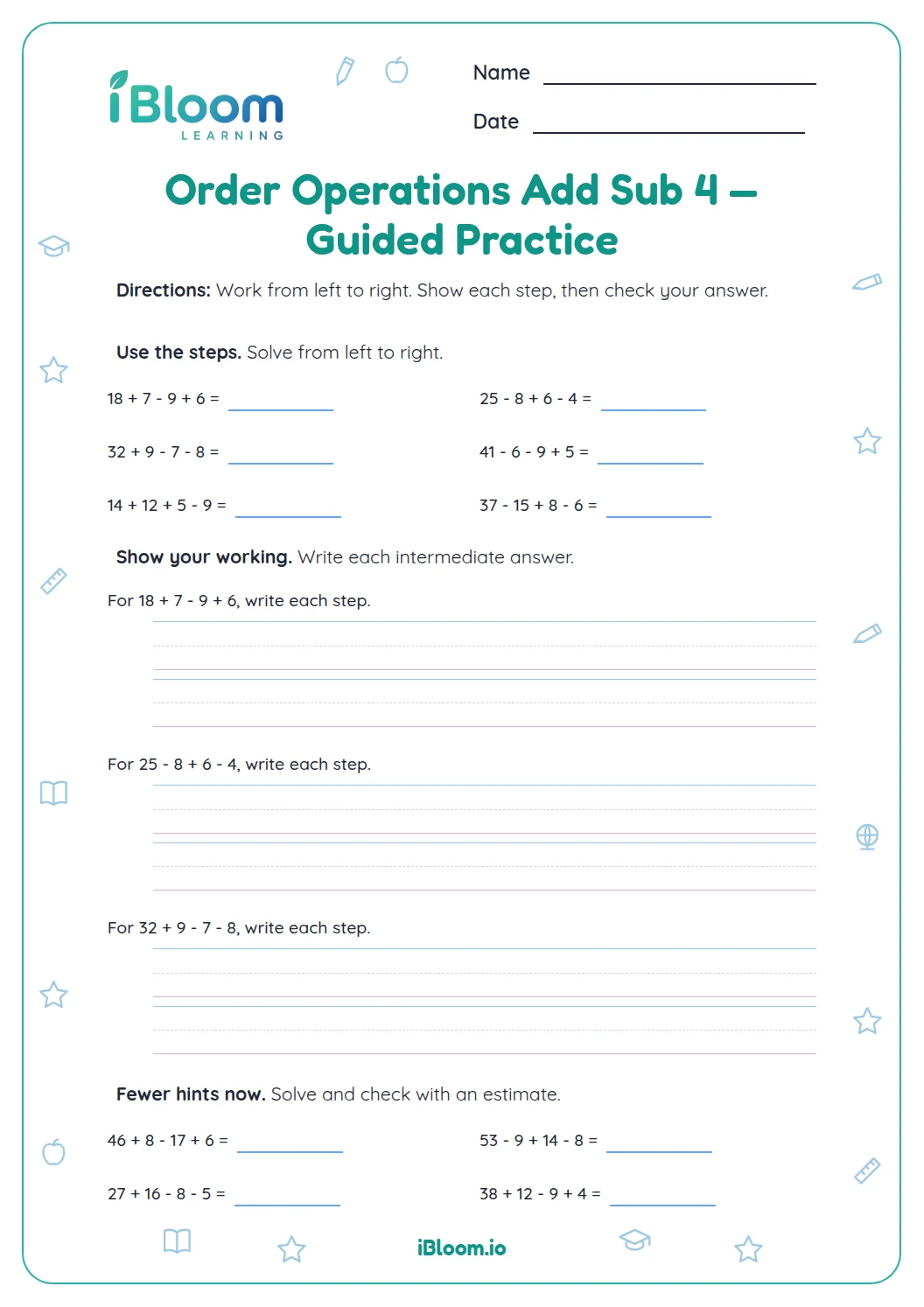
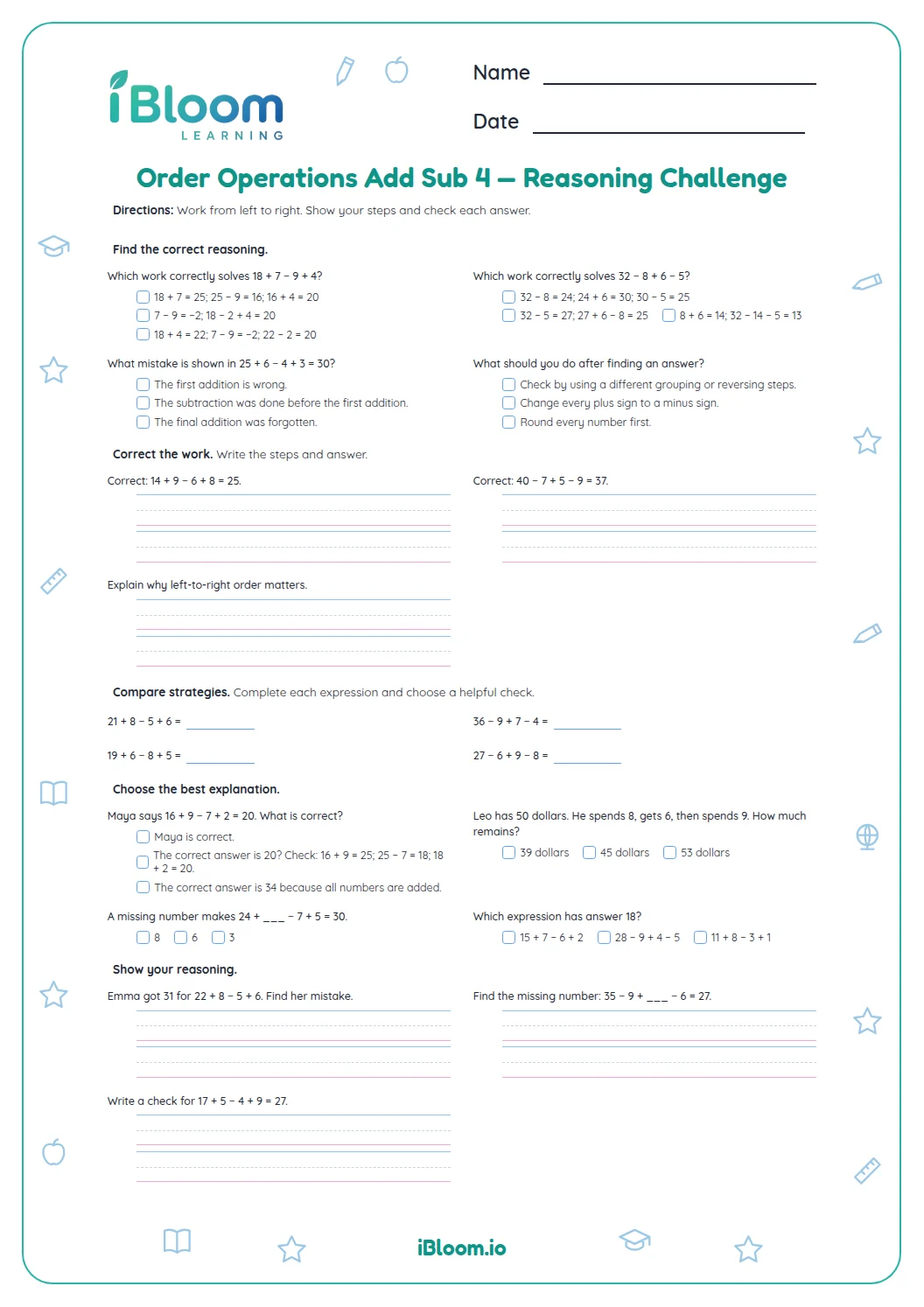
Learners work through four-number expressions in order, then use the same sequence of changes in short stories. The practice focuses on addition and subtraction with whole numbers within 100.
Work through the operations in order
When addition and subtraction appear together with no parentheses, calculate from left to right. Write each new total before doing the next operation.
For example, 12 + 5 − 3 + 4 becomes 17 − 3 + 4, then 14 + 4, so the result is 18.
Use the same steps in a story
Translate each change in the story into addition or subtraction, then keep the events in the order given. Check that the final number answers the question.
How to use this worksheet
- 1Solve each expression from left to right, recording every step.
- 2For the stories, write an expression that follows the events in order.
- 3Check the answer key after completing the page.
A common mix-up
The mistake
Adding all numbers first and subtracting afterward.
The fix
Follow the expression from left to right, changing the total at each step.
What to practice next
Questions parents and teachers ask
What does “four number” mean here?
Each expression connects four numbers with addition or subtraction. Students update the total after every sign, then use the same left-to-right sequence to represent events in four short stories and find each final amount. This is why the signs and numbers must stay in order.
Which order should I use?
When addition and subtraction appear together without parentheses, calculate from left to right. Keep each intermediate total so you can see how the next operation changes it and catch a missed step. This method works for every expression on the sheet.
Are there story problems too?
Yes. Four final problems describe a sequence of changes, such as people sitting down and leaving. Write an expression that follows each event in order, then find the final total and label it. The key includes the final result for each story.
How can I check a missed answer?
Recalculate one operation at a time, keeping each intermediate total before moving to the next sign. Then substitute the final result into the original expression and check the arithmetic from the beginning. If the totals differ, check the first step where they changed.