




About this worksheet
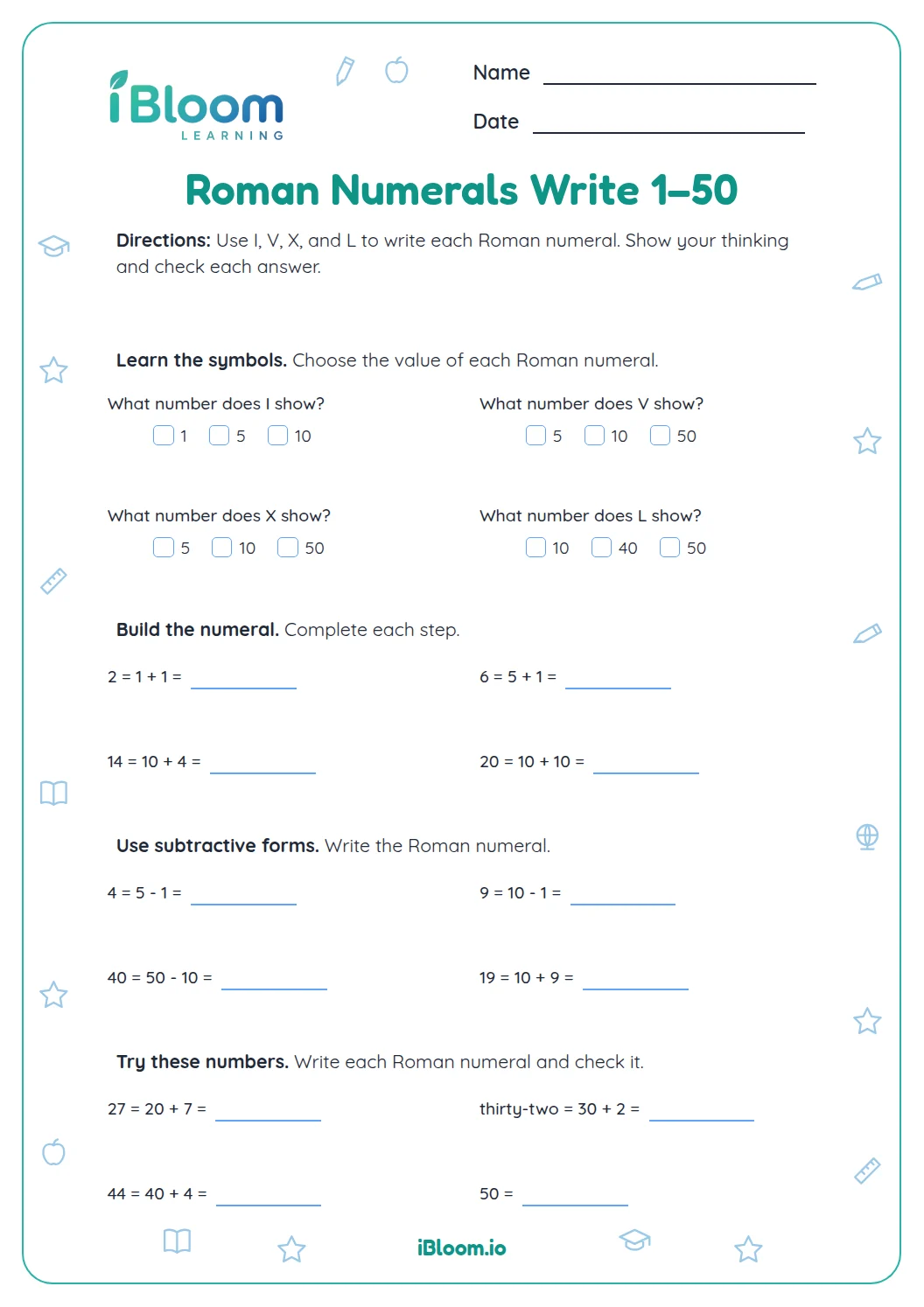
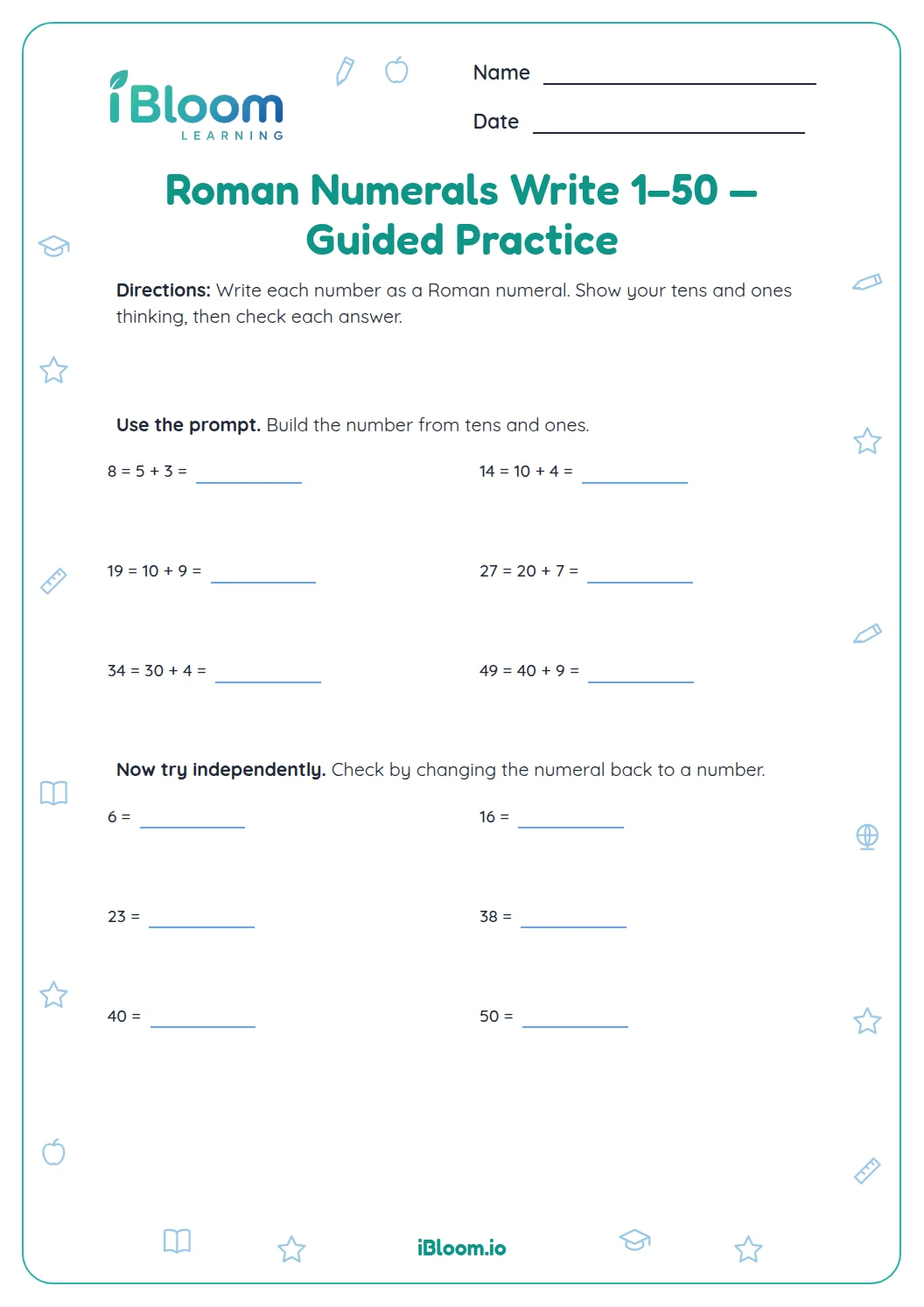
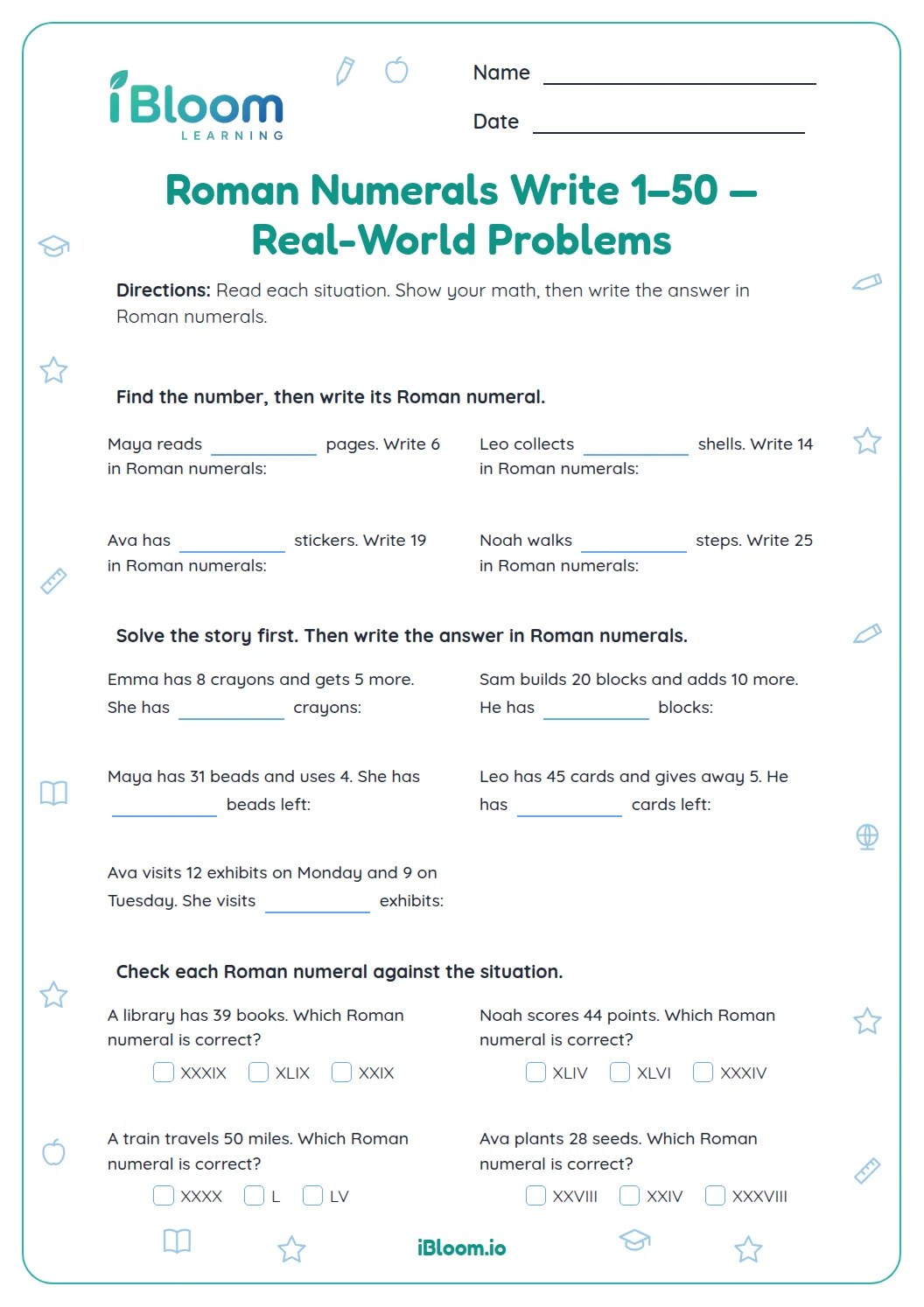
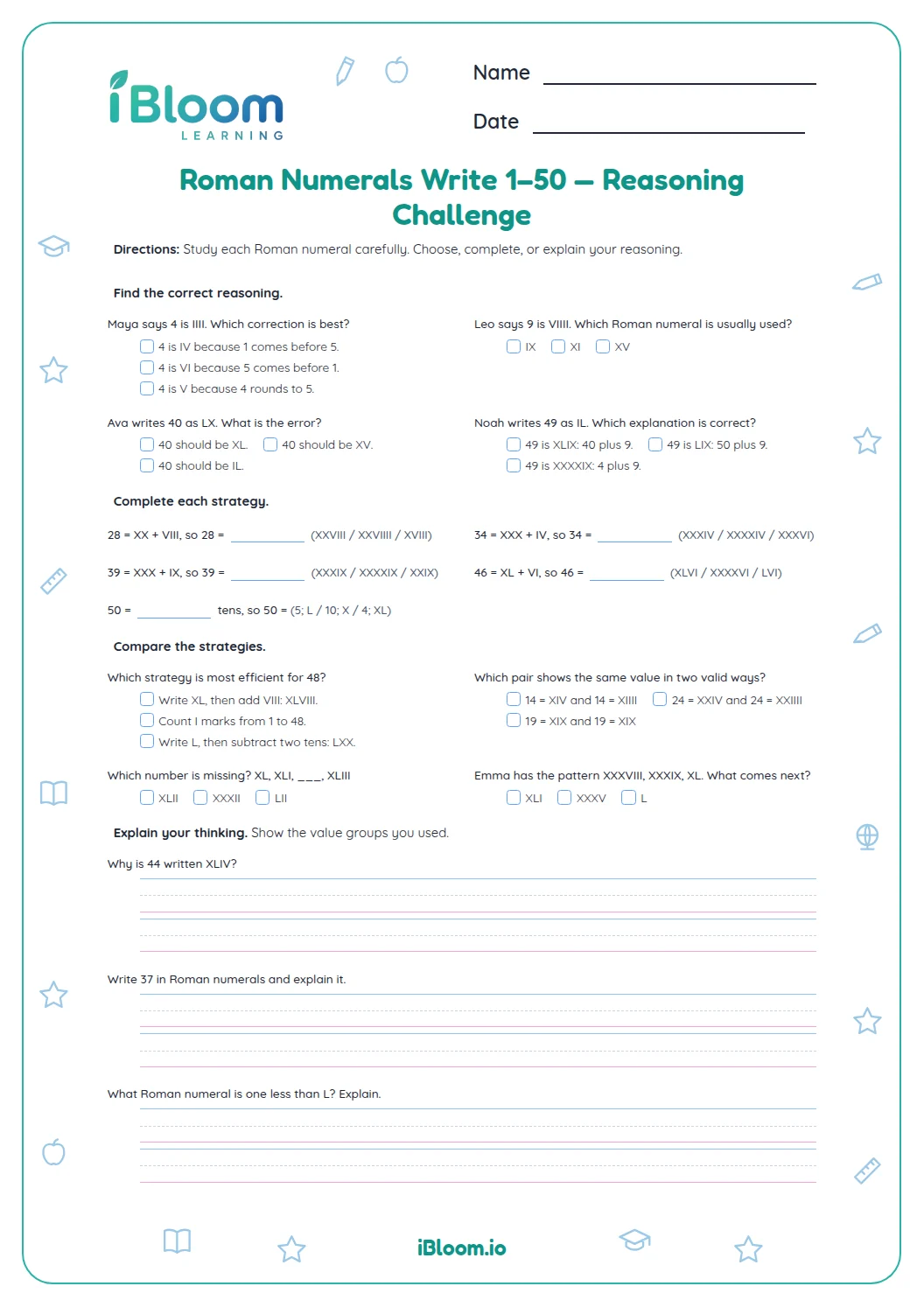
This Grade 3 printable uses two tables to practice writing Roman numerals for every whole number from 1 through 50. Children convert each number in order, then check the sequence with the answer key.
How do the number lines help you write numerals?
Each labeled point marks a whole number. Read its value, then express that value with Roman numeral symbols.
- 1Point A is 1, so write I. Point E is 5, so write V.
- 2The point labels keep the values in order.
How do I, V and X combine?
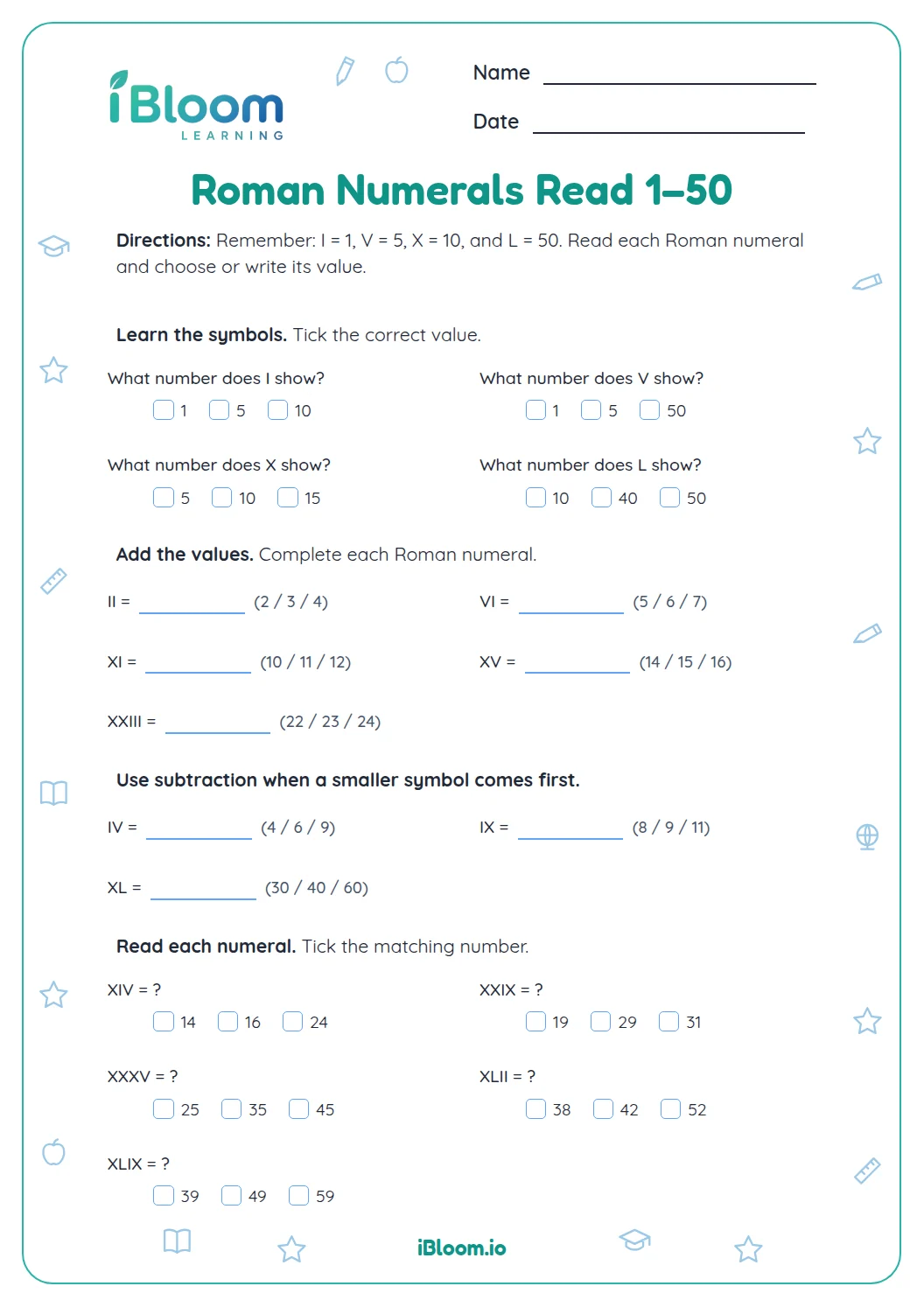
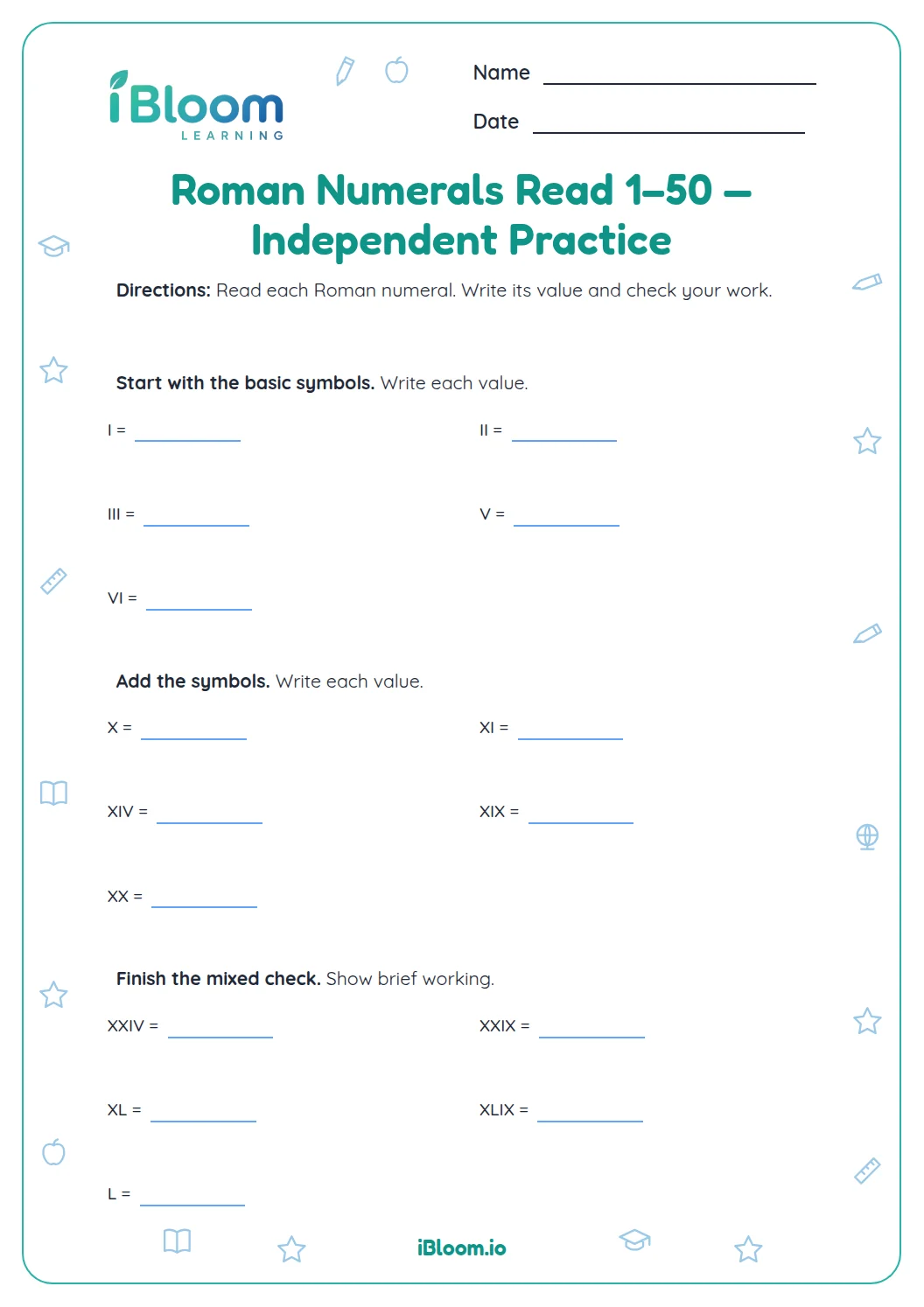
I means one, V means five and X means ten. Most symbols add when placed from larger to smaller.
- 1Point J marks 20, so write XX.
- 2Two X symbols add to twenty.
When do you subtract a smaller symbol?
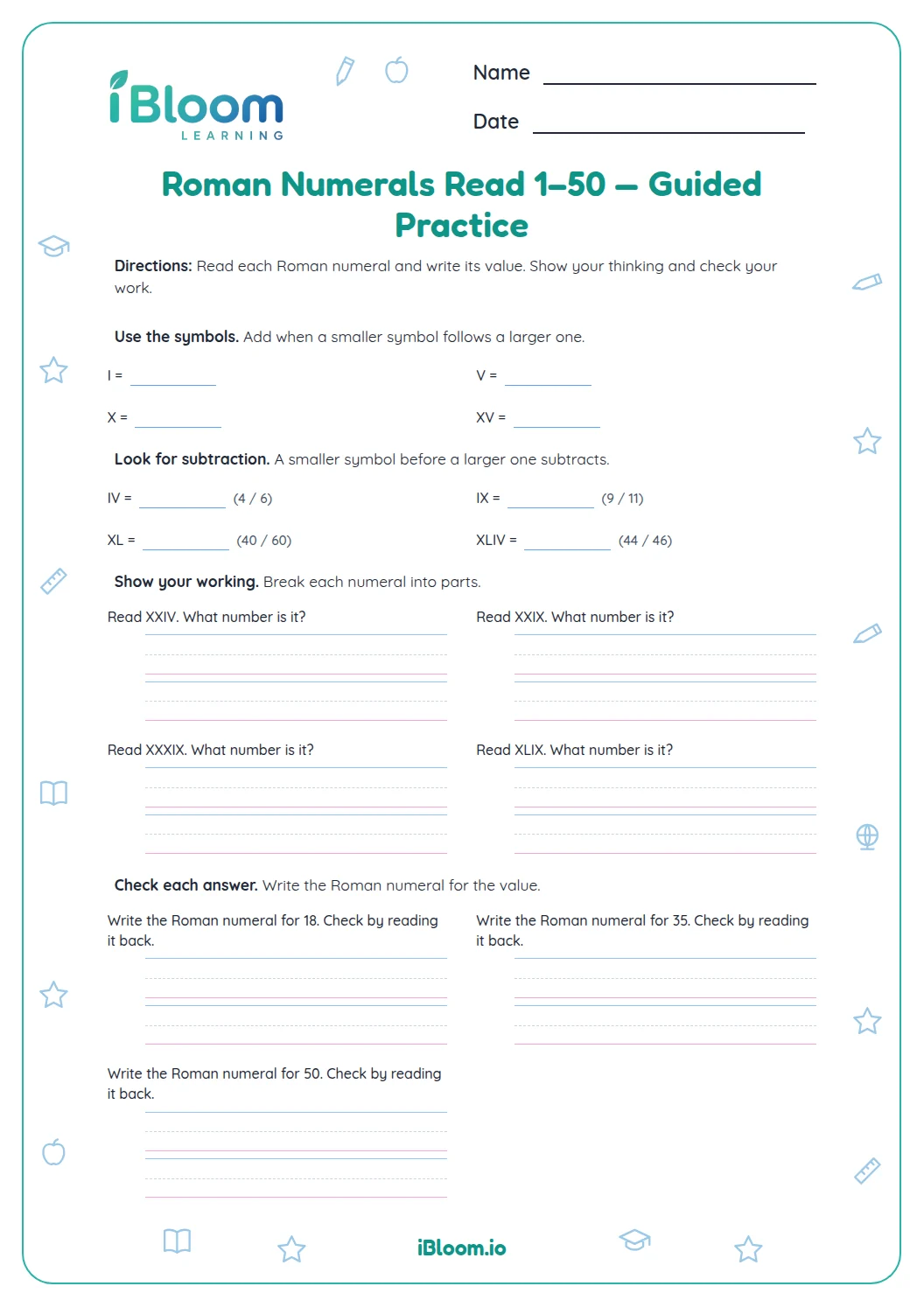
A smaller I before V or X means subtract one. That gives IV for four and IX for nine; XL uses X before L for forty.
- 1Point J marks 50, so write L.
- 2L is the symbol for fifty.
How to use this worksheet
- 1Read the value below each labeled point.
- 2Write the Roman numeral symbols that make that value.
- 3Use IV for four and IX for nine.
- 4Use XL for forty and L for fifty.
- 5Read your symbols back to check each value.
Common mistakes and quick fixes
The mistake
Writing IIII for four.
The fix
Write IV: I before V means five minus one.
The mistake
Writing XXXX for forty.
The fix
Write XL: ten before fifty means fifty minus ten.
The mistake
Reading IX as eleven.
The fix
When I comes before X, subtract one from ten.
What to practice next
Make more practice
Questions parents and teachers ask
Which Roman numeral symbols appear here?
This page uses I for one, V for five, X for ten and L for fifty. These symbols are enough to write every whole number from 1 through 50, including values that use subtractive forms. Ask the student to explain how the response meets the direction before checking the answer key together.
Why is 4 written IV?
When I comes before V, subtract one from five to make four. This compact form helps distinguish four from an additive sequence such as IIII, which is not used in this practice. Ask the student to explain how the response meets the direction before checking the answer key together.
How is 40 different from 39?
Thirty-nine is XXXIX: three tens followed by IX for nine. Forty is XL, where X before L means subtract ten from fifty. Reading the symbols in order helps keep the values separate. Ask the student to explain how the response meets the direction before checking the answer key together.
Does the worksheet include every number from 1 to 50?
Yes. Five number lines mark every integer from 1 through 50 in order. Students write ten numerals for each line, and the answer key lists all 50 responses for checking. Ask the student to explain how the response meets the direction before checking the answer key together.
How can a student check a numeral?
Read the symbols from left to right, adding most values and subtracting a smaller symbol when it comes before a larger one. Compare that total with the value printed in the prompt. Ask the student to explain how the response meets the direction before checking the answer key together.