





About this worksheet
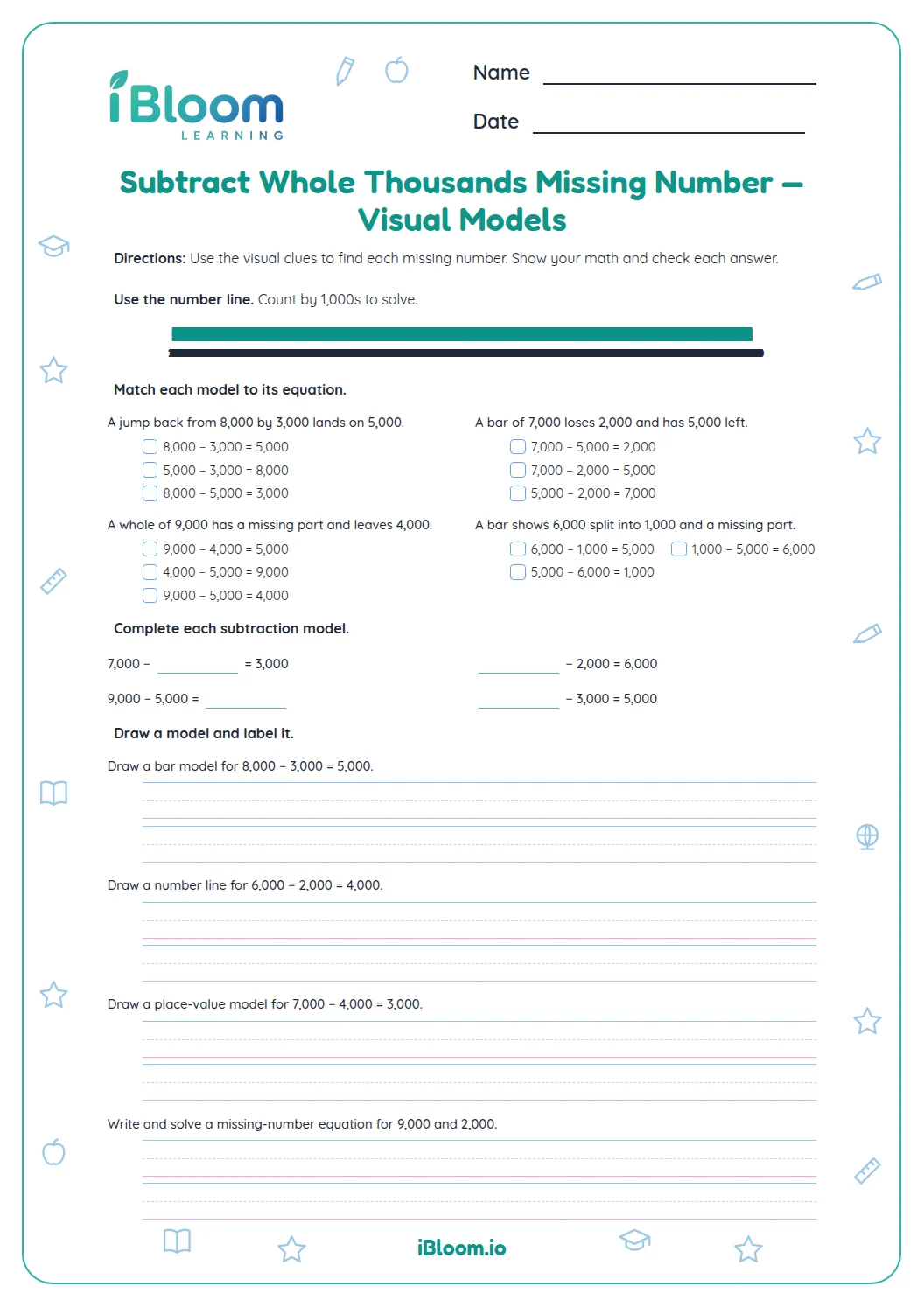
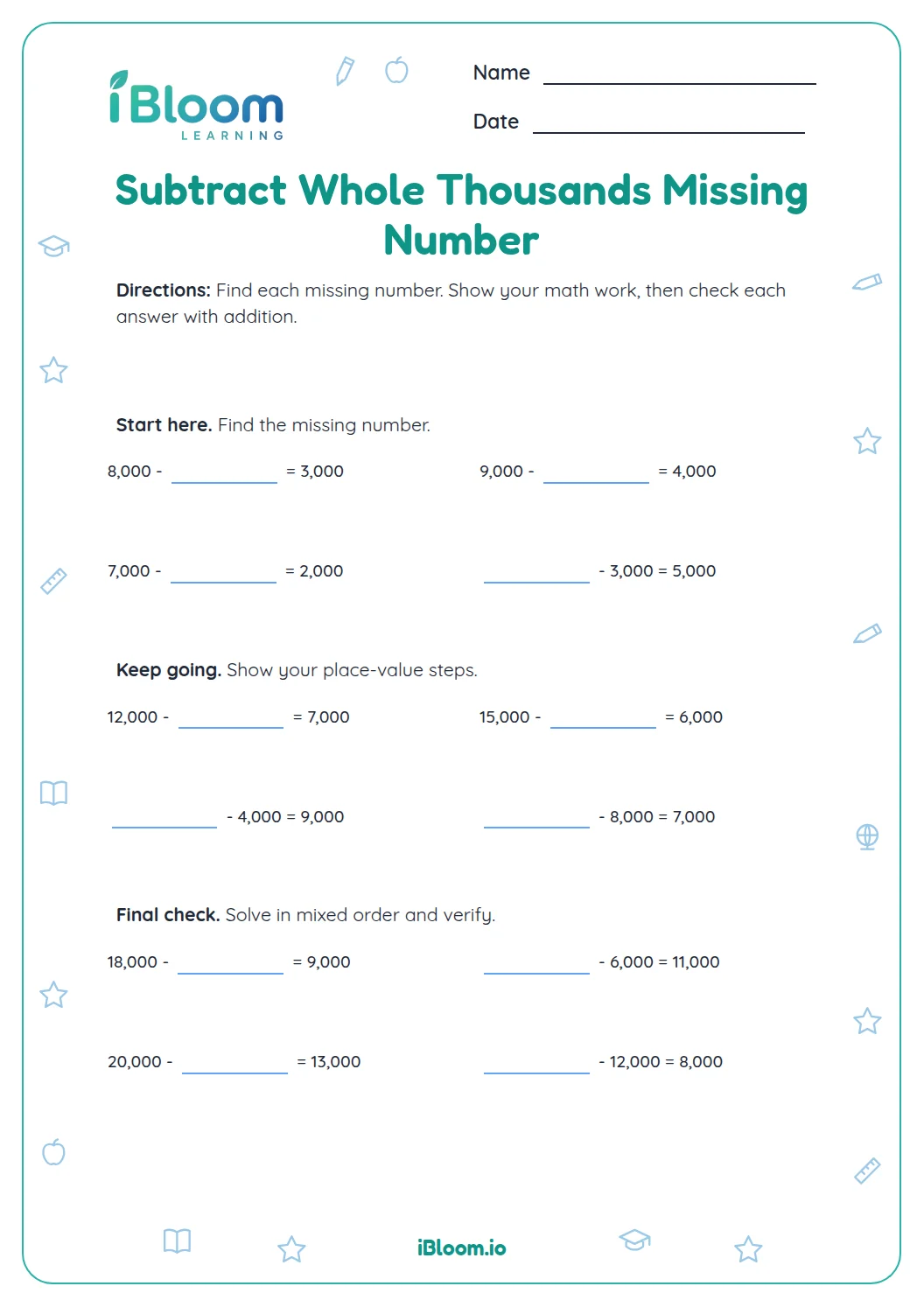
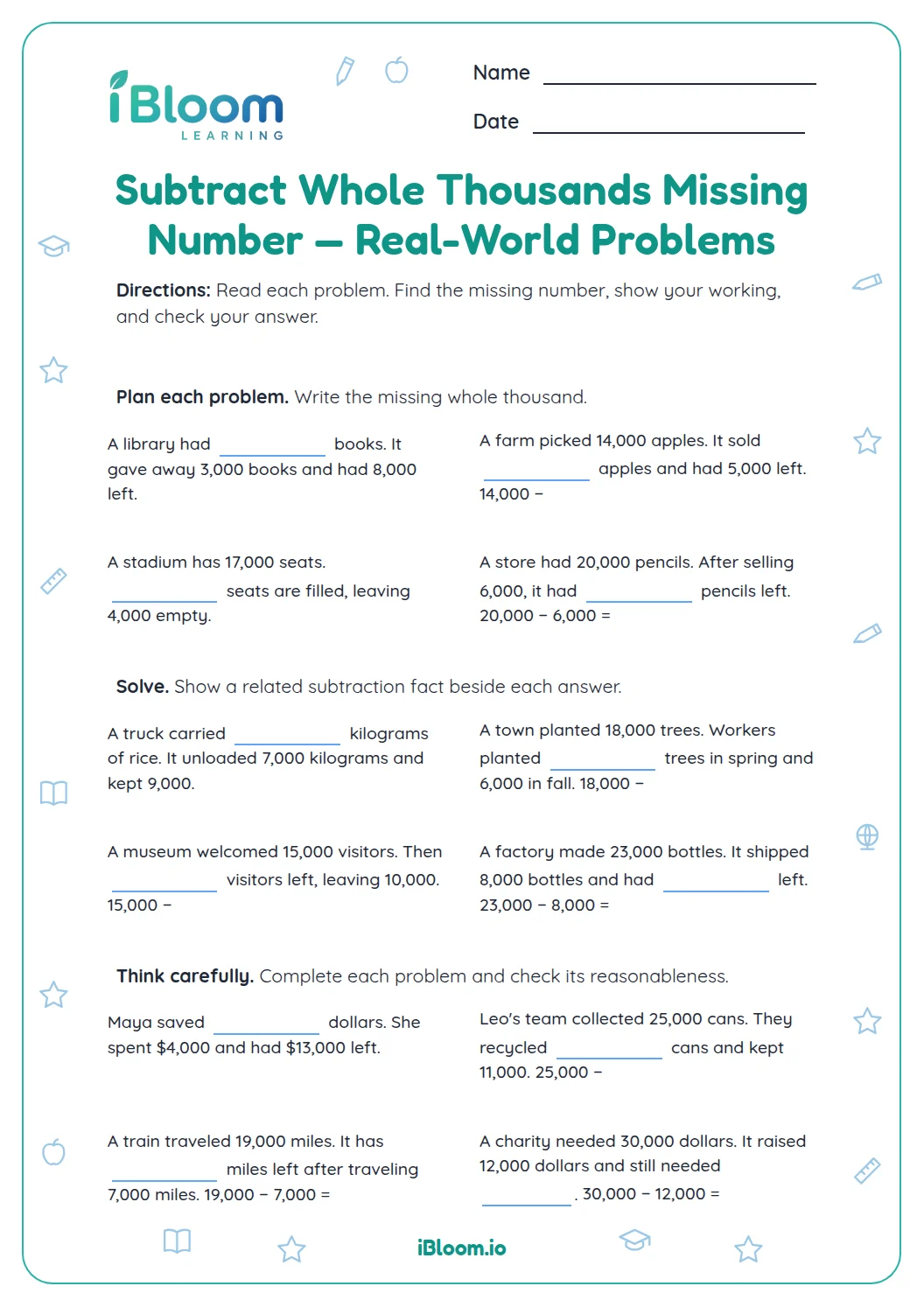
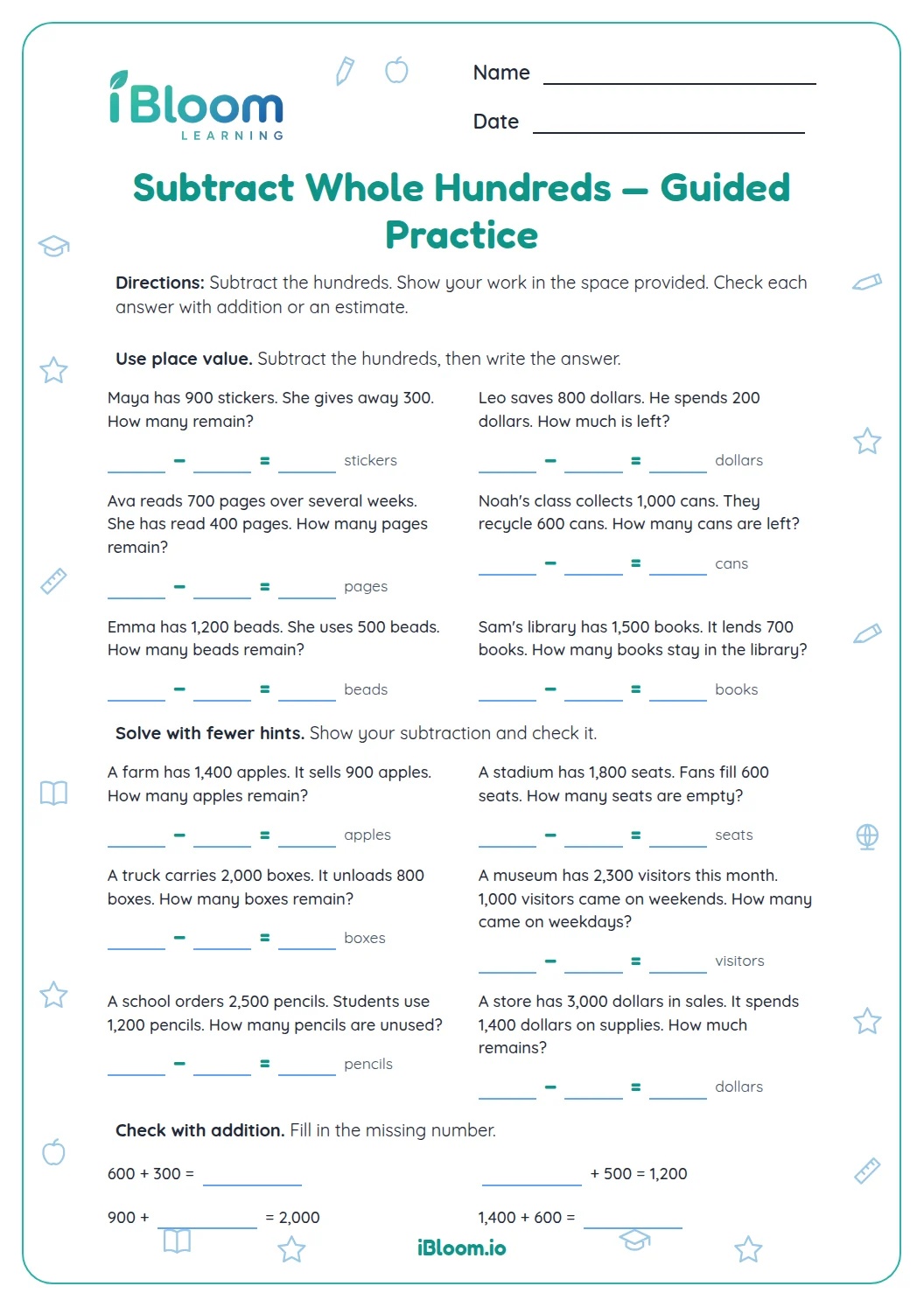
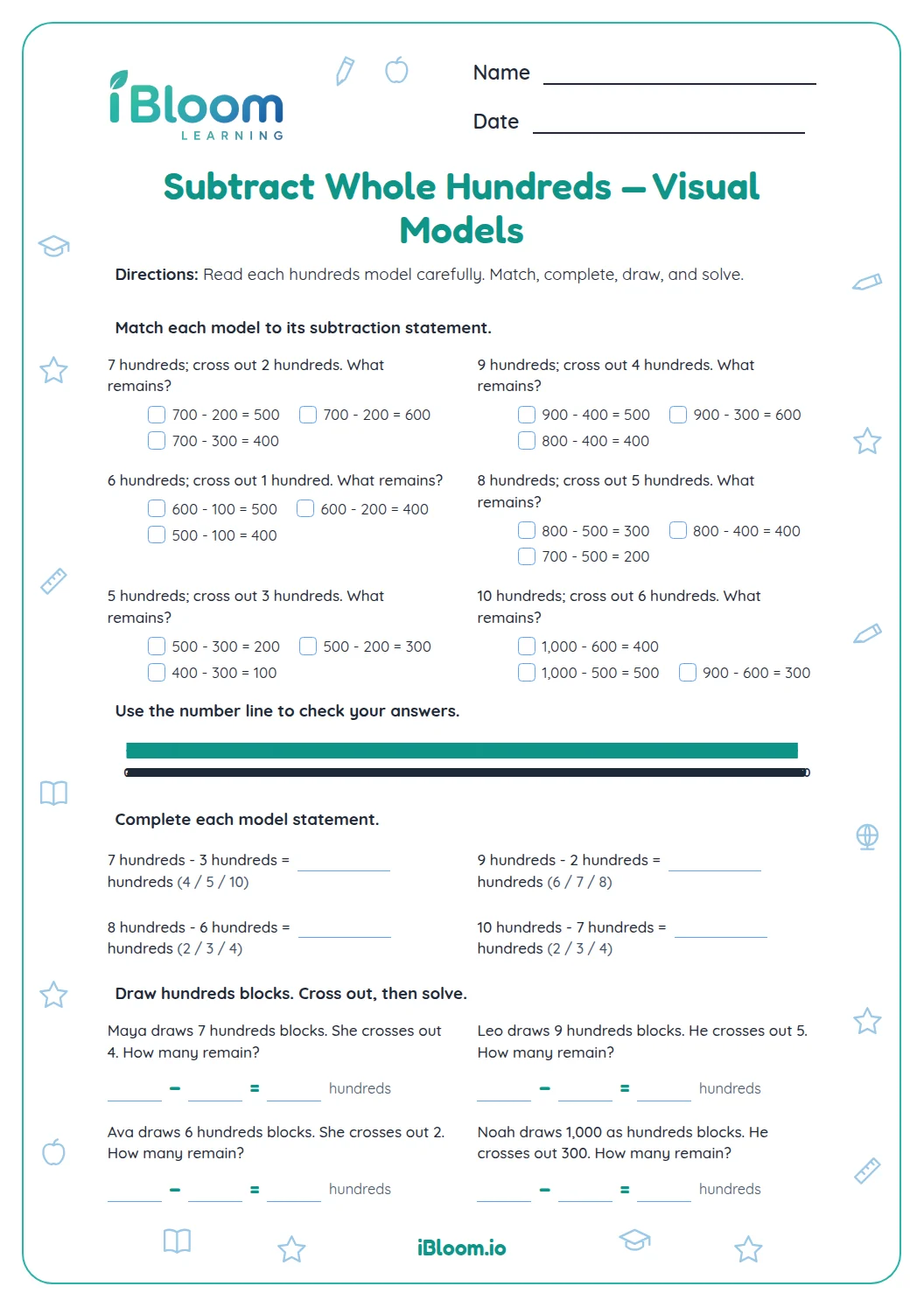
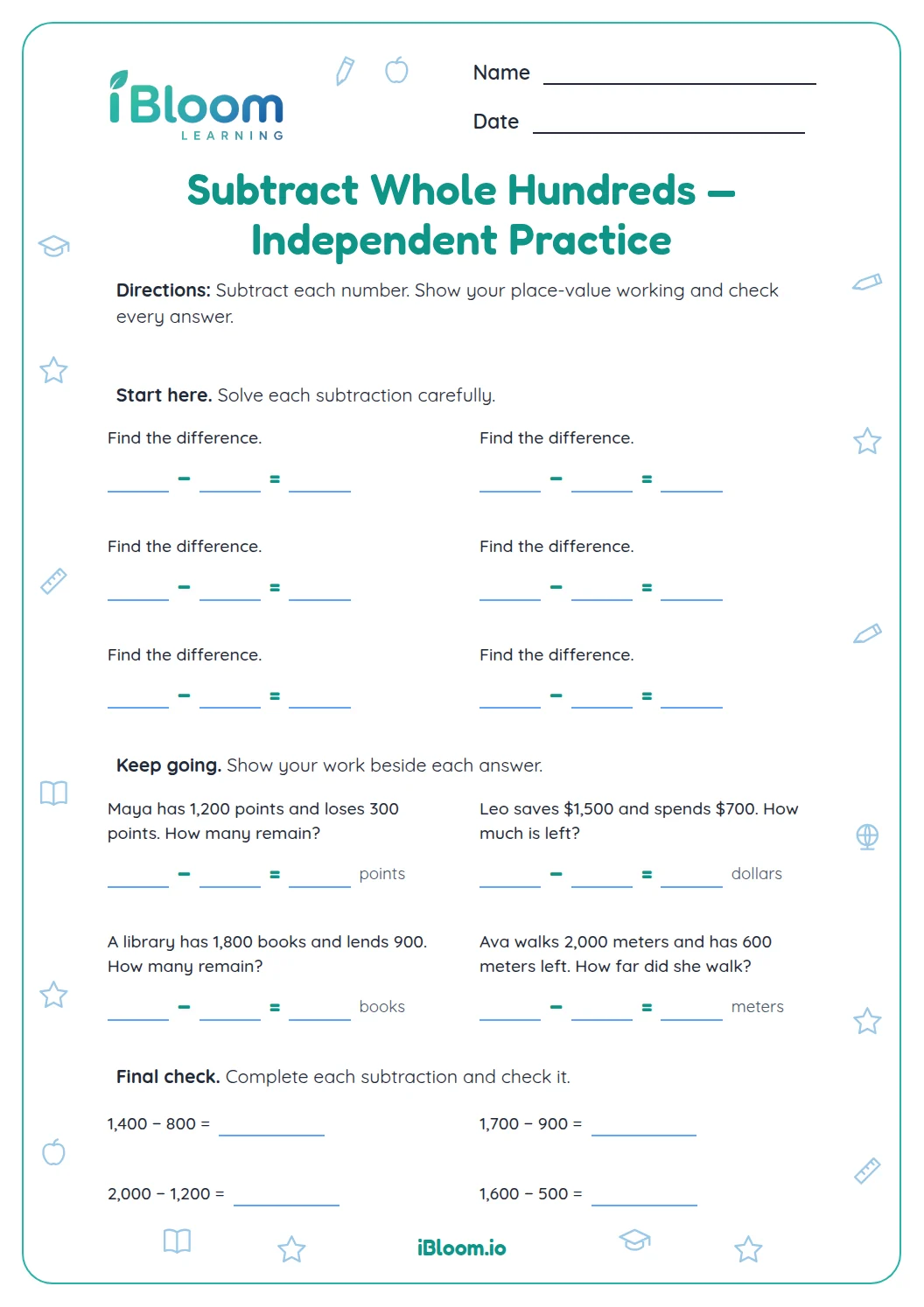
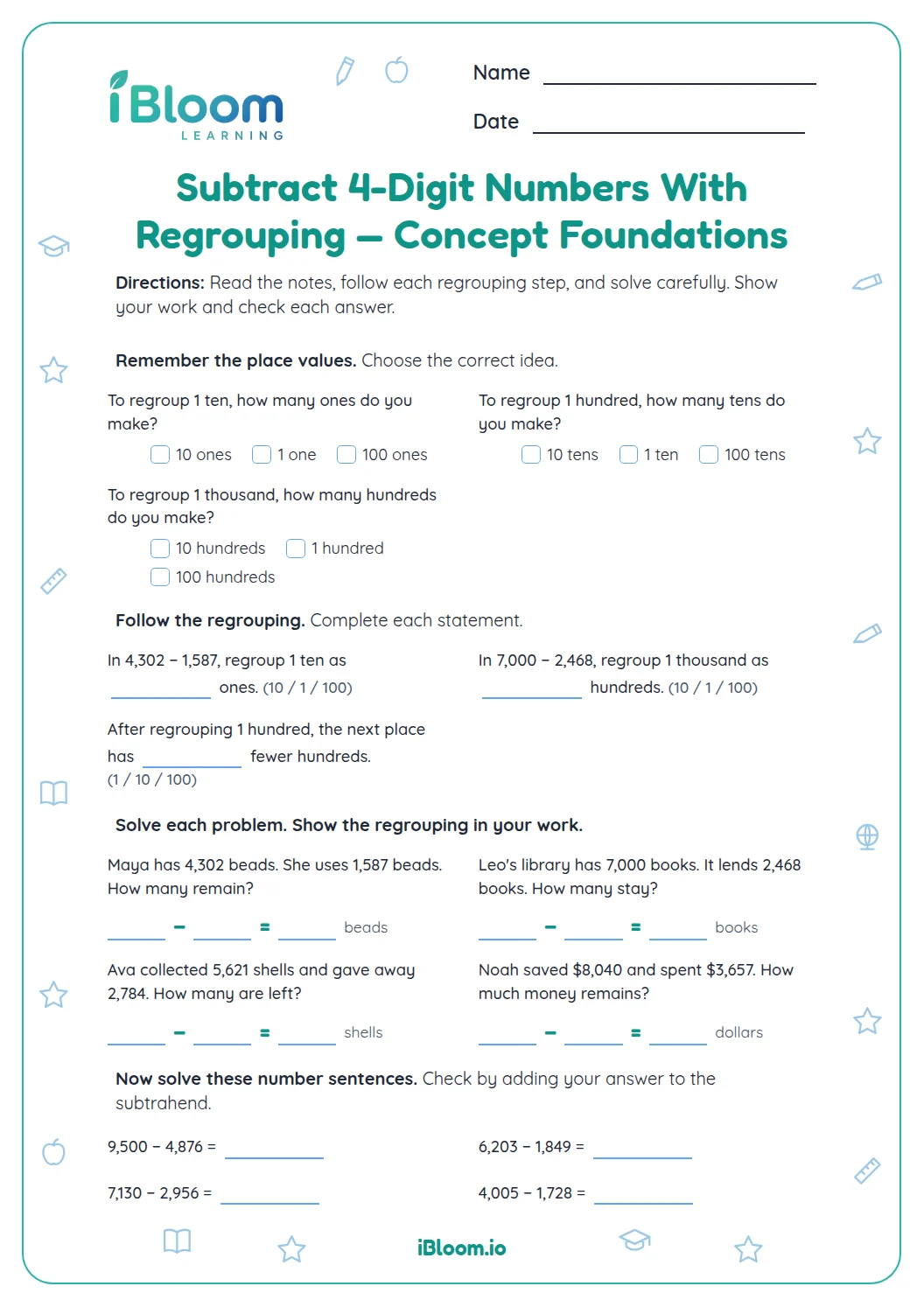
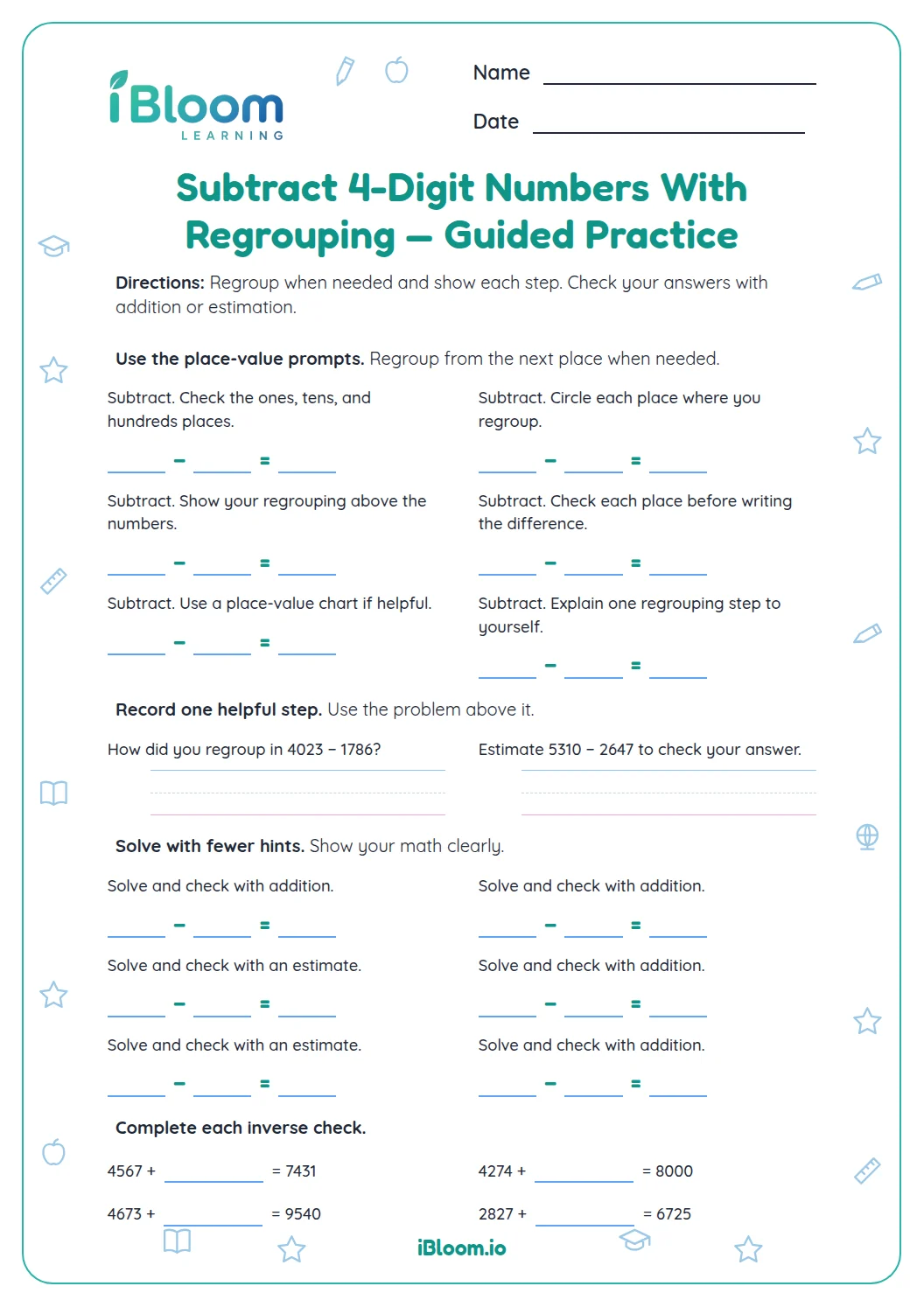
This guided practice worksheet gives students 16 problems about subtraction with whole thousands. They find missing minuends, subtrahends, and differences, check answers with related addition facts, and solve word problems about quantities that decrease. The three parts move from equations to story contexts, and the separate answer key lists each value with units for the stories.
How can the unknown’s position help?
In 8,000 − ___ = 3,000, the unknown is the amount removed. Find the difference between 8,000 and 3,000: 5,000. In ___ − 2,000 = 5,000, the unknown is the starting amount, so combine the amount removed and the result.
- 18,000 − ___ = 3,000
- 28,000 − 3,000 = 5,000, so the missing number is 5,000.
How do you check a missing value?
Substitute the value into the original equation and calculate. For ___ − 4,000 = 6,000, the missing starting amount is 10,000; checking gives 10,000 − 4,000 = 6,000.
How do word problems become equations?
Identify the starting amount and what changed, then subtract. A library with 7,000 books that donates some and has 4,000 left donated 3,000 books.
How to use this worksheet
- 1Mark which number is missing: start, amount subtracted, or difference.
- 2Use subtraction or addition to find the unknown.
- 3For each story, identify the starting amount and what changed.
- 4Write the number with its thousands comma.
- 5Substitute your answer into the equation to check.
Common mistakes and quick fixes
The mistake
Subtracting when the missing value is the starting amount.
The fix
For ___ − 2,000 = 5,000, combine the remaining amount and amount removed.
The mistake
Using addition in a story where items leave the collection.
The fix
Words such as shipped, sold, or donated signal a decrease.
The mistake
Finding a plausible value but not checking it.
The fix
Put the value back into the original number sentence and verify both sides.
What to practice next
Make more practice
Questions parents and teachers ask
How do you find a missing number in subtraction?
First decide whether the blank is the starting amount, the amount taken away, or the difference. Use the related addition or subtraction fact, then substitute the result into the original equation to check it and confirm both sides are equal.
How many questions are on the worksheet?
There are 16 questions in three parts: eleven missing-value equations, one equation choice tied to a story, and four subtraction word problems. The separate answer key lists the missing values and includes units for each story answer. Each story answer is labeled with the matching quantity.
How do you solve 8,000 − ___ = 3,000?
Find the difference between 8,000 and 3,000. Since 8,000 − 3,000 = 5,000, the missing amount is 5,000; putting it back confirms that 8,000 − 5,000 equals 3,000. The check confirms that substituting the missing value makes a true equation.
What if the blank is the starting amount?
Combine the amount removed with the amount left. For ___ − 2,000 = 5,000, add 2,000 and 5,000 to get a starting amount of 7,000. Subtracting 2,000 checks that 5,000 remains. This inverse check links subtraction to addition.
How should students check a story problem?
Write or identify a subtraction equation that matches what changed, solve it, and include the quantity’s unit. For a warehouse with 9,000 boxes that ships 2,000, subtract to find 7,000 boxes remaining. The unit helps make clear what the number represents.