

About this worksheet
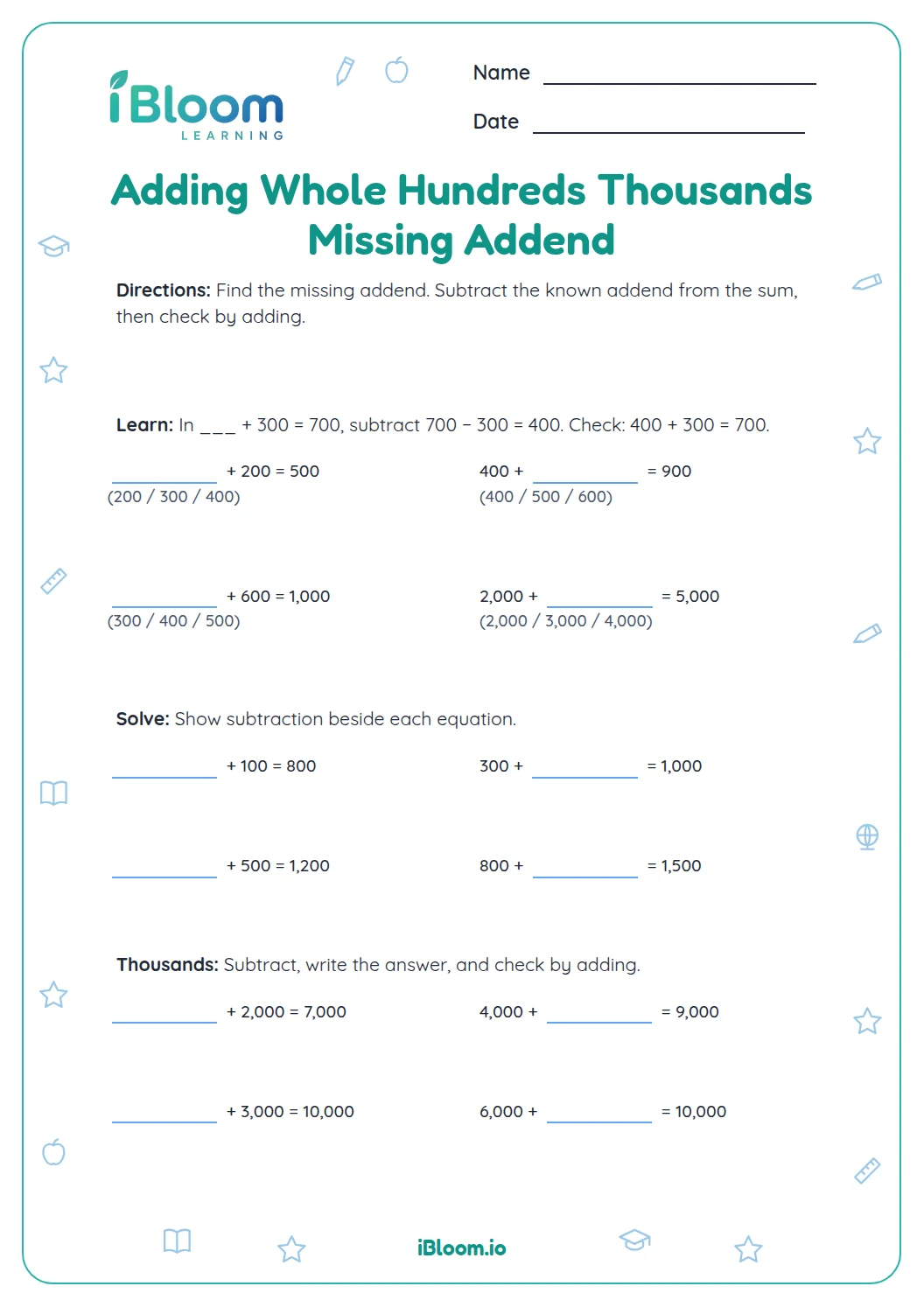
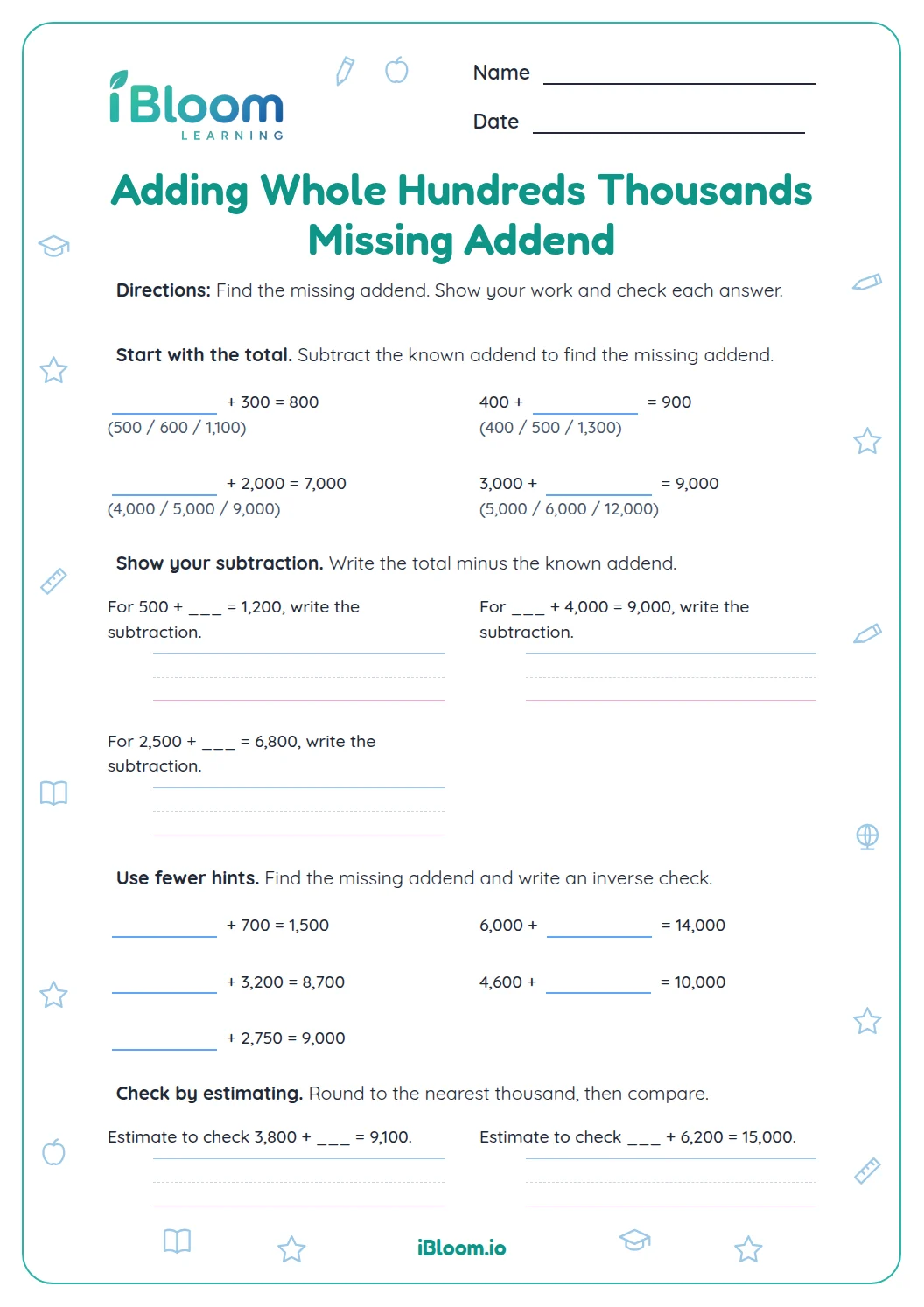
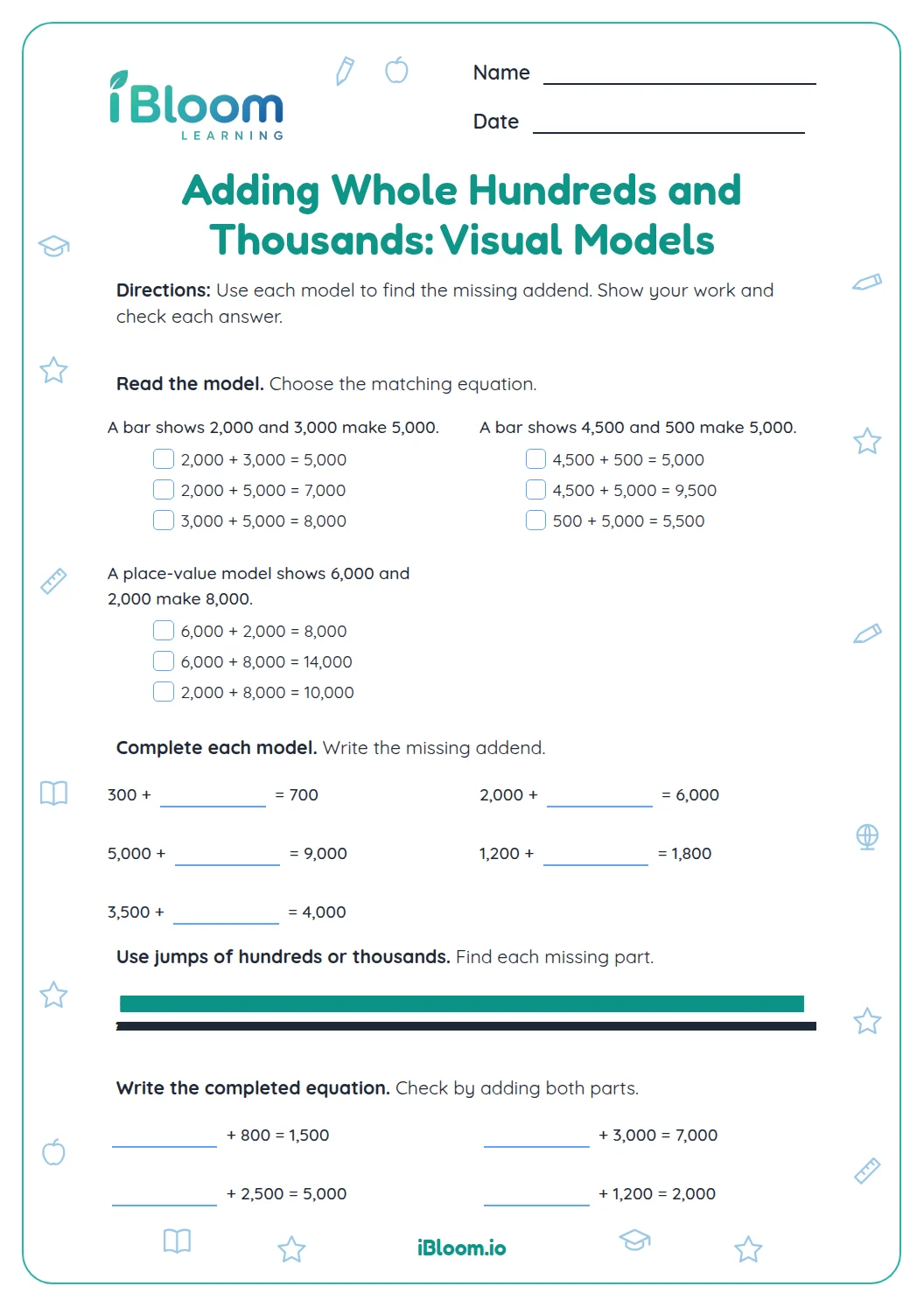
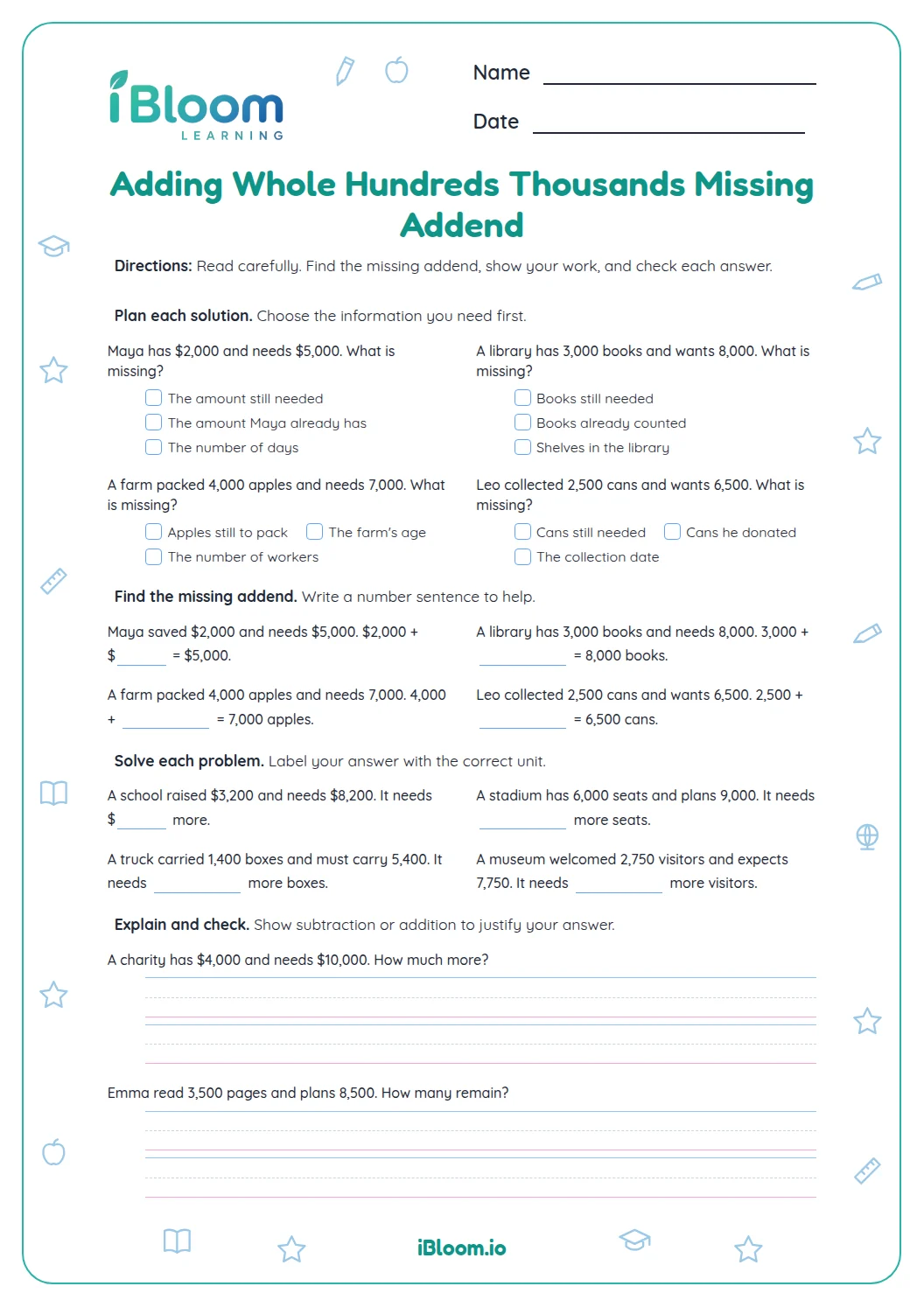
This independent practice uses whole-hundreds and whole-thousands addends within 15,000. Students find the unknown in different positions and verify each result by addition.
Aligned to 4.NBT.4
What is the missing-addend strategy?
In an equation such as ___ + 2,400 = 6,700, the two addends combine to make the sum. Subtract the known addend from the sum: 6,700 − 2,400 = 4,300.
These problems use whole hundreds and thousands. Keep place value lined up when subtracting, especially when a place has zero.
How can students check?
Add the known addend to the answer. If the result matches the stated sum, the missing addend is correct. For example, 4,300 + 2,400 = 6,700.
How to use this worksheet
- 1Read the directions at the start of each part before solving.
- 2Work through the examples and questions in order, writing neatly in the spaces.
- 3Use the separate answer key to check each response and explain any correction.
Common mistakes and quick fixes
The mistake
A common error is subtracting the known addend from the smaller number or misaligning place values.
The fix
Write the sum above the known addend and check each column before subtracting.
Common Core alignment
The page practices multi-digit addition and subtraction with whole-number place values, emphasizing the inverse relationship between the operations.
Fluently add and subtract multi-digit whole numbers using the standard algorithm.
On this sheet: The worksheet gives students guided practice applying this skill in context.
Show the official wordingHide the official wording
Fluently add and subtract multi-digit whole numbers using the standard algorithm.
What to practice next
Further reading
Questions parents and teachers ask
How do I solve an equation with a missing addend?
Subtract the known addend from the sum to find the unknown. For example, if the sum is 6,700 and one addend is 2,400, calculate 6,700 minus 2,400. Then add the result back to check. In class, ask the child to explain the choice and point to the clue that supports it.
Why do some answers include hundreds?
The page uses whole hundreds and whole thousands as addends, so a missing amount can be a multiple of one hundred without being a whole thousand. Keep each digit in its place while subtracting. In class, ask the child to explain the choice and point to the clue that supports it.
What does checking by addition show?
Adding the known addend and the answer should reproduce the given sum. This check confirms both the subtraction and the place-value alignment, especially when the equation includes zeros. In class, ask the child to explain the choice and point to the clue that supports it.
Are these problems intended for Grade 4?
Yes. The numbers require multi-digit computation, and the equations ask students to use subtraction to reason about an addition total. Students can show the subtraction algorithm and verify with addition. In class, ask the child to explain the choice and point to the clue that supports it.
Why are the addends whole hundreds or thousands?
Each given addend is a multiple of one hundred or one thousand, so students can focus on place value while finding the unknown. The missing number may include hundreds. Subtract carefully and then add the result back to check the original total.