
About this worksheet
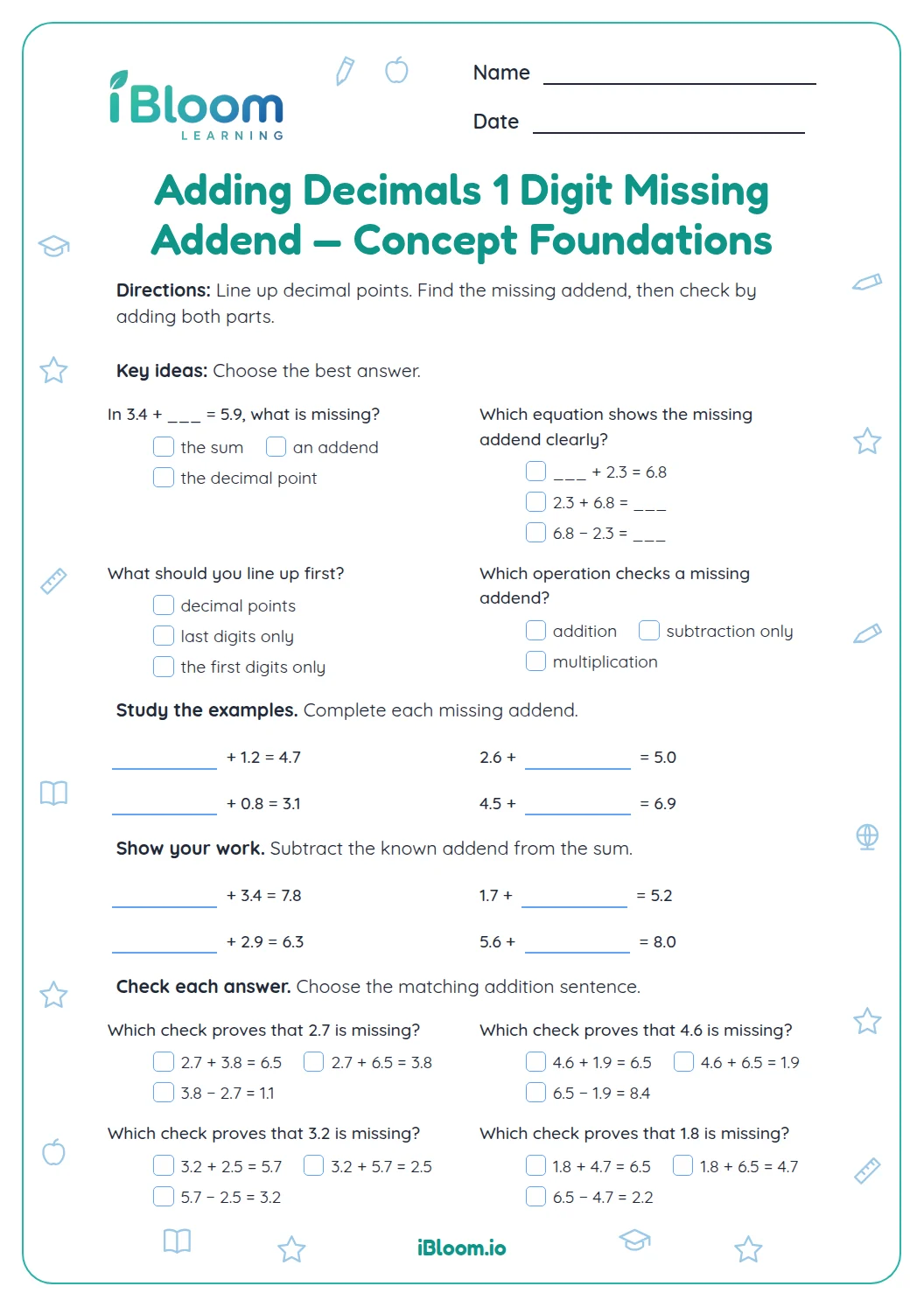
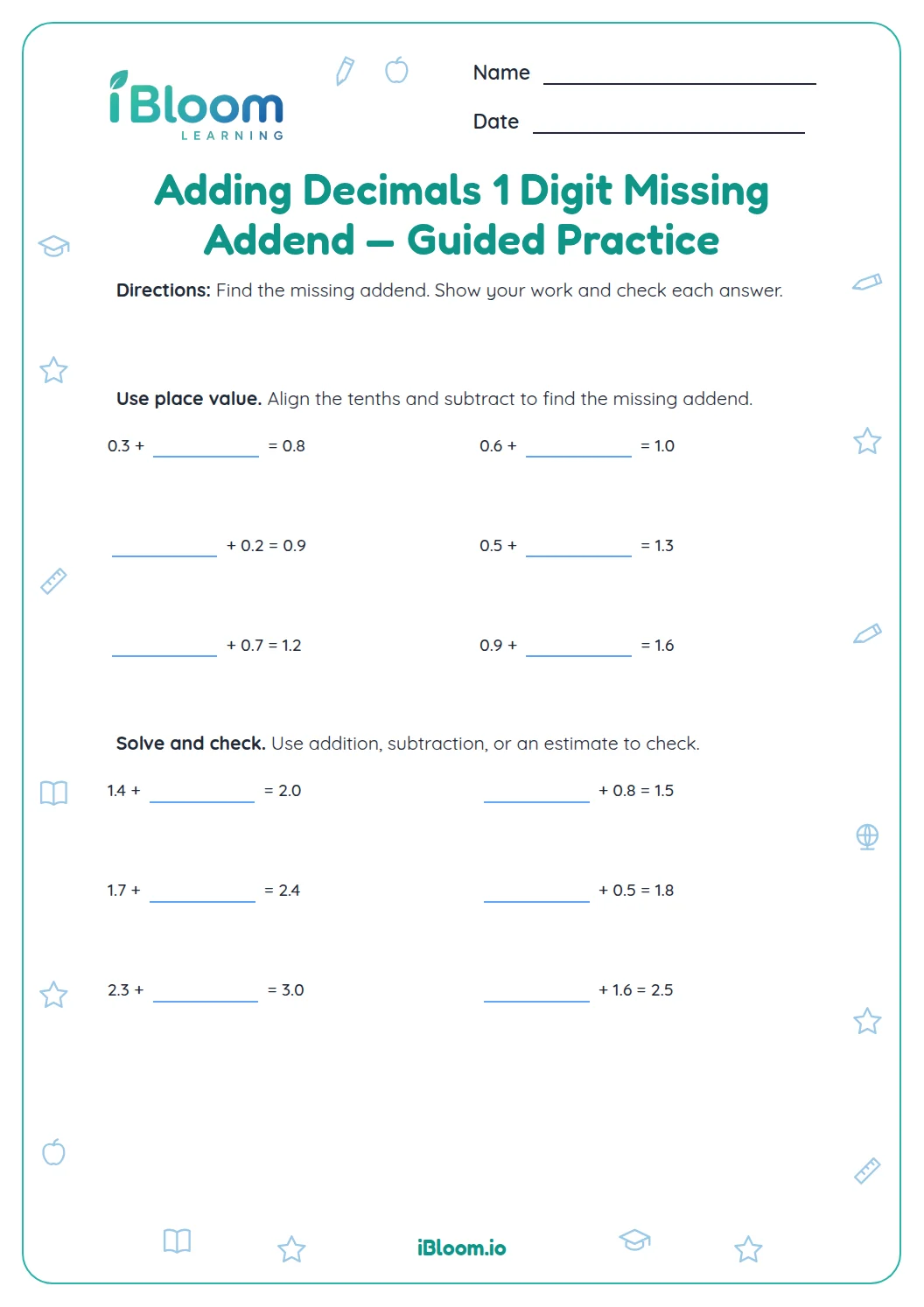
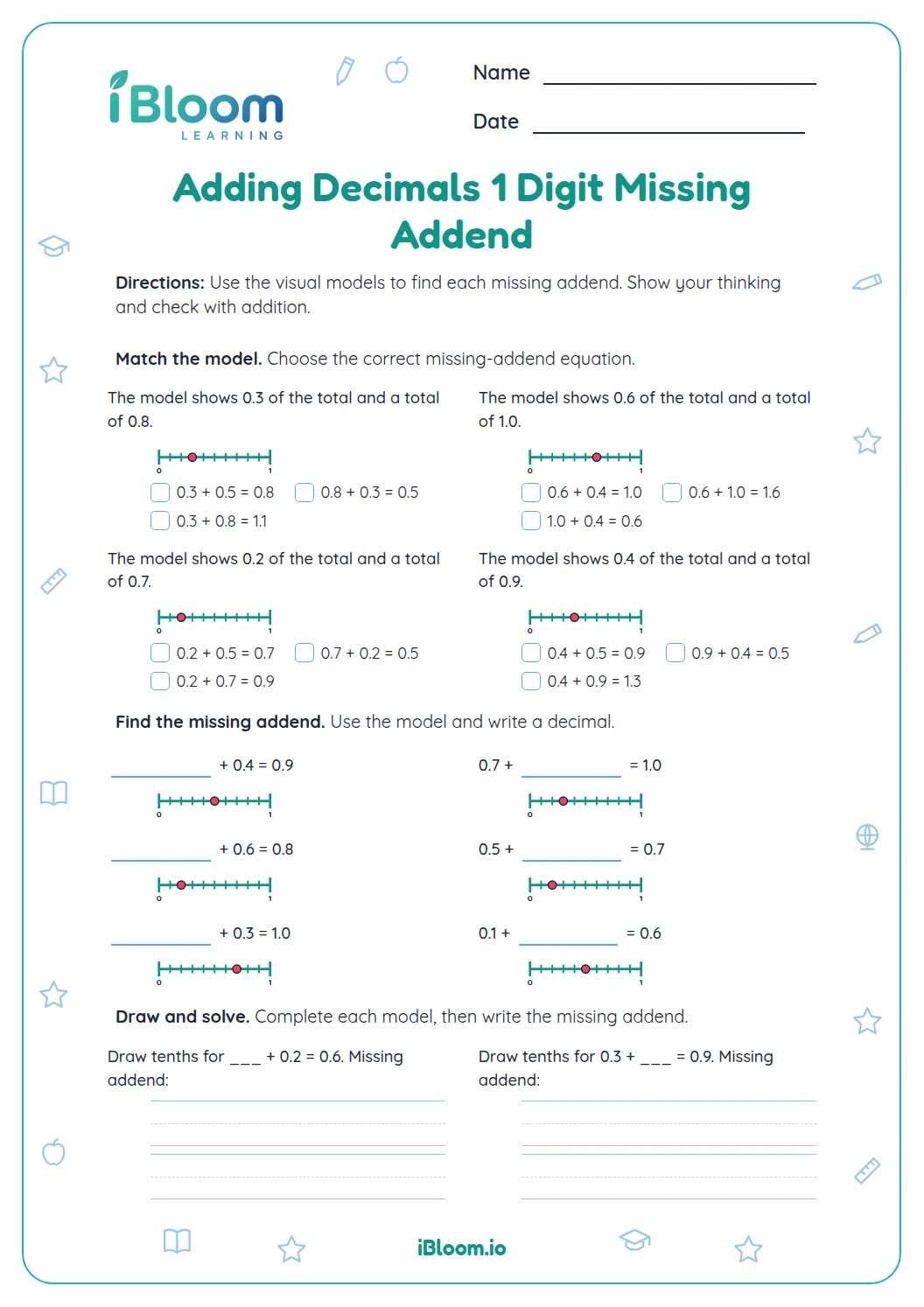
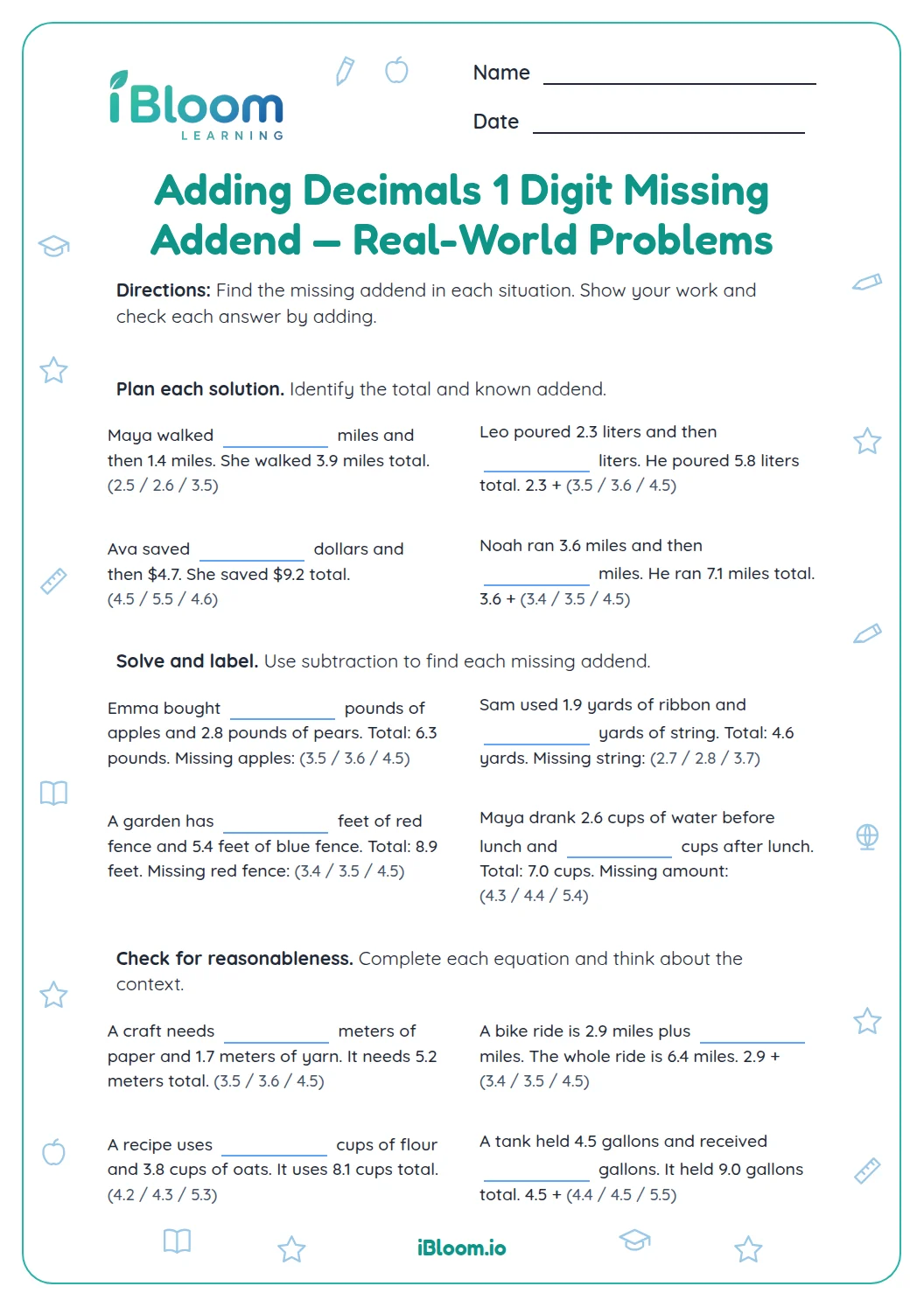
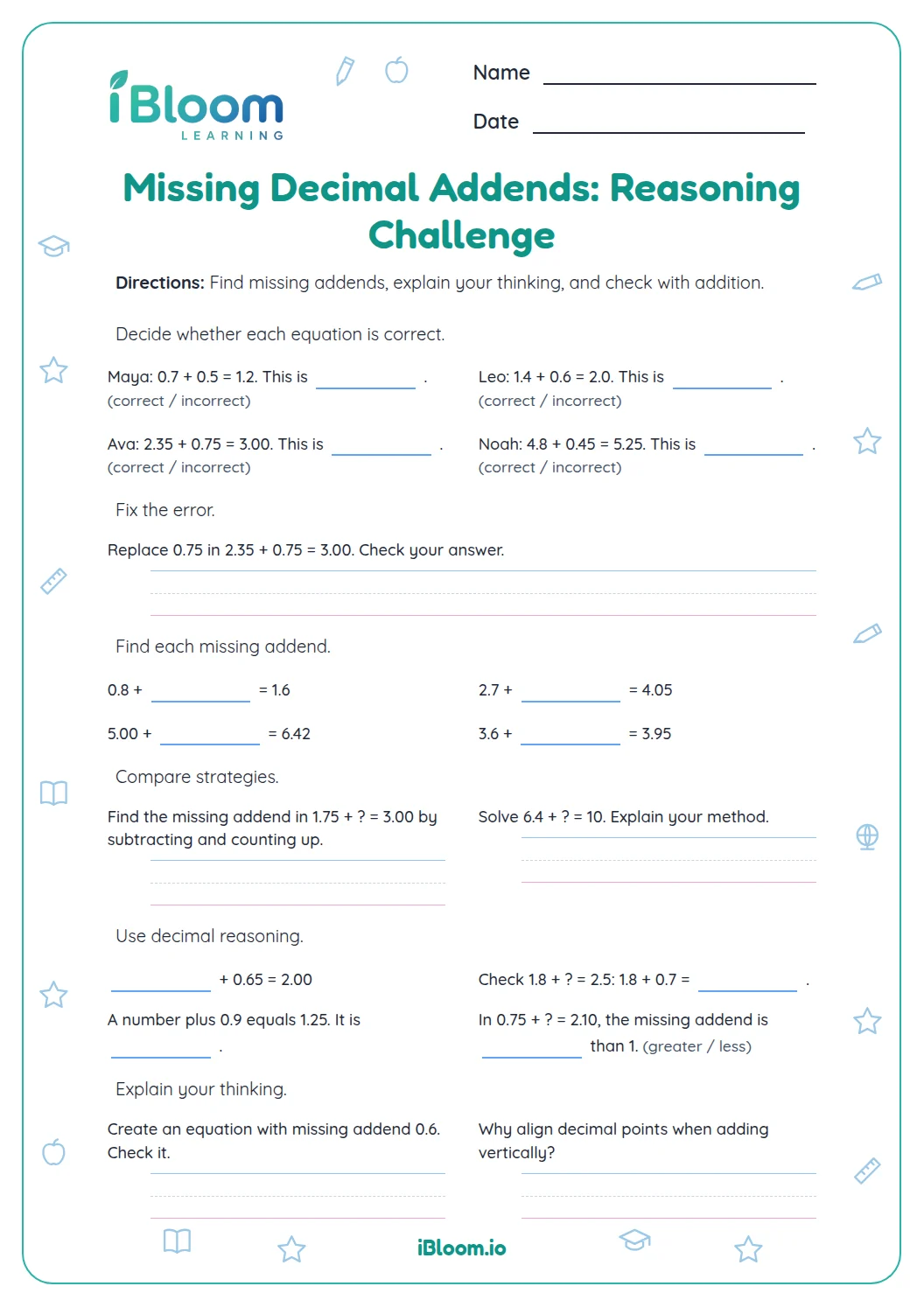
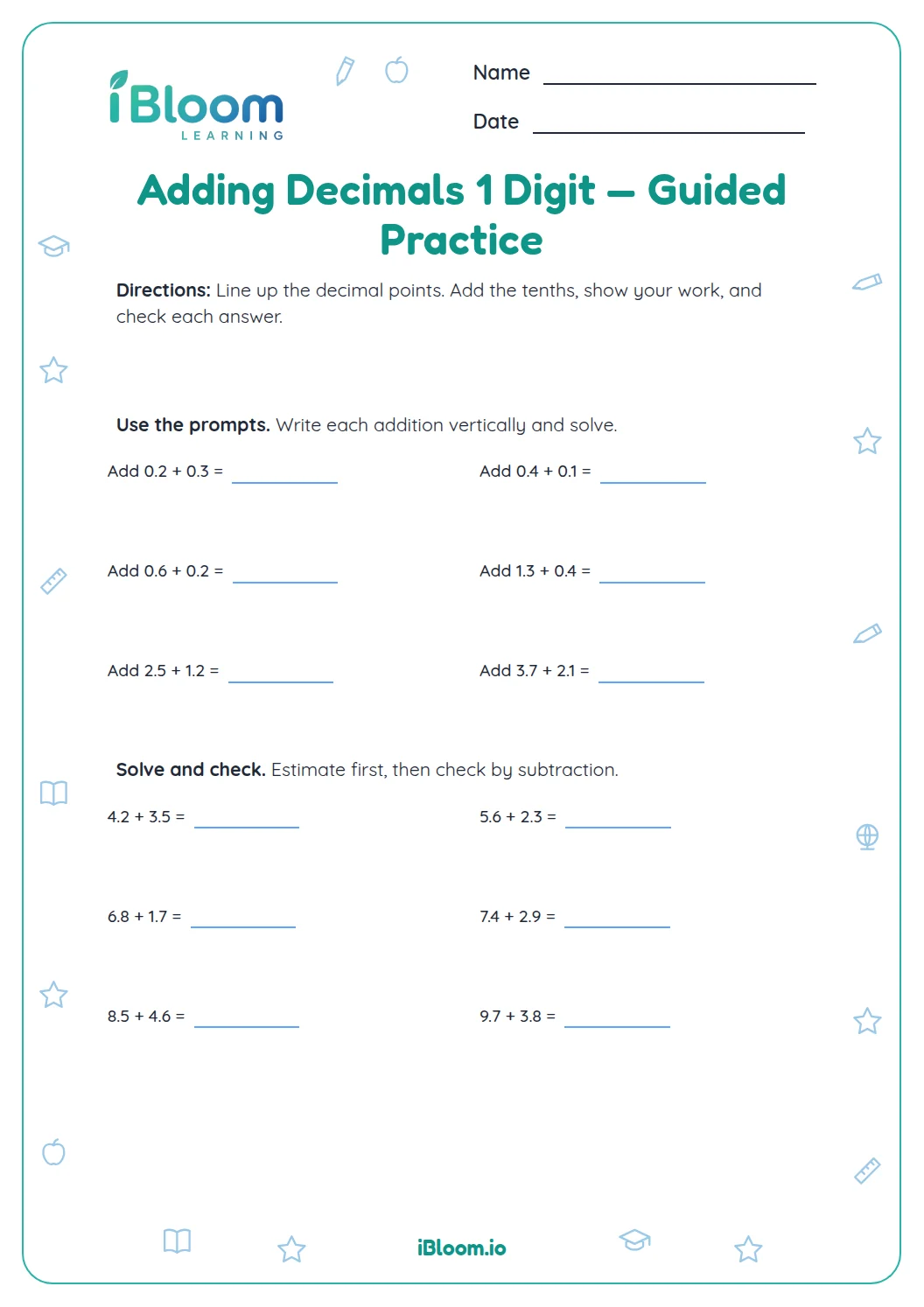
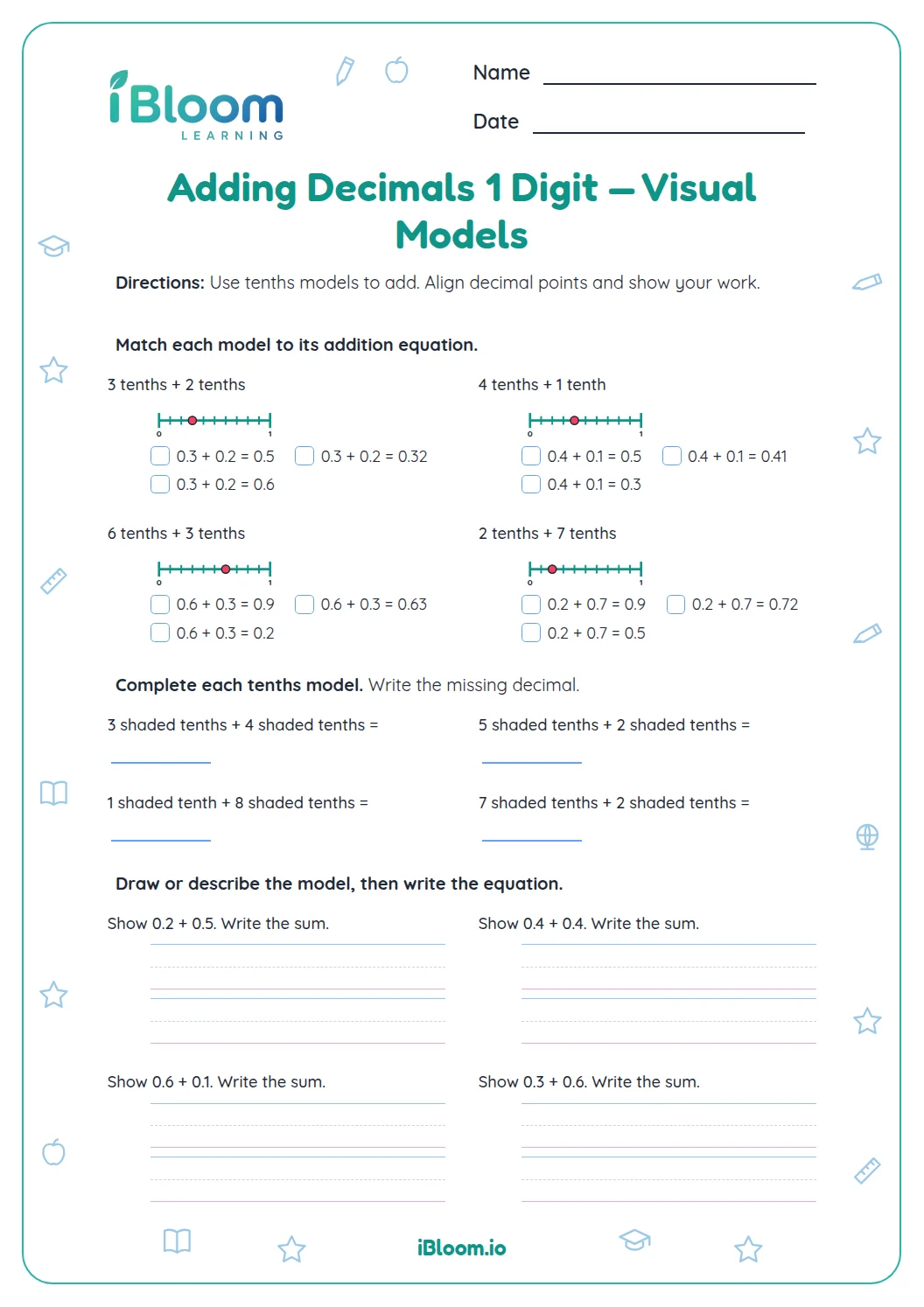
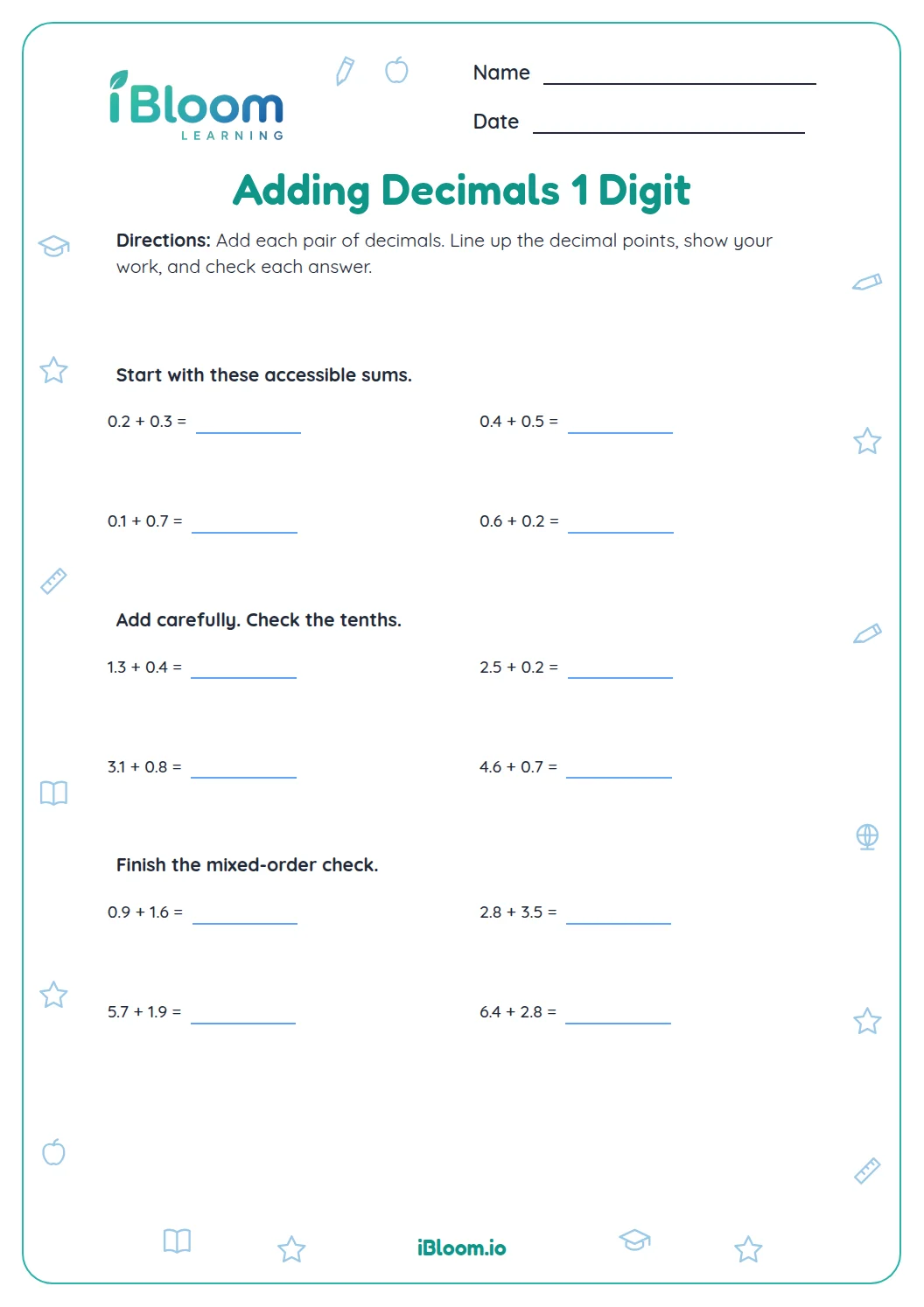
This printable gives Grade 4 learners 15 problems on finding a missing addend when decimals are written in tenths. Part A uses equations such as 2.4 + ___ = 5.1. Part B puts the same relationship into measurement and money stories. Part C returns to direct equations, and Part D asks learners to explain or write an equation of their own. Each decimal uses tenths, including values such as 20.0, so learners can align place values and use subtraction to check. A separate answer key follows the three practice pages. The work practices CCSS 5.NBT.B.7, adding and subtracting decimals by place value and the relationship between the operations.
Aligned to 5.NBT.B.7
How do you find an unknown addend?
Subtract the known addend from the total. Keep tenths under tenths and whole numbers under whole numbers; writing a zero in 20.0 makes the tenths place visible.
In question 1, 2.4 + ___ = 5.1. Subtract 2.4 from 5.1 to get 2.7, then check that 2.4 + 2.7 equals 5.1.
How do decimal stories use the same idea?
Look for the starting amount, the part added or removed, and the total or amount left. The question tells you which number is missing; the equation makes that relationship clear.
Question 6 describes an 8.5-foot ribbon with a 3.7-foot piece. The remaining length is 8.5 − 3.7 = 4.8 feet. In question 8, the amount poured out is the difference between 5.6 liters and 2.4 liters.
How can you check a missing addend?
Add your answer to the known addend. If the sum matches the total, the missing number fits. For an explanation, name the subtraction you used and the addition check.
Question 14 asks whether 2.4 + 1.4 = 3.8. The sum is correct: 4 tenths plus 4 tenths is 8 tenths, and 2 plus 1 is 3.
What is in the answer key?
The separate key lists the answers for all 15 questions. Written responses have sample answers; other number sentences can use equivalent tenths notation, such as 2.5 and 2.50.
How to use this worksheet
- 1Write the decimal points in a vertical line when you set up subtraction.
- 2Subtract the known addend from the total to solve Part A.
- 3For each story, identify the total and the amount you already know.
- 4Write a subtraction equation, solve it, and include the unit named in the story.
- 5Check each missing addend by adding it to the known amount.
- 6Use the key after trying all 15 questions; explain any correction in a sentence.
Helpful checks
The mistake
Subtracting the total from the known addend.
The fix
Use total − known addend so the missing amount is positive.
The mistake
Misaligning tenths and ones.
The fix
Line up decimal points, and write a zero in an empty tenths place when useful.
The mistake
Leaving off the story unit.
The fix
Include feet, dollars, liters, miles, meters, or gallons as the prompt requires.
This worksheet supports the following Common Core skill.
Use place value and the inverse relationship of addition and subtraction to find decimal addends.
On this sheet:
Show the official wordingHide the official wording
Add, subtract, multiply, and divide decimals to hundredths, using concrete models or drawings and strategies based on place value, properties of operations, and/or the relationship between addition and subtraction; relate the strategy to a written method and explain the reasoning used.
What to practice next
Make more practice
Further reading
Questions parents and teachers ask
How many questions and pages are included?
There are 15 questions across four parts: equations, decimal word problems, more equations, and written reasoning. The printable takes three worksheet pages, followed by a separate three-page answer key. Learners can complete one part at a time and check the key after attempting the full set.
What decimal places does this worksheet use?
Every decimal is in tenths, though some totals are written with a zero in the tenths place, such as 20.0. That zero keeps the place-value columns easy to line up. The questions do not ask learners to calculate with hundredths.
Why does subtraction help find an addend?
Addition combines two addends to make a sum. If the sum and one addend are known, subtracting the known addend leaves the other one. For example, 5.1 − 2.4 = 2.7, and adding 2.4 + 2.7 checks the result.
What should learners write for the story problems?
The story problems ask learners to show a number sentence and solve. They should include the unit from the prompt, such as feet or liters, in the answer. The key gives a concise result; learners may show the subtraction they used in their working.
How can an adult support a learner who is stuck?
Ask the learner to point out the whole amount and the amount already known. Then write the whole amount first and subtract the known part. Invite the learner to add the result back to the known amount and see whether it returns to the whole.
What is a good next step after this practice?
The Grade 4 adding-decimals worksheets let learners practice finding sums with tenths before moving to two-digit decimal addends. A subtraction-with-decimals page also reinforces the inverse operation used here. These related pages build fluency with decimal place value. They offer a clear next practice step.