


About this worksheet
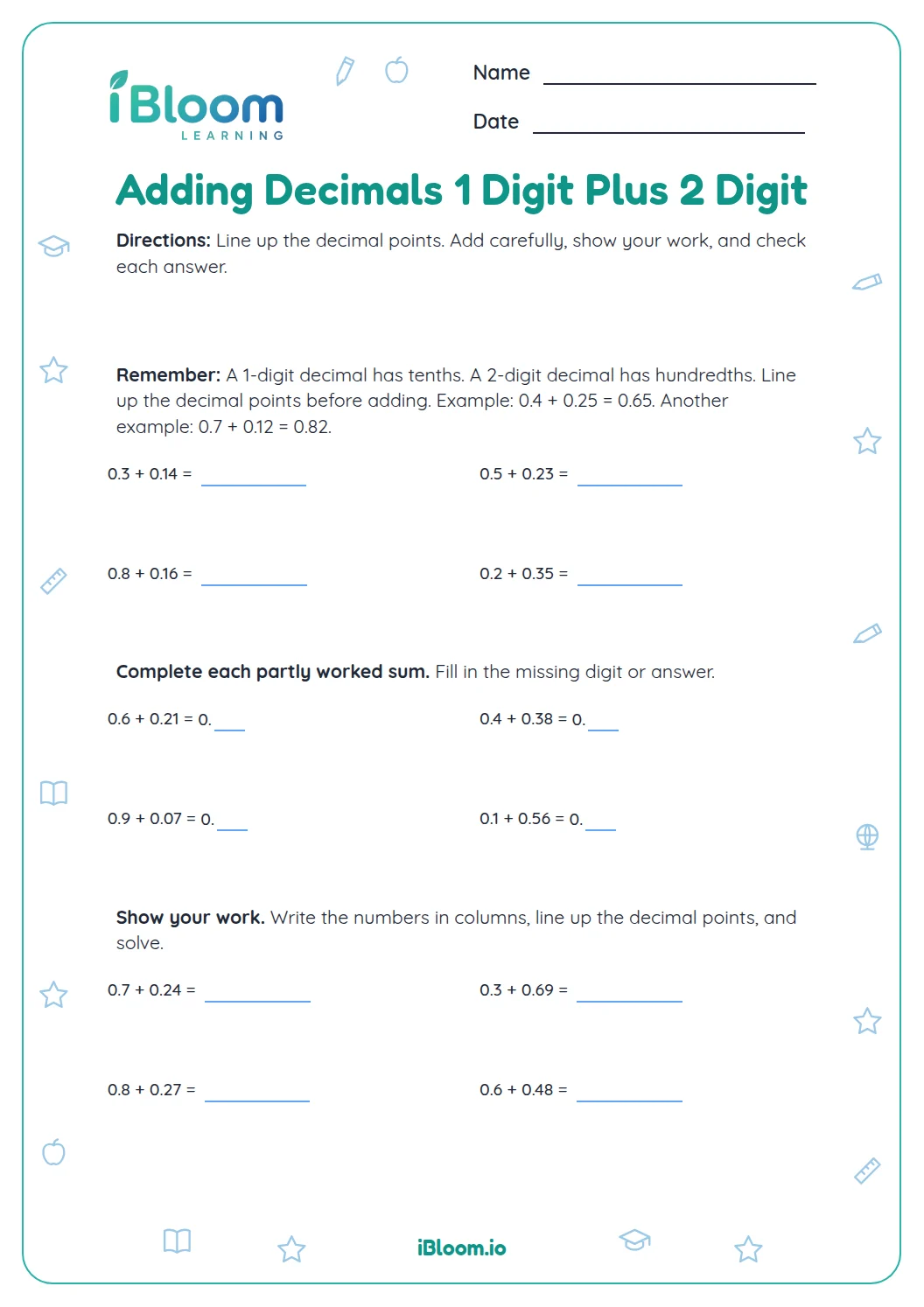
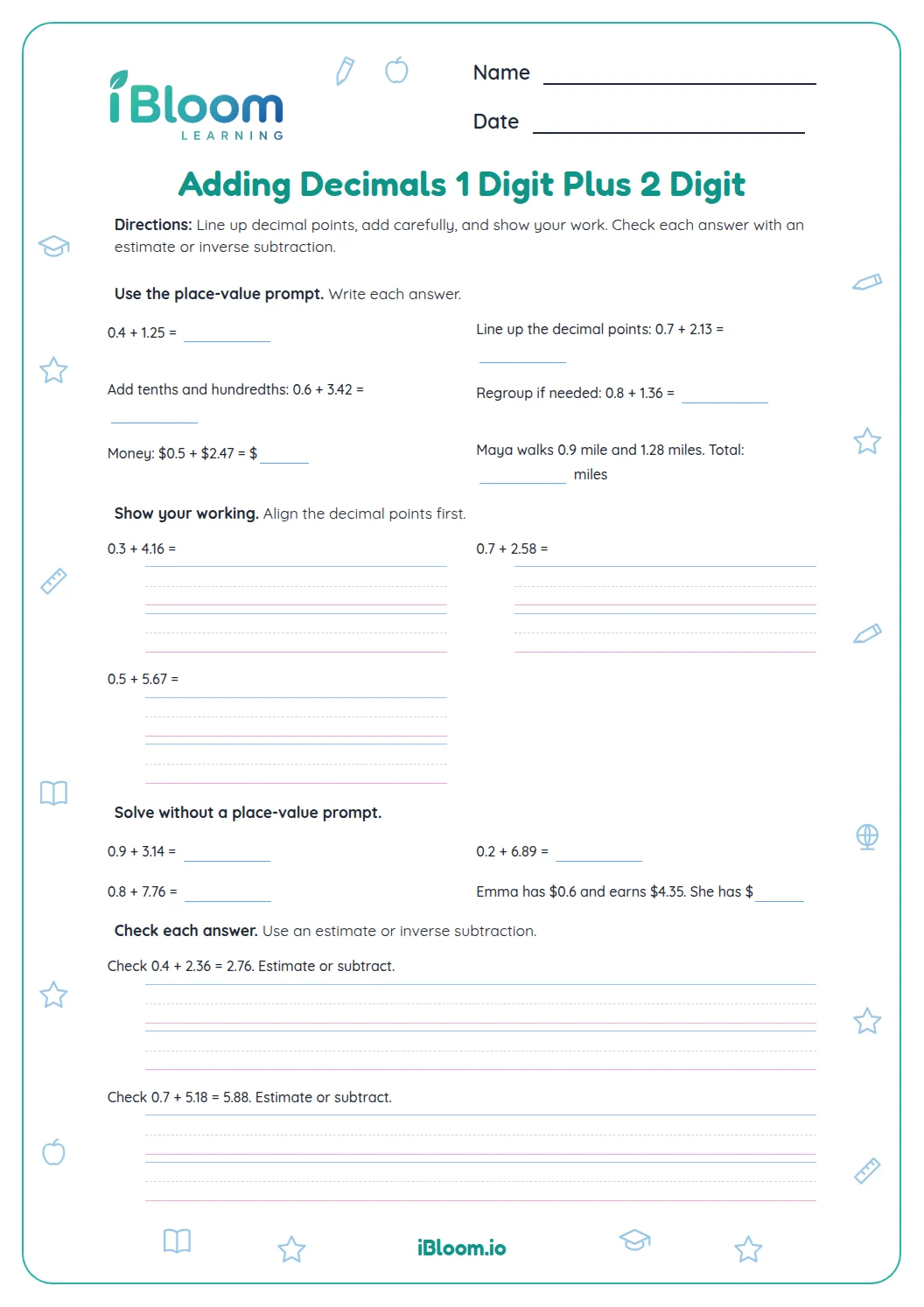
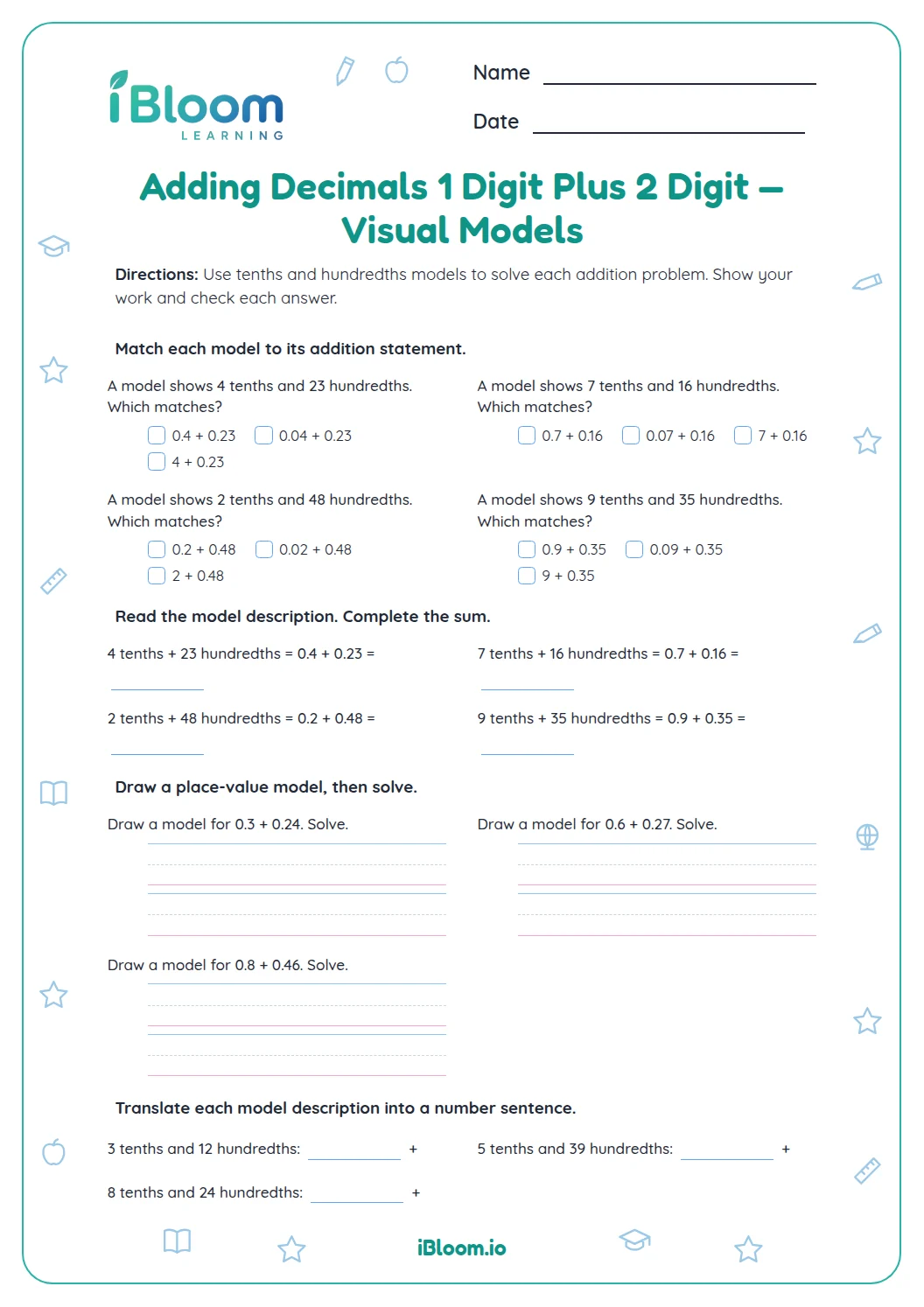
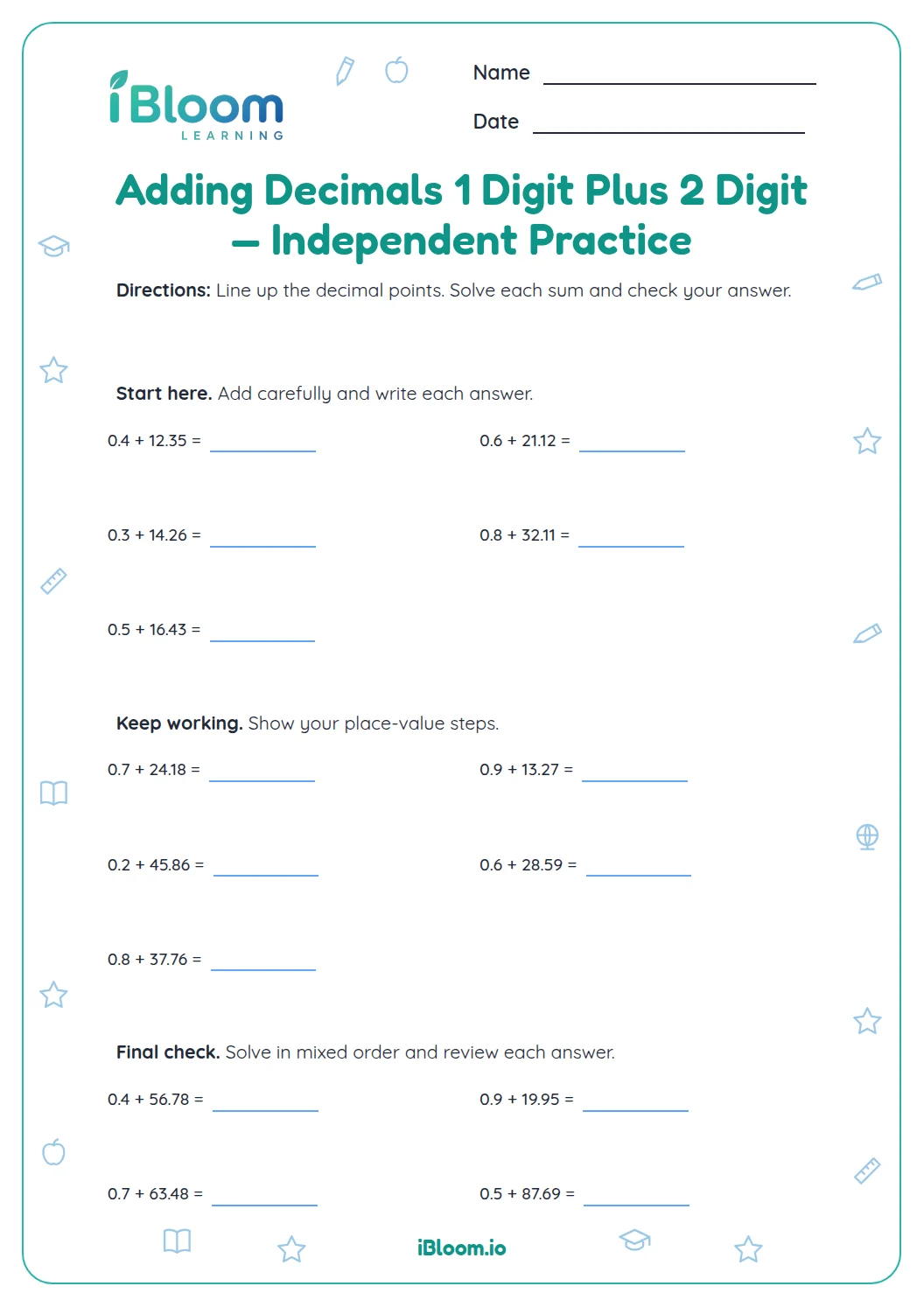
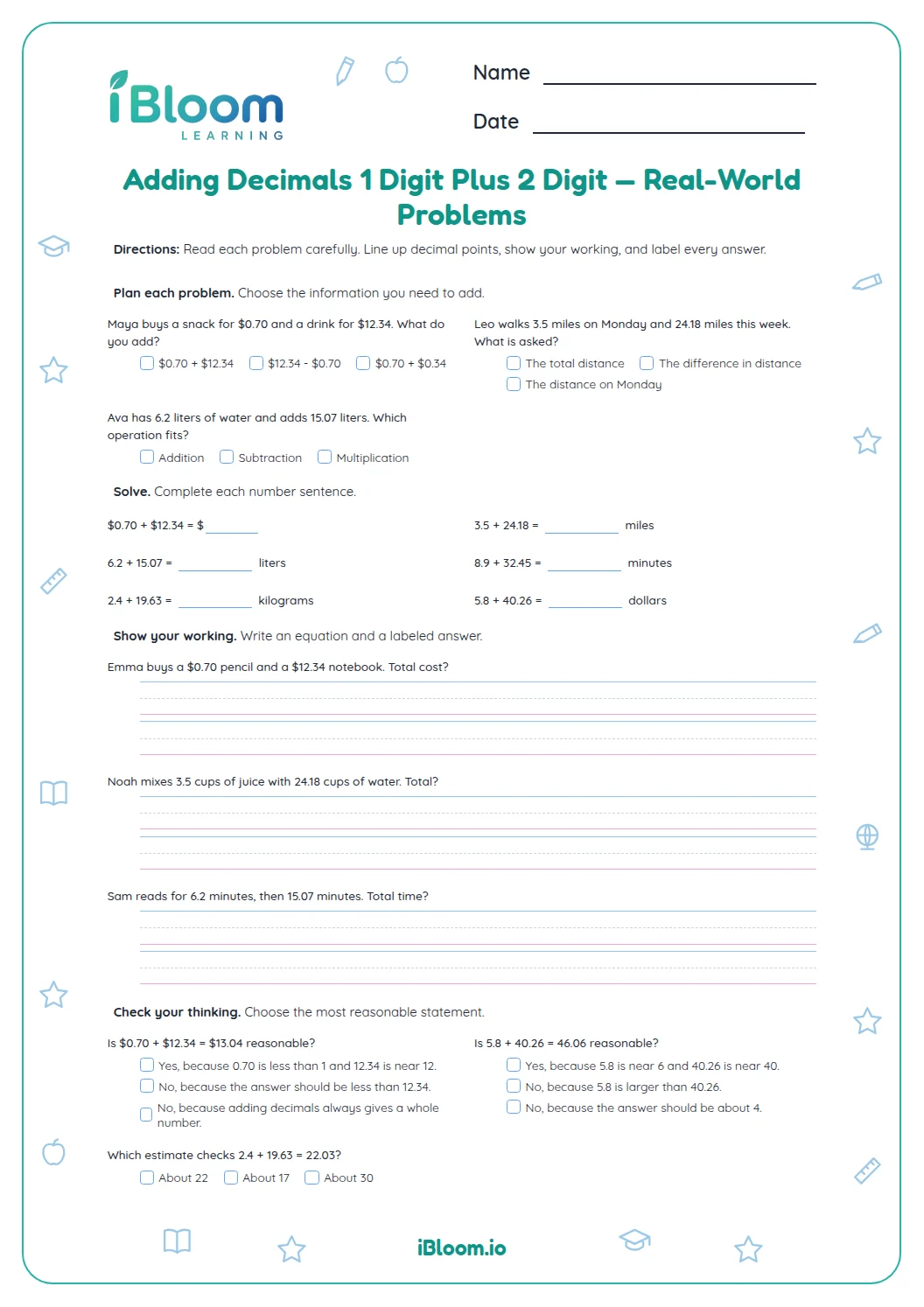
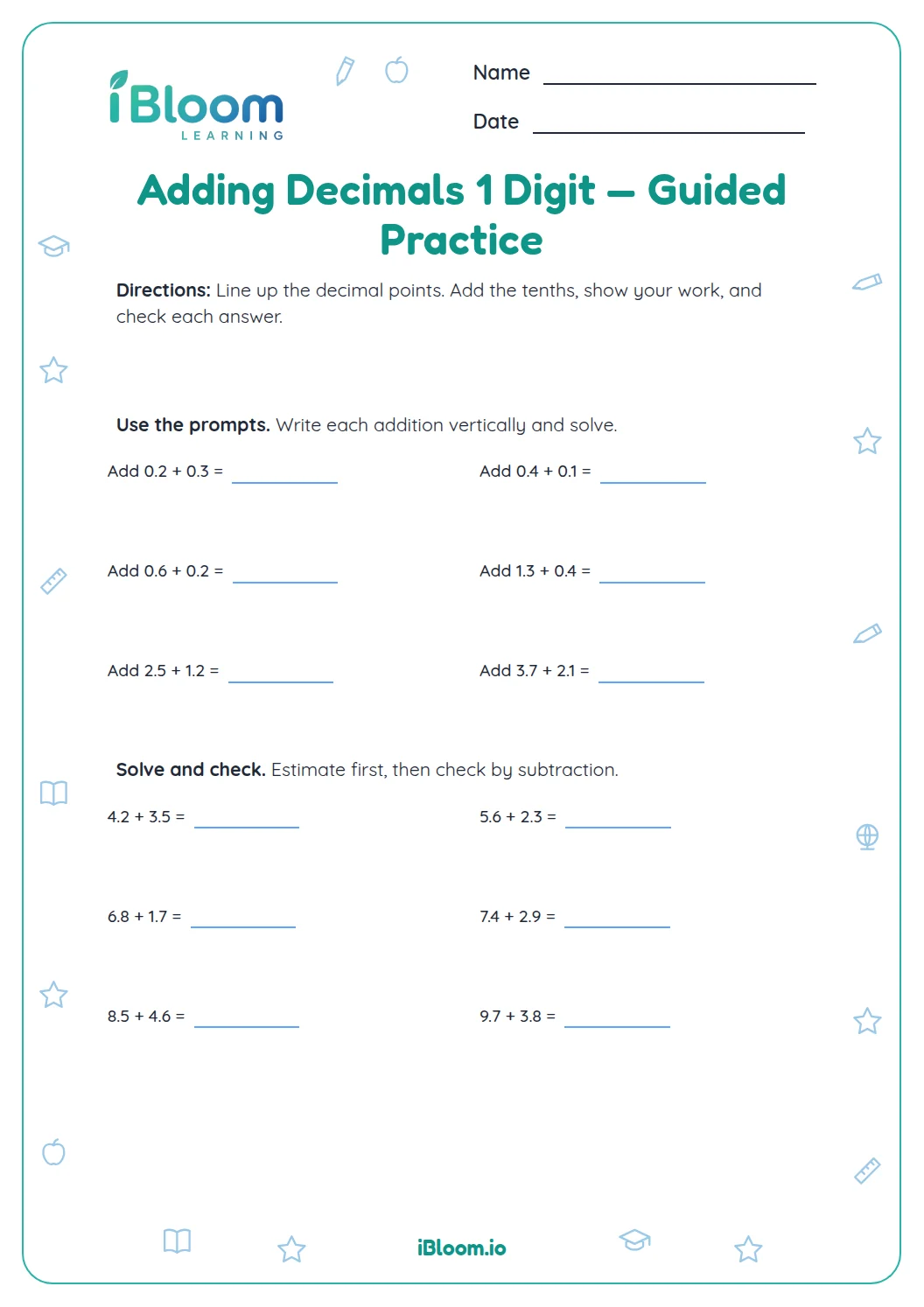
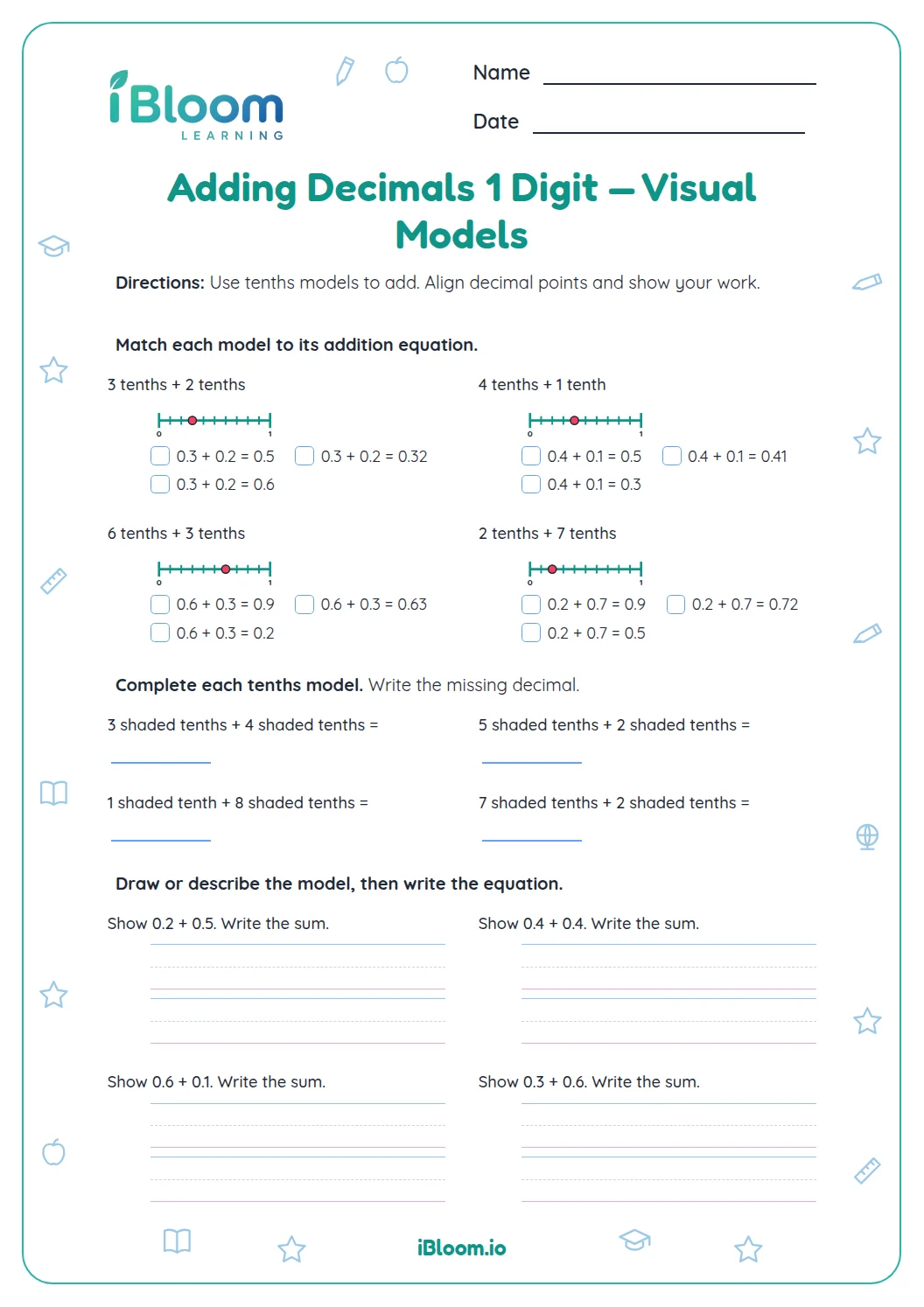
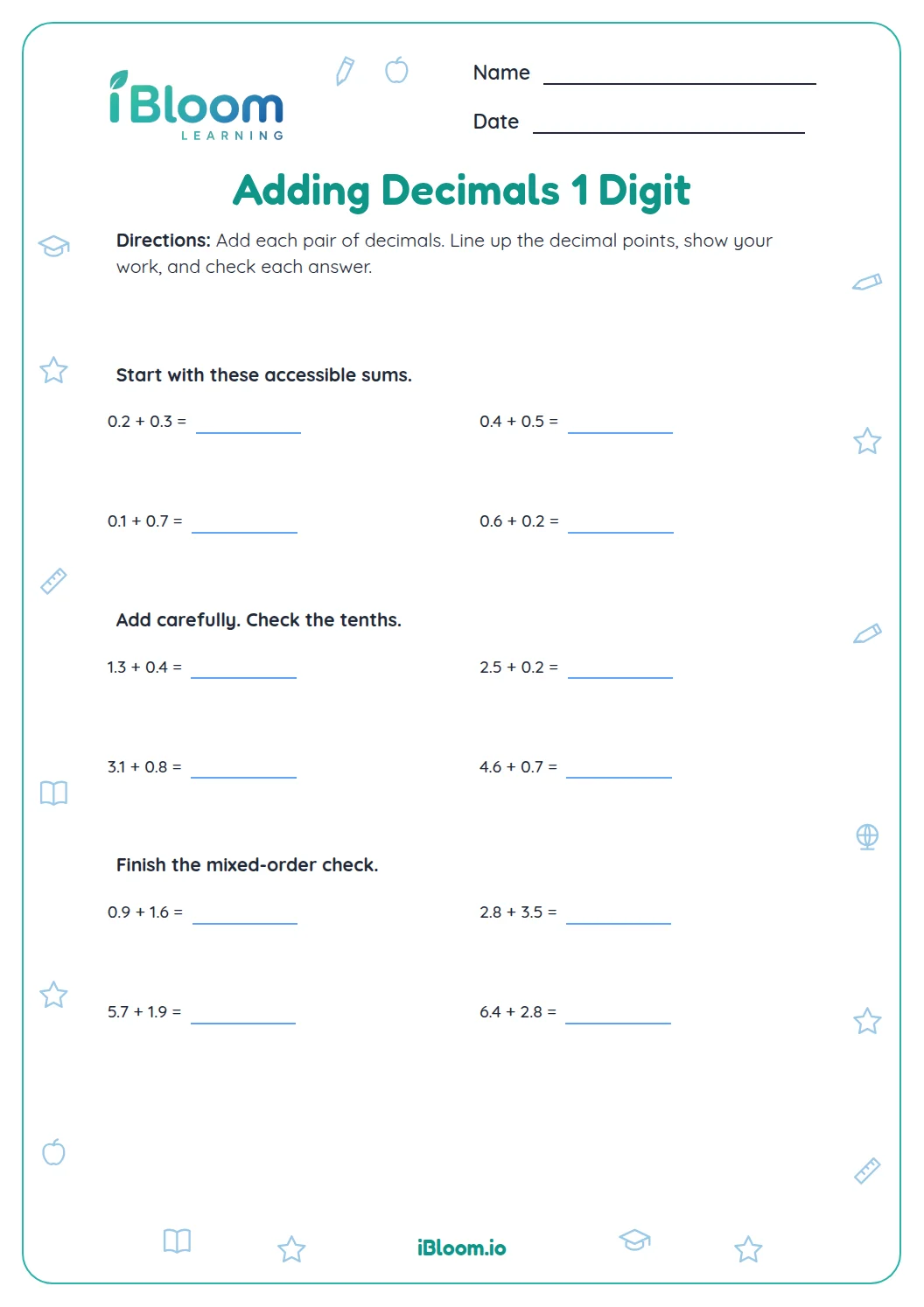
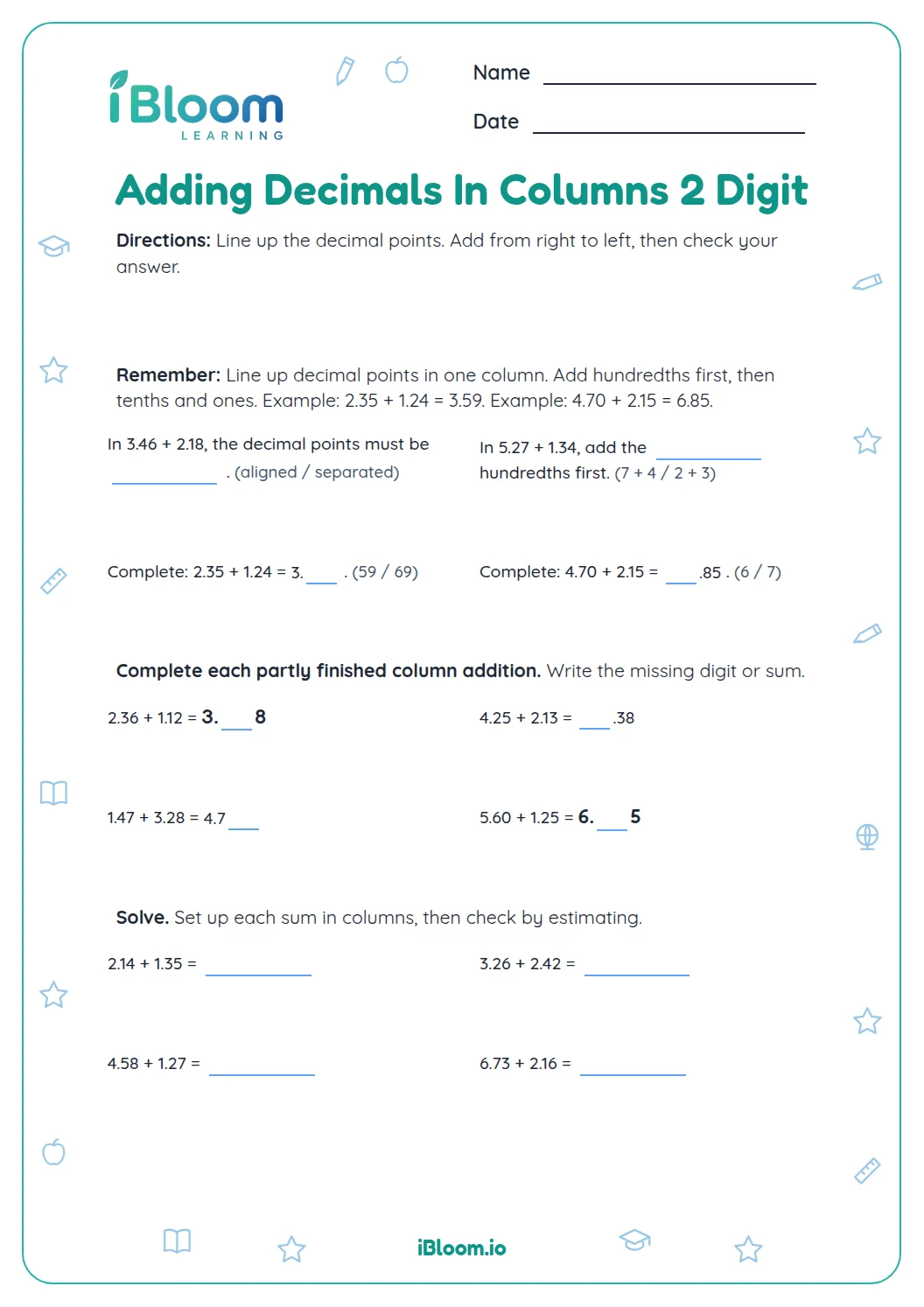
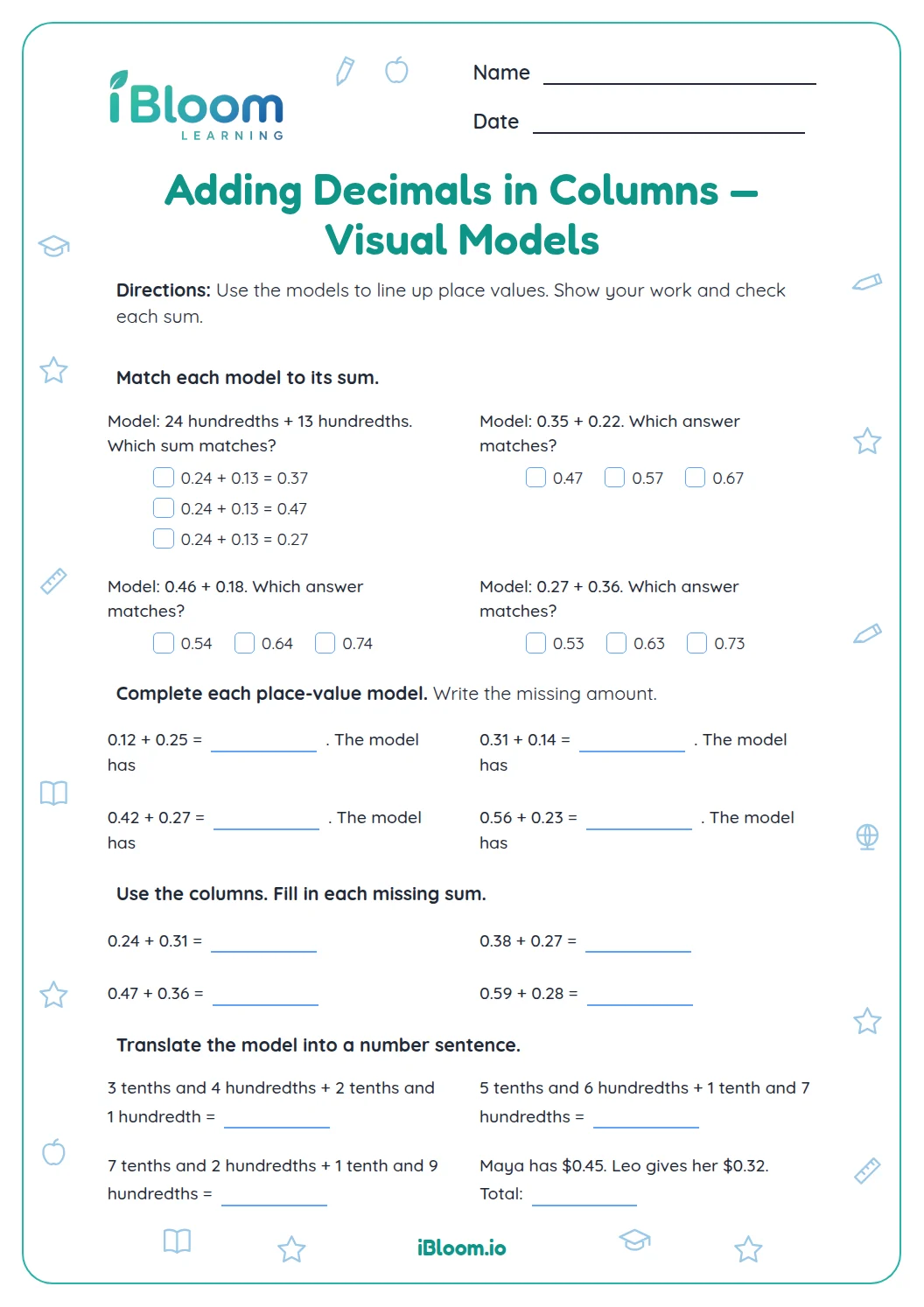
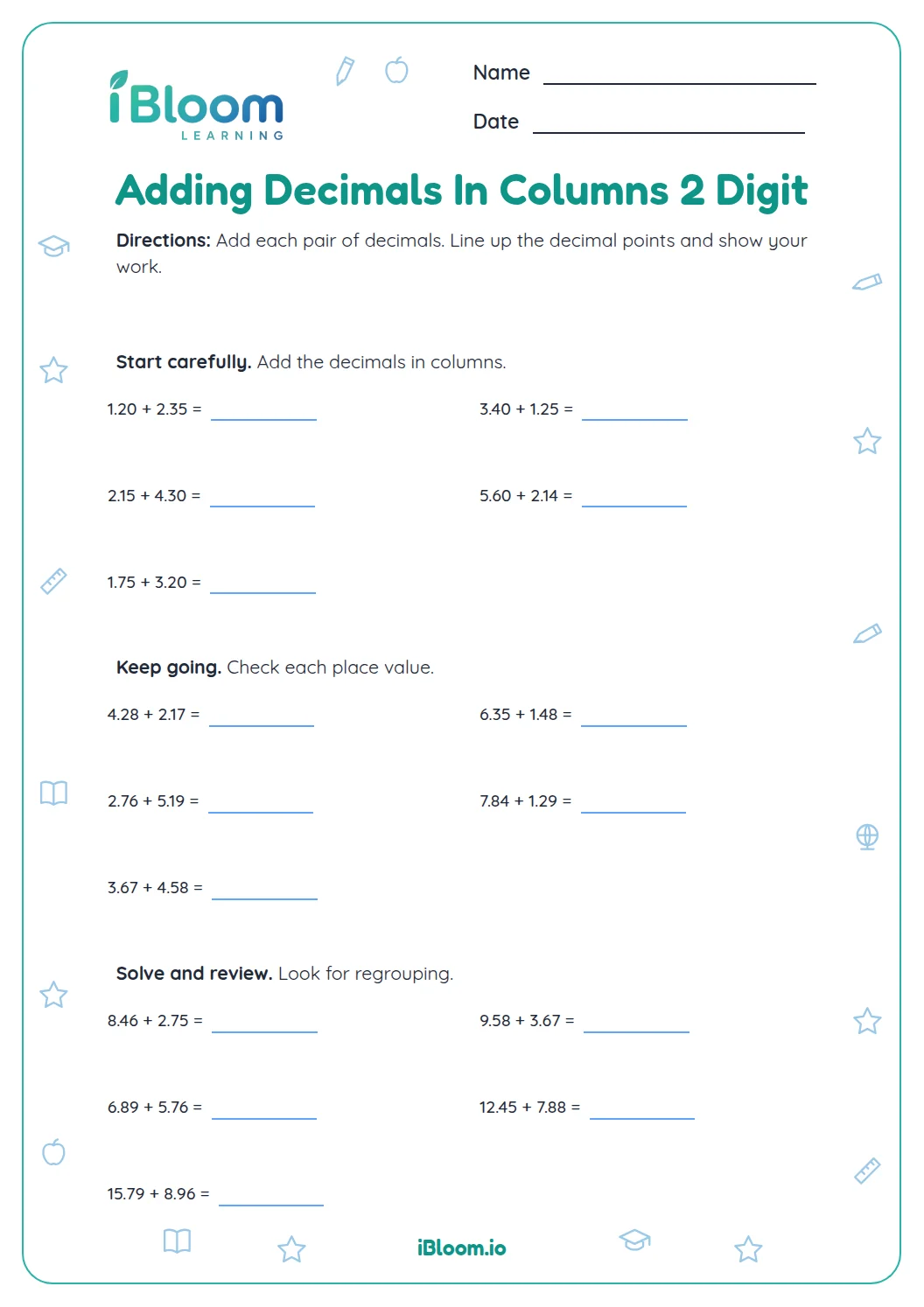
This Grade 4 worksheet practices adding tenths and hundredths. Students align decimal points, add by place value, compare two sums, and check a worked error. The separate answer key supports review of all 20 questions.
Aligned to 5.NBT.B.7
How do you align tenths and hundredths?
Match each decimal place before adding. A trailing zero can show the same number of places in both addends.
- 10.4 + 1.26
- 20.40 + 1.26 = 1.66
How can you compare two sums?
Compare like place values or calculate each total. Keeping the decimal points aligned helps identify which total is larger.
- 12.6 + 5.74 = 8.34
- 22.6 + 5.47 = 8.07
- 3The first sum is greater.
How can you check an addition error?
Align the decimal points and add again. Estimating first can also show when a proposed answer is far from the expected total.
- 13.7 + 4.36
- 23.70 + 4.36 = 8.06
A way to work through the sheet
- 1Read each addend and identify its tenths and hundredths.
- 2Write a trailing zero when it helps match decimal places.
- 3Align decimal points before adding.
- 4Estimate the total and compare it with your exact answer.
- 5For the comparison, calculate or align both expressions before choosing.
Check for these slips
The mistake
Adding digits without lining up place values
The fix
Align the decimal points first.
The mistake
Treating 0.4 and 0.40 as different amounts
The fix
Remember the trailing zero names zero hundredths.
The mistake
Accepting an answer far from the estimate
The fix
Recheck the decimal point and each column.
Curriculum alignment
Add decimals to hundredths using place value and equivalent forms.
On this sheet: Questions add tenths and hundredths by aligning place values and use estimates to check results.
Show the official wordingHide the official wording
Add, subtract, multiply, and divide decimals to hundredths, using concrete models or drawings and strategies based on place value, properties of operations, and/or the relationship between addition and subtraction; relate the strategy to a written method and explain the reasoning used.
What to practice next
Make more practice
Further reading
Questions parents and teachers ask
How do I add decimals with different lengths?
Write a zero to show equal decimal places, then align the decimal points and add each place value. For example, 0.4 can be written as 0.40 before adding 1.26. The zero changes the way the number is written, not its value.
Why does adding a zero not change the value?
A zero at the end of a decimal is a placeholder that names the same amount in another way. Four tenths and forty hundredths are equal, so 0.4 and 0.40 have the same value. Matching places can make the addition easier to organize.
How can estimation help check a sum?
Round each addend to a nearby tenth or whole number to estimate the total. Compare the estimate with the exact answer to catch a misplaced decimal point or an addition slip. The page also asks students to compare sums and examine a worked error.
What does the error question ask students to notice?
It presents a student’s incorrect result for 3.7 + 4.36 and asks for the correct sum. Aligning 3.70 and 4.36 shows why the total is 8.06. Students can compare their calculation with the offered choices and identify the accurate result.
What kinds of decimals appear on this sheet?
Each addition item combines a number written in tenths with one written in hundredths. The questions include sums below and above 10, a comparison between two totals, and an error check. The answer key provides the result for every item.