



About this worksheet
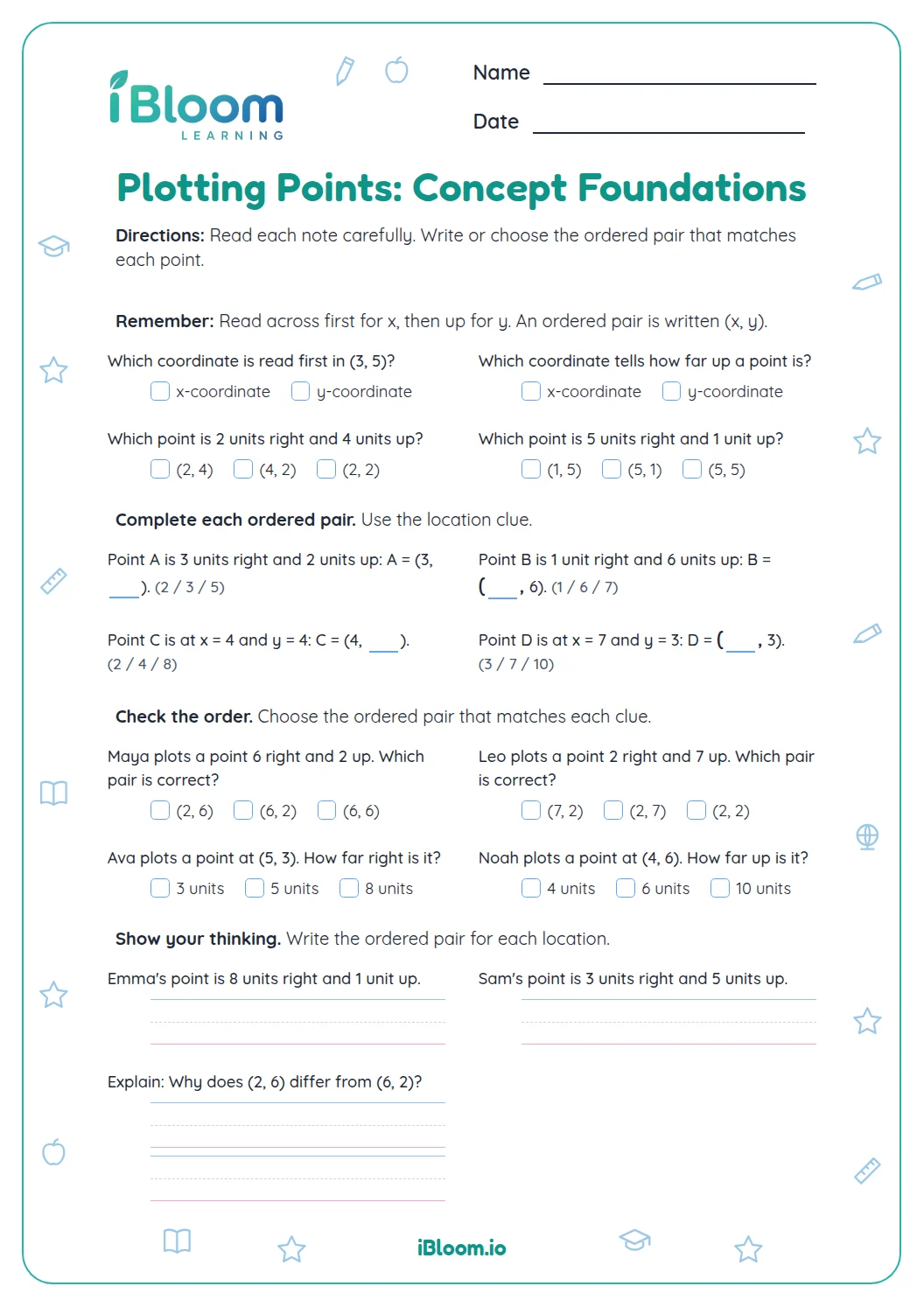
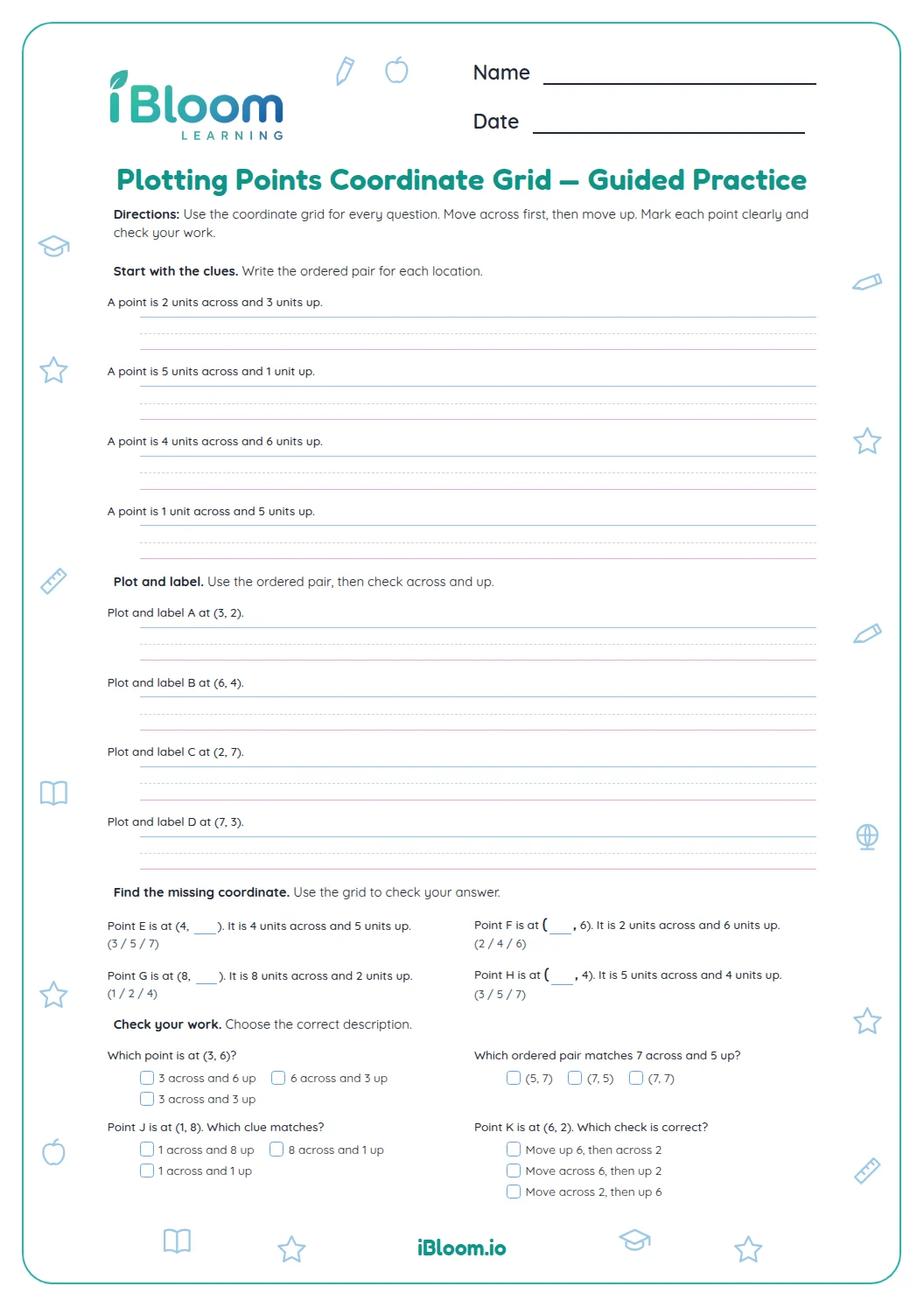
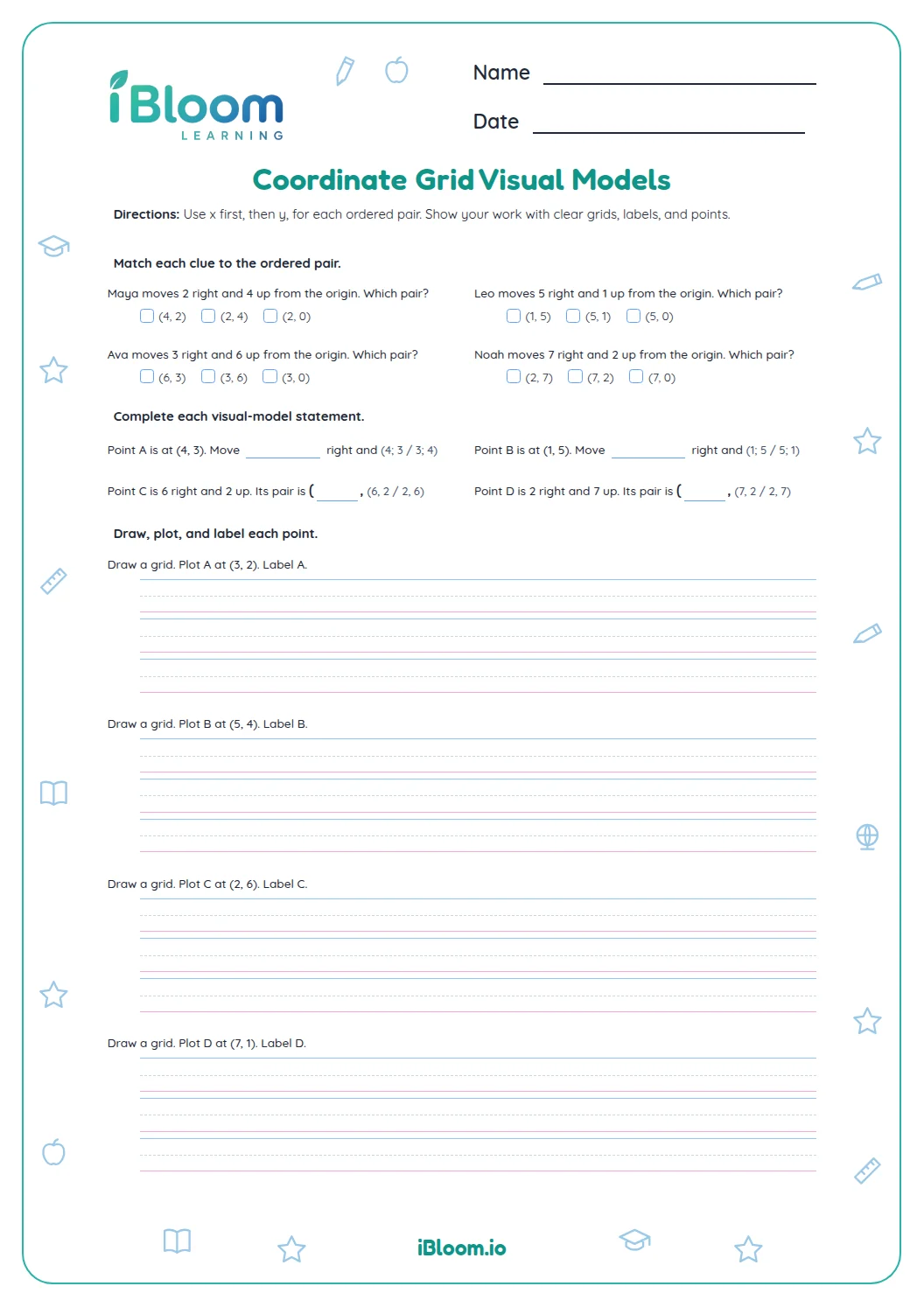
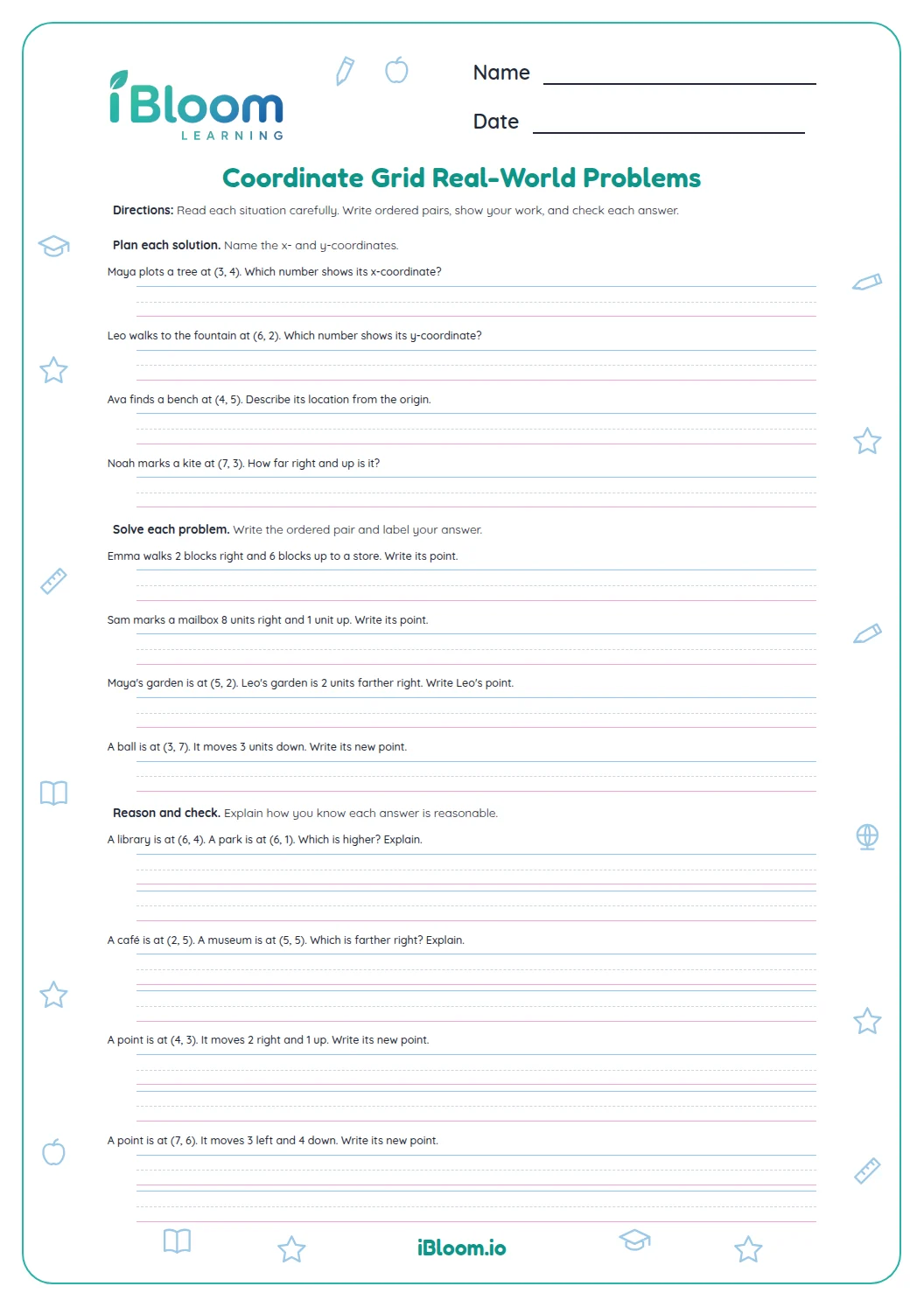
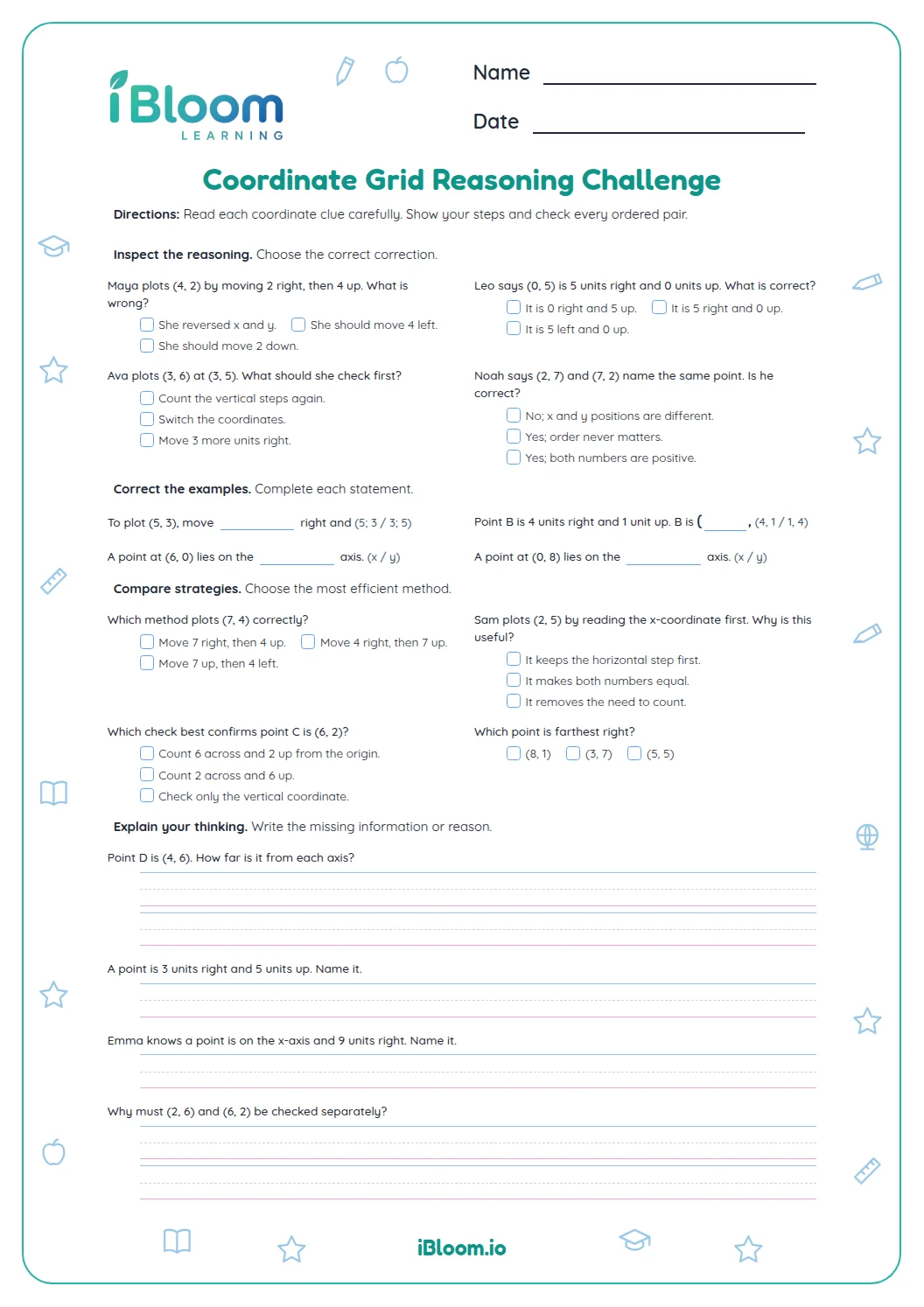
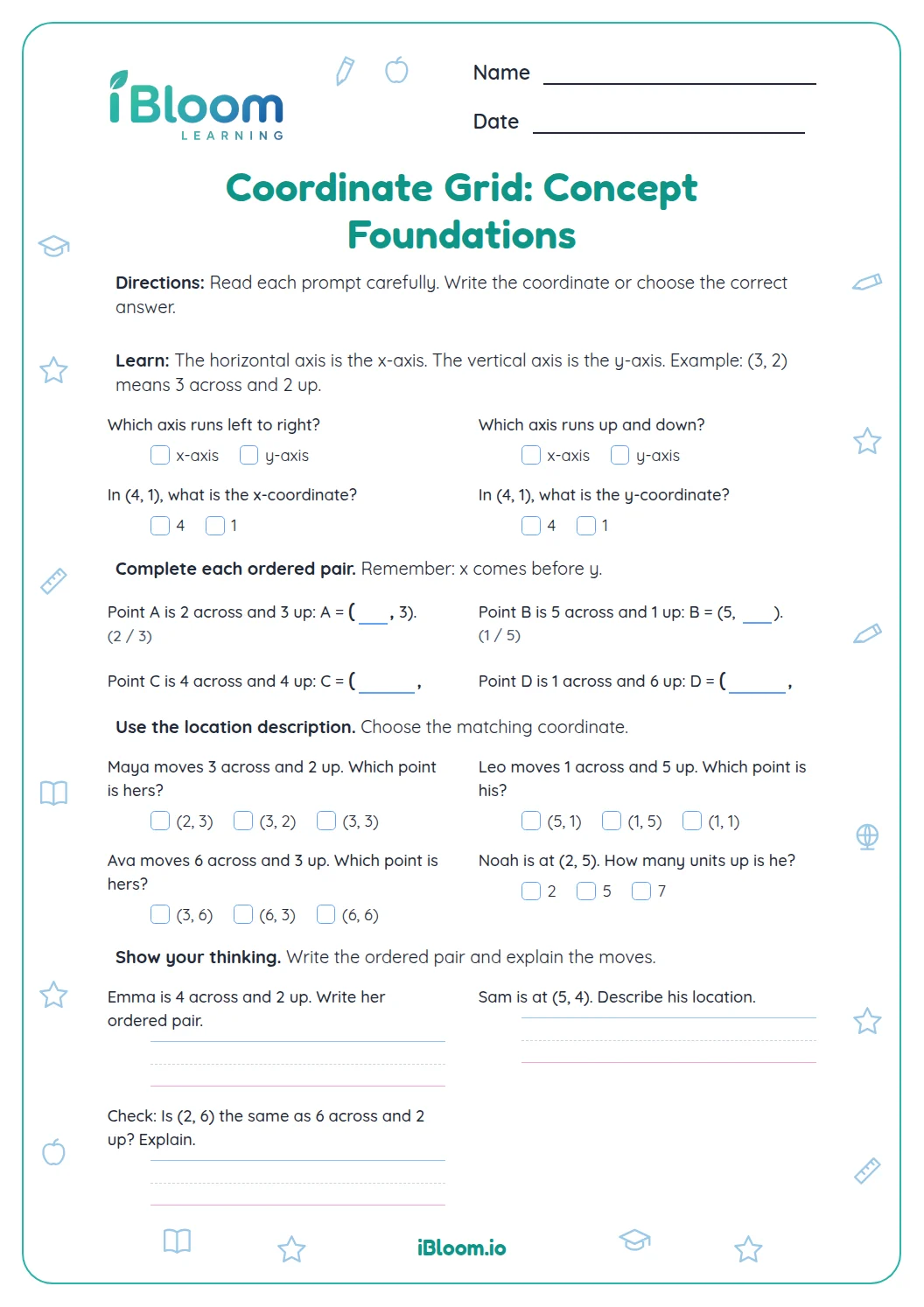
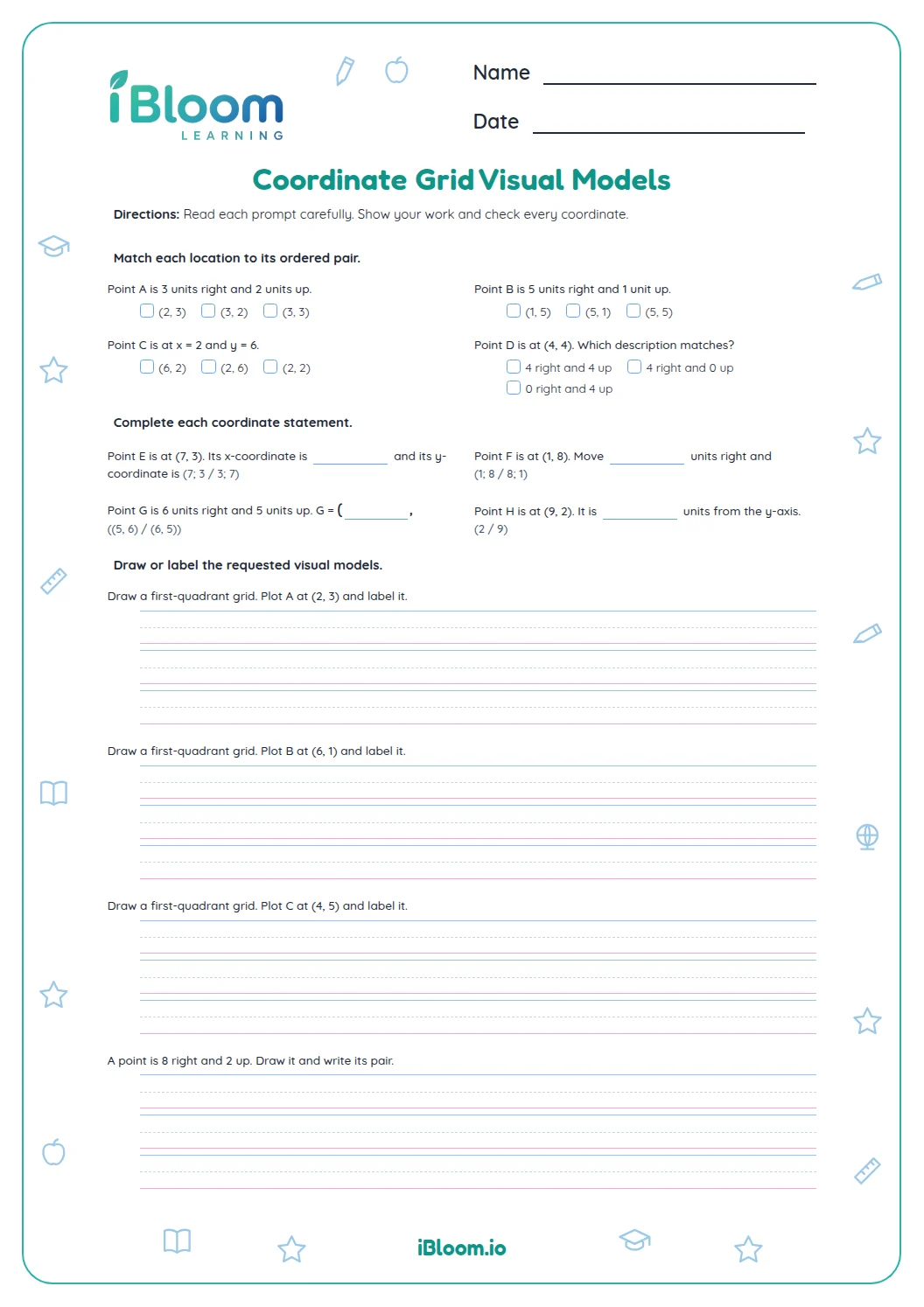
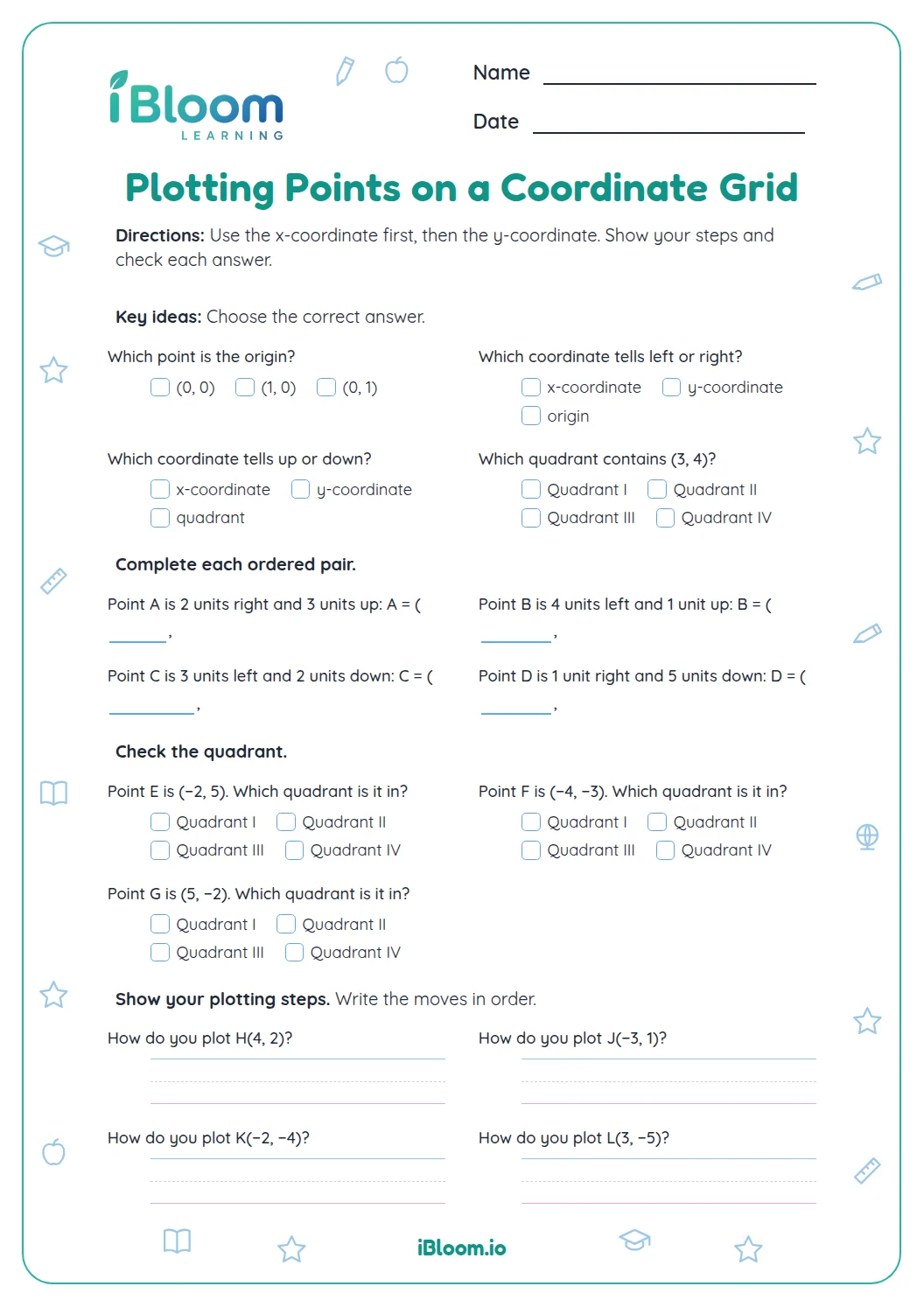
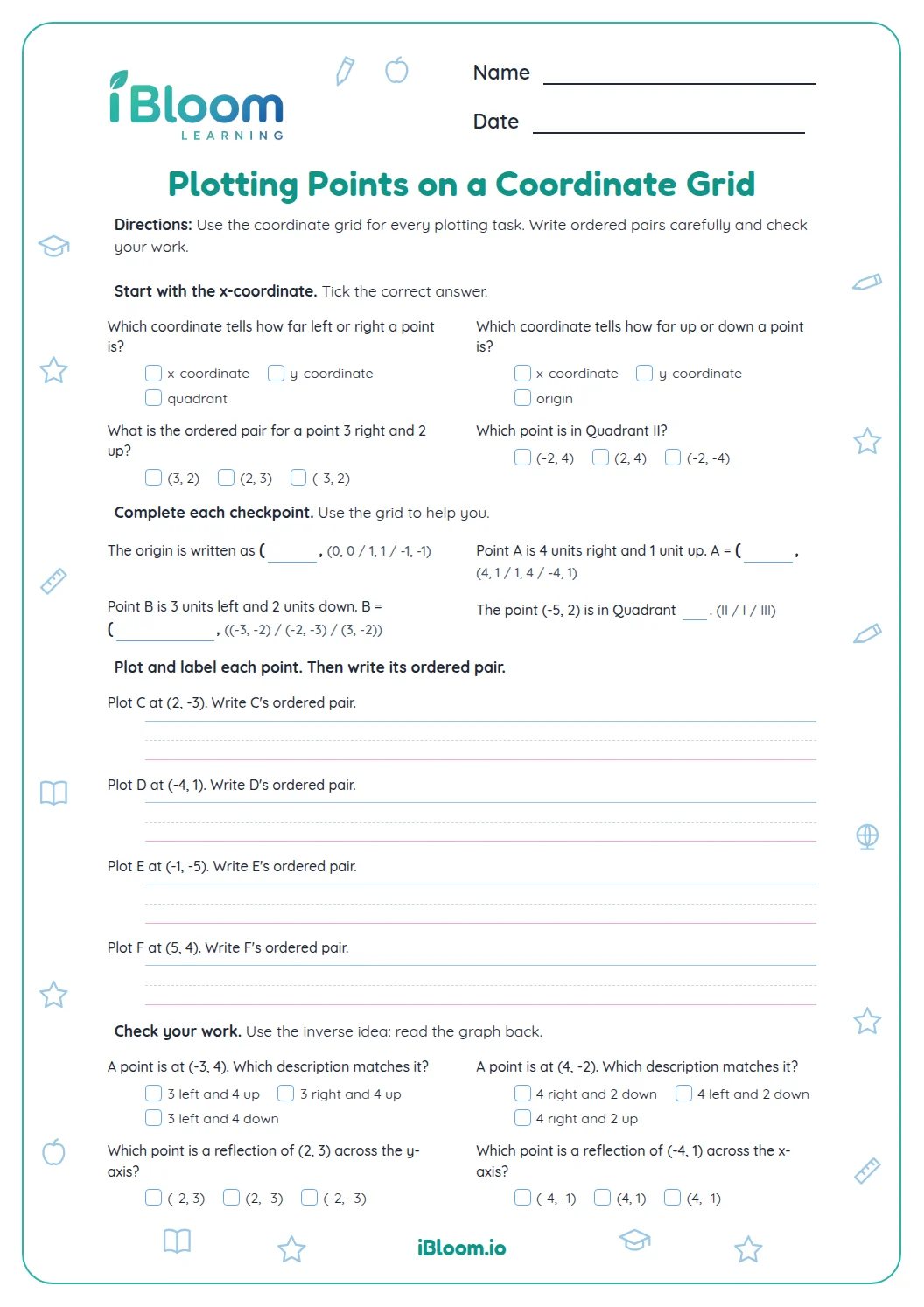
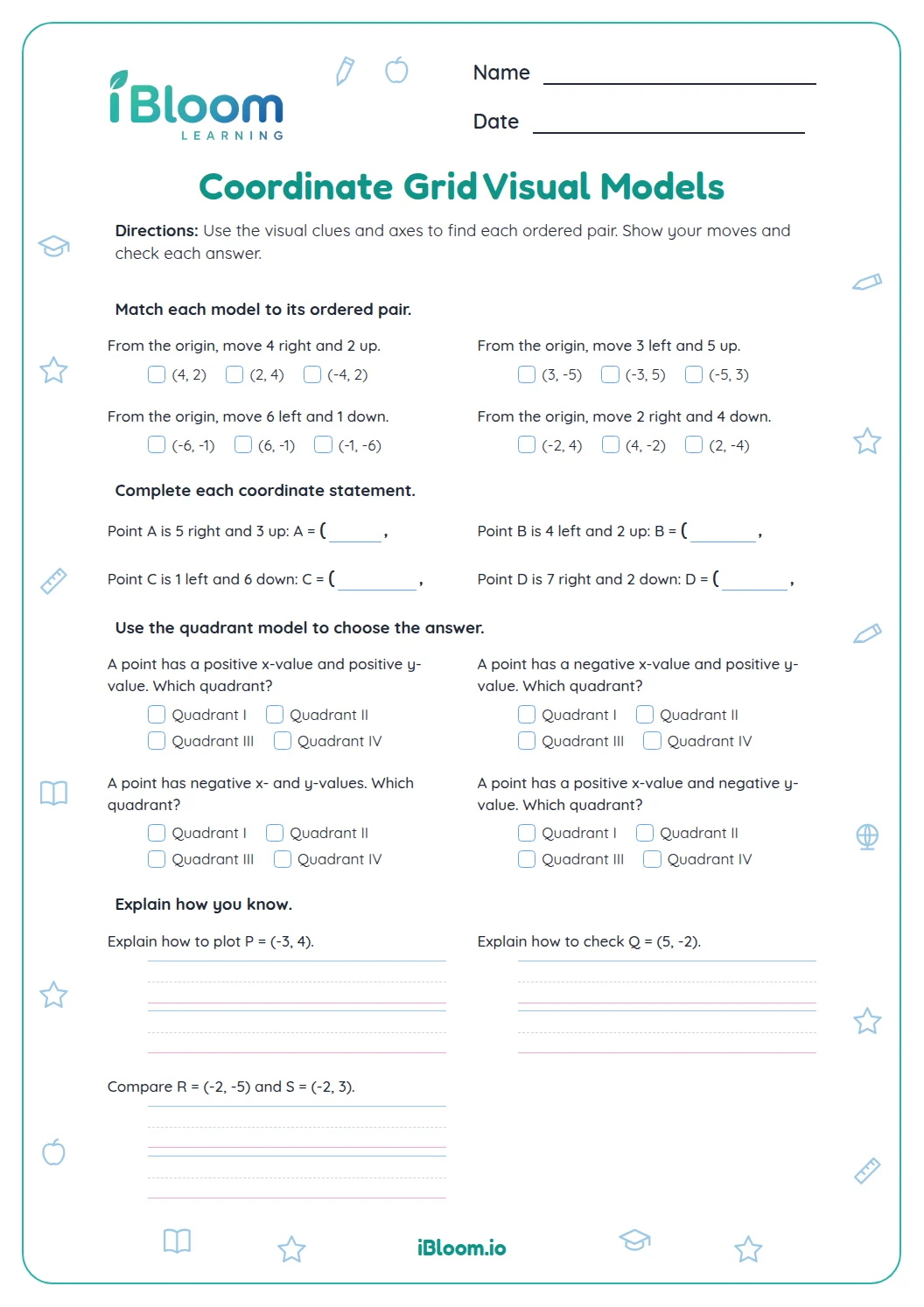
This Grade 5 independent practice page uses one first-quadrant grid with ten labeled points. Students record their ordered pairs and complete 13 short questions about reading and comparing coordinates. The answer key shows the plotted locations and each response. This work practices CCSS 5.G.A.1 and 5.G.A.2.
Aligned to 5.G.A.1 and 5.G.A.2
How do you plot an ordered pair?
Start where the axes meet. Move across by x, then up by y, and mark the intersection.
- 1For B (3, 4), move right 3 units.
- 2Then move up 4 units and label the point B.
How can you check a plotted point?
Check the horizontal coordinate first and the vertical coordinate second. Compare each position on the grid with the ordered pair.
Which coordinate helps compare points?
Use x-values to compare left and right, and y-values to compare height. Change only the coordinate named by a move.
How to plot and check
- 1Locate the origin at (0, 0).
- 2Read x and move right that many spaces.
- 3Read y and move up that many spaces.
- 4Mark and label the intersection.
- 5Check both coordinates against the pair.
Common mistakes and quick fixes
The mistake
Reversing x and y.
The fix
Say “across, then up” before plotting each pair.
The mistake
Starting from the end of an axis instead of the origin.
The fix
Find the point where both axes begin; use it as the starting point.
The mistake
Counting grid lines instead of spaces.
The fix
Count each unit interval as one move, starting with the first space after zero.
Common Core alignment
Use perpendicular axes and ordered pairs to name points on a coordinate grid.
On this sheet:
Show the official wordingHide the official wording
Understand that a two-dimensional coordinate system is defined by a pair of perpendicular number lines, called axes, that intersect at the origin (the 0 point on each line). Understand that the point where the axes intersect is called the origin, and that the numbers on the coordinate grid are called coordinates.
Graph and interpret first-quadrant points in mathematical problems.
On this sheet:
Show the official wordingHide the official wording
Represent real world and mathematical problems by graphing points in the first quadrant of the coordinate plane, and interpret coordinate values of points in the context of the situation.
What to practice next
Make more practice
Further reading
Questions parents and teachers ask
How many points are on the grid?
One first-quadrant grid shows ten labeled points. Students record each ordered pair, then answer 13 short questions about reading and comparing coordinates. The separate answer key includes the plotted grid so learners can check the point locations as well as their written responses.
Which number do I use first?
Use x first. Move horizontally to the right from the origin by that many units, then use y to move upward. For (3, 4), move right 3 and up 4 before marking the point. Say “across, then up” while tracing the two moves.
What is the origin?
The origin is where the horizontal and vertical axes meet, at (0, 0). Find it before plotting each pair. Count unit spaces from zero along the axes rather than counting the grid lines. It is the starting point for every plotted coordinate.
Does the answer key show the plotted locations?
Yes. The separate key repeats the grid with all ten labeled locations plotted and gives the ordered pair for each label. Students can compare the horizontal and vertical positions with their written responses, then check the remaining coordinate questions.
How can I check a point I plotted?
Begin at the origin and count spaces right for x, then up for y. The final intersection should match the ordered pair in that order. For (3, 4), the point is three spaces right and four spaces up.