


About this worksheet
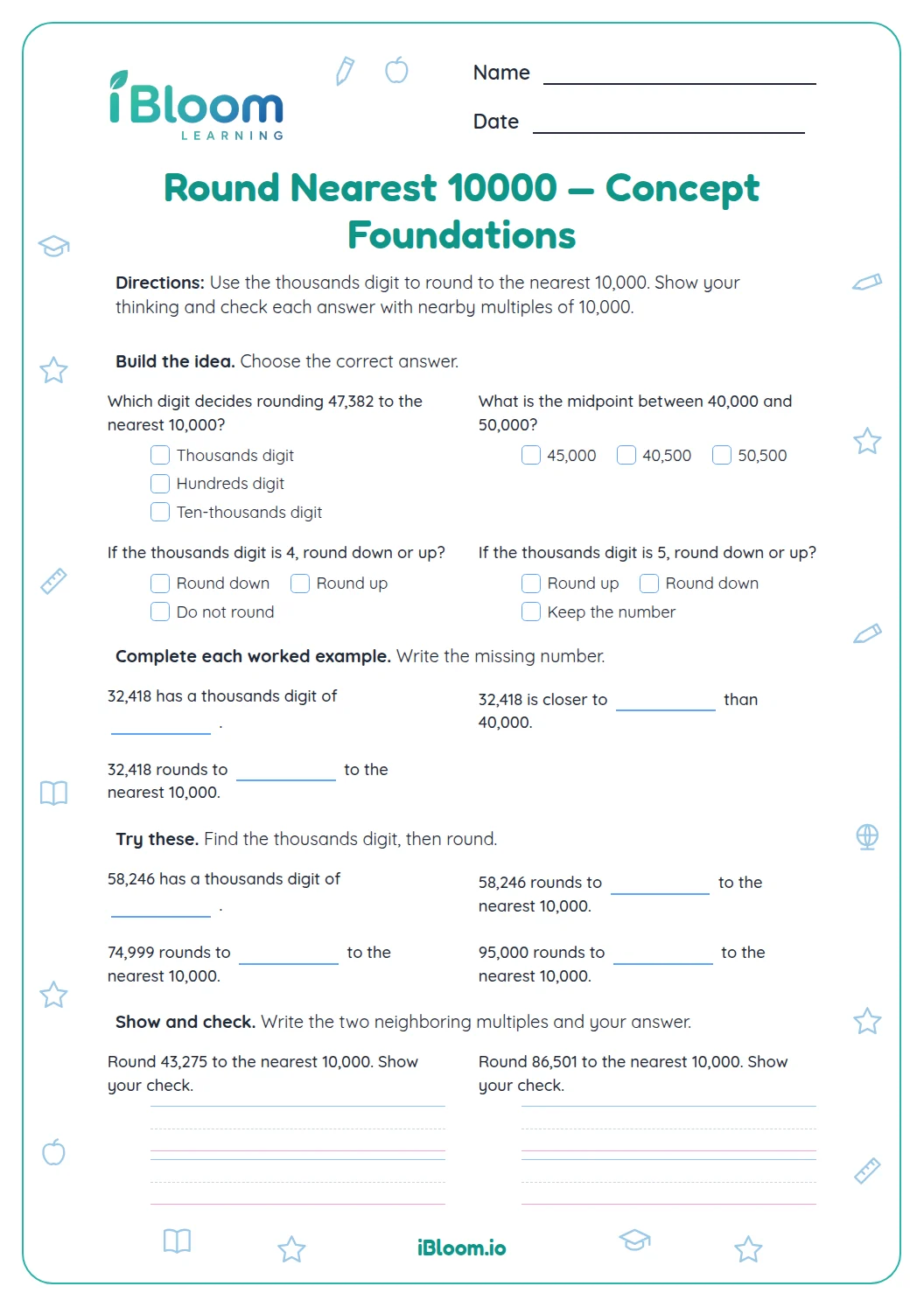
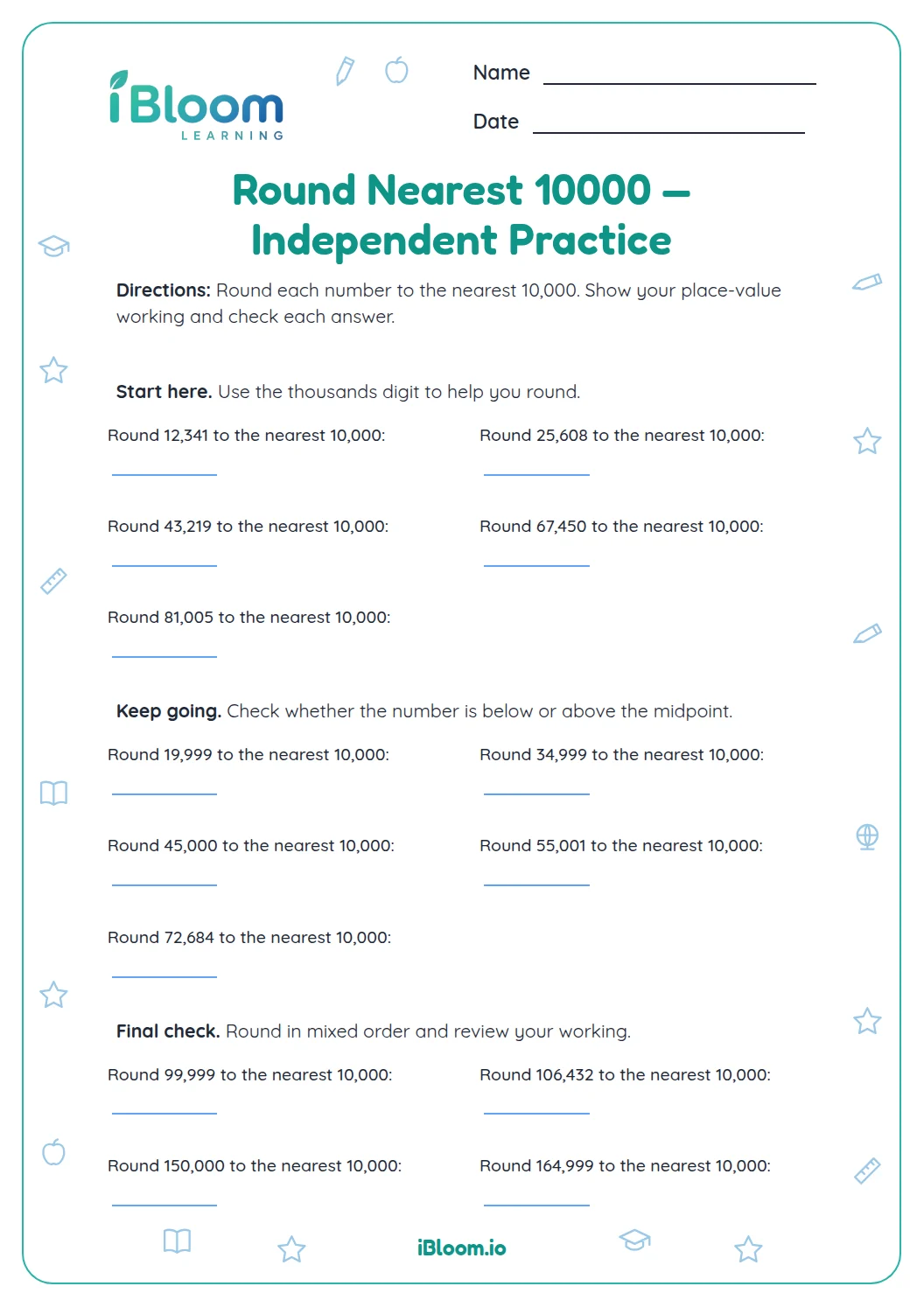
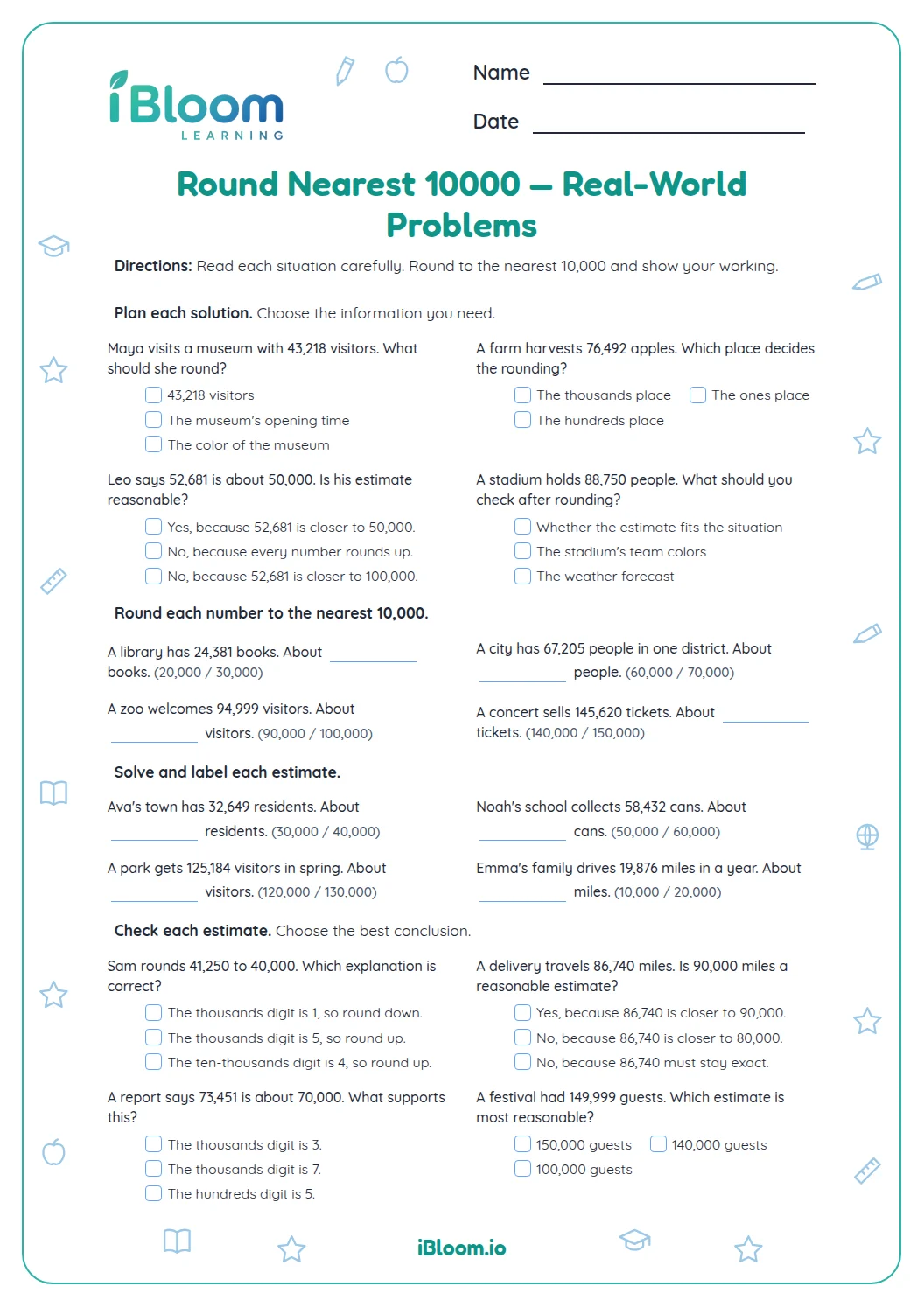
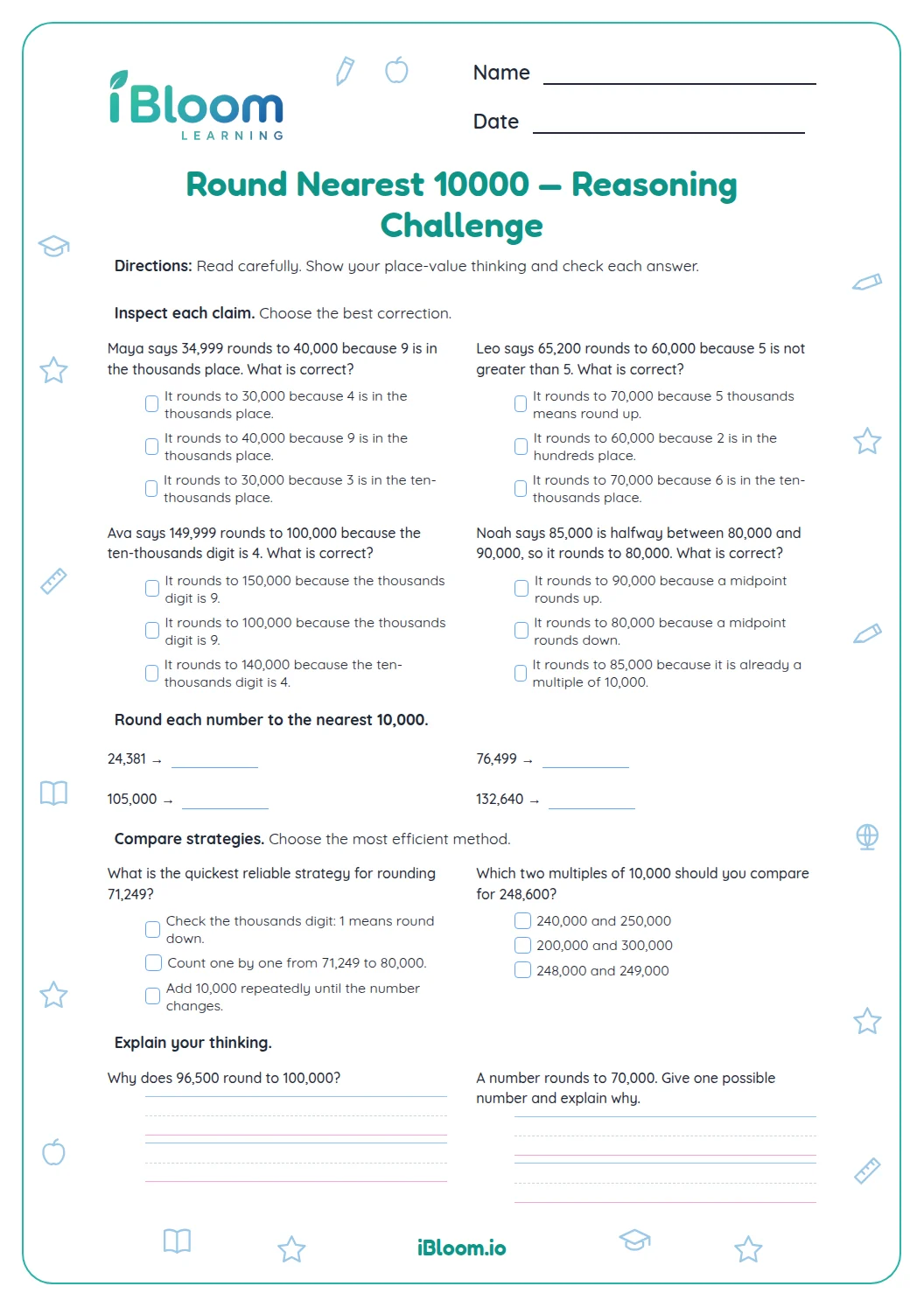
This Grade 4 guided practice starts with the thousands digit, then rounds whole numbers to the nearest 10,000. Students also find midpoints, estimate a stadium seating count and county population, and check rounding claims.
Aligned to 4.NBT.A.3
How do you round to the nearest 10,000?
Find the ten-thousand the number sits between. Look at the thousands digit: 0 through 4 means round down, while 5 through 9 means round up. Keep the ten-thousands digit and change the digits to its right to zeros.
For 43,286, the thousands digit is 3. Since 3 is below 5, 43,286 rounds down to 40,000. For 76,200, the thousands digit is 6, so it rounds up to 80,000.
What is on this worksheet?
The 16 questions progress from a place-value clue to rounding, midpoint reasoning, and estimates in context. The last items check rounding claims and identify the ten-thousands around a midpoint.
- Part A: identify the deciding digit
- Part B: round numbers and find a midpoint
- Part C: use rounding in estimates and check claims
- Answer key on a separate page
How can you check a rounding estimate?
For question 2, 61,742 lies between 60,000 and 70,000. The thousands digit is 1, so it rounds down to 60,000.
How to use this worksheet
- 1Find the two ten-thousands around the number.
- 2Look at the thousands digit.
- 3Round down for 0–4 or up for 5–9.
- 4Change all digits to the right of the ten-thousands place to zero.
- 5Check that the result is the nearer ten-thousand.
Common mistakes and quick fixes
The mistake
Looking at the hundreds digit instead of the thousands digit.
The fix
Use the digit immediately to the right of the ten-thousands place.
The mistake
Keeping nonzero digits after rounding.
The fix
Write zeros in every place to the right.
The mistake
Rounding down at a 5.
The fix
A thousands digit of 5 means round up.
Common Core alignment
This worksheet practices the listed Common Core skill at the stated grade.
Use place value to round multi-digit whole numbers to any place.
On this sheet: Every item rounds whole numbers to the nearest ten-thousand or reasons about that rounding.
Show the official wordingHide the official wording
Use place value understanding to round multi-digit whole numbers to any place.
What to practice next
Make more practice
Further reading
Questions parents and teachers ask
Which digit decides rounding to the nearest 10,000?
Look at the thousands digit, immediately to the right of the ten-thousands place. In 43,286 that digit is 3, so the number rounds down to 40,000. This worksheet starts with that clue and then asks children to round whole numbers and check estimates.
What happens at the midpoint between two ten-thousands?
A number exactly halfway between two ten-thousands rounds up to the greater ten-thousand. For example, 35,000 is halfway between 30,000 and 40,000, so it rounds to 40,000. The worksheet asks students to find a midpoint and apply this rounding rule.
Why do the digits to the right become zeros?
Rounding to the nearest 10,000 gives an estimate at that place. The digits in the thousands, hundreds, tens, and ones places become zeros, making the result a multiple of 10,000. For example, 61,742 rounds to 60,000. This makes the rounded value easy to read and compare with the original number.
Does the worksheet include an answer key?
Yes. The separate key gives the rounded value for each blank, the midpoint endpoints, and the responses to the rounding checks. A parent or teacher can use it to review the reasoning after the child has completed the two-page practice sheet.
How can a child check a rounding answer?
First find the two neighboring multiples of 10,000. Then check whether the original number is closer to the lower or higher value, remembering that a midpoint rounds up. Questions 11 and 12 apply this check to a stadium seating estimate and a county population estimate.