



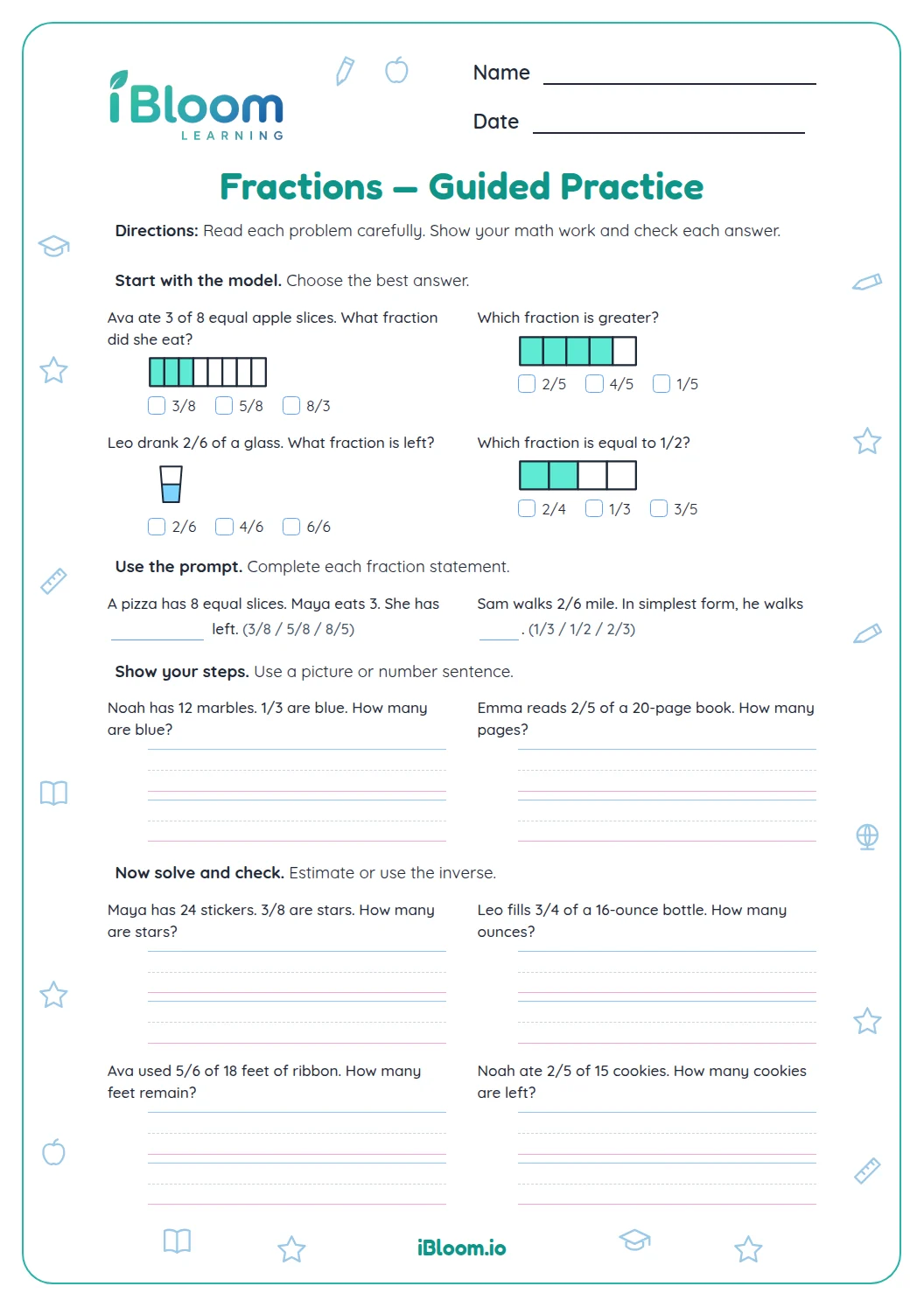

About this worksheet
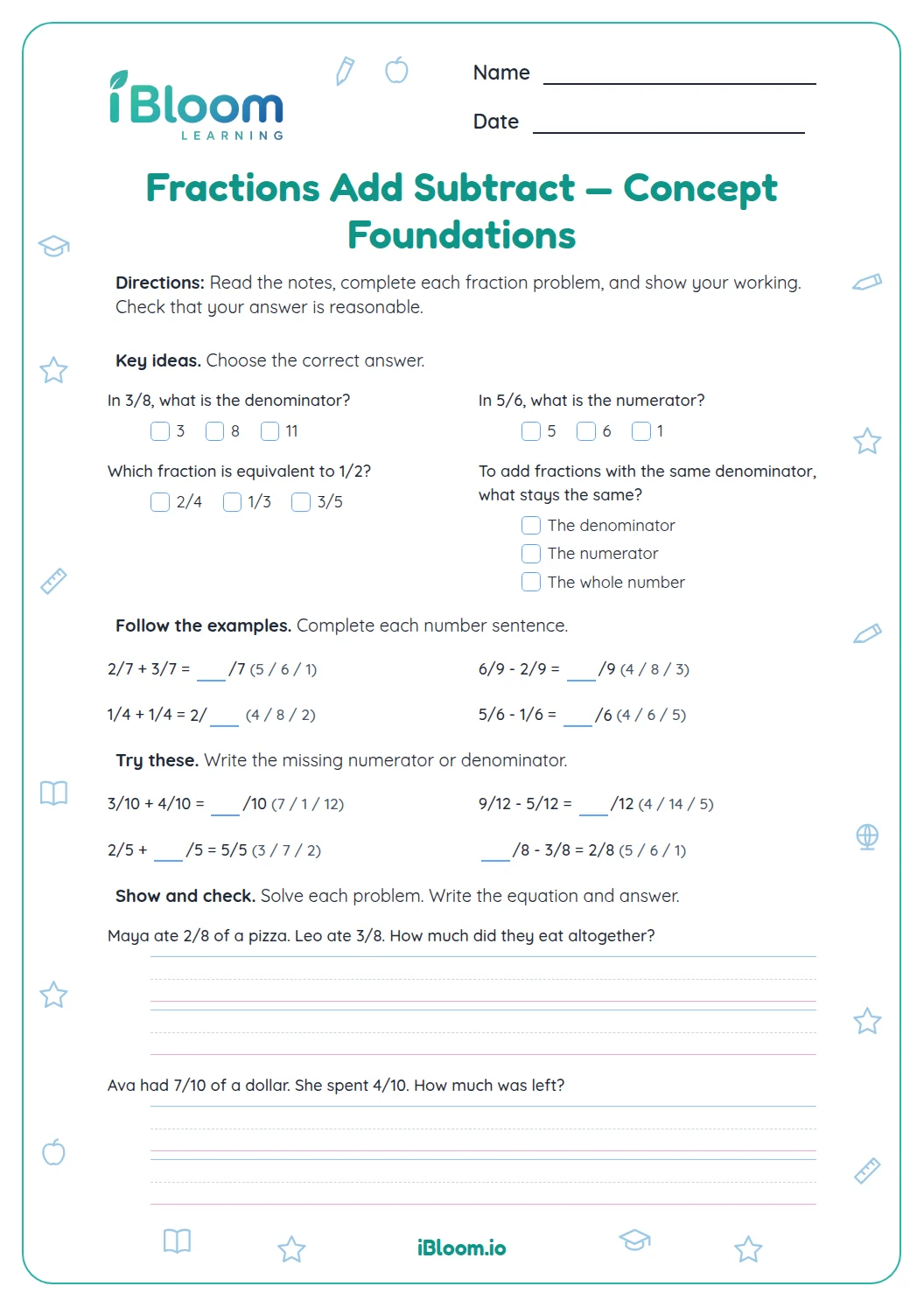
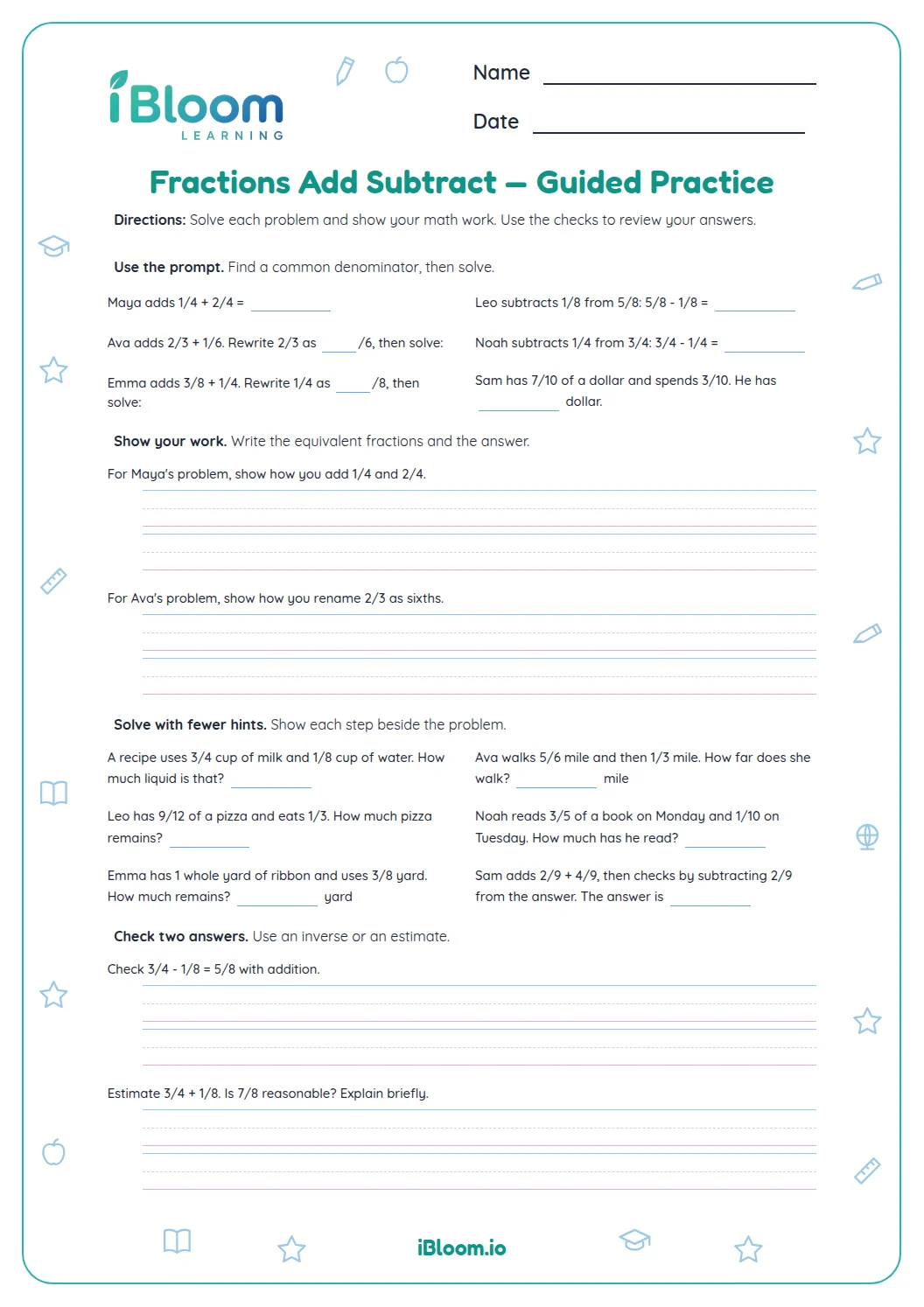
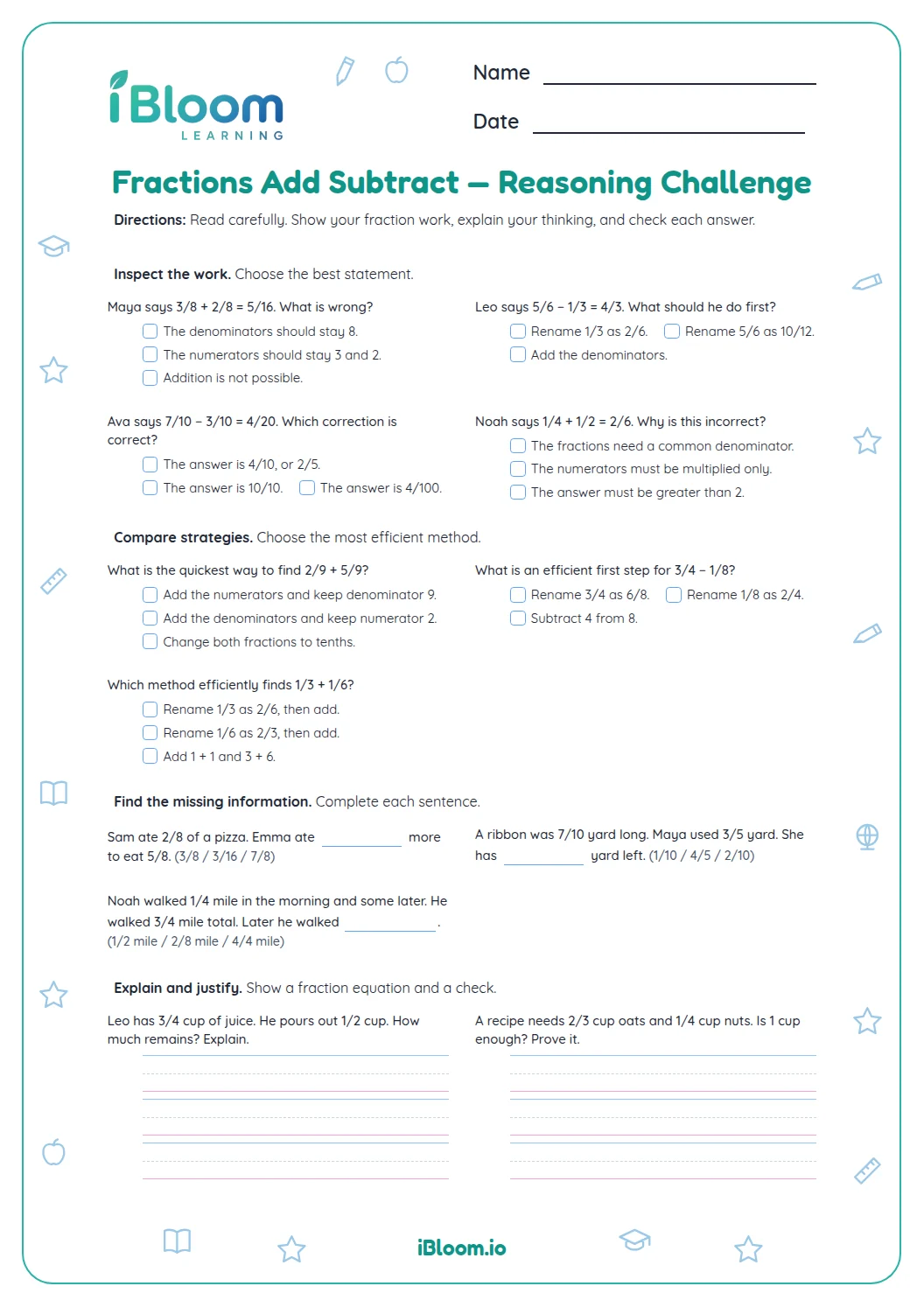
This free printable gives Grade 4 students 11 fraction word problems to solve independently. Part A starts with like denominators. Part B asks students to rename fractions with a common denominator. Part C combines missing amounts, two changes to a tank and a total greater than one whole. Each problem has a line for an equation and an answer. The sheet practices Common Core 4.NF.B.3d and 5.NF.A.2 through fraction addition and subtraction stories. A separate answer key gives a simplified result for every question.
Aligned to 4.NF.B.3d and 5.NF.A.2
Why must the parts be the same size?
The denominator names the size of each fraction part. Three eighths and two eighths can be added directly because both count eighths. A half and a fourth need a shared unit first: rename the half as two fourths.
How do students find a common denominator?
Look for a denominator that both fractions can use. In question 4, fourths work because a half equals two fourths. In question 11, thirds and fourths can both be written as twelfths. Multiply the numerator and denominator by the same number to keep each amount unchanged.
- 11/2 L + 1/4 L
- 21/2 = 2/4
- 32/4 L + 1/4 L = 3/4 L
- 4The jug now has 3/4 liter.
How can students check the last four stories?
The book and oats problems ask how much more is needed, so subtract the amount already available from the goal. In the tank problem, both changes refer to the capacity of the full tank.
The rope total is greater than one meter: 3/4 + 2/3 = 9/12 + 8/12 = 17/12, or 1 5/12. A result smaller than either starting piece would not fit this joining story.
How to use this worksheet
- 1Read each story and name its whole or measurement unit.
- 2Solve Part A by counting equal-sized parts; write an equation for each answer.
- 3For Part B, rename fractions with unlike denominators using equivalent fractions.
- 4In Part C, decide whether to find a difference, a total or two successive changes.
- 5Label measurement answers and compare their size with the amounts in the story.
- 6Use the key to check the result, then review the equation for any missed question.
Mistakes to check
The mistake
Adding denominators to get 3/8 + 2/8 = 5/16.
The fix
Both amounts count eighths. Keep the denominator 8 and add the numerators.
The mistake
Renaming 1/2 as 1/4 before adding.
The fix
Multiply both parts of the fraction by 2: 1/2 = 2/4. The amount stays the same.
The mistake
Adding 3/10 and 4/5 in the reading-goal story.
The fix
The goal is 4/5, or 8/10. Subtract the 3/10 already read to find the amount still needed.
Common Core alignment
Solve stories by adding or subtracting fractions with like denominators.
On this sheet: Part A and the oats story use addition or subtraction of fractions referring to the same whole with like denominators.
Show the official wordingHide the official wording
Solve word problems involving addition and subtraction of fractions referring to the same whole and having like denominators, e.g., by using visual fraction models and equations to represent the problem.
Solve fraction addition and subtraction stories with unlike denominators.
On this sheet: Parts B and C use common denominators to solve fraction stories; students check the size of each result.
Show the official wordingHide the official wording
Solve word problems involving addition and subtraction of fractions referring to the same whole, including cases of unlike denominators, e.g., by using visual fraction models or equations to represent the problem. Use benchmark fractions and number sense of fractions to estimate mentally and assess the reasonableness of answers. For example, recognize an incorrect result 2/5 + 1/2 = 3/7, by observing that 3/7 < 1/2.
What to practice next
Make more practice
Further reading
Questions parents and teachers ask
Does this sheet include unlike denominators?
Yes. Part A begins with like denominators, and Part B introduces pairs such as halves and fourths or thirds and ninths. Part C includes a rope problem with thirds and fourths. Students use equivalent fractions to make the parts equal in size before calculating.
Should students simplify their answers?
Equivalent fractions are mathematically correct, and the key uses simplified answers. For example, question 2 leaves 4/10 meter, which is the same amount as 2/5 meter. Ask students to explain the equality before requiring the simplest form, so simplifying stays connected to the size of the amount.
Can an answer be greater than one whole?
Yes. Question 11 joins 3/4 meter and 2/3 meter of rope, so the total is greater than one meter. Renaming the pieces as twelfths gives 9/12 plus 8/12, or 17/12. The key writes this amount as the mixed number 1 5/12 meters.
How do I help with the tank problem?
Keep the full tank as the whole throughout question 10. The tank starts 7/8 full, loses 1/4 of its full capacity and gains 1/8 of that same capacity. Rename 1/4 as 2/8, then calculate 7/8 minus 2/8 plus 1/8 to get 3/4 full.
Does the answer key show every calculation?
The answer key gives a result for each of the 11 problems. Students supply their own equations in the working space on the worksheet. During review, compare those equations with the story, and accept equivalent fraction forms when they represent the same amount with the correct unit.