






About this worksheet
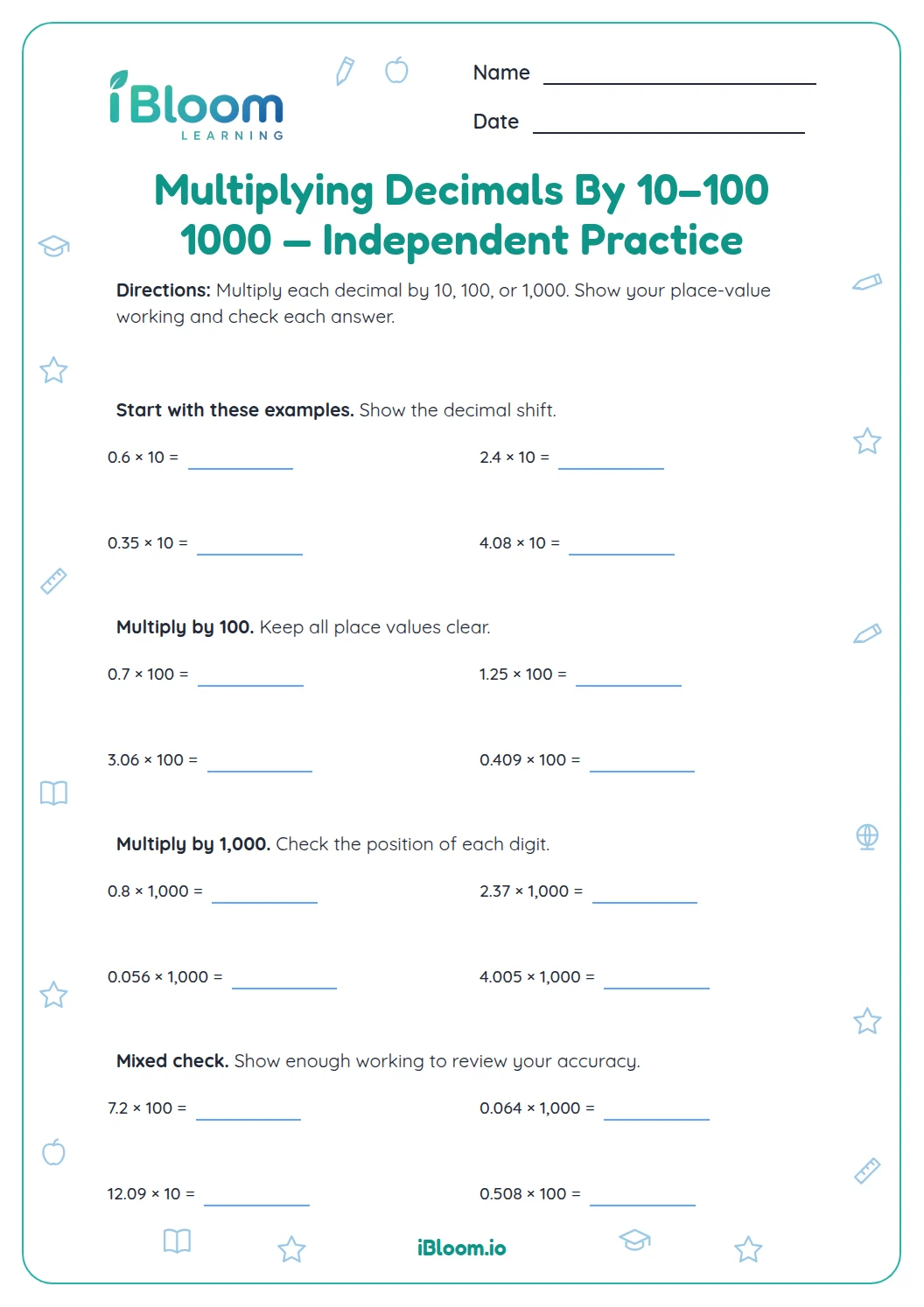
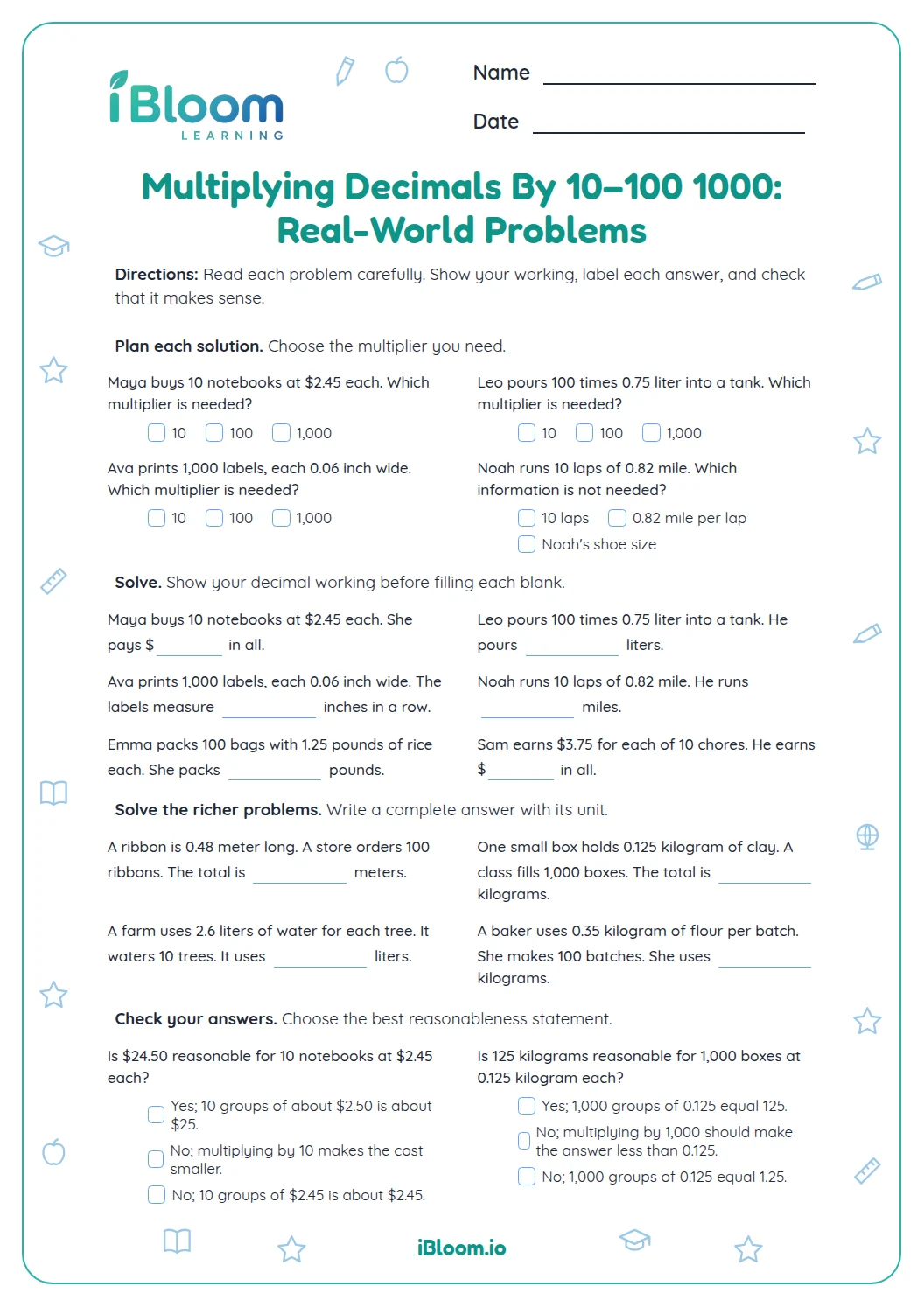
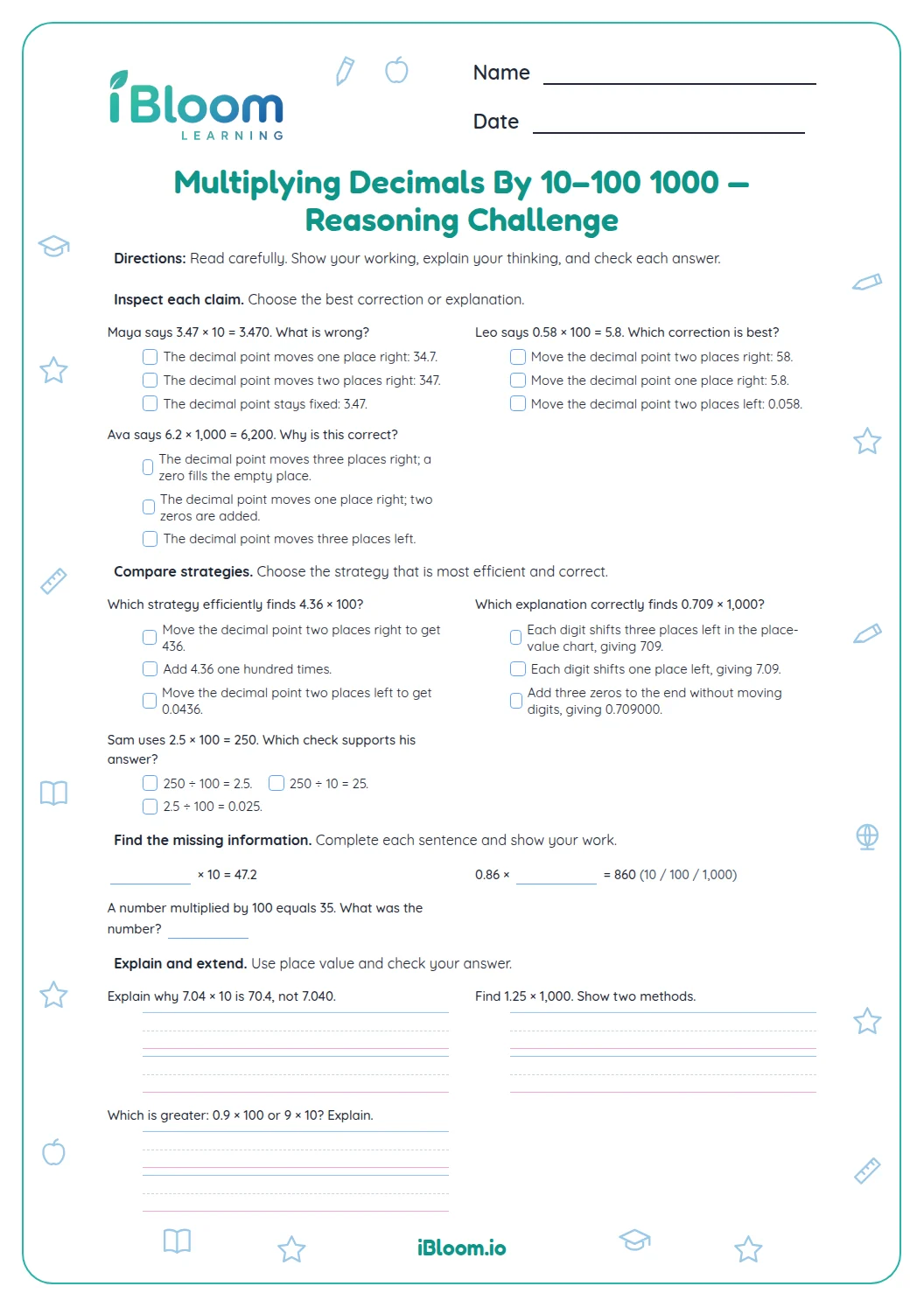
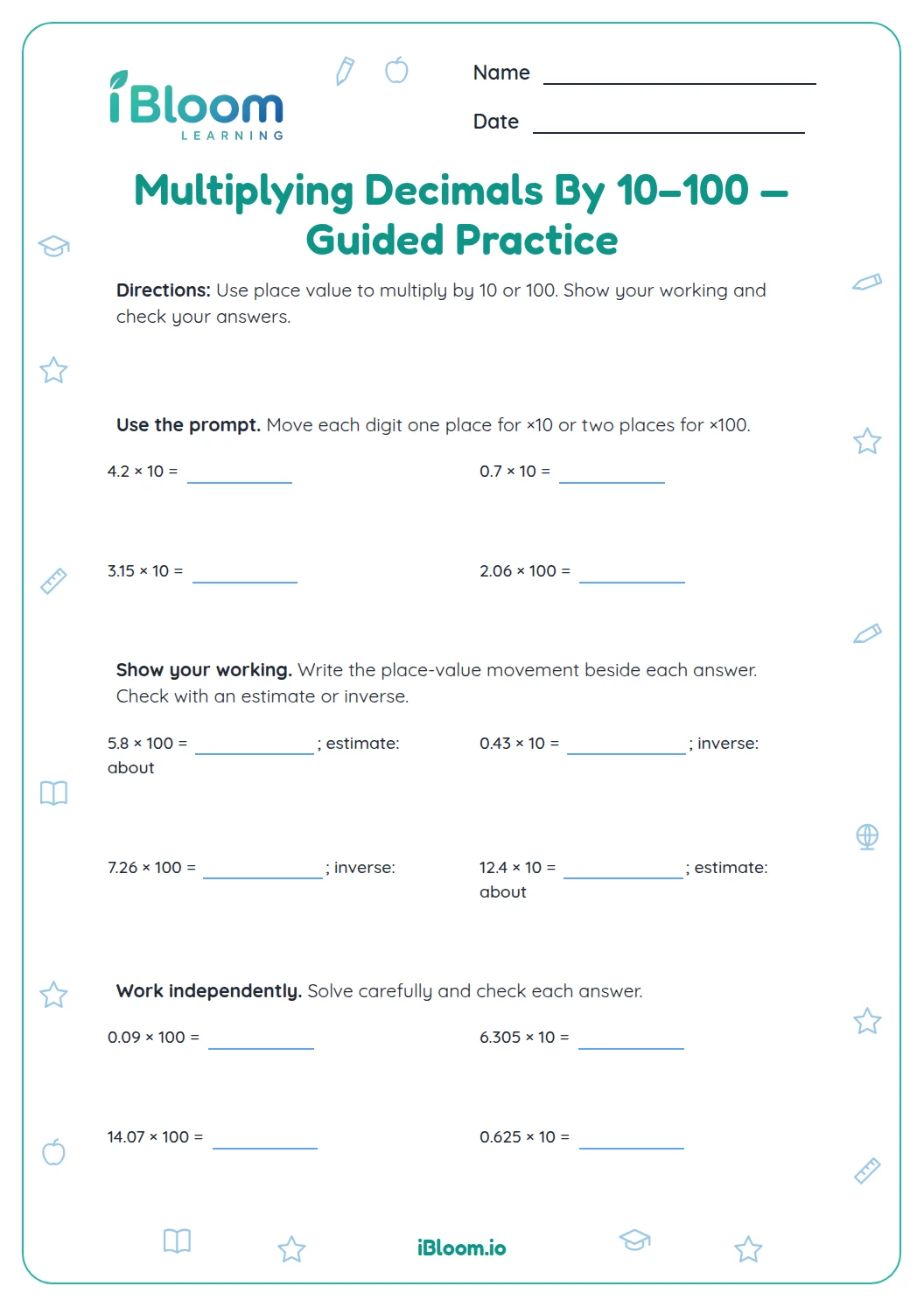
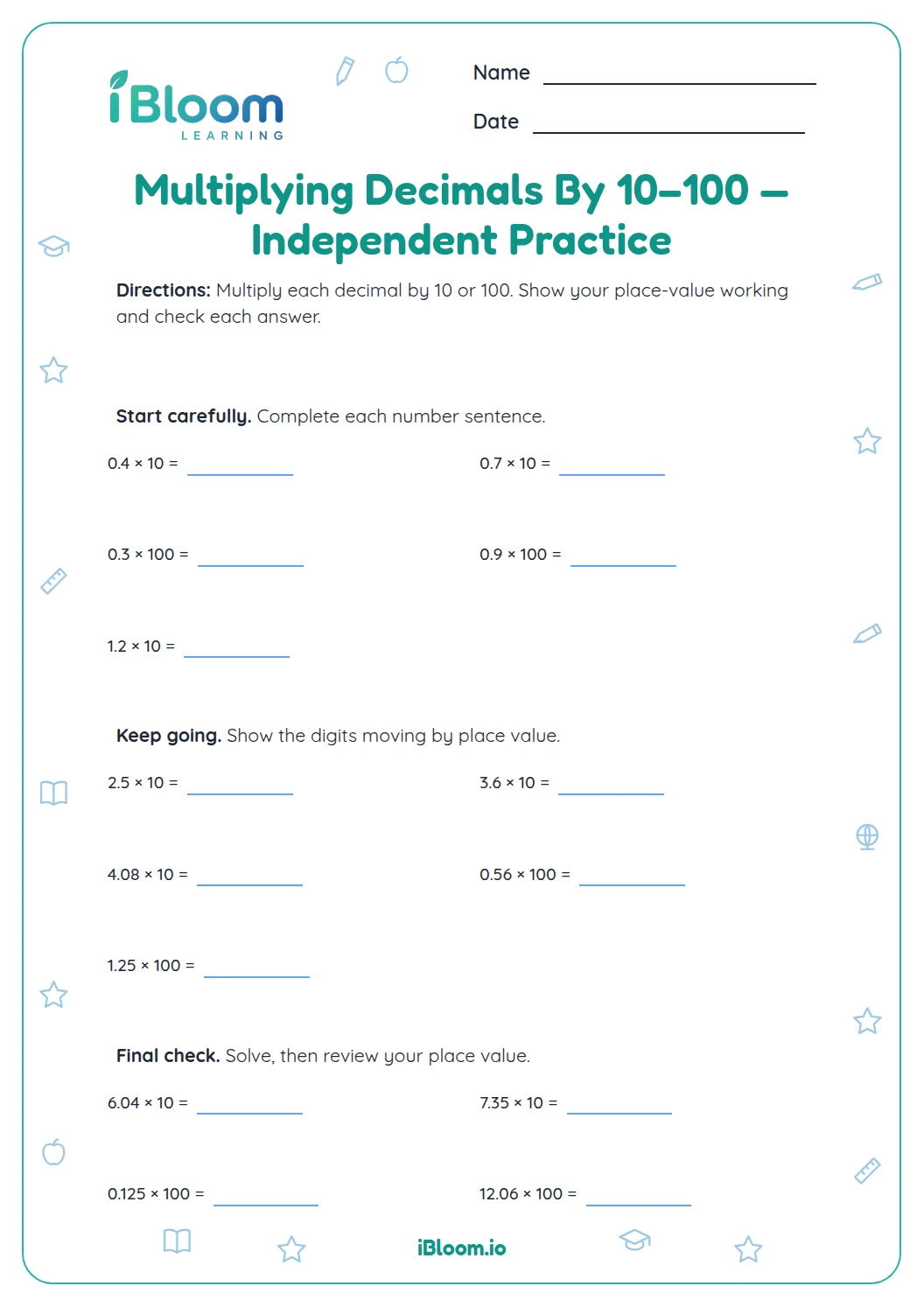
This free Grade 5 worksheet builds visual and symbolic understanding of multiplying decimals by powers of 10. Students first read two tenths-strip models, then solve 12 multiplication equations and six short-answer calculations with factors of 10, 100, and 1,000. The practice connects decimal shifts to place value in CCSS 5.NBT.A.2, with a separate answer key.
Aligned to 5.NBT.A.2
What do the tenths models show?
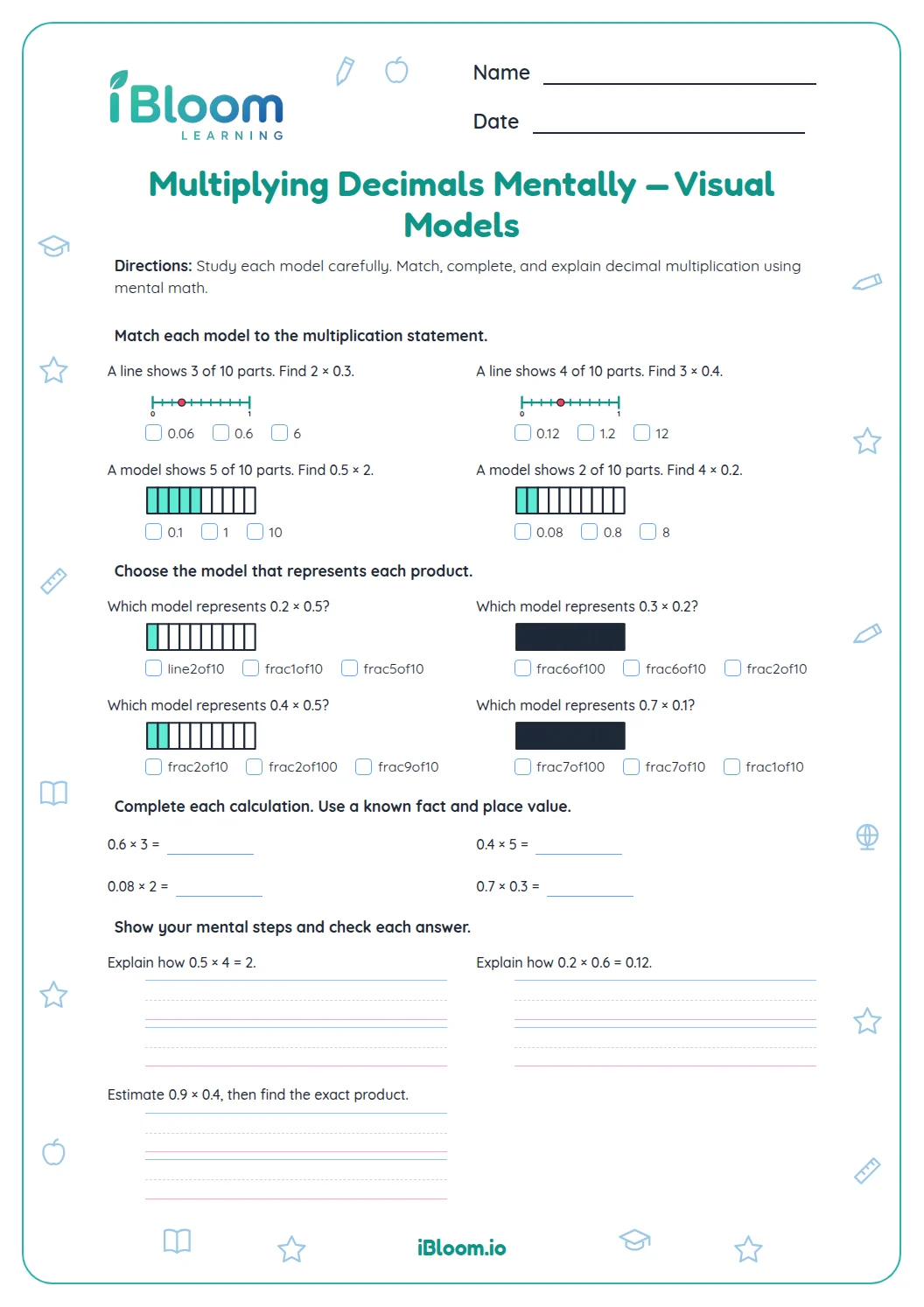
The first model has four of ten equal parts shaded, so it shows 4 tenths, or 0.4. The second has two full wholes and seven tenths, so it shows 2.7.
The first two items establish decimal quantities visually before students work with powers of ten.
- 12 wholes and 7 tenths
- 22 + 0.7 = 2.7
- 3So the model shows 2.7.
What changes when a decimal is multiplied by 10?
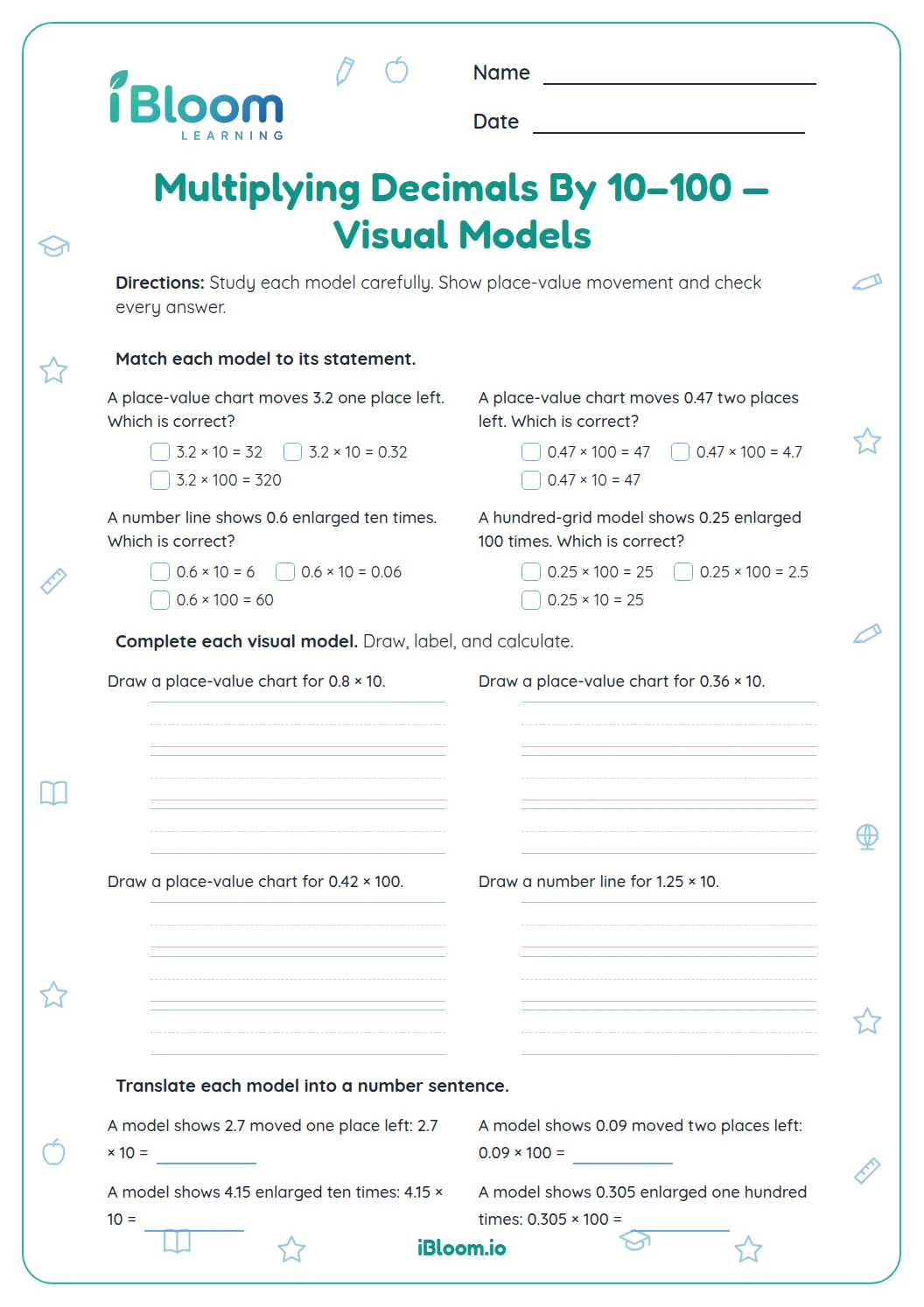
Each digit becomes ten times as valuable, so it shifts one place to the left on a place-value chart. For example, 0.6 × 10 = 6. With 100, digits shift two places; with 1,000, three places.
The decimal point is a useful marker, but the digits’ place values explain why the product changes.
How can you check a decimal product?
Estimate the size before finalizing the answer. Multiplying 0.34 by 100 should make a number near 34, and the exact product is 34. A product smaller than 0.34 would signal that the digits moved in the wrong direction.
How to use this worksheet
- 1Read the first two tenths-strip models by counting wholes and tenths.
- 2For each equation, identify whether the factor is 10, 100, or 1,000.
- 3Move each digit one, two, or three places to a greater value.
- 4Write the product with a decimal point that matches its place value.
- 5Estimate the product and use the answer key to check.
Common mistakes and quick fixes
The mistake
Moving the decimal digit pattern to a smaller value when multiplying.
The fix
Check that multiplying by 10 makes the value ten times as large; 0.6 becomes 6.
The mistake
Moving digits the wrong number of places for 100 or 1,000.
The fix
Use one place per factor of ten: 100 has two tens, and 1,000 has three.
The mistake
Dropping a zero or placing the decimal point without considering value.
The fix
Name each digit’s new place and estimate the product before writing it.
Common Core alignment
This worksheet practices the listed Common Core skill through the questions and examples on the printable.
Explain patterns when multiplying decimals by powers of 10.
On this sheet: Questions multiply decimals by 10, 100 and 1,000 and track place-value shifts.
Show the official wordingHide the official wording
Explain patterns in the number of zeros of the product when multiplying a number by powers of 10, and explain patterns in the placement of the decimal point when a decimal is multiplied or divided by a power of 10. Use whole-number exponents to denote powers of 10.
What to practice next
Make more practice
Further reading
Questions parents and teachers ask
What does multiplying a decimal by 10 do?
Multiplying by 10 makes the number ten times as large. Each digit shifts one place to the left in a place-value chart: tenths become ones, ones become tens, and so on. For example, 0.6 × 10 equals 6. Have the student name the digit’s new place and estimate the product before writing the final answer.
How does multiplying by 100 differ from multiplying by 10?
Multiplying by 100 moves each digit two place-value positions to the left because 100 is ten times ten. For instance, 0.34 × 100 equals 34. Think about how much the value grows, rather than moving a decimal point without tracking the digits.
What is shown in the visual models?
The worksheet begins with two tenths-strip models. One shows four tenths, or 0.4; the other shows two wholes and seven tenths, or 2.7. Students read these amounts before solving multiplication questions. Ask the child to say the amount as a decimal and as tenths.
How many questions are included?
There are 20 questions: two model-reading items, 12 equations, and six short-answer calculations. The multiplication practice uses factors of 10, 100, and 1,000. A separate key provides the expected values. Students can use the models to connect the written decimal with tenths.
What grade is this worksheet for?
The worksheet is written for Grade 5 students studying decimal place value and powers of ten. It uses tenths models, decimal factors, and whole-number powers of ten so learners can connect the changing product to digit positions. Have the student name the digit’s new place and estimate the product before writing the final answer.
How can I check whether a decimal answer is reasonable?
Estimate the size first. A number multiplied by 100 should be one hundred times its starting value. For 0.34 × 100, a result near 34 makes sense; a result below 0.34 shows that the digits shifted in the wrong direction.