



About this worksheet
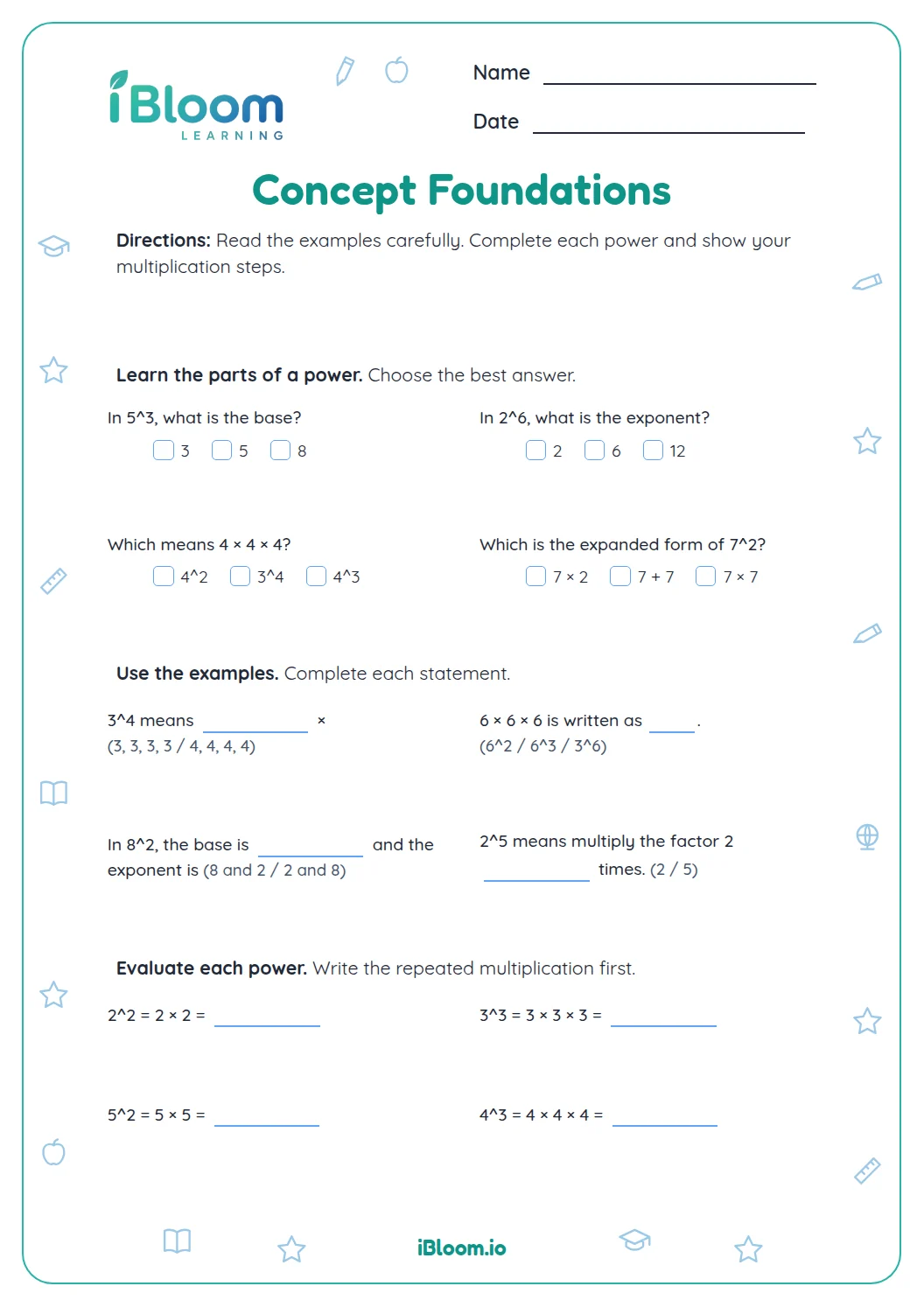
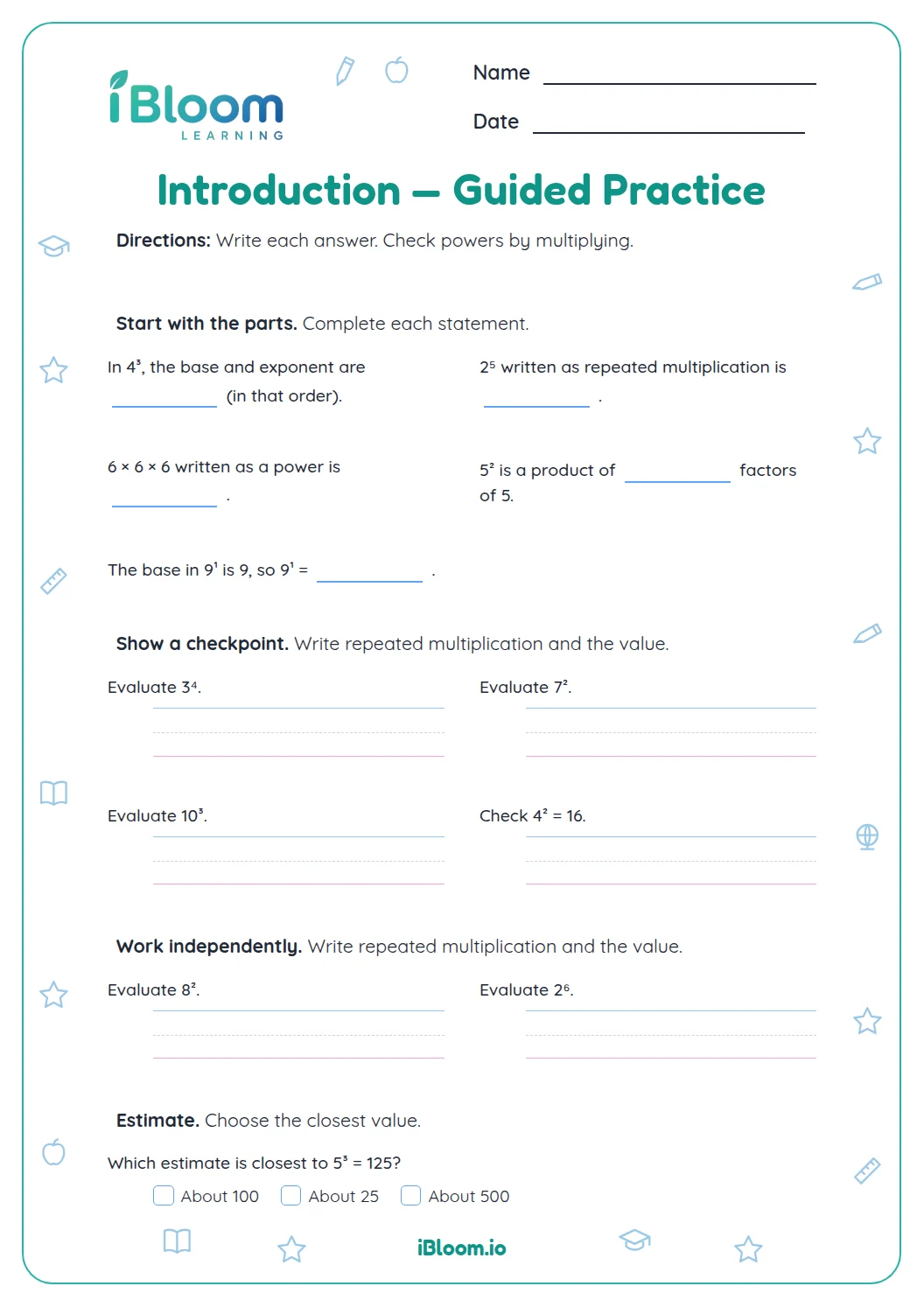
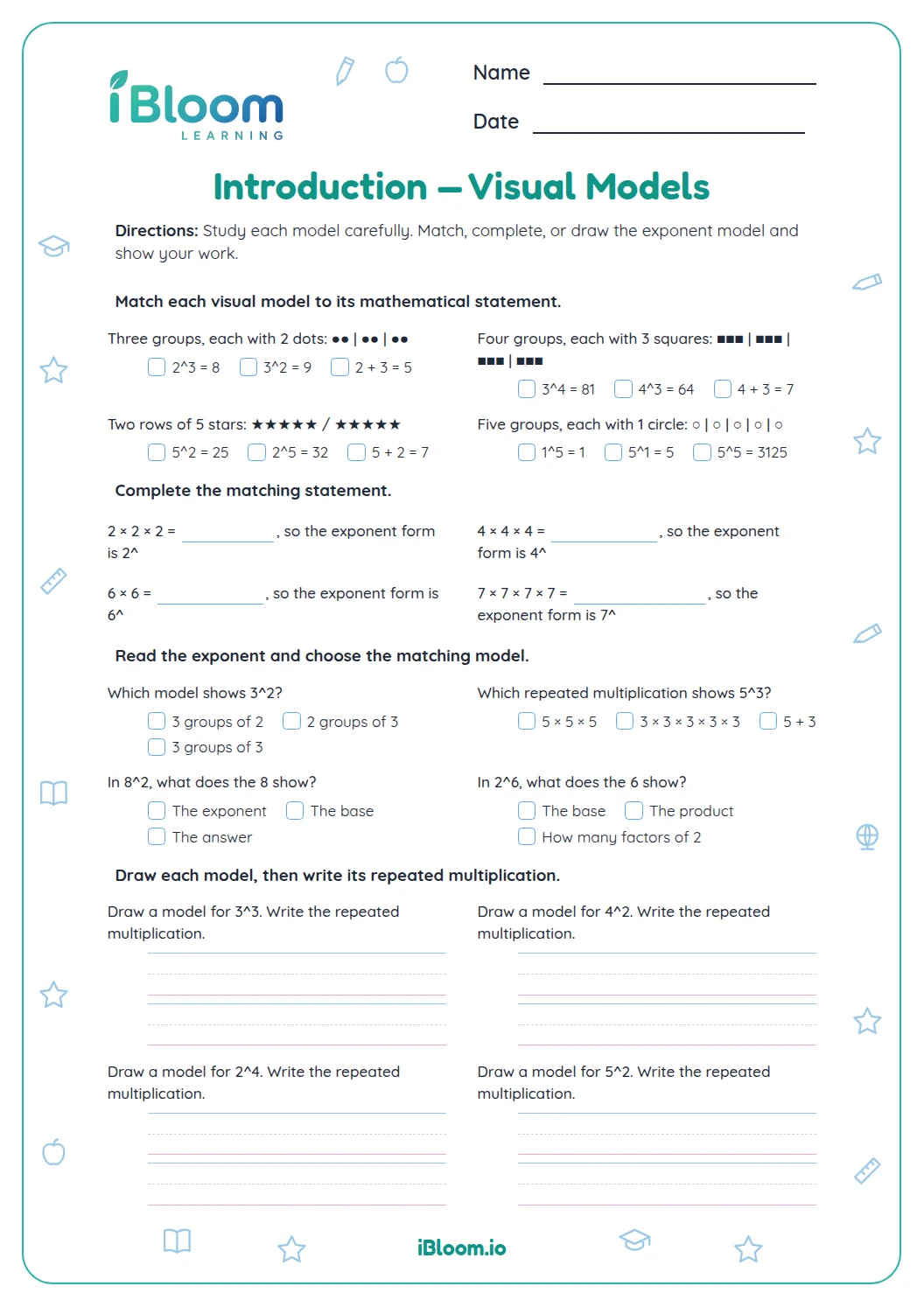
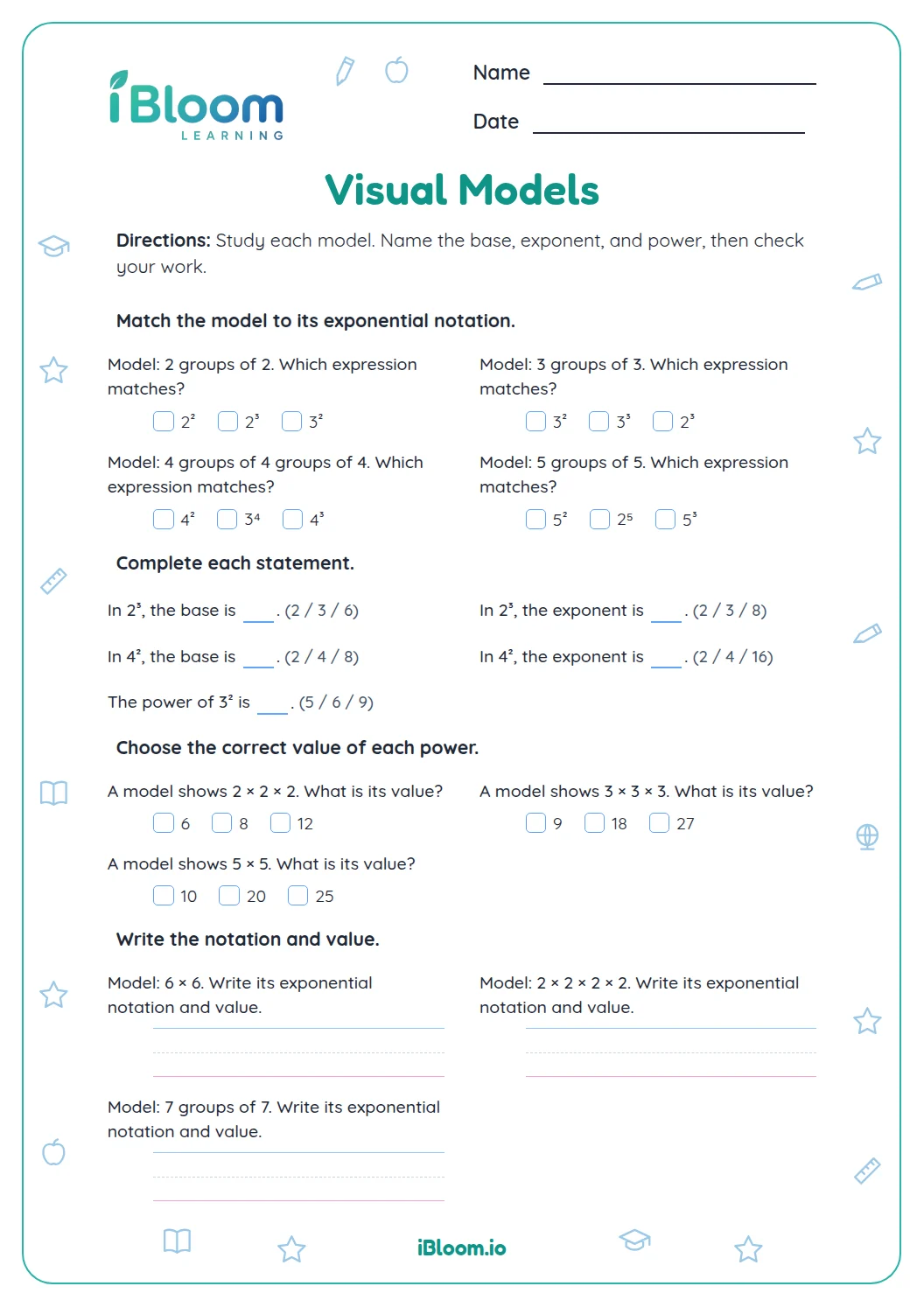
This Grade 5 math worksheet gives students 14 guided questions on writing exponents. They count equal factors, identify a base and exponent, expand powers into repeated multiplication, and evaluate small powers. The examples use several bases so students focus on what exponent notation records. A separate answer key includes the expanded products for the written responses.
How does repeated multiplication become a power?
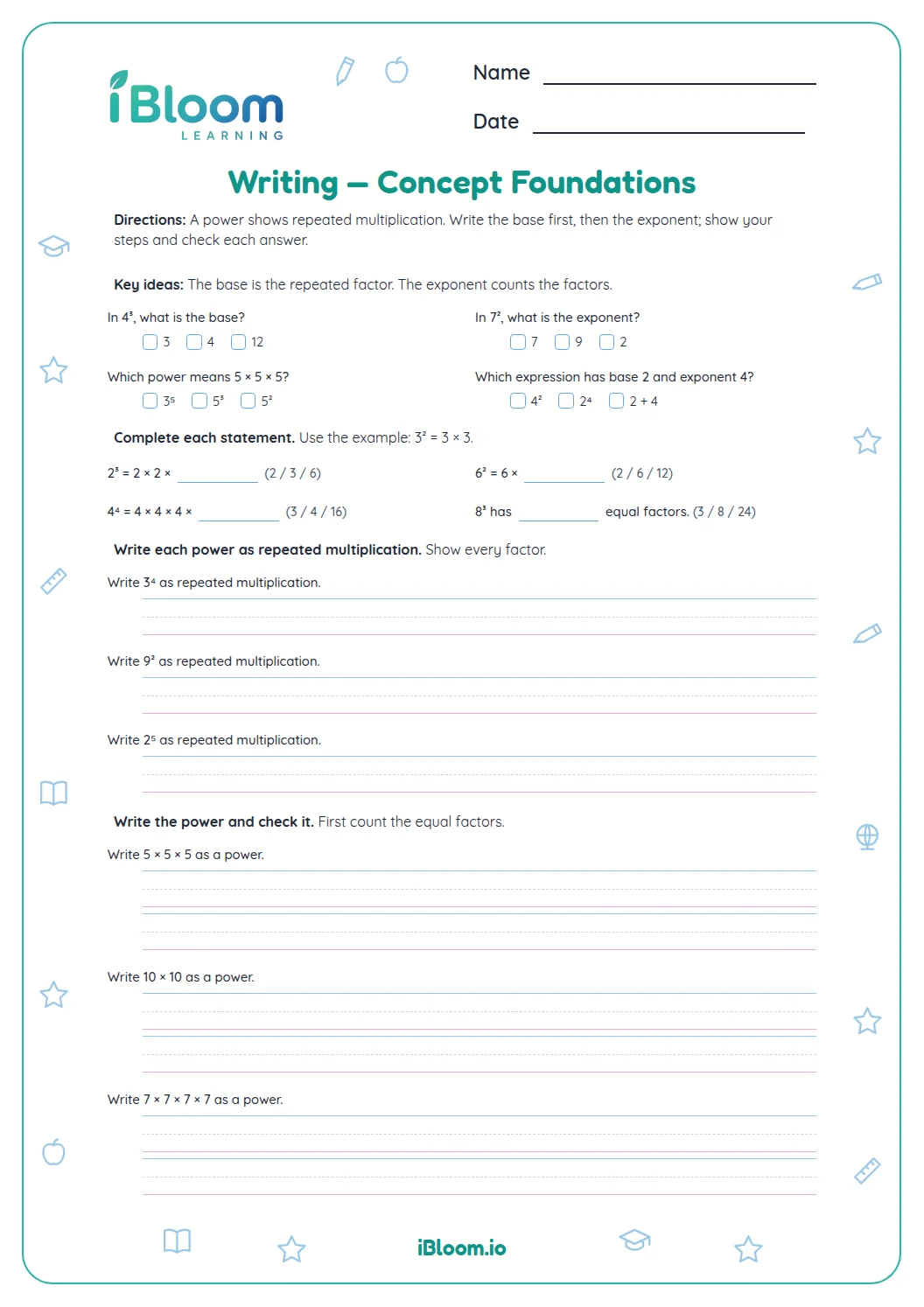
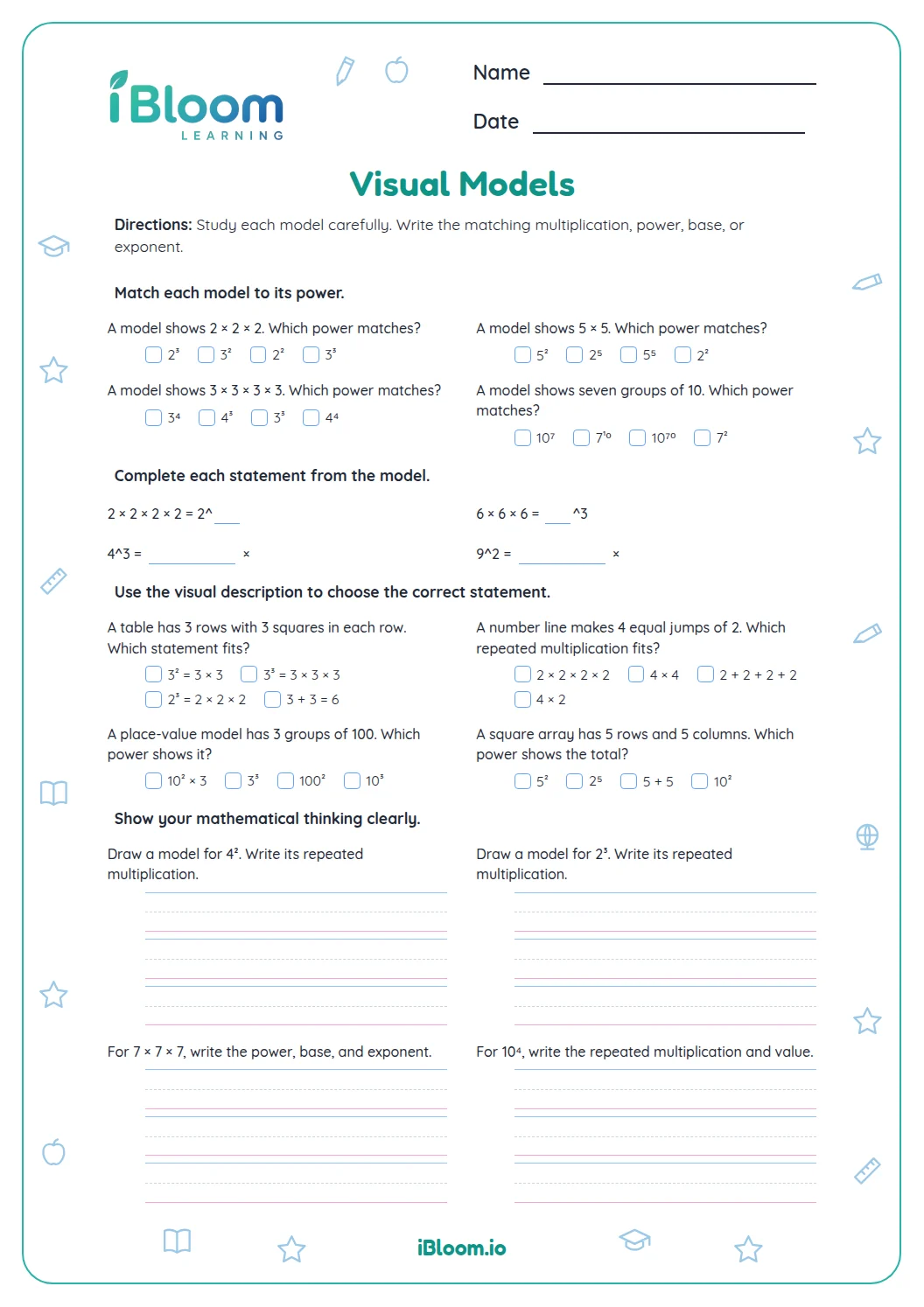
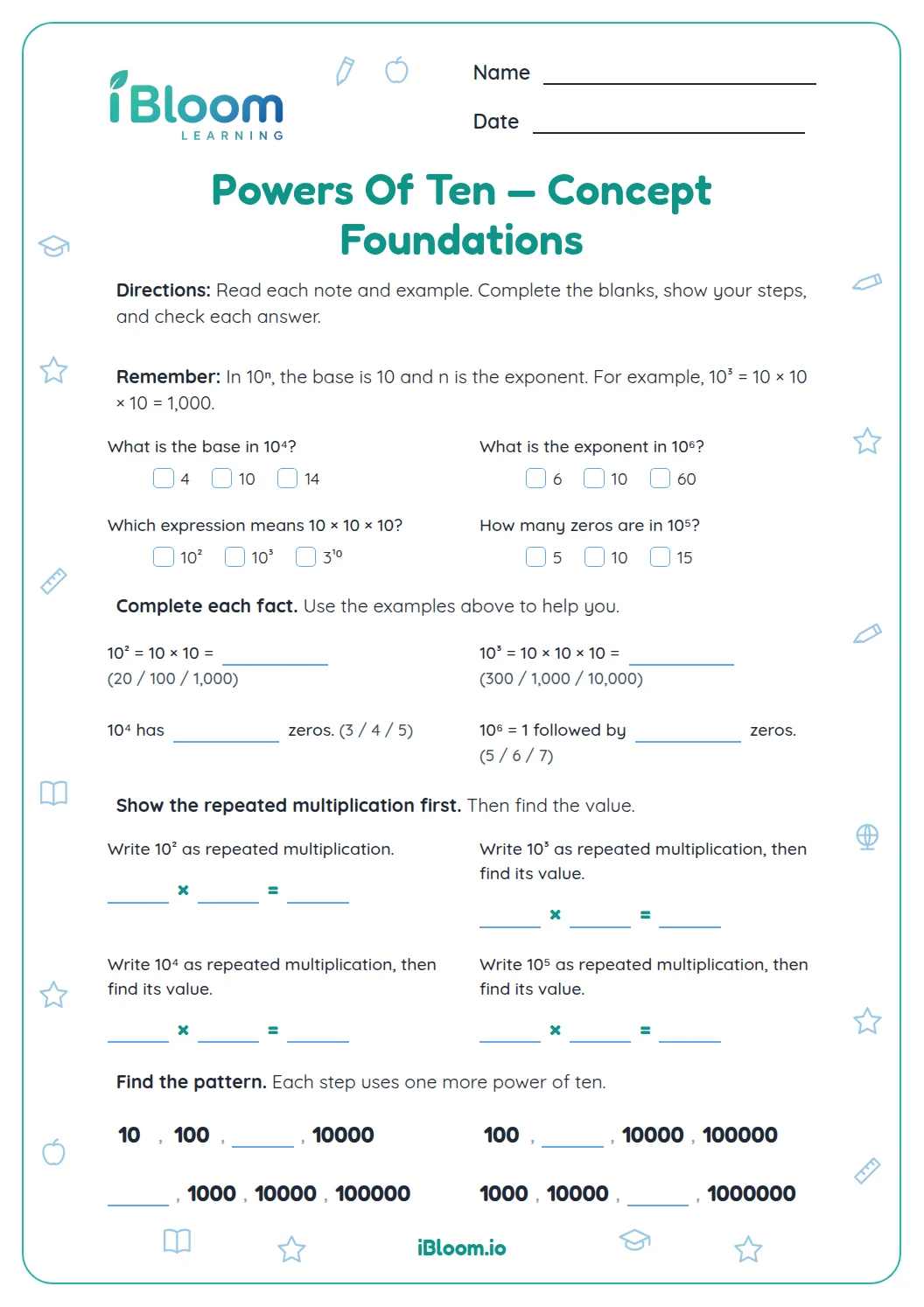
Part A shows equal factors and asks for the matching exponent. Count the number of 3s in 3 × 3 × 3; there are three factors, so the power is 3^3.
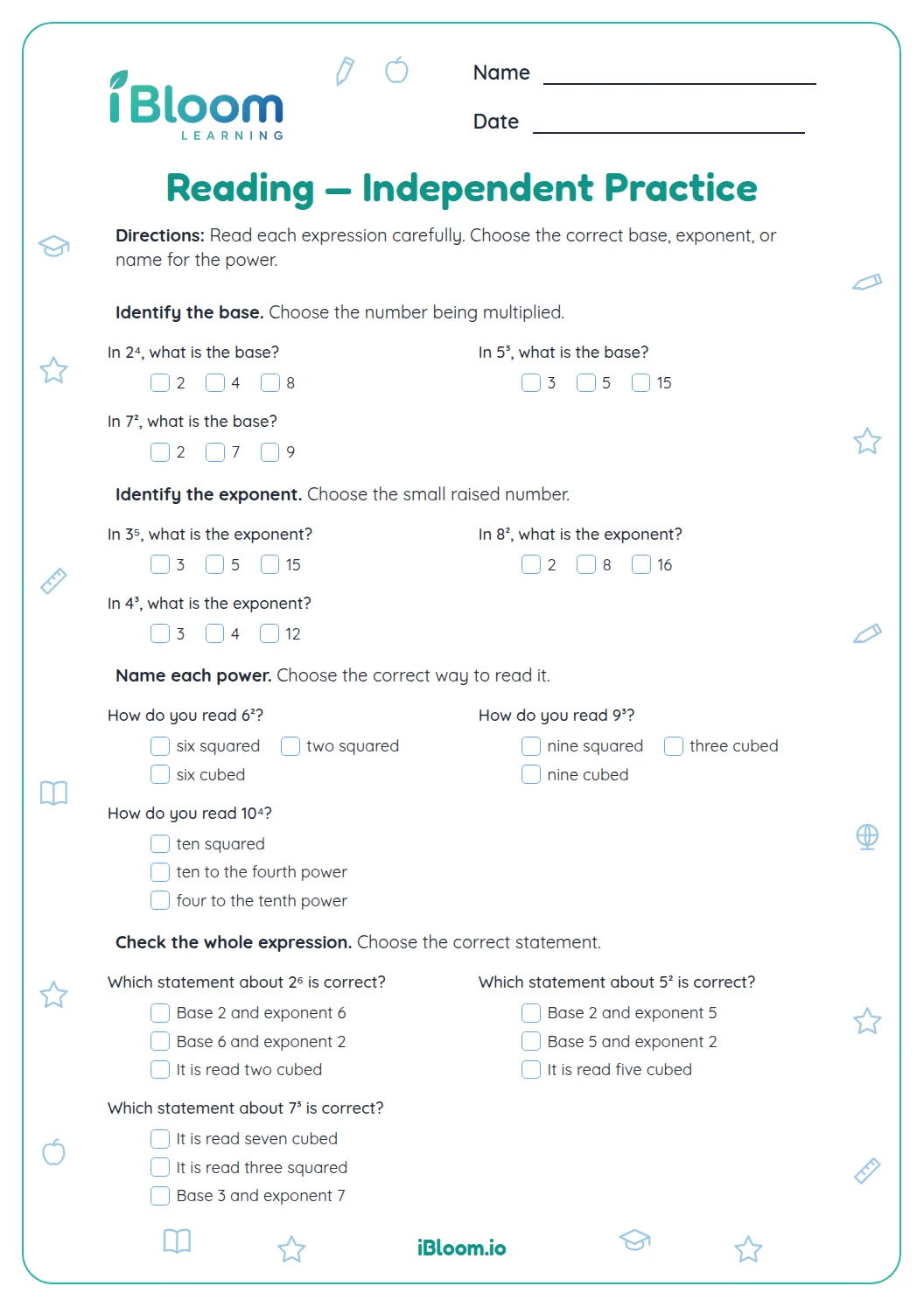
The base names the repeated factor. The exponent tells how many times to use that base.
How do you expand a power?
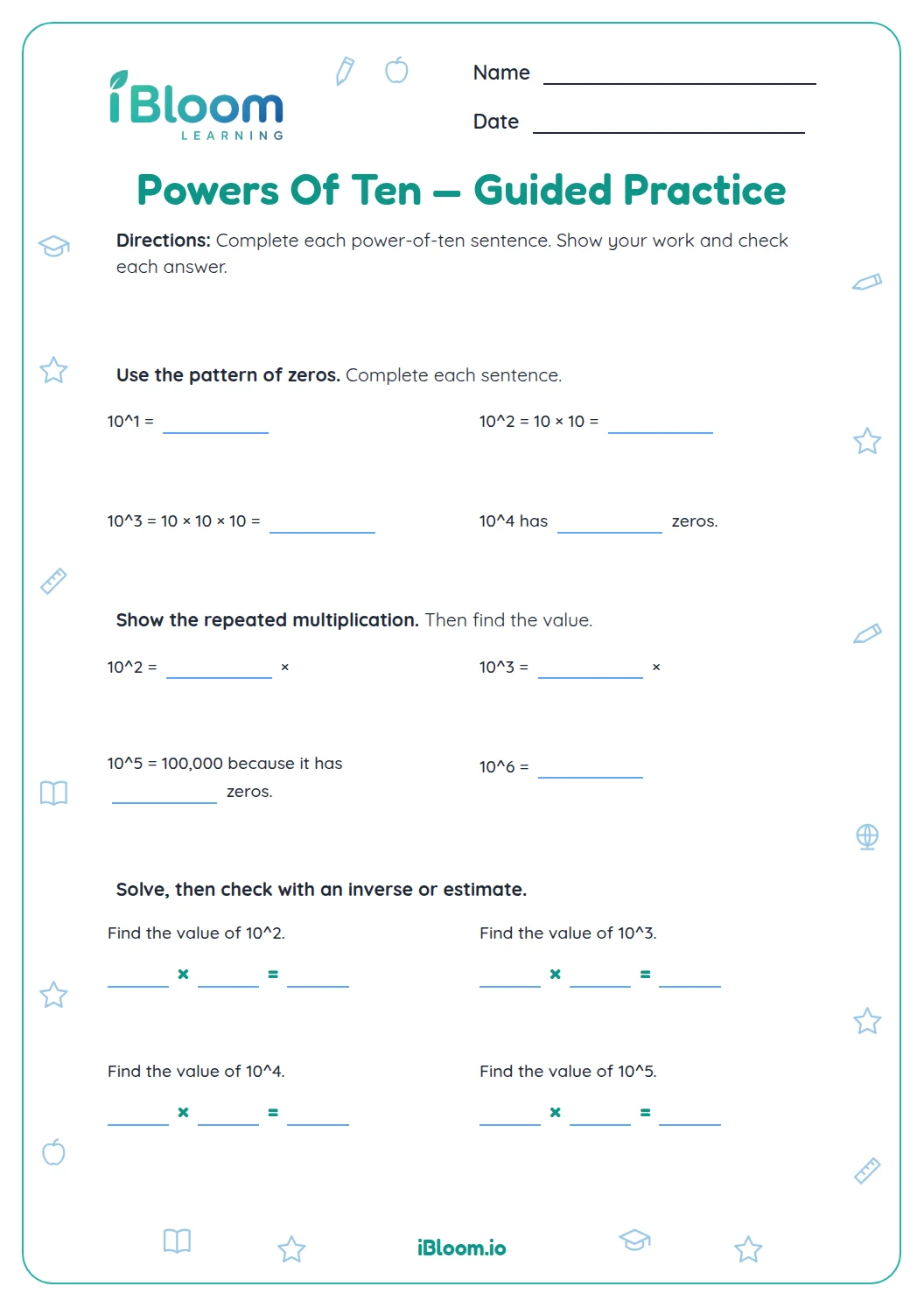
Part B turns notation back into multiplication. In 2^5, write five 2s: 2 × 2 × 2 × 2 × 2. Then multiply the factors when the question asks for a value.
Question 10 asks for 3^3. Expanding gives 3 × 3 × 3, which equals 27.
How can you check the value of a power?
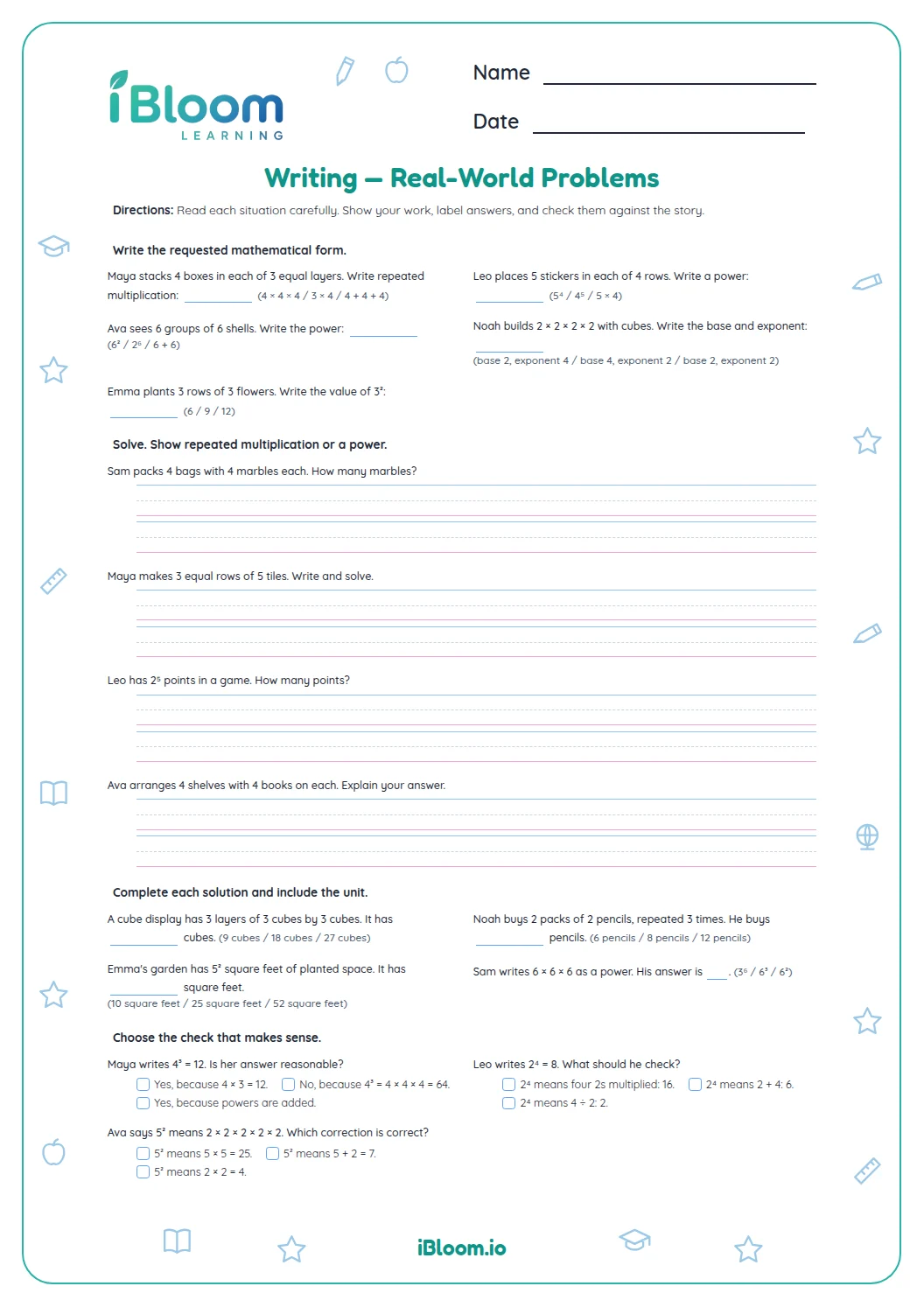
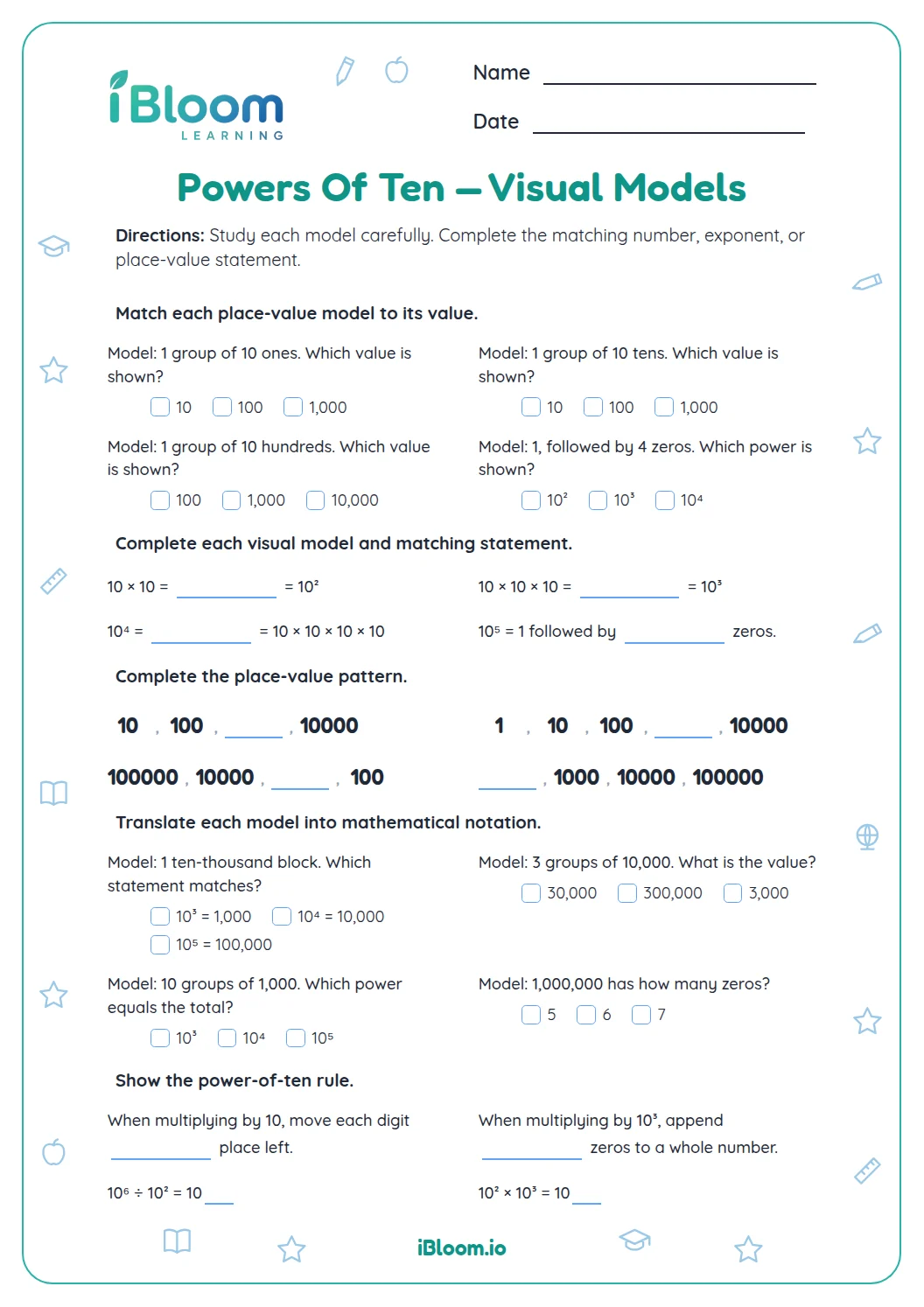
Part C checks the values of 2^4 and 3^3 in questions 9–10. Expand each power or use known multiplication facts to find the product.
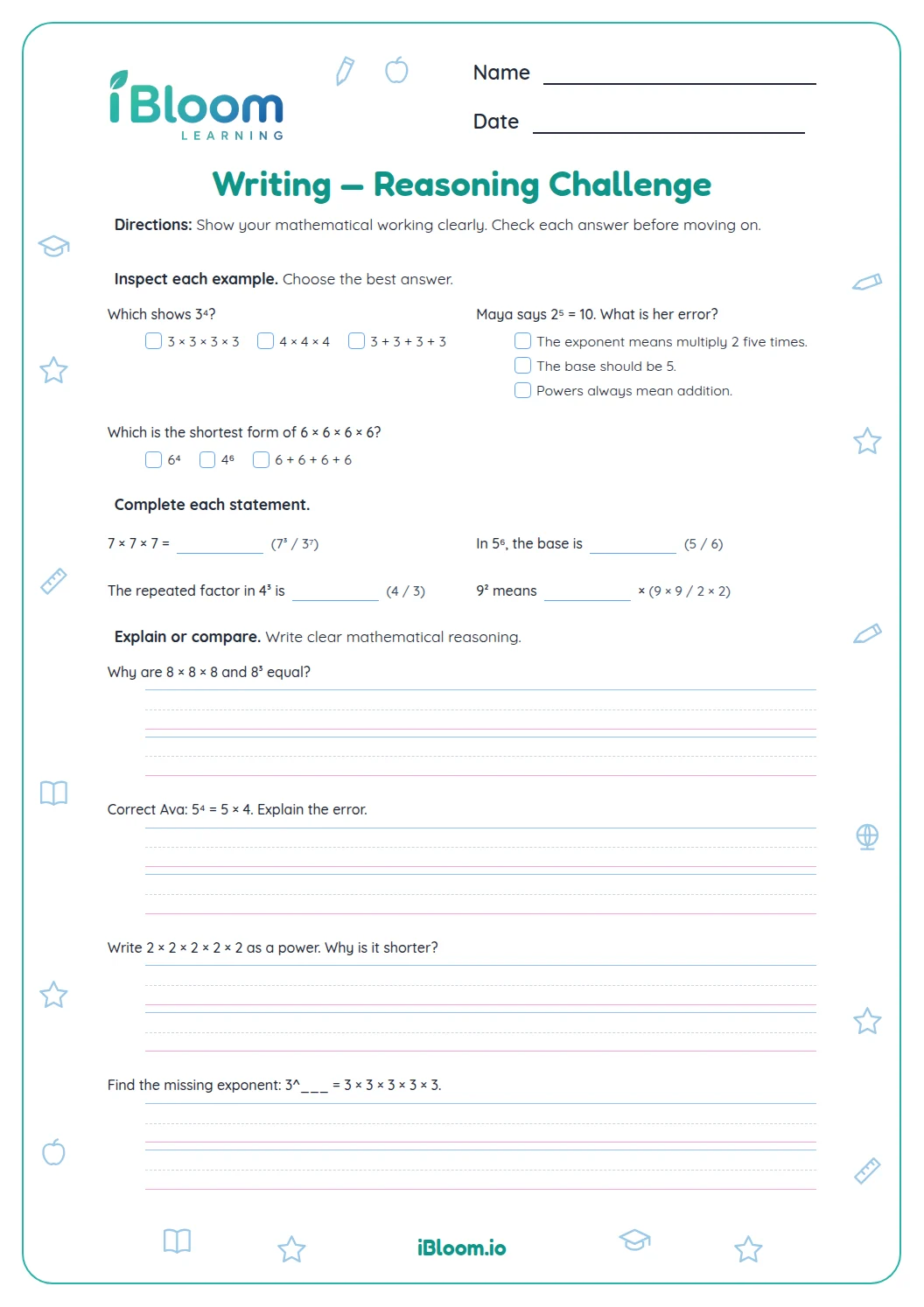
Part D asks for repeated multiplication and the value for 3^4 and 2^6, then checks how many factors appear in 8 × 8 × 8 and the value of 9^2.
- 13^4 has four factors of 3.
- 23 × 3 × 3 × 3 = 9 × 9.
- 39 × 9 = 81.
How to use this worksheet
- 1Find the base, the repeated factor.
- 2Count the factors to determine the exponent.
- 3To expand a power, write the base once for each count in the exponent.
- 4Multiply the factors to find a value.
- 5Check your product by grouping factors, such as 3 × 3 × 3 × 3 = 9 × 9.
Mistakes to watch for
The mistake
Reading 3^4 as 3 × 4.
The fix
Write four factors of 3: 3 × 3 × 3 × 3.
The mistake
Using the exponent as the base.
The fix
In 6^4, the base is 6 and the exponent is 4.
The mistake
Writing too few factors when expanding.
The fix
Count the repeated factors and compare that count with the exponent.
What to practice next
Make more practice
Questions parents and teachers ask
What does an exponent tell you?
An exponent tells how many times the base is used as a factor. In 3^4, the base is 3 and it appears four times: 3 × 3 × 3 × 3. The first section practices counting factors and recording that count as an exponent.
How is 3^4 different from 3 × 4?
The power 3^4 means four factors of 3 multiplied together, which equals 81. The expression 3 × 4 has just one factor of 3 and one factor of 4, so it equals 12. Expanding the power makes the difference visible.
How many problems are included?
There are 14 questions in four parts. Students write missing exponents, identify bases and exponents, expand powers as repeated multiplication, and find values. Part D includes two expanded products, a factor-count check, and one more value check. The answer key shows each product.
What is the base in 6^4?
The base is 6, the number being multiplied by itself. The exponent is 4, so 6^4 means 6 × 6 × 6 × 6. Question 4 asks for the base, and question 5 asks for the exponent. Naming each part helps students read the power accurately.
How can students check an answer?
Expand the power into the number of equal factors named by the exponent, then multiply. For example, 3^3 becomes 3 × 3 × 3, or 27. The answer key shows expanded forms for the written questions so students can compare each factor.