
About this worksheet
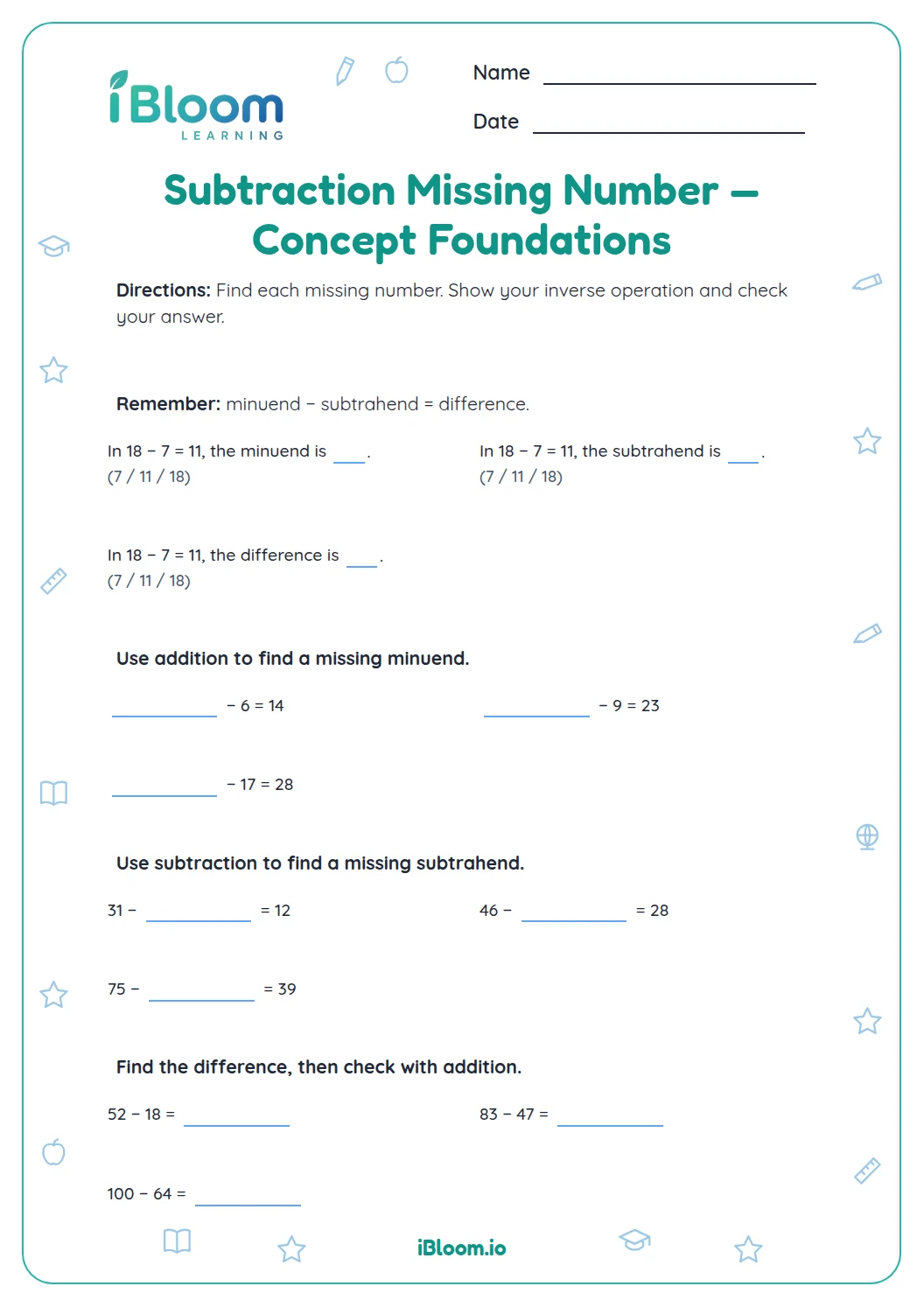
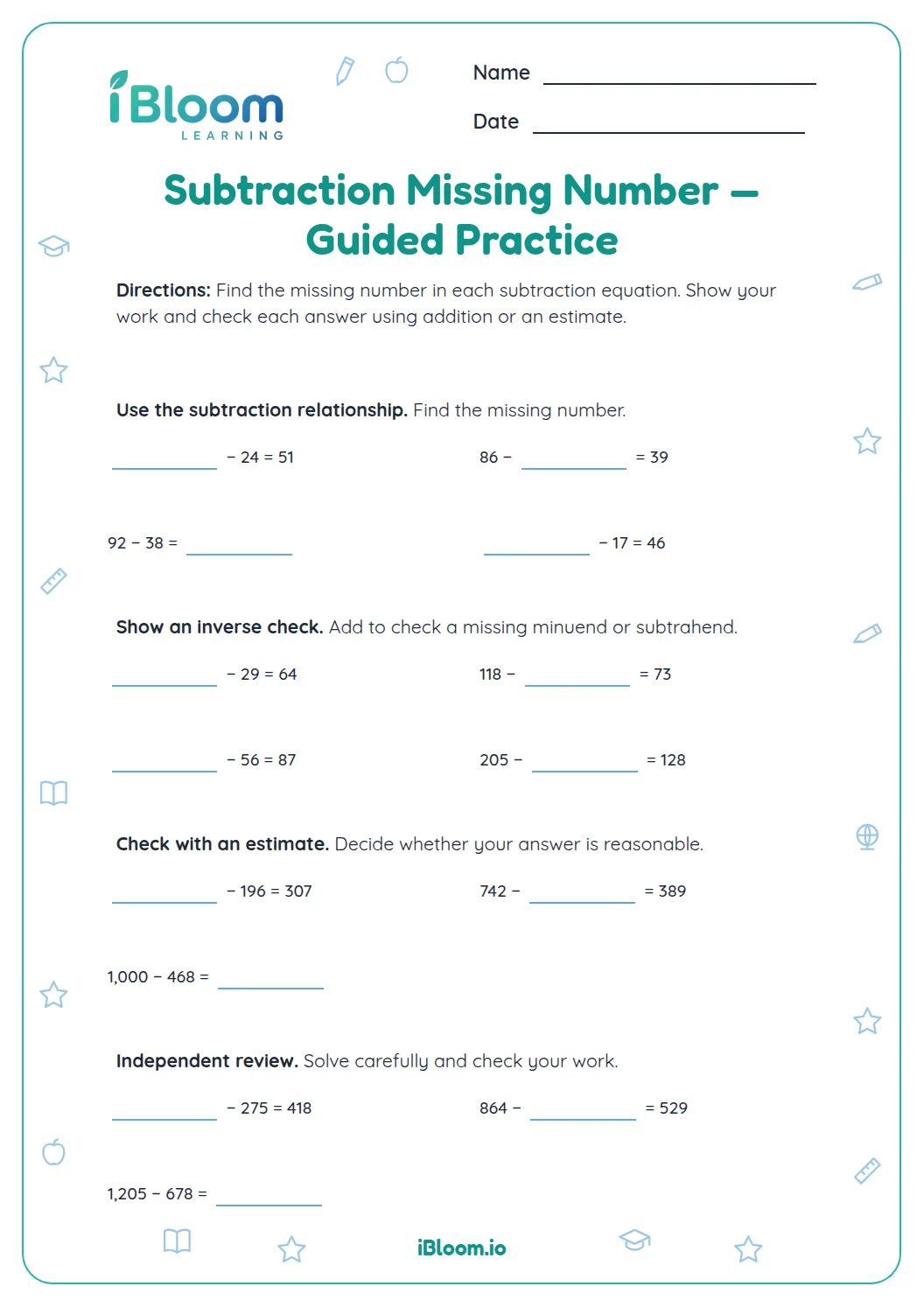
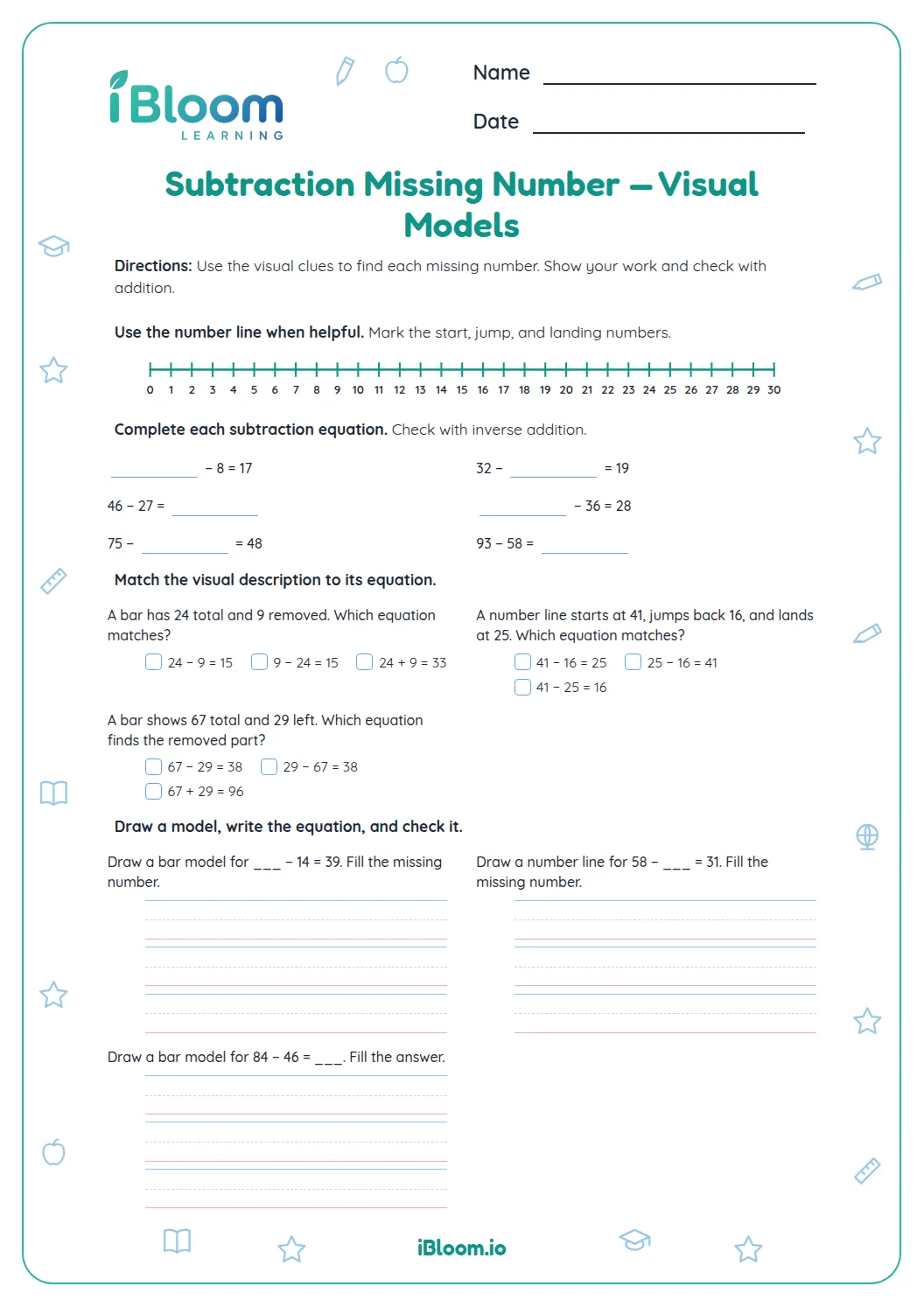
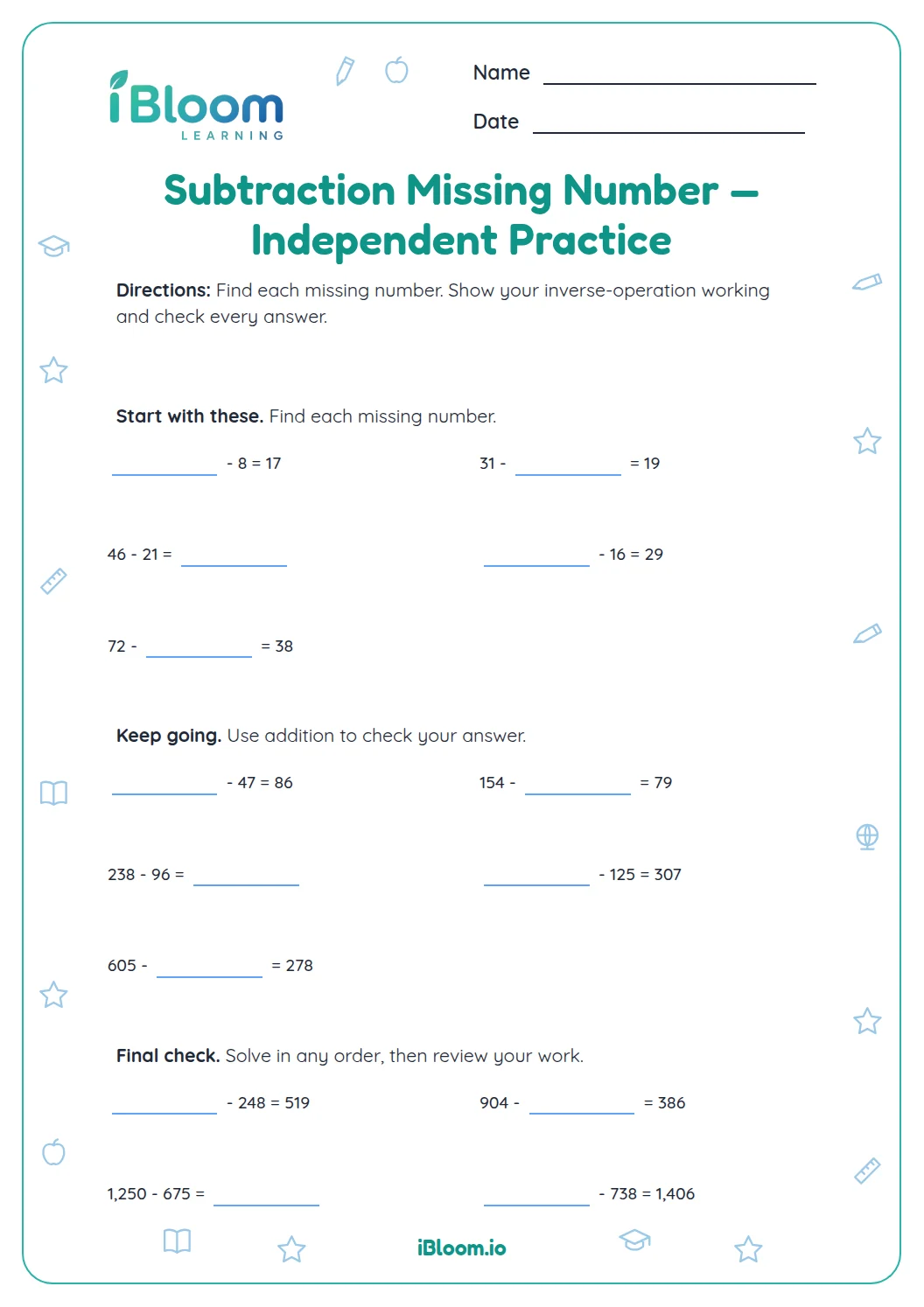
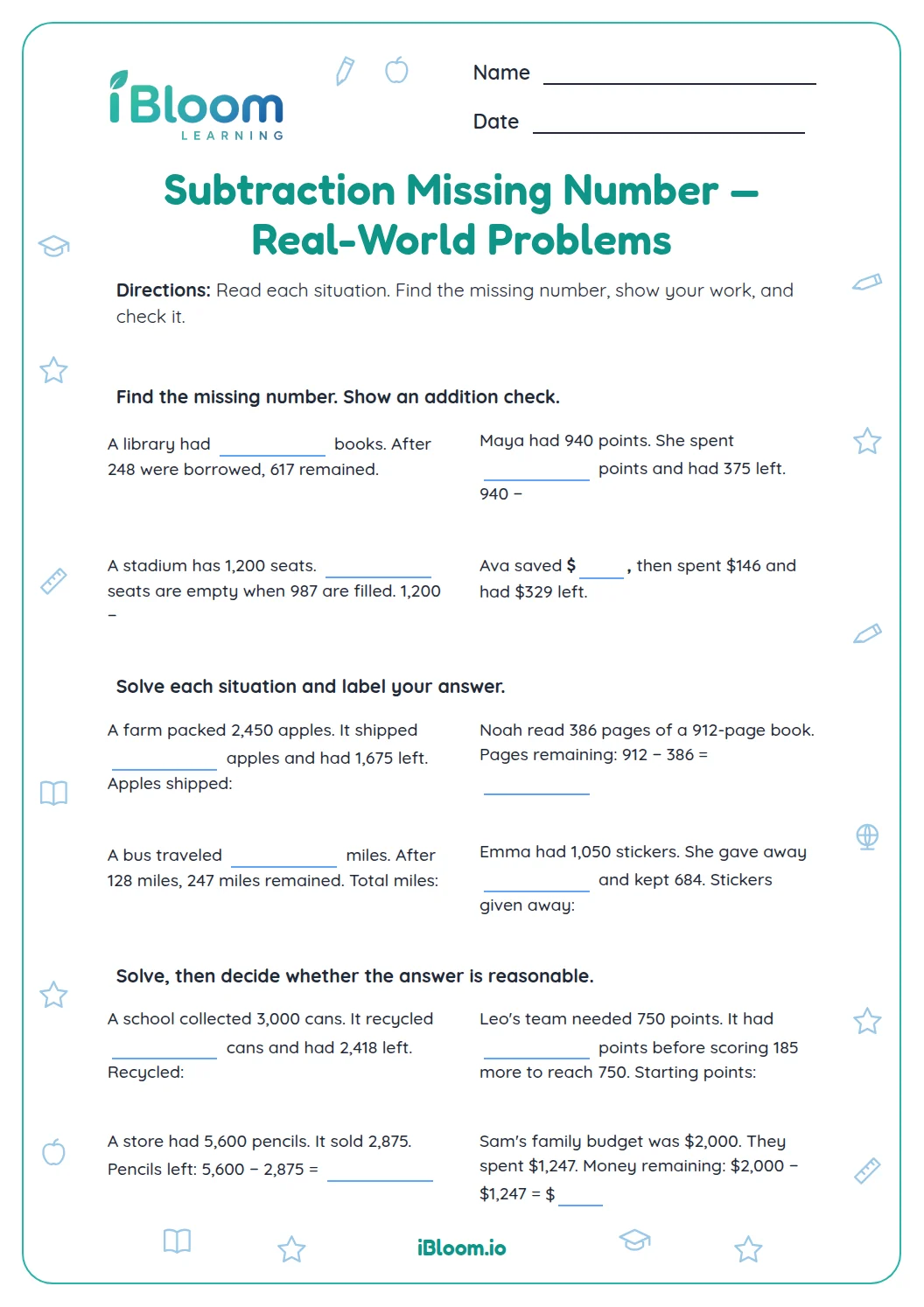
This Grade 6 worksheet practices finding unknowns in subtraction equations and checking the reasoning behind them. Learners first inspect four worked claims and choose a valid check, then solve four missing-number equations and six short applications. The questions use whole numbers, decimals, and a fraction. A separate answer key supports checking.
How can you check subtraction reasoning?
For 72 − ___ = 29, Maya’s blank of 43 is correct because 72 − 43 = 29. Checking the original equation confirms the missing subtrahend.
How do you find a missing starting number?
For ___ − 47 = 29, add 47 and 29. The missing minuend is 76 because 76 − 47 = 29.
How do the applications use subtraction?
The later questions use situations about distance, books, water, and visitors. Write the subtraction equation first, then check the result in its context.
A simple practice routine
- 1Read the equation and identify the unknown.
- 2Use addition to undo subtraction.
- 3Check a claim in the original equation.
- 4Write an equation for each situation.
- 5Substitute your answer to check it.
Watch for these slips
The mistake
Subtracting the difference from the subtrahend
The fix
For a missing minuend, add the subtrahend and difference.
The mistake
Stopping after one operation
The fix
Read the full question and check the result.
The mistake
Copying a value inaccurately
The fix
Compare each digit or word with the prompt.
What to practice next
Make more practice
Questions parents and teachers ask
How does addition help solve these equations?
Addition reverses subtraction. Add the known subtrahend and the difference to find a missing minuend, or subtract the difference from the minuend to find a missing subtrahend. Substitute your result into the original equation to confirm that both sides match. The examples include whole numbers and decimals, so check place value as you solve each equation.
Are decimal numbers included?
Yes. Several equations and situations use decimals, including hundredths. Read each decimal carefully and align place values when subtracting. A quick inverse-operation check can show whether the unknown value restores the original equation. The examples include whole numbers and decimals, so check place value as you solve each equation.
What is a missing minuend?
The minuend is the number from which another number is subtracted. In ___ − 47 = 29, the minuend is missing. Add 47 and 29 to find the starting number, then subtract 47 to check your result. The examples include whole numbers and decimals, so check place value as you solve each equation.
What is a missing subtrahend?
The subtrahend is the number being taken away. In 96 − ___ = 38, subtract the difference, 38, from the minuend, 96. The missing value is 58, and 96 − 58 = 38 confirms it. The examples include whole numbers and decimals, so check place value as you solve each equation.
Is an answer key included?
Yes. A separate answer key follows the worksheet and lists the answers to all 14 items. Learners can try each equation and application first, then use the key to find any calculation that needs another look. The examples include whole numbers and decimals, so check place value as you solve each equation.