
About this worksheet
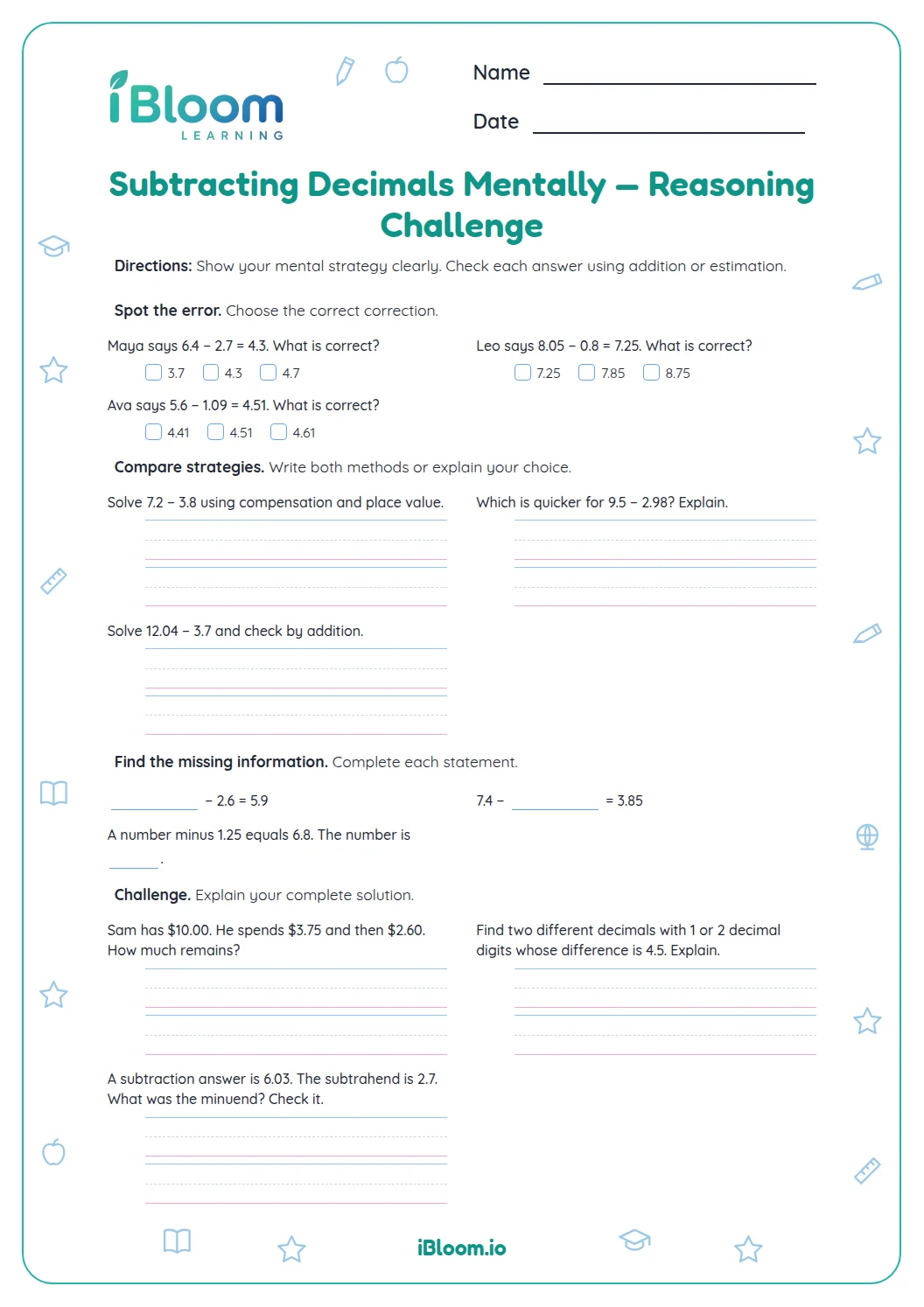
This Grade 6 worksheet applies mental subtraction of decimals to 16 real-world situations. The problems use tenths and hundredths in money, distance, length, capacity, and weight contexts. Students find a remaining amount, a starting amount, or a difference, and include the unit in each answer. A separate key gives the answers with units.
Aligned to 6.NS.B.3
How can mental subtraction help with measurements?
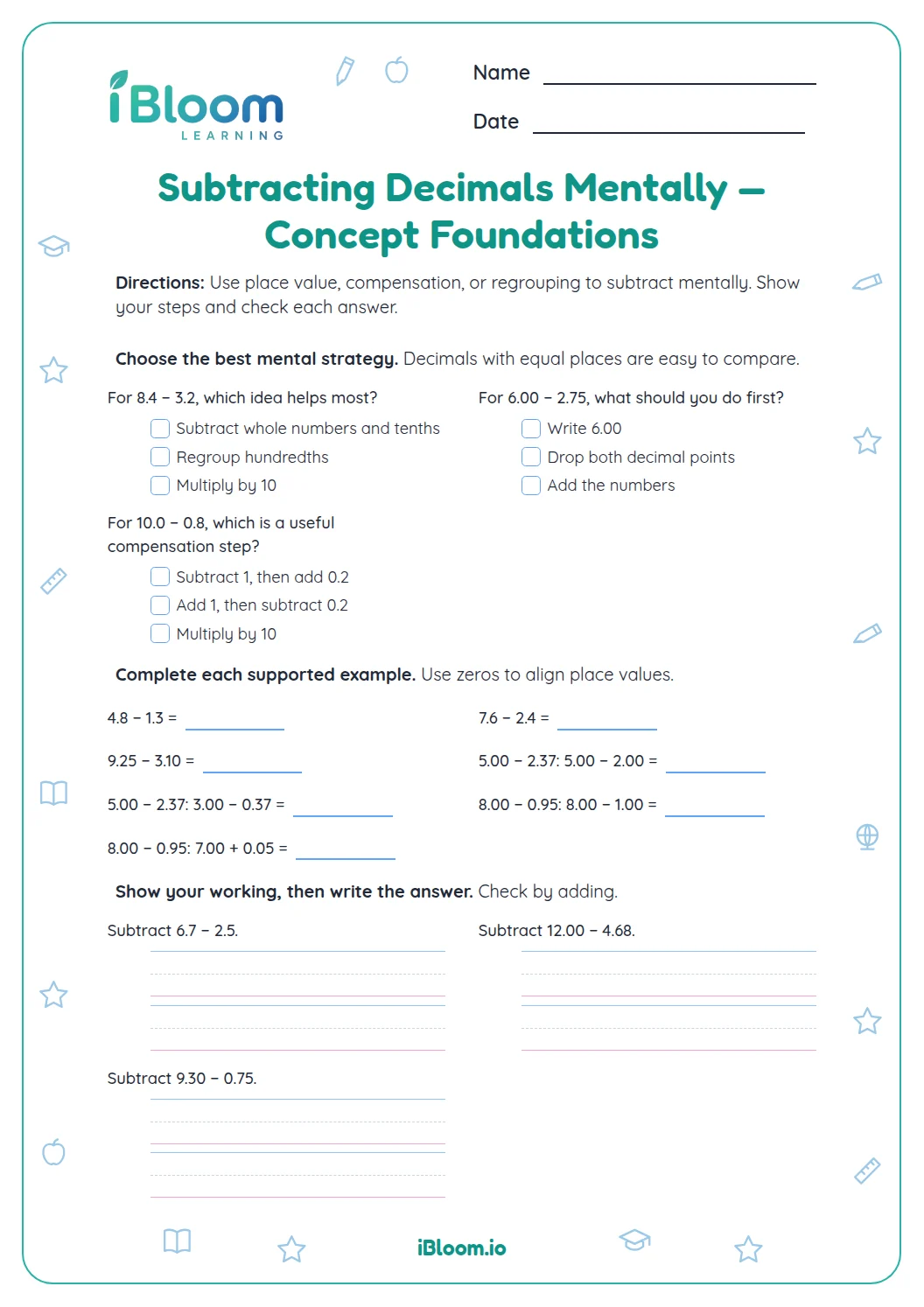
Keep the unit attached to the quantities and subtract the amount removed. A 4.8 m ribbon with 1.3 m cut off has 3.5 m left. Think of 4.8 as 4 plus 0.8 and subtract 1 plus 0.3.
- 1Keep the unit attached to the quantities and subtract the amount removed.
What if the problem gives the ending amount?
Use the relationship between starting amount, amount used, and amount left. If a bottle holds 1.5 L and 0.65 L remains, subtract the remainder from the starting amount to find 0.85 L used.
- 1Use the relationship between starting amount, amount used, and amount left.
How do you solve a money situation?
Align dollars and cents mentally, then keep the dollar sign. A $6.80 notebook with a $1.25 coupon costs $5.55. Check that the result is sensible: a discount lowers the price.
- 1Align dollars and cents mentally, then keep the dollar sign.
How to work through the page
- 1Underline the starting amount and the amount removed or remaining.
- 2Decide what the question asks you to find.
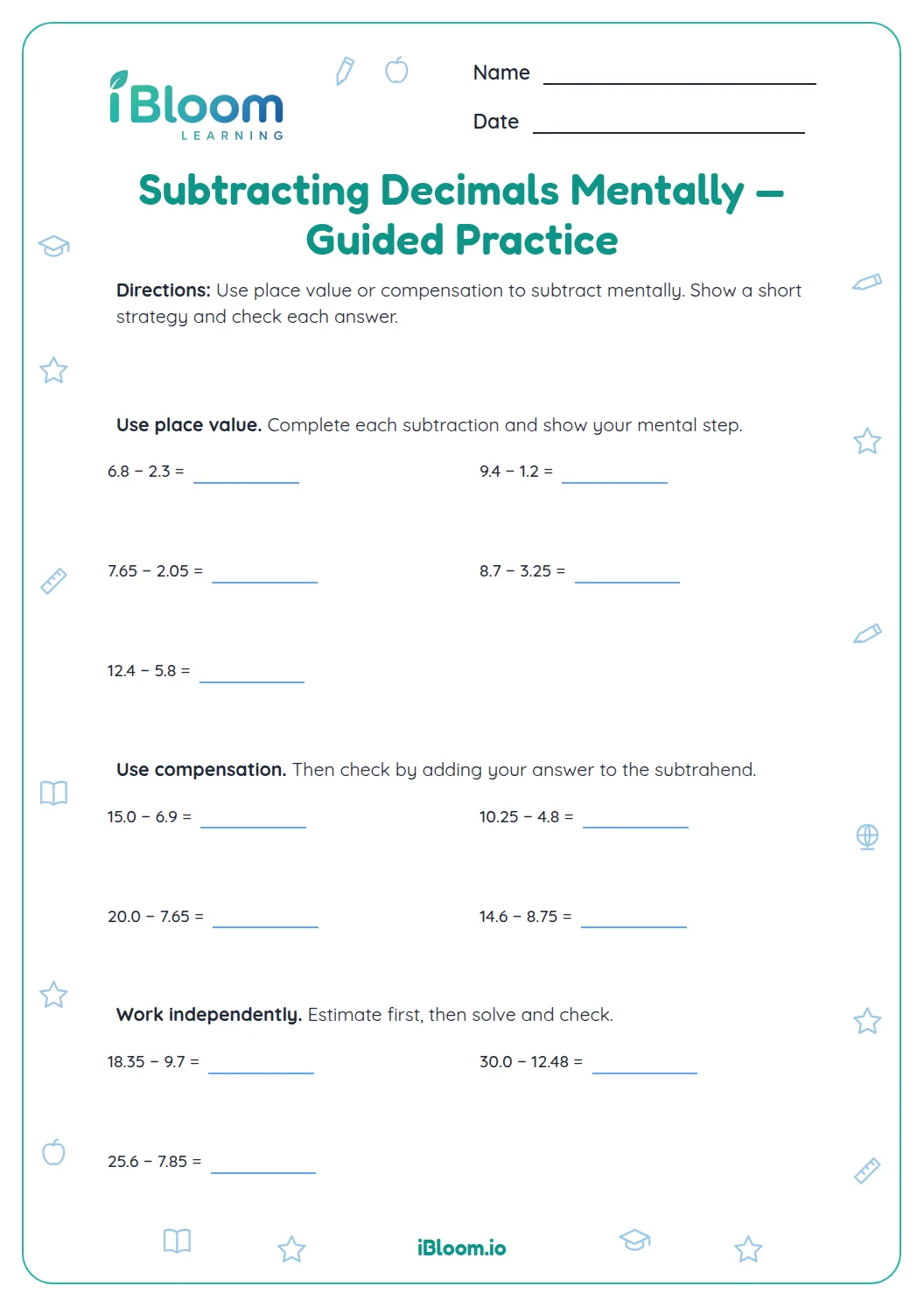
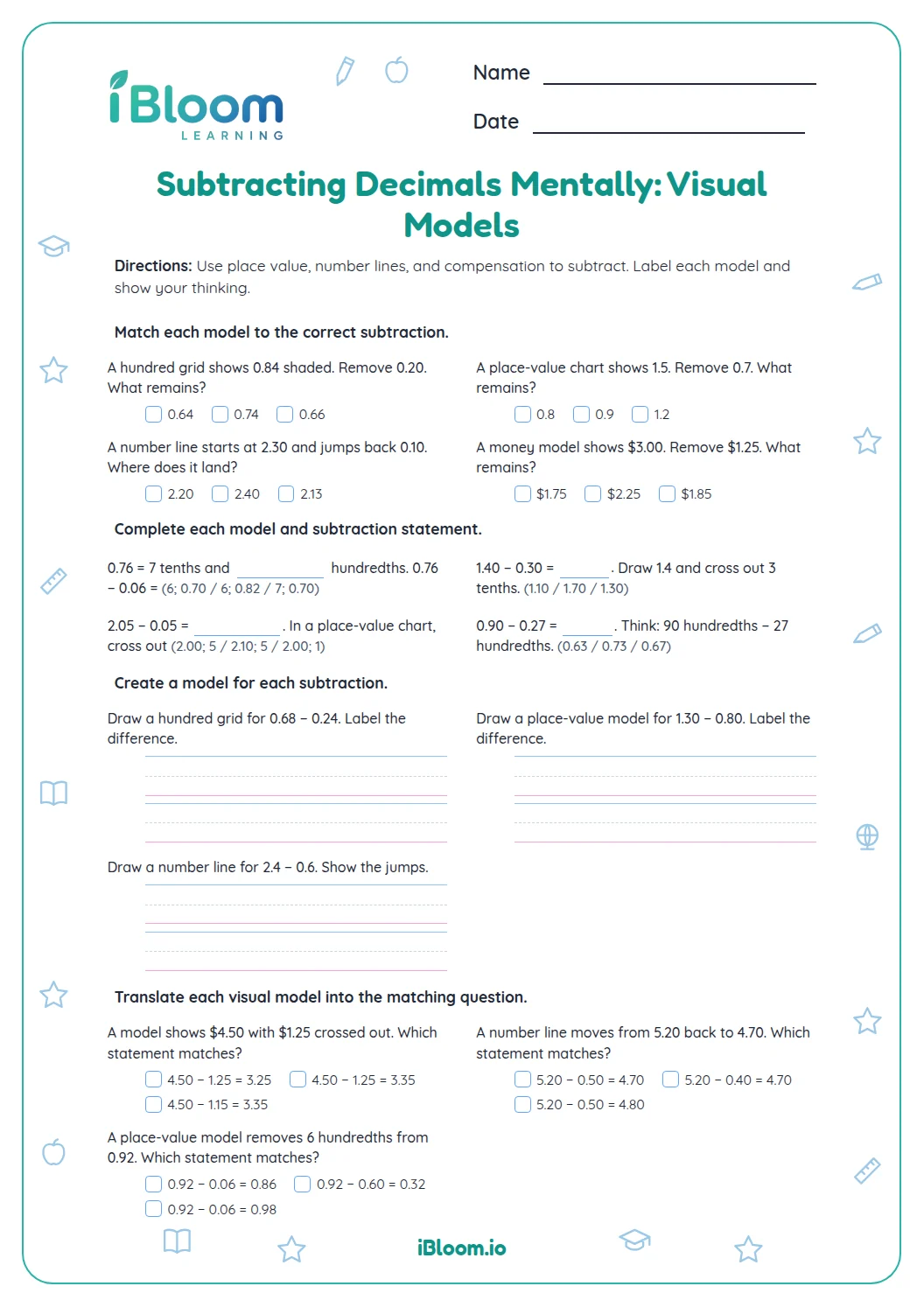
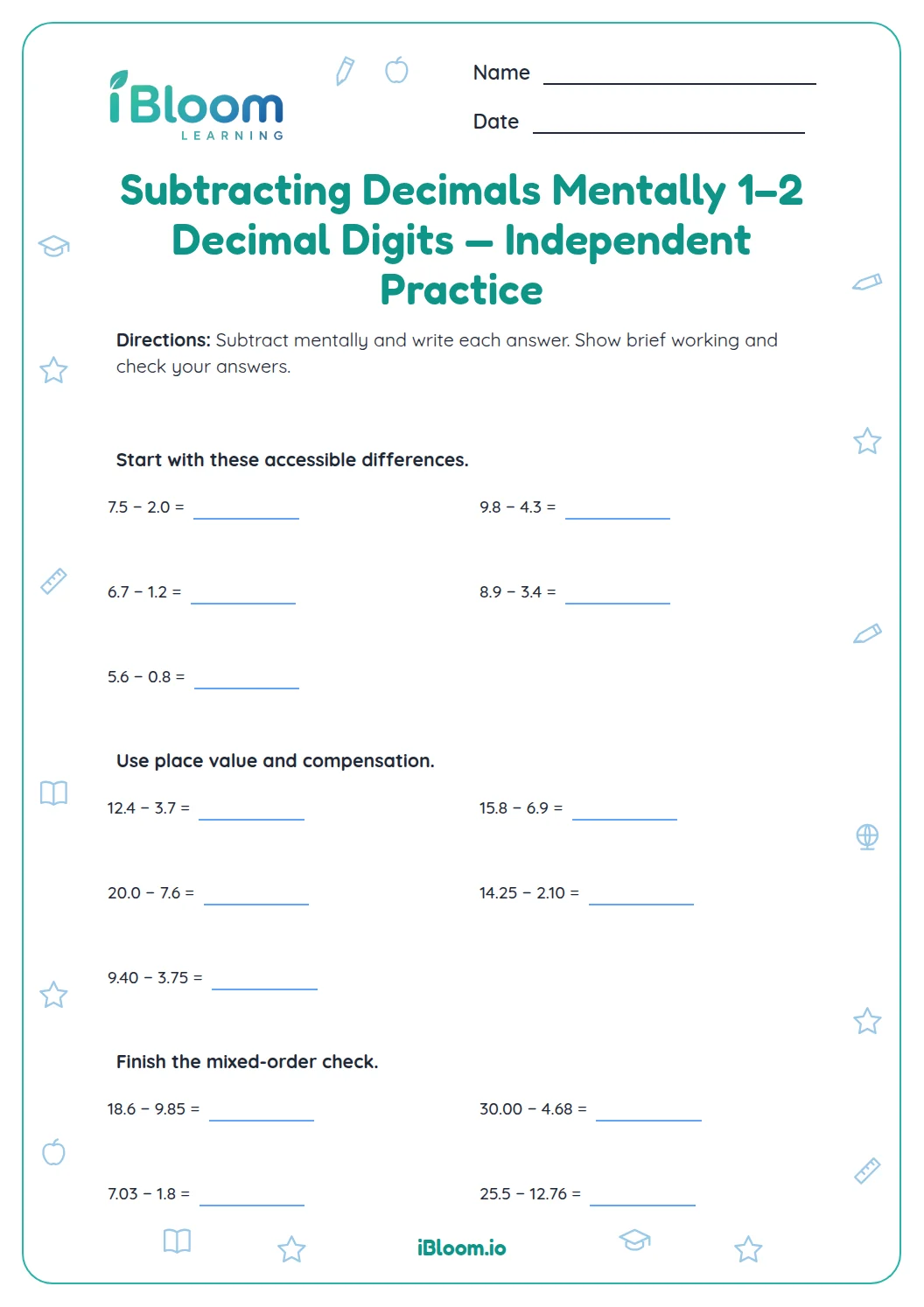
- 3Subtract tenths or hundredths mentally by decomposing the decimals if helpful.
- 4Write the correct unit or dollar amount with the answer.
- 5Estimate to check that the result is sensible.
Common errors to check
The mistake
Mistake: subtracting the smaller amount from the larger without following the story.
The fix
Identify what is known and what is missing.
The mistake
Mistake: dropping or changing a unit.
The fix
Carry the unit from the quantities in the problem.
The mistake
Mistake: treating a coupon as an added cost.
The fix
Check whether the situation increases or decreases the amount.
Common Core alignment
Subtract multi-digit decimals in practical situations.
On this sheet: All 16 situations require decimal subtraction; students may use mental place-value strategies.
Show the official wordingHide the official wording
Fluently add, subtract, multiply, and divide multi-digit decimals using the standard algorithm for each operation.
What to practice next
Make more practice
Further reading
Questions parents and teachers ask
How many problems are on this decimal worksheet?
There are 16 real-world problems. They use decimal tenths and hundredths in contexts such as money, distance, length, capacity, and weight. The answer key follows the worksheet and includes units. Ask the student to explain one answer using the sentence or number relationship that supports it.
Are the answers supposed to include units?
Yes. The worksheet directions ask students to label each answer. Use the unit from the situation, such as meters, liters, miles, or dollars. For money, keep the dollar sign and two decimal places when appropriate. Ask the student to explain one answer using the sentence or number relationship that supports it.
What does “mentally” mean for these problems?
Students can use place value, friendly-number adjustments, or decimal decomposition without setting up the standard algorithm in columns. For 4.8 − 1.3, subtract 1 and then 0.3 to reach 3.5. Ask the student to explain one answer using the sentence or number relationship that supports it.
Do all the questions ask for the amount left?
Most ask for a remainder, but several ask for a related unknown such as the starting amount, amount used, distance already traveled, or amount still needed. Read the final question carefully before choosing the subtraction order. Ask the student to explain one answer using the sentence or number relationship that supports it.
How can a student check a decimal difference?
Estimate first, then use addition to check. If 6.80 − 1.25 is 5.55, adding $1.25 back gives $6.80. The estimate also makes sense because subtracting a little over one dollar from under seven dollars leaves a little under six dollars.