



About this worksheet
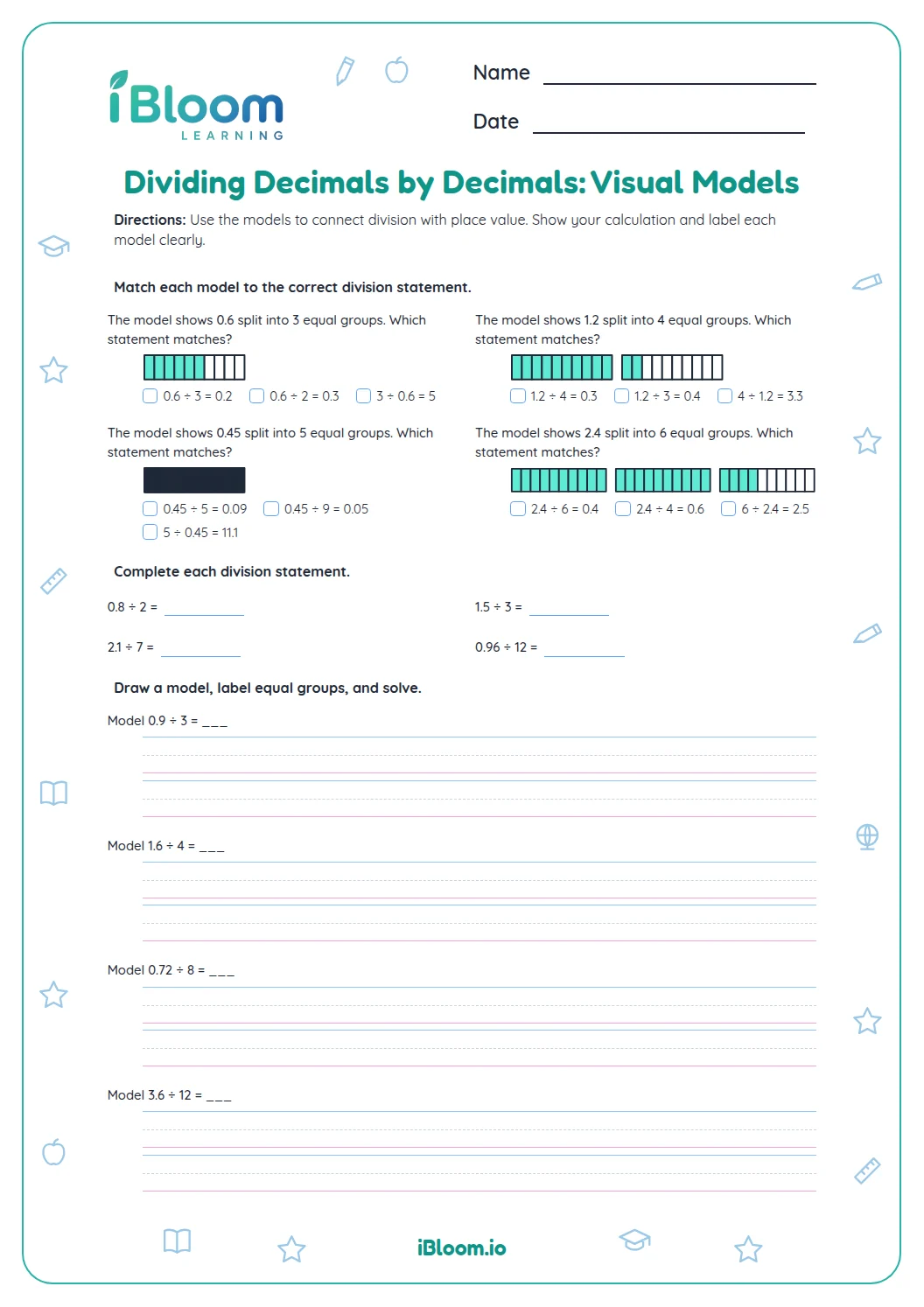
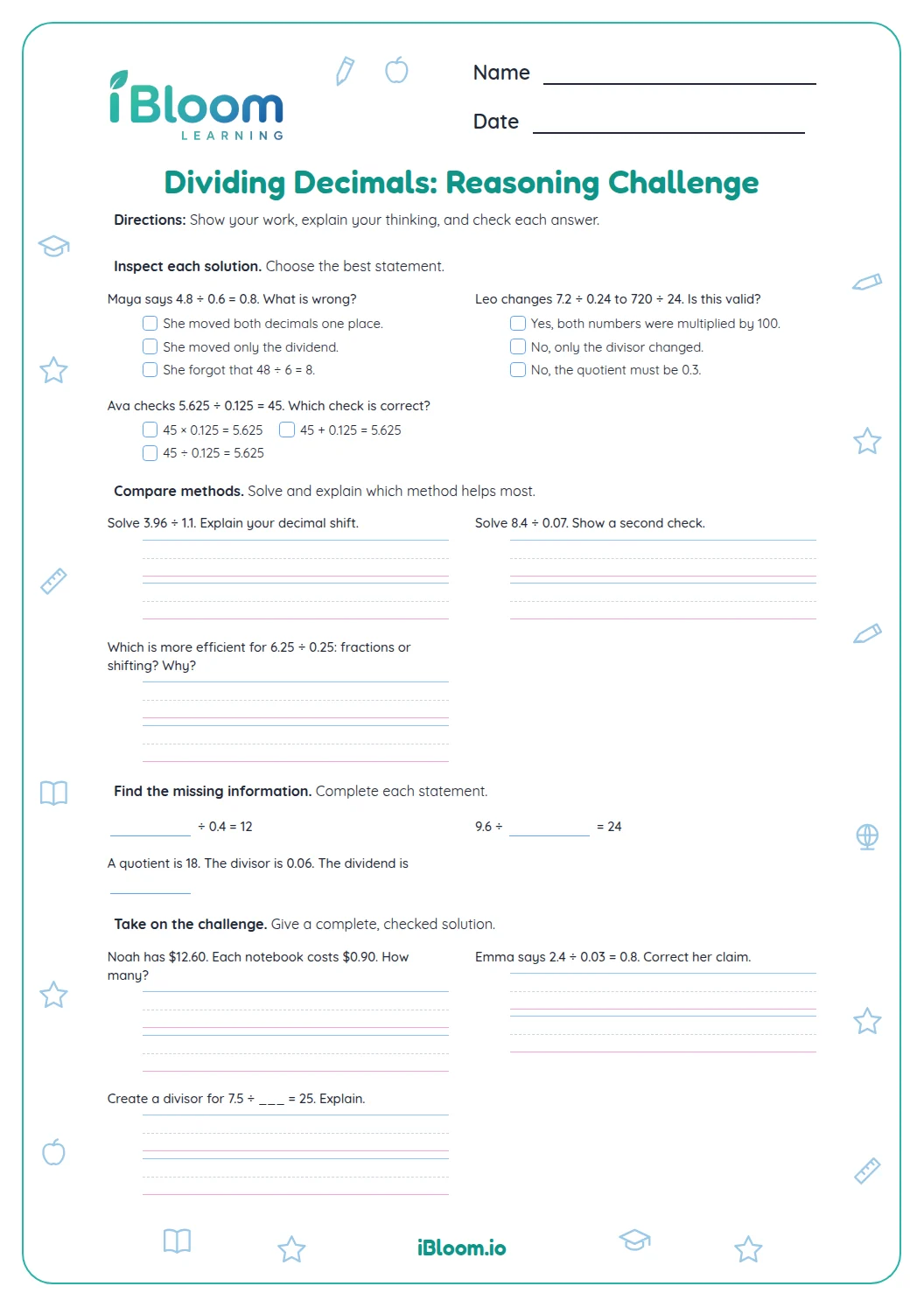
This Grade 6 independent practice worksheet contains 16 decimal division problems in three sets. Students multiply the dividend and divisor by the same power of ten to make the divisor a whole number, then divide and check. The skill practices CCSS 6.NS.B.3. A separate answer key lists the quotients.
Aligned to 6.NS.B.3
How do you make a decimal divisor whole?
The worksheet groups the problems into three sets. For each one, move the decimal point in the divisor until it is a whole number, then move it the same number of places in the dividend.
How can you check a quotient?
Multiply the quotient by the original divisor. The product should equal the original dividend.
- 14.8 ÷ 0.6
- 2Scale both numbers by 10: 48 ÷ 6
- 348 ÷ 6 = 8
- 4Check: 8 × 0.6 = 4.8
How to use this worksheet
- 1Count the divisor’s decimal places.
- 2Multiply both numbers by the same power of ten.
- 3Divide and multiply back to check.
Common decimal division mistakes
The mistake
Scaling the divisor but not the dividend.
The fix
Multiply both numbers by the same power of ten.
The mistake
Moving the decimal the wrong number of places.
The fix
Count the places needed to make the divisor a whole number.
The mistake
Skipping the check.
The fix
Multiply the quotient by the original divisor to see whether it returns the dividend.
Curriculum alignment
This practice supports the named skill at the listed grade level.
Fluently divide multi-digit decimals using the standard algorithm.
On this sheet: Fluently divide multi-digit decimals using the standard algorithm.
Show the official wordingHide the official wording
Fluently add, subtract, multiply, and divide multi-digit decimals using the standard algorithm for each operation.
What to practice next
Make more practice
Questions parents and teachers ask
How do I divide by a decimal?
Multiply the dividend and divisor by the same power of ten until the divisor is a whole number, then divide. The quotient stays the same because both numbers were scaled equally. For example, multiplying both parts of 4.8 ÷ 0.6 by 10 produces 48 ÷ 6 without changing the quotient.
What does scaling both numbers mean?
It means multiplying both values by 10, 100, or another matching power of ten. For 4.8 ÷ 0.6, multiplying both numbers by 10 gives 48 ÷ 6. The decimal point in each number shifts the same number of places, so their ratio remains unchanged.
How many problems are on the worksheet?
There are 16 problems in three practice sets. The divisor may have one, two, or three decimal places, and each item asks for a quotient. The separate key gives each quotient for checking after the student has finished the work.
How can I check a quotient?
Multiply the quotient by the original divisor, before scaling. For example, 8 × 0.6 equals 4.8, so 8 is the correct quotient for 4.8 ÷ 0.6. This check uses the original divisor and dividend, not only the scaled numbers from the division step.
Does the worksheet include an answer key?
Yes. The separate two-page key lists the quotient for each of the 16 problems. Use the key after completing the work to compare each quotient and find any step to revisit. Compare the quotient with the original problem to see whether both values were scaled correctly.