



About this worksheet
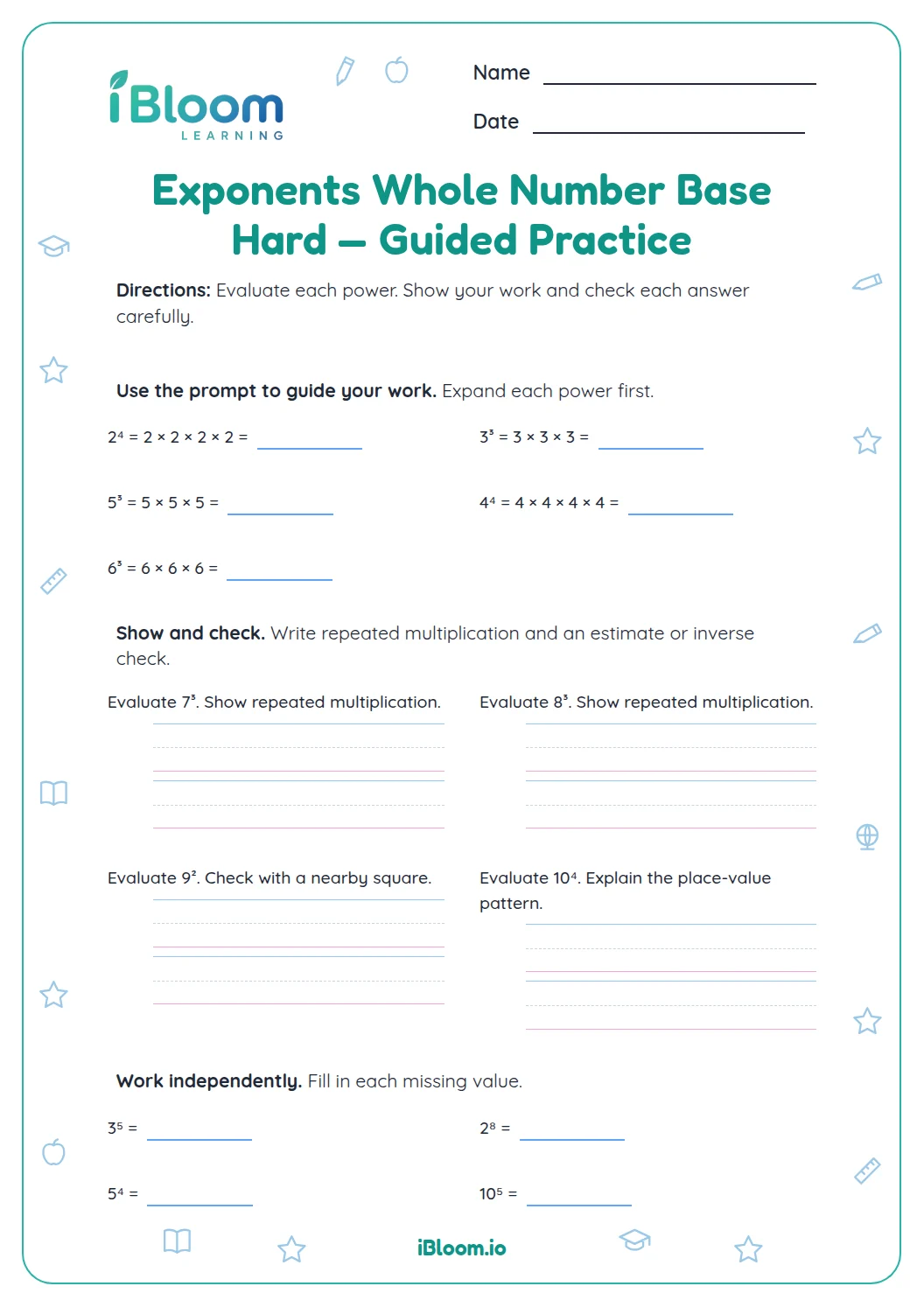
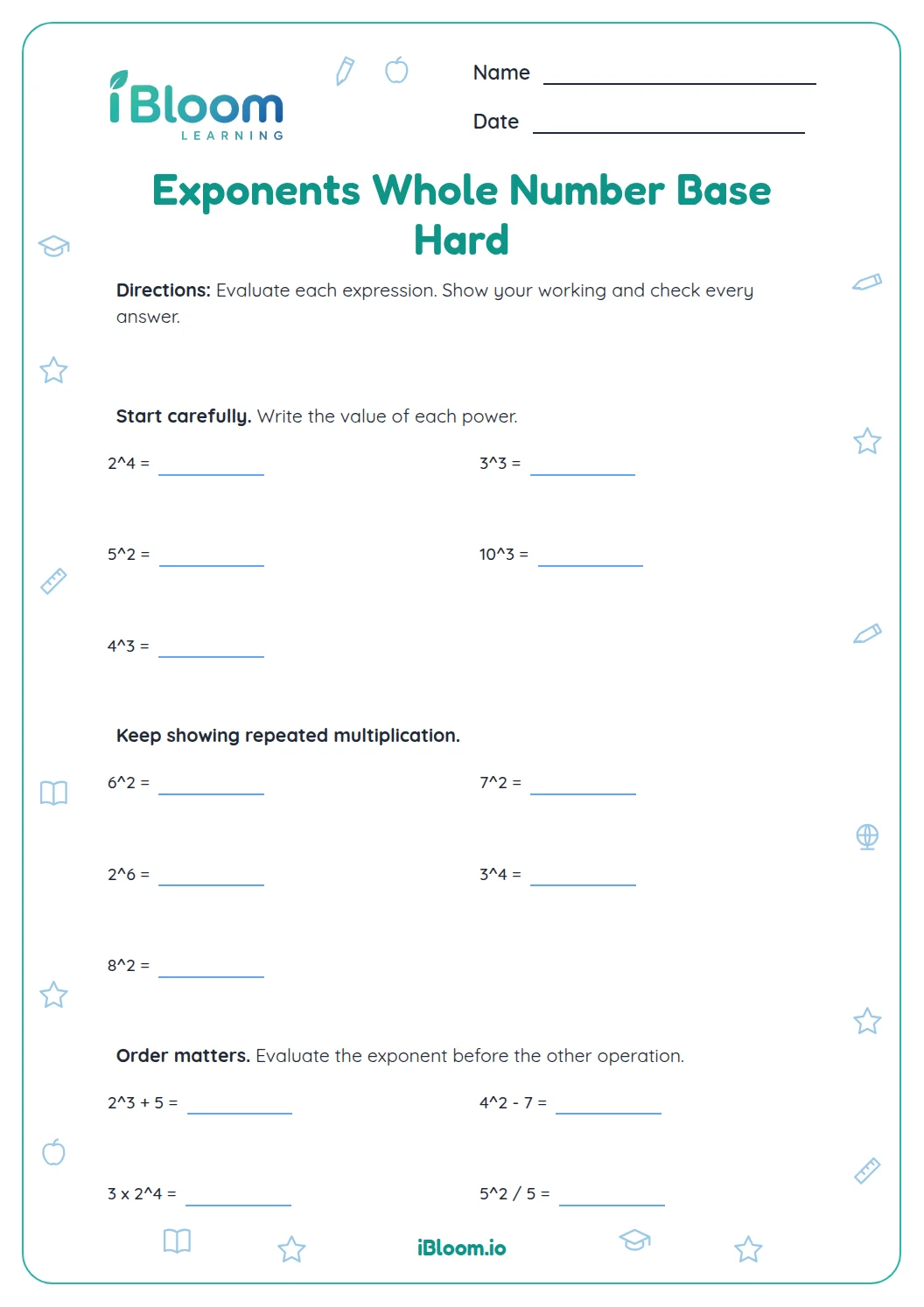
This Grade 6 worksheet builds understanding of whole-number exponents. Children evaluate powers, write repeated factors as a power, expand a power, and use exponents in short expressions. It practices CCSS 6.EE.A.1, writing and evaluating numerical expressions involving whole-number exponents. The answer key is included.
Aligned to 6.EE.A.1
What does an exponent tell you?
In 3^4, the base 3 is used as a factor four times: 3 × 3 × 3 × 3 = 81. The exponent counts factors; it does not mean multiply the base by the exponent.
How does this sheet connect powers and products?
Part A asks learners to evaluate six powers. Part B moves among repeated multiplication, exponent notation, comparisons, and short expressions. For example, 2^4 × 2^2 means 16 × 4, which equals 64.
How can an exponent answer be checked?
Expand the power into equal factors and multiply. For an expression with more than one power, evaluate each power first, then apply the operation between them.
How to work with powers
- 1Identify the base and exponent.
- 2Write the base as a repeated factor as many times as the exponent says.
- 3Multiply to evaluate the power.
- 4For an expression, evaluate each power before combining values.
- 5Check by counting the factors in your expansion.
Exponent checks
The mistake
Multiplying the base by the exponent.
The fix
Use the exponent as a count of equal base factors.
The mistake
Writing one too few repeated factors.
The fix
Count the factors; their number must equal the exponent.
The mistake
Combining powers before evaluating them in a mixed expression.
The fix
Evaluate each power first, then add or multiply as the prompt says.
Common Core alignment
Write and evaluate expressions with whole-number exponents.
On this sheet: Children translate repeated multiplication to powers and evaluate powers and short expressions.
Show the official wordingHide the official wording
Write and evaluate numerical expressions involving whole-number exponents.
What to practice next
Make more practice
Further reading
Questions parents and teachers ask
What does 2 to the fifth power mean?
It means multiply five factors of 2: 2 × 2 × 2 × 2 × 2 = 32. The small 5 counts how many times the base appears as a factor. The first part of the worksheet asks learners to evaluate powers using this repeated-factor meaning.
Does an exponent mean multiply the base by that number?
No. The exponent tells how many copies of the base to multiply together. For example, 3^4 is 3 × 3 × 3 × 3, or 81. The worksheet asks learners to expand powers so they can see and count each factor.
What kinds of questions are on this sheet?
There are 16 questions: six ask for power values, and ten connect powers with repeated multiplication, comparisons, and expressions. One item uses a cube’s side length to express its volume. A separate answer key lists the responses on its own pages for convenient checking.
How do you write repeated multiplication as a power?
Use the repeated factor as the base and count how many times it appears for the exponent. For example, 7 × 7 × 7 is 7^3. Part B includes items that ask learners to move between expanded products and exponent notation.
How can learners check a power?
Expand it and count the factors before multiplying. For 5^3, write 5 × 5 × 5 and calculate 125. If the expansion has three factors of 5, its notation matches the original power. The worksheet uses this check throughout.