

About this worksheet
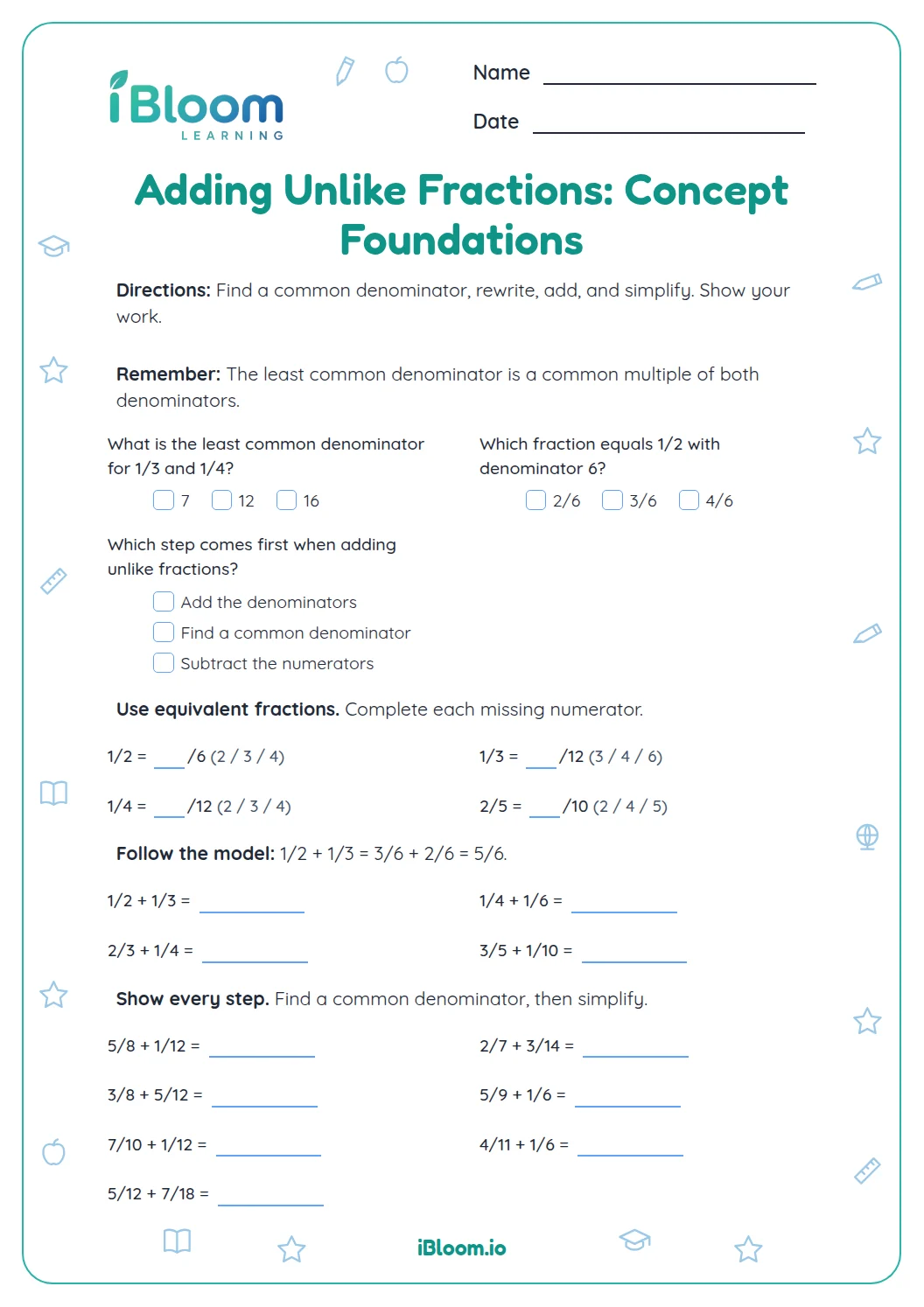
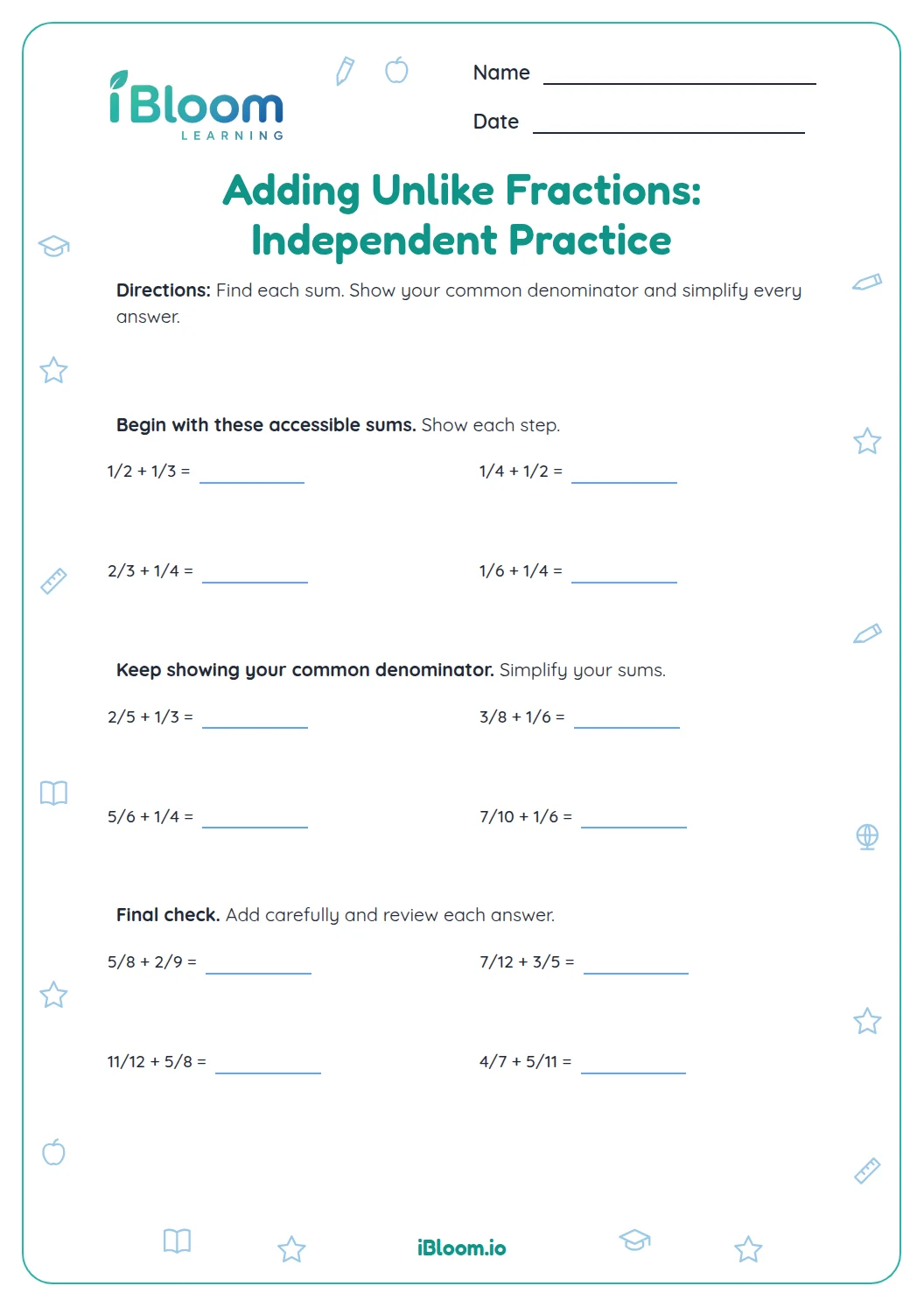
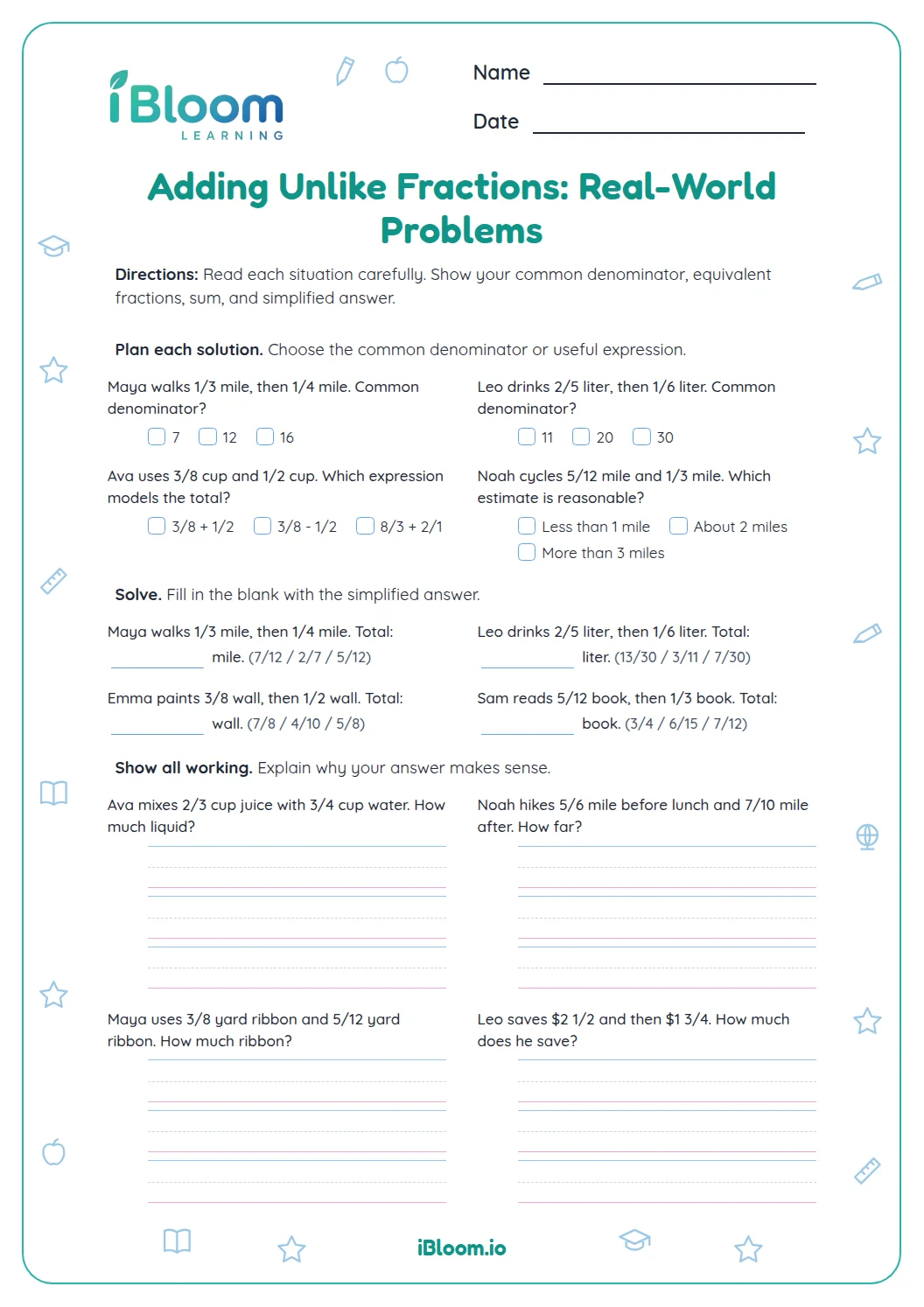
The worksheet practices adding unlike fractions with denominators drawn from 2 through 12. Learners rewrite each pair with a common denominator, add, and simplify; the final part applies the same steps in context.
Find a common denominator
Choose a common multiple of both denominators. Rewrite each fraction as an equivalent fraction with that denominator, then add the numerators.
Write the sum in simplest form
Reduce the resulting fraction when its numerator and denominator share a factor. If the sum is greater than one, write it as a mixed number.
How to use this worksheet
- 1Find a common denominator for each pair.
- 2Add the numerators and keep the common denominator.
- 3Simplify each result; use the answer key to check your work.
A common mix-up
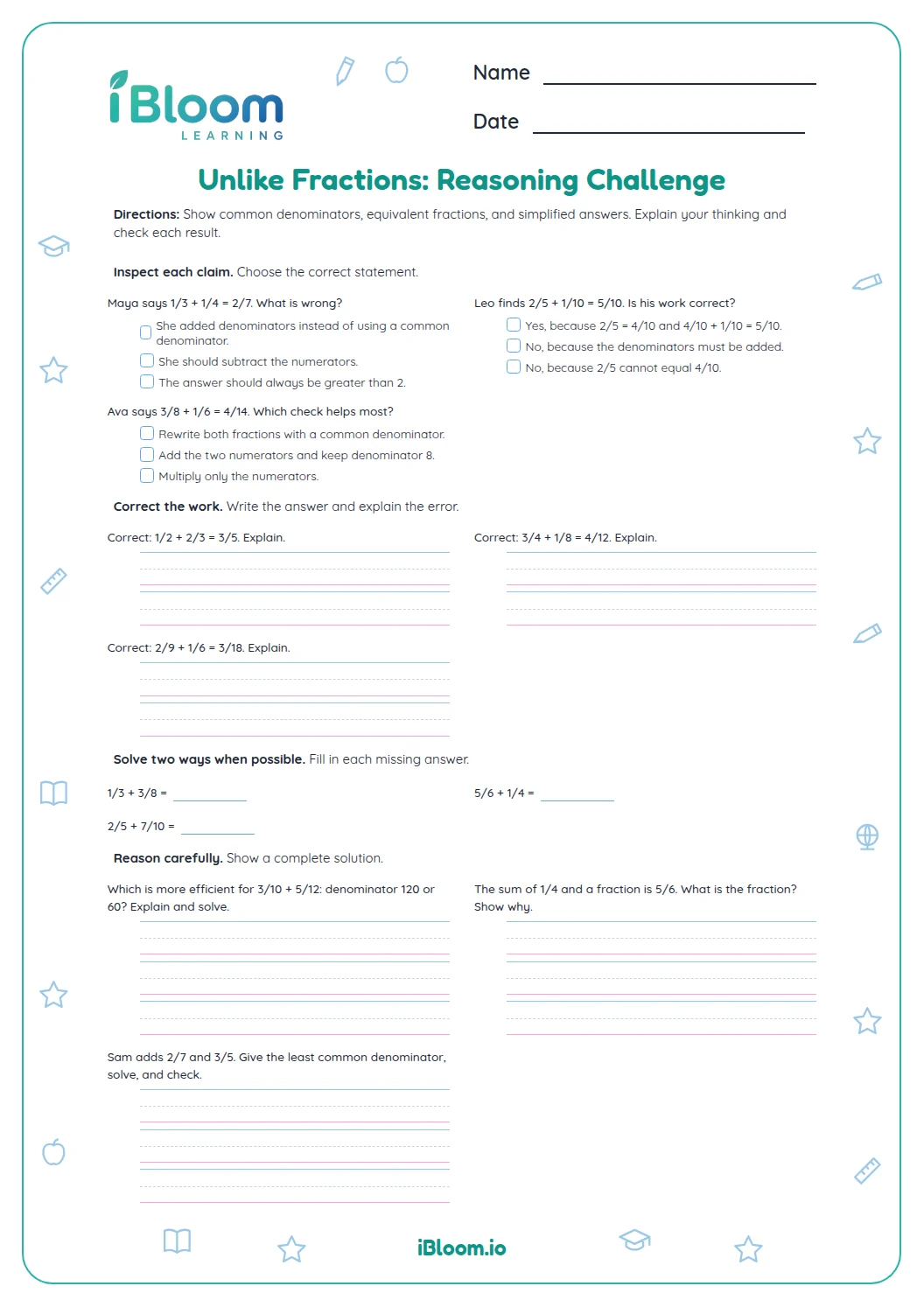
The mistake
Adding the denominators as well as the numerators.
The fix
Use equivalent fractions with the same denominator before adding.
What to practice next
Further reading
Questions parents and teachers ask
What denominators appear on this worksheet?
The problems use every denominator from 2 through 12. Learners practice choosing a common denominator for each pair, including pairs whose denominators are not multiples of one another, and simplify the sum when possible. Several denominators share factors, so simplifying is useful.
Should answers be simplified?
Yes. Reduce each result when the numerator and denominator share a factor. If the sum is greater than one, write it as a mixed number in simplest form. The answer key shows simplified answers for the practice items.
Does the worksheet include word problems?
Yes. Four final questions apply fraction addition to ingredient amounts, ribbon lengths, and distance. Each asks learners to add two unlike fractions and label the total with the unit given in the problem. Students should include the unit in each final answer.
What is the first step when denominators differ?
Find a common denominator, then rewrite each fraction as an equivalent fraction. Add the new numerators and keep the shared denominator. Simplify the result if possible, and change an improper fraction to a mixed number when needed. This keeps the parts equal in size.