



About this worksheet
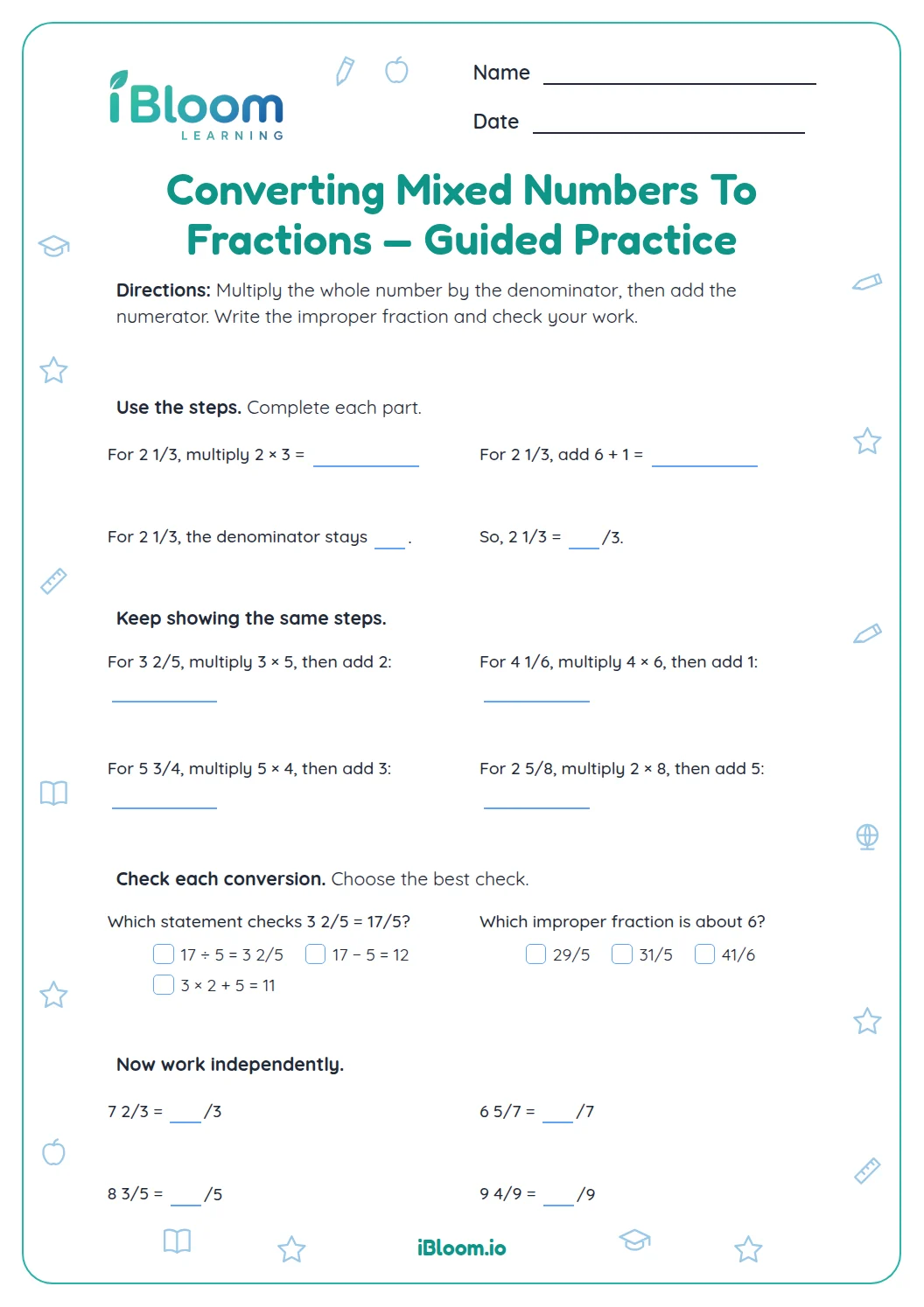
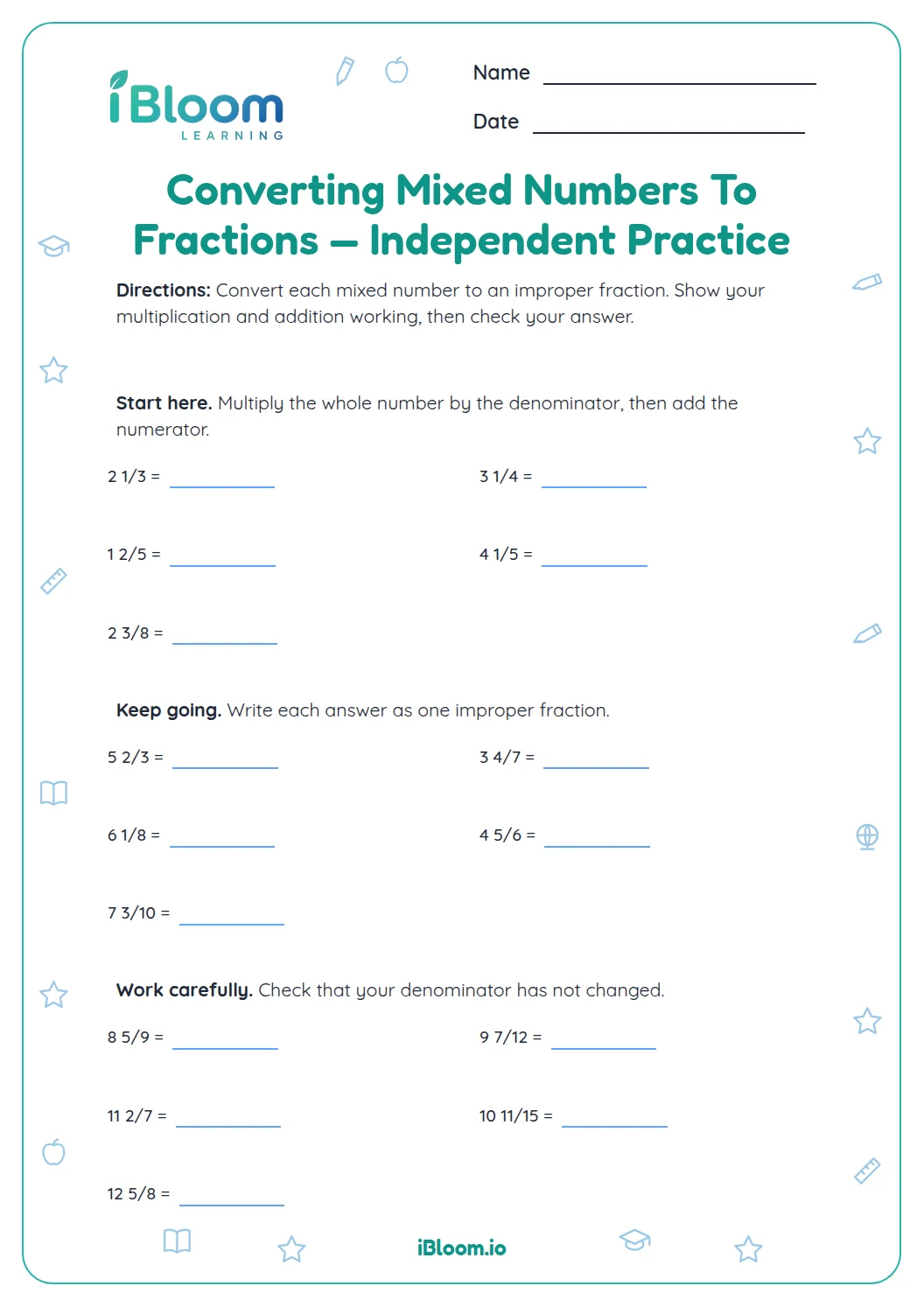
This Grade 6 worksheet develops the conversion from a mixed number to an improper fraction. Learners first convert familiar mixed numbers, then read fraction models, and finally write equivalent-fraction reasoning. There are 16 questions and a separate answer key.
Aligned to 5.NF.B.3
What stays the same when converting?
The denominator stays the same because each whole is divided into the same size parts. The numerator counts all those parts together.
How does a model show the conversion?
Question 9 shows one whole bar divided into thirds and one more third shaded. There are four shaded thirds altogether, so the total is 4/3.
- 11 whole = 3/3
- 2Add 1/3
- 33/3 + 1/3 = 4/3
How can you check the result?
Divide the numerator by the denominator. The quotient should be the original whole number and the remainder should be the original numerator.
How to use this worksheet
- 1Keep the denominator because the part size stays the same.
- 2Multiply the whole number by the denominator.
- 3Add the numerator to count all parts.
- 4Write the total over the original denominator.
- 5Check by dividing the numerator by the denominator.
Common mistakes and quick fixes
The mistake
Check the operation or unit before answering.
The fix
Reread the prompt and keep the unit with the result.
The mistake
Skip a step in the process.
The fix
Write each step clearly before checking the answer.
The mistake
Use one detail to describe the whole task.
The fix
Check that your answer fits the full question.
Common Core alignment
This sheet practices the listed skill through its worksheet questions.
Relate mixed numbers and improper fractions through equal-sized parts.
On this sheet: Grade 6
Show the official wordingHide the official wording
Interpret a fraction as division of the numerator by the denominator (a/b = a ÷ b). Solve word problems involving division of whole numbers leading to answers in the form of fractions or mixed numbers.
What to practice next
Further reading
Questions parents and teachers ask
What does this worksheet practice?
It practices changing mixed numbers into improper fractions while keeping the same denominator. The 16 questions move from direct conversions to reading fraction bars and completing numerator calculations. A separate two-page answer key lets students check the fraction and revisit each step.
How do you convert a mixed number?
Multiply the whole-number part by the denominator, then add the numerator. Keep the original denominator. For example, 2 1/3 becomes (2 × 3 + 1)/3, or 7/3. The worksheet repeats this rule with several denominators and gives learners a key for checking each result.
What do the fraction bars show?
The bars show one or more complete wholes and an additional shaded part. Count the equal parts in each whole, then add the remaining shaded parts. Question 9 shows one whole and one third, which totals 4/3. The key repeats the value so students can compare their count.
How many questions and pages are included?
There are 16 questions on two worksheet pages, followed by a two-page answer key. The practice includes direct conversions, four shaded fraction models, and numerator blanks. The key gives the expected improper fractions and a sample explanation for the last writing question.
How can a student check a conversion?
Divide the improper fraction numerator by its denominator. The quotient should match the whole-number part, and the remainder should match the original numerator. For 17/5, the quotient is 3 with remainder 2, so the mixed number is 3 2/5.