

About this worksheet
This Kindergarten printable practices the parts that make five. Children complete number bonds, solve missing-addend equations, and use short stories to find how many more are needed. The sequence connects part-and-whole models with equations and familiar situations. This set-based work supports Common Core K.OA.A.3, which asks children to decompose numbers into pairs using objects, drawings or equations. A separate answer key lists each missing part.
Aligned to K.OA.A.3
What does it mean to make five?
Five can be split into two parts. In question 3, the number bond shows 3 as one part of 5, so the missing part is 2. The two parts join to make the whole.
Check the answer with an equation: 3 + 2 = 5.
- 1The bond shows 3 and a missing part.
- 25 − 3 = 2.
- 3The two parts are 3 and 2.
How do pictures connect to addition?
A missing-addend equation names the same two parts as a number bond. In 1 + ___ = 5, the known part is 1 and the whole is 5; the missing part is 4.
What is on the practice pages?
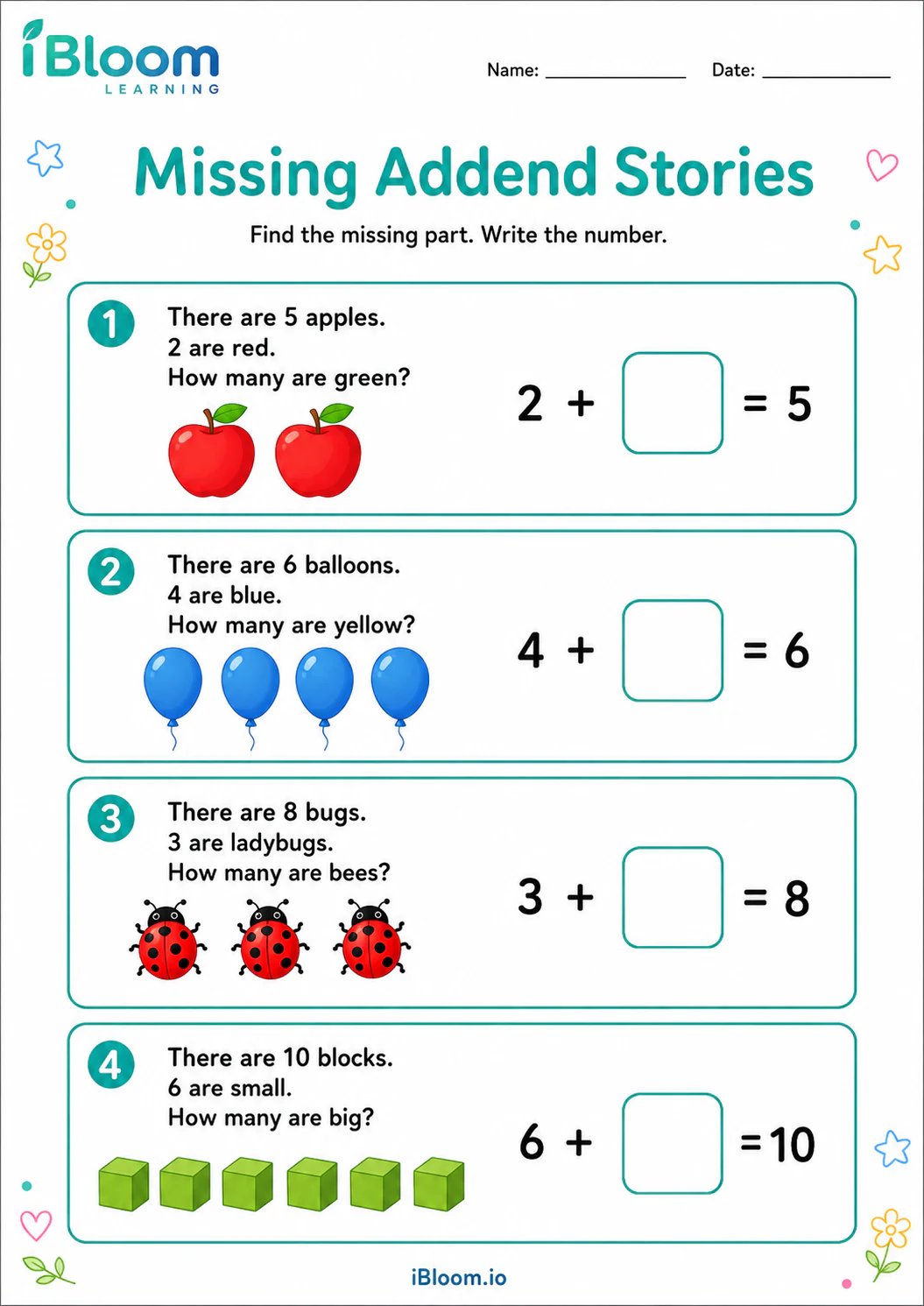
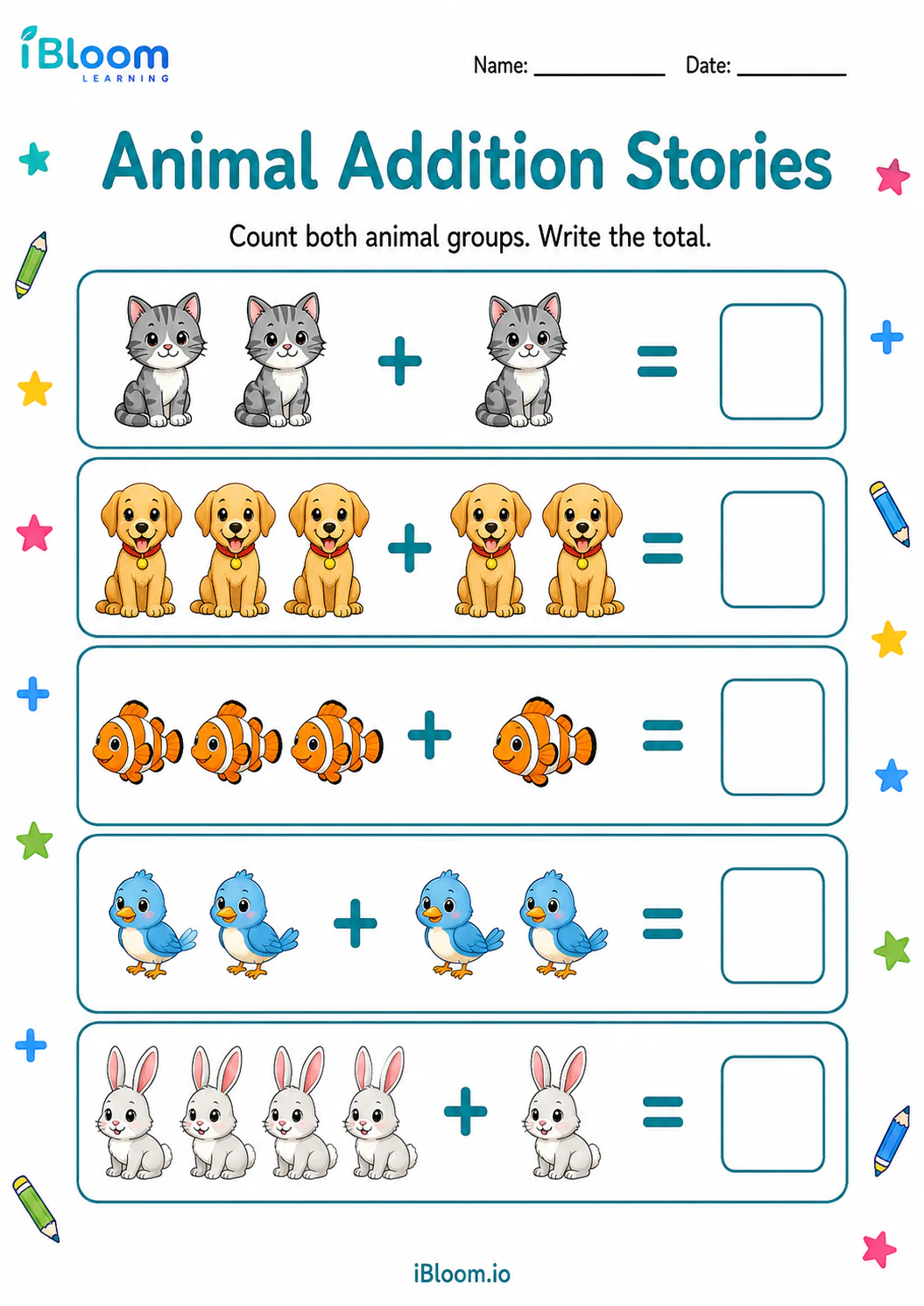
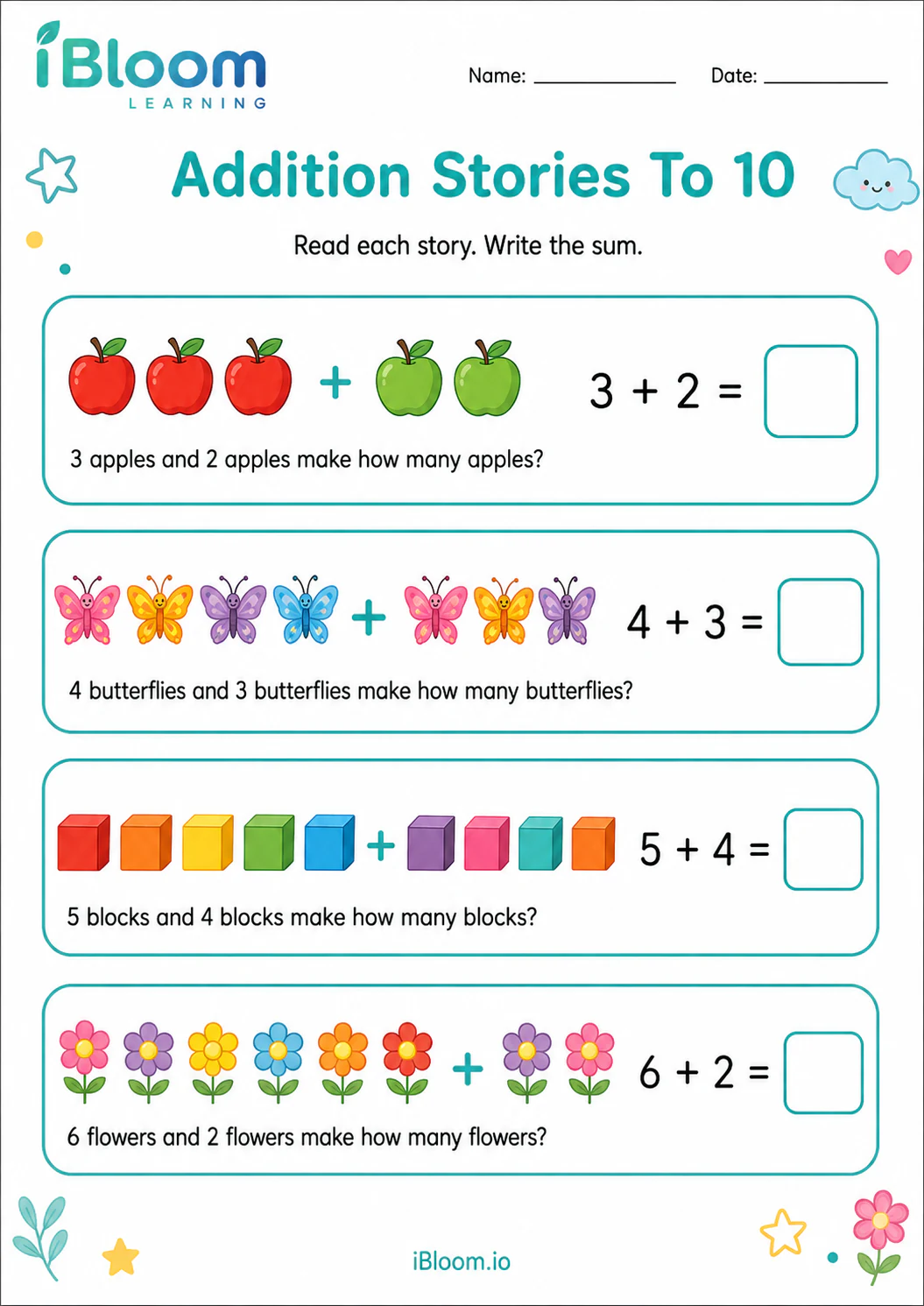
The 16 questions move from number bonds to equations and short make-five stories. Every item asks for the missing part that completes a whole of five. The original five-frame activity is represented with number bonds and related equations.
- Part A: 8 number bonds with a missing part
- Part B: 4 missing-addend equations
- Part C: 4 make-five stories
- The answer key lists the missing part for every item.
How can an adult support this practice?
- 1Read the whole and known part in a number bond or story.
- 2Think about how many more are needed to make five.
- 3For an equation, name the missing addend.
- 4Use the two parts to check that they make five.
- 5For a story, answer with the item or group the question asks about.
Common mistakes and quick fixes
The mistake
Answering with the number of counters already shown.
The fix
Ask “How many more?” and count on to five.
The mistake
Adding the known part to five instead of finding the missing part.
The fix
Ask what number joins the known part to make a whole of five.
The mistake
Writing a number that makes the parts total more or less than five.
The fix
Add the two parts to check that their whole is five.
Common Core alignment
The page connects physical groups, drawings and addition equations.
Show pairs that compose five with objects, pictures and equations.
On this sheet: Children find and record pairs that make five.
Show the official wordingHide the official wording
Decompose numbers less than or equal to 10 into pairs in more than one way, e.g., by using objects or drawings, and record each decomposition by a drawing or equation (e.g., 5 = 2 + 3 and 5 = 4 + 1).
What to practice next
Make more practice
Further reading
Questions parents and teachers ask
What does “make five” mean?
It means finding two parts that join to make a total of five. If three counters are already present, two more complete the group. Children use the pictures and number sentences to notice that the same total can be made in several ways.
Why count on instead of starting at one?
Counting on uses the known group as a starting point. For three counters, say “four, five” to find two more. This helps children connect the missing part with the count needed to reach the target. Try acting out the group with counters, then count on to five to check the result.
What models appear on the replacement sheet?
The sheet uses number bonds, missing-addend equations and short stories to practice making five. Each item gives a whole of five and one known part, and the child finds the part that is missing. An adult can use blocks or counters alongside the printed questions if a hands-on model is helpful.
How can an adult use the answer key?
Invite the child to explain or show one answer with counters before checking the key. The key gives the missing number for each fixed-answer question, and a child can verify it by joining the two parts to make five.
What if a child counts all the way from one?
Counting on is a useful way to find a missing part. For a known part of 3, say “four, five” to find that 2 more are needed. The number bonds and equations on the sheet show the known part and the whole so children can focus on the missing amount.
Is this practice appropriate for home use?
Yes. An adult can print the worksheet pages and keep the answer key nearby. Real buttons or blocks can also help a child act out a question, but the printed pictures and equations provide enough information to complete the sheet.