
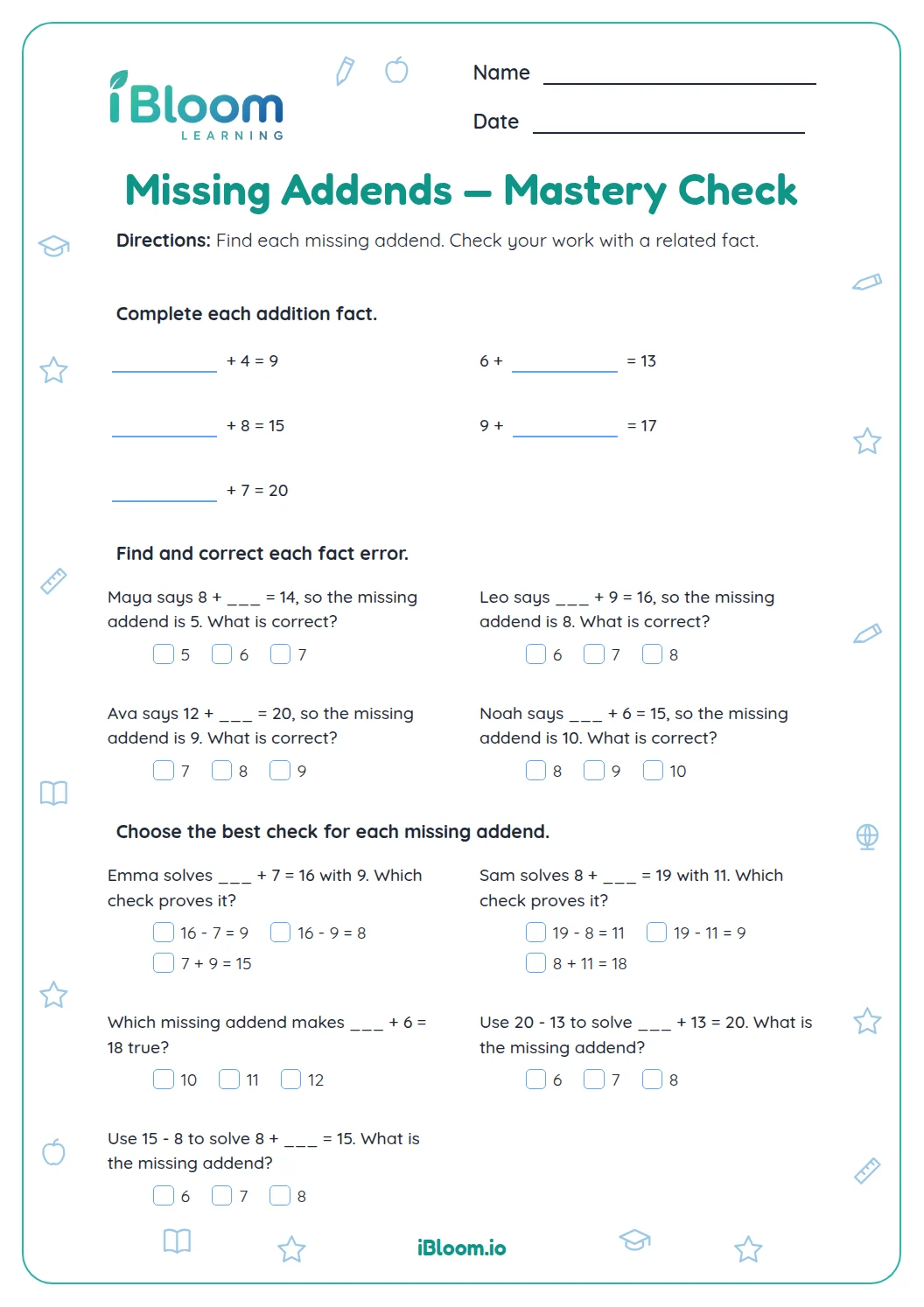
About this worksheet
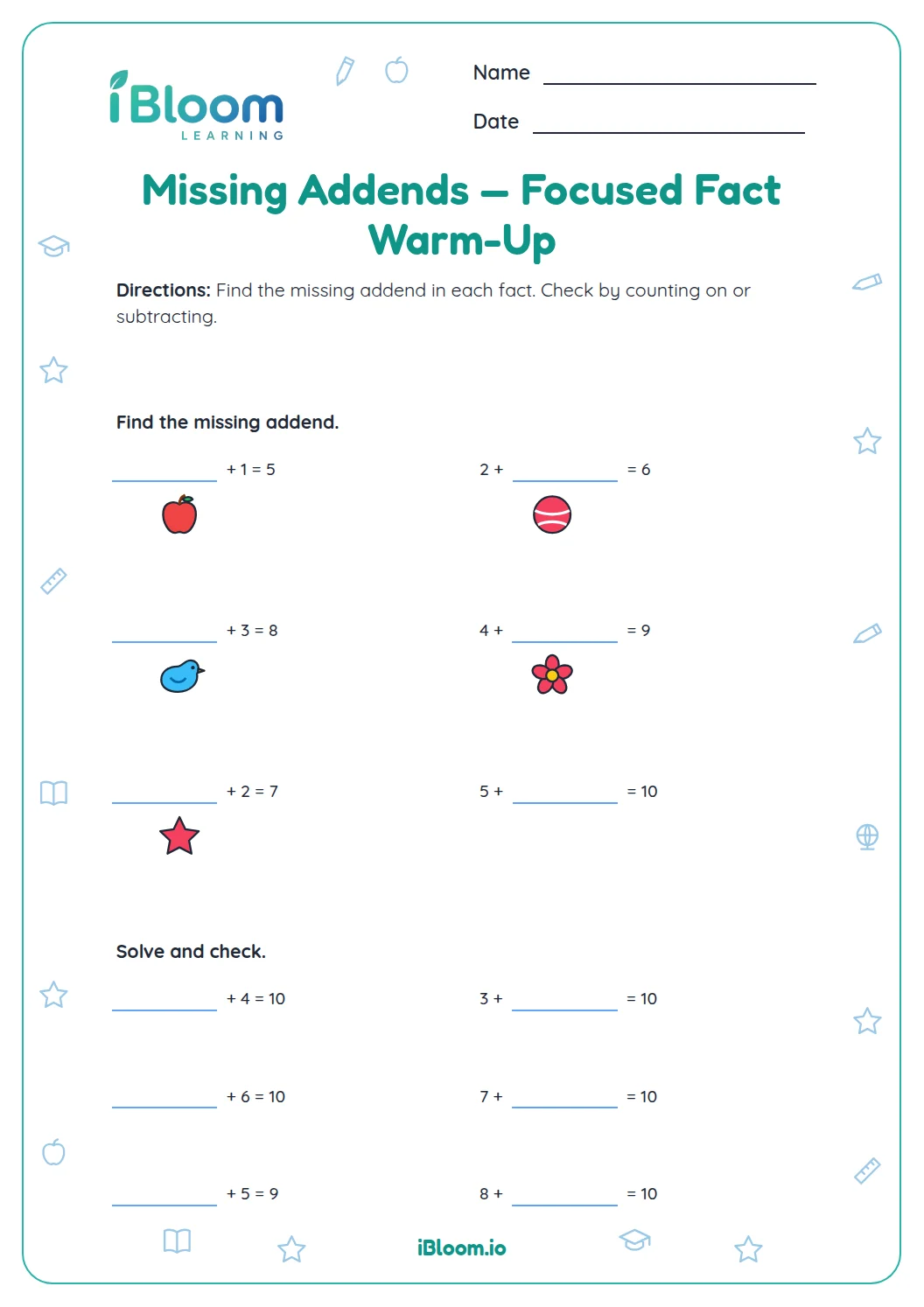
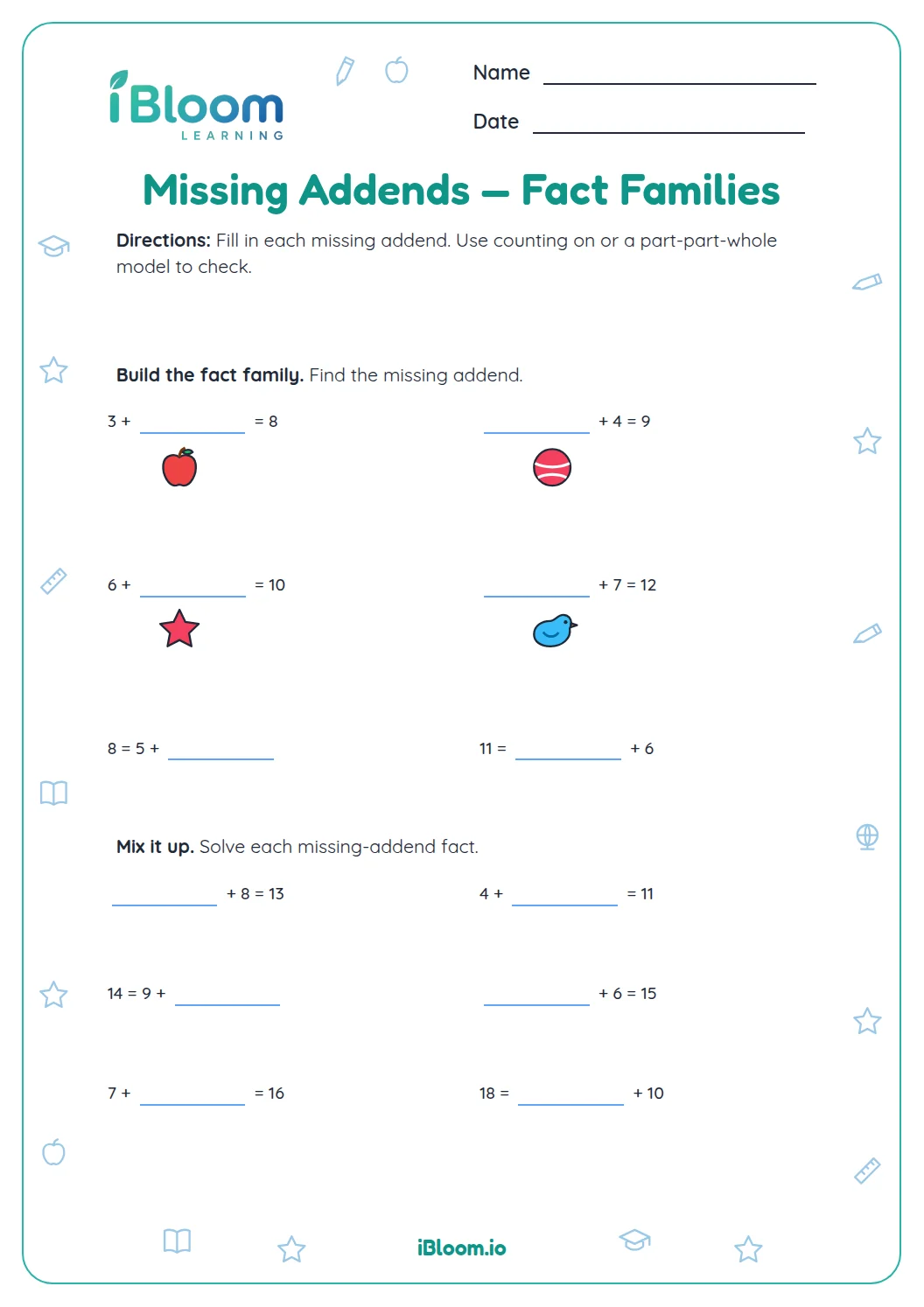
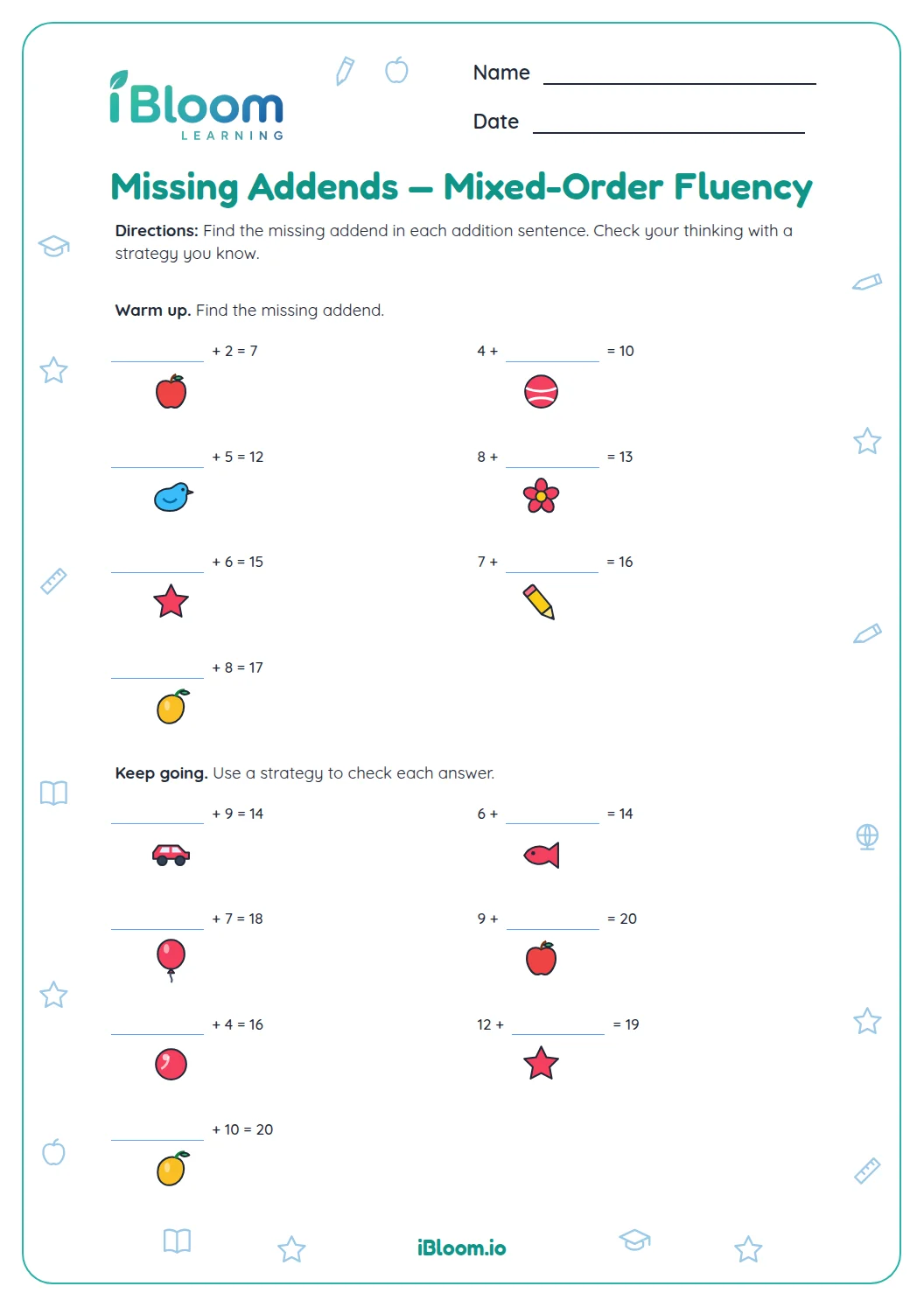
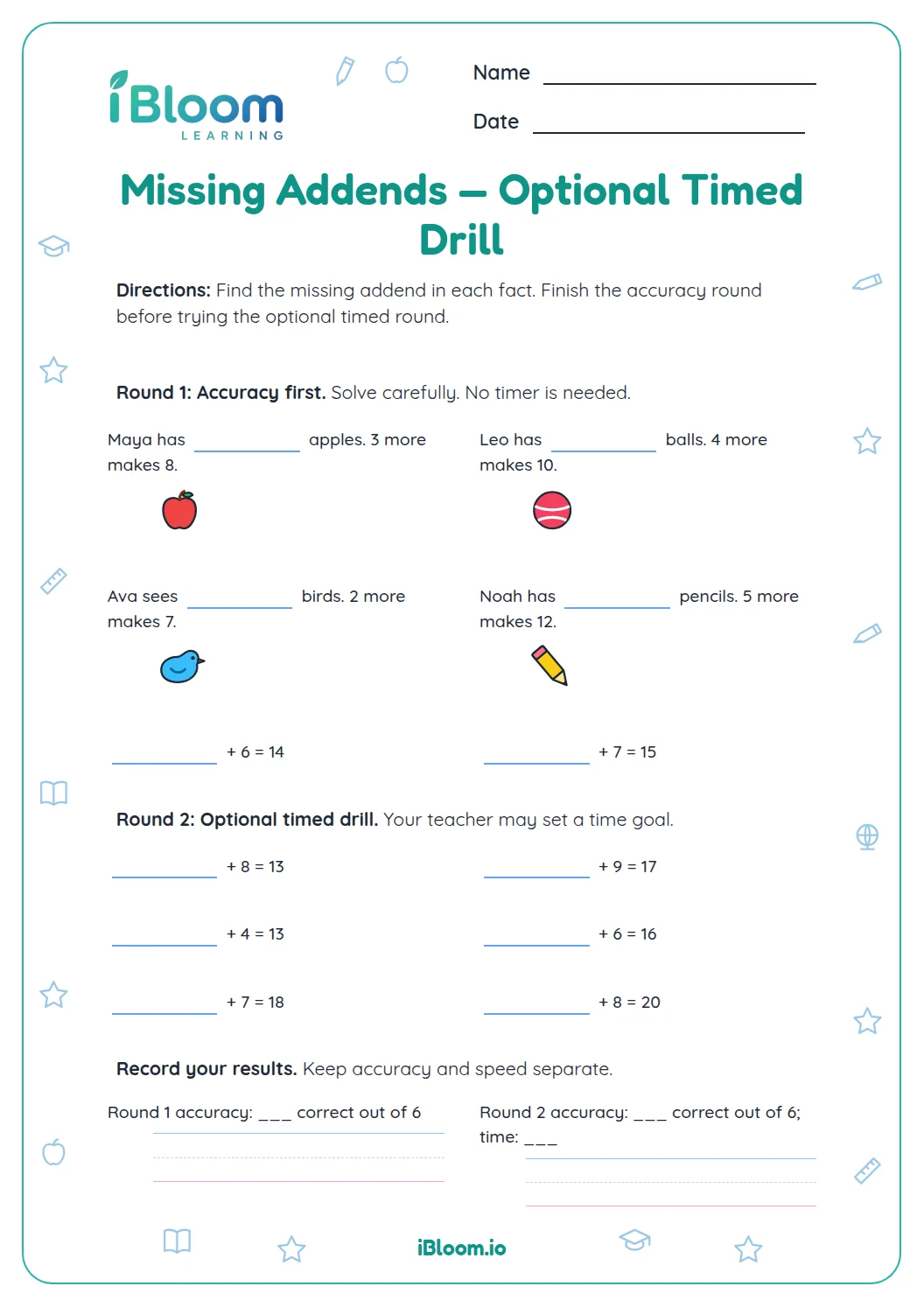
This printable gives Grade 1 and 2 students 20 addition facts with a missing addend or total. The unknown moves to different places in the equation, and two short situations connect the facts to everyday quantities. The separate answer key supports checking with a related addition or subtraction fact.
Aligned to 1.OA.8
What is a missing addend?
An addend is a number being added. In 6 + ___ = 14, the missing number is the part that joins 6 to make 14. A blank after the equal sign asks for the total instead.
This sheet includes 20 items: equations and short situations, with sums no greater than 20.
Which strategy helps?
Count on from a known addend, or subtract the known part from the total. For a situation, first write the addition fact that matches it. Put your answer back into the equation to check.
How to use this worksheet
- 1Read the directions at the start of each part before solving.
- 2Work through the examples and questions in order, writing neatly in the spaces.
- 3Use the separate answer key to check each response and explain any correction.
Common mistakes and quick fixes
The mistake
A common slip is subtracting the known addend from the wrong number. Point to the total first, then subtract the known part, and finally check by adding.
The fix
Common Core alignment
This worksheet practices finding an unknown number in an addition equation within 20, a Grade 1 Common Core expectation.
Determine the unknown whole number in an addition or subtraction equation relating three whole numbers.
On this sheet: The worksheet gives students guided practice applying this skill in context.
Show the official wordingHide the official wording
Determine the unknown whole number in an addition or subtraction equation relating three whole numbers.
What to practice next
Further reading
Questions parents and teachers ask
Does every blank stand for an addend?
No. Some blanks stand for an addend, while a blank after the equal sign stands for the sum. Read the equal sign and all the numbers before solving. For example, in 9 + 5 = ___, the missing number is the total, 14.
What strategies can children use?
Children may count on from the known addend, use a related subtraction fact, or think of two parts that make the total. After finding the missing number, add it to the known number to verify the equation. In class, ask the child to explain the choice and point to the clue that supports it.
What number range does the page use?
Every sum on the page is 20 or less, which keeps the practice within early addition facts. The unknown can appear first, second, or after the equal sign, and the child should attend to its position. In class, ask the child to explain the choice and point to the clue that supports it.
Is this suitable for Grade 1 and Grade 2?
Yes. The page focuses on unknown numbers in addition equations within 20, an early elementary skill. Children who need support can use counters or a number line before writing the answer. In class, ask the child to explain the choice and point to the clue that supports it.
How can I check an addition fact?
Put the missing number into the blank and read the equation from left to right. If the two addends combine to make the total, the equation is correct. For example, 6 + 8 = 14 checks the missing addend in 6 + ___ = 14.