


About this worksheet
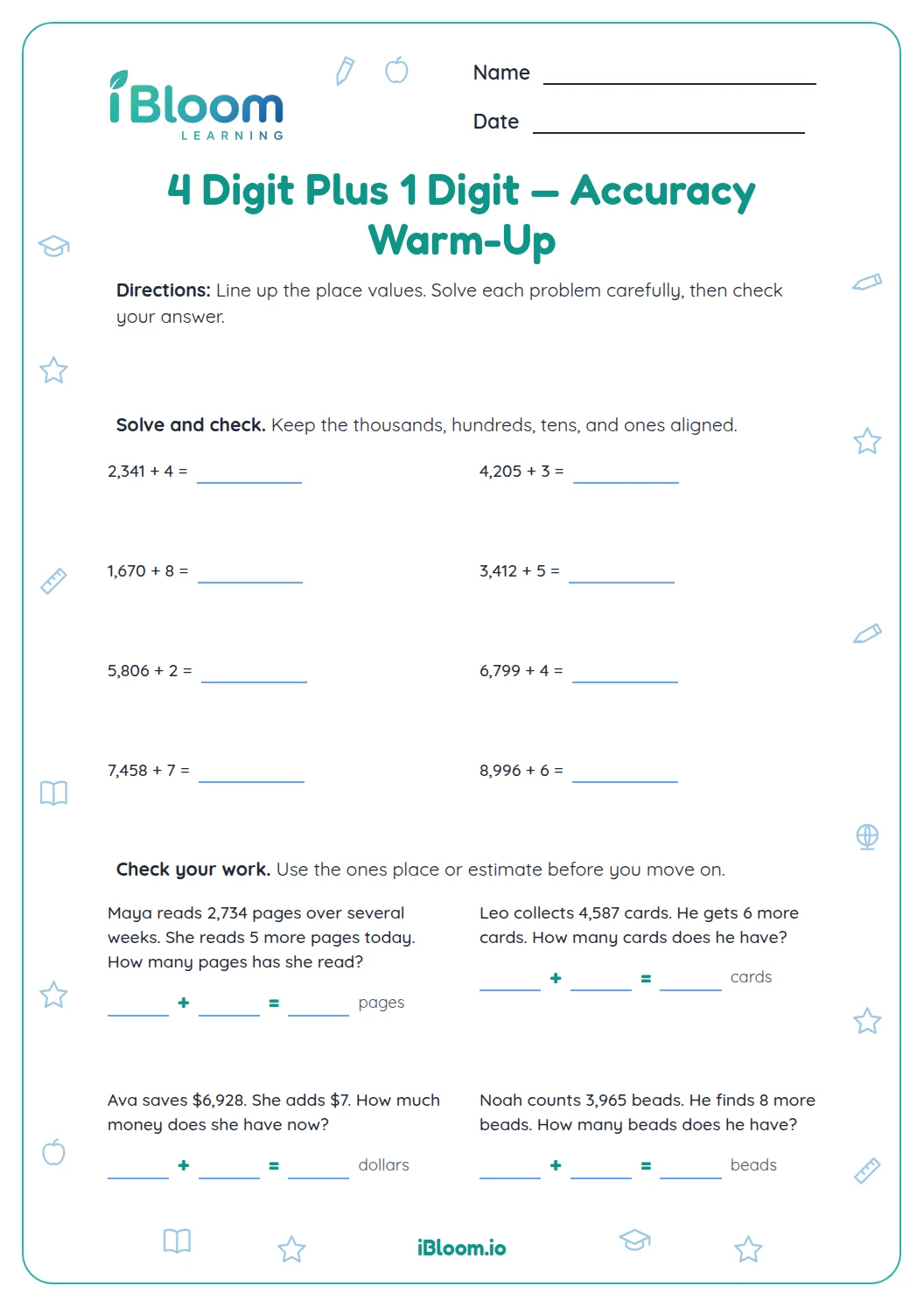
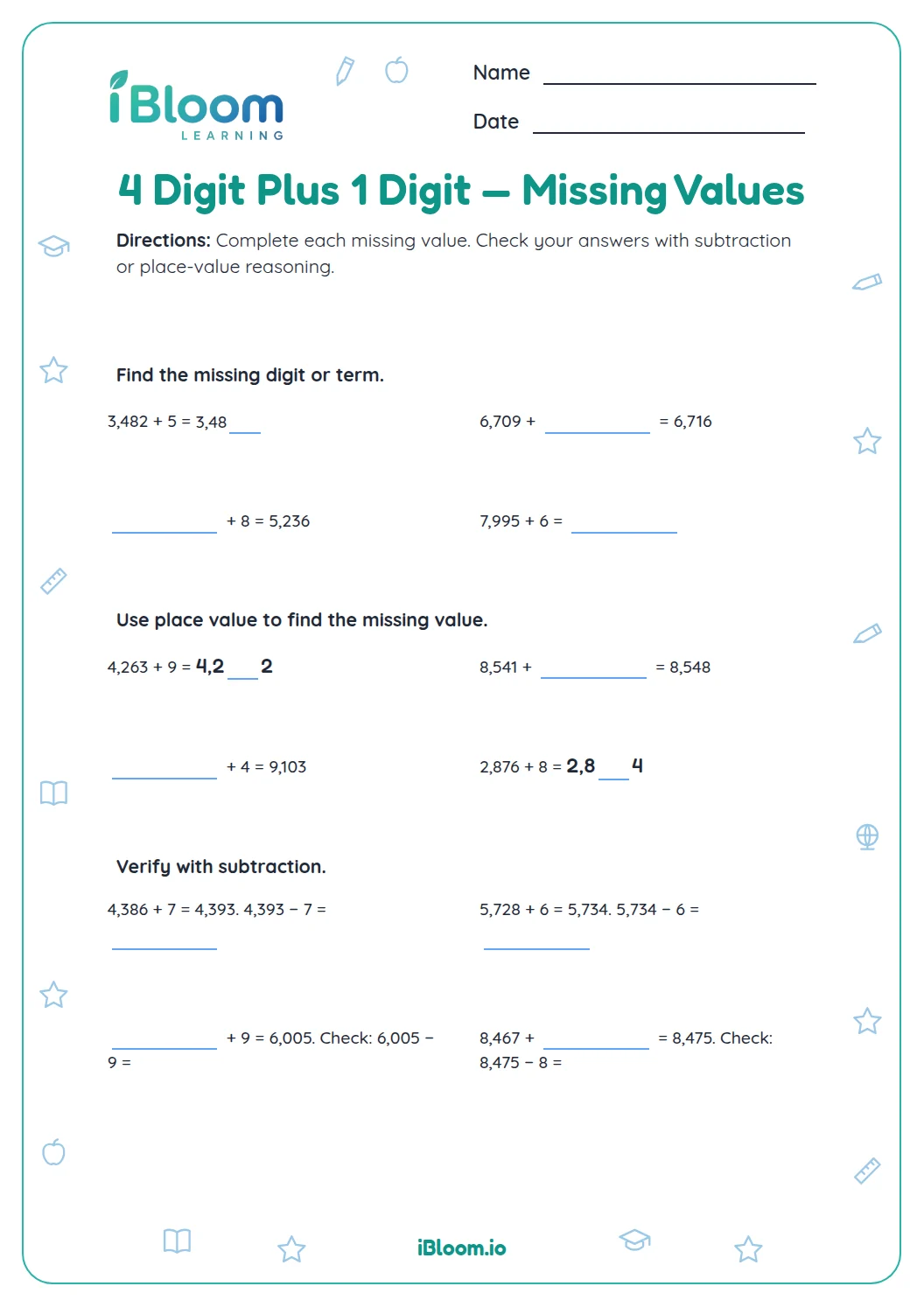
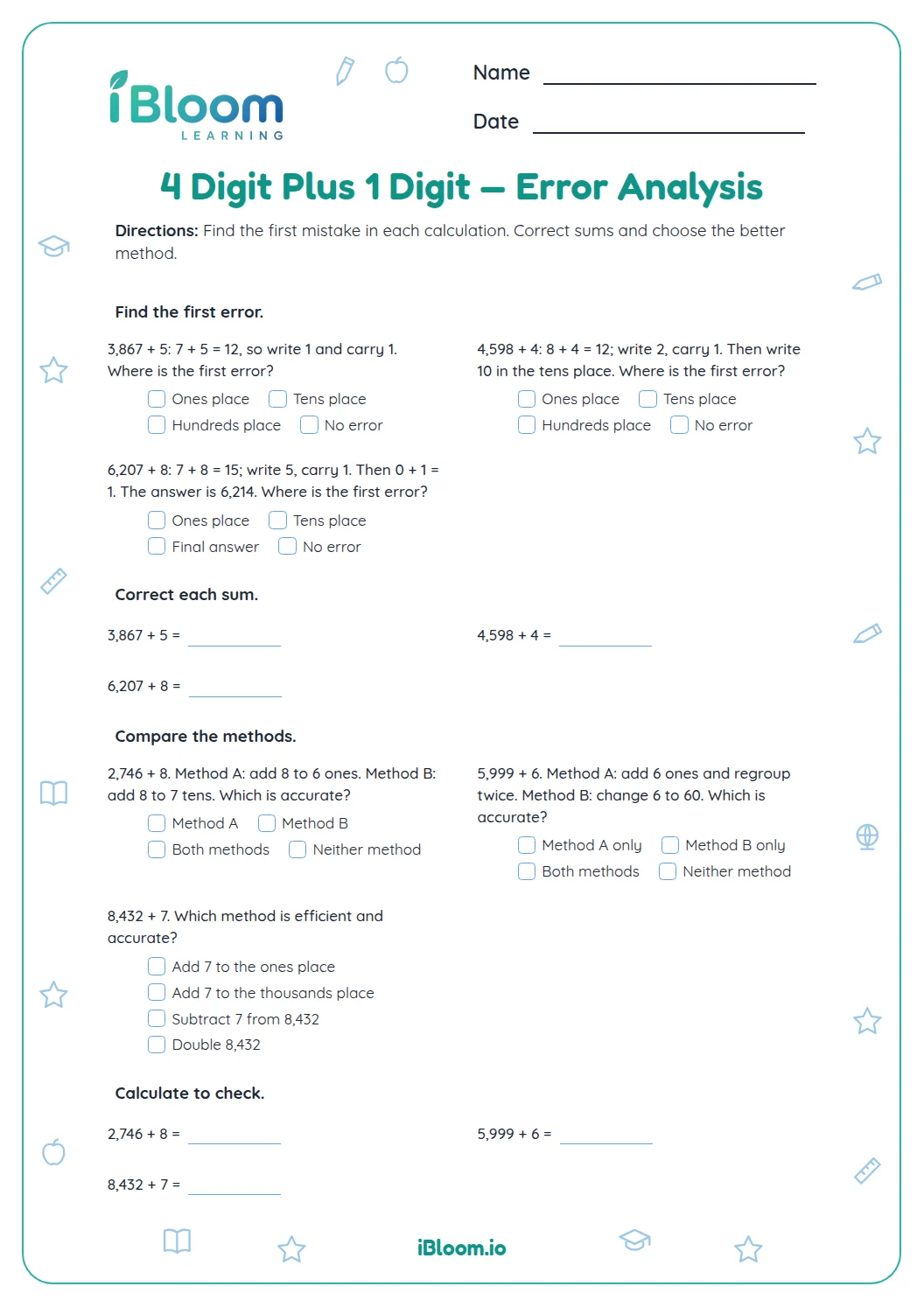
This Grade 4 addition drill has 20 four-digit plus one-digit sums. Students align the addends, add from the ones place, and regroup when needed. The examples include sums with and without regrouping, organized in three parts across two worksheet pages; a separate two-page key lists every sum. This practice supports Common Core math standard 4.NBT.B.4, adding multi-digit whole numbers with the standard algorithm.
Aligned to 4.NBT.B.4
How do you add a one-digit number to four digits?
Place the one-digit addend under the ones column. Add from right to left, regrouping into the next place when a column total is ten or more.
What changes across the drill?
The twenty sums move from initial column practice to mixed examples. Some ones-column totals stay below ten; others require regrouping into the tens place.
How does regrouping work?
Add the ones first. If the total is ten or more, write the ones digit and carry one ten.
- 11,243 + 5
- 23 + 5 = 8; no regrouping is needed.
- 3Answer: 1,248
How to use this worksheet
- 1Write the four-digit number with its place values aligned.
- 2Add the one-digit number in the ones place.
- 3Regroup any tens into the tens column.
- 4Check each sum by adding the one-digit addend again.
Common mistakes and quick fixes
The mistake
Adding the digit to the thousands place.
The fix
Set the one-digit addend under the ones digit.
The mistake
Forgetting a regrouped ten.
The fix
Mark the carried ten before adding the next column.
The mistake
Checking with an unrelated subtraction.
The fix
Subtract the exact one-digit addend from the sum.
Common Core alignment
Fluently add multi-digit whole numbers using the standard algorithm.
On this sheet: Every computation adds a four-digit number and a one-digit number, with regrouping as needed.
Show the official wordingHide the official wording
Fluently add and subtract multi-digit whole numbers using the standard algorithm.
What to practice next
Make more practice
Further reading
Questions parents and teachers ask
Do all problems require regrouping?
No. The set includes sums both with and without regrouping. That lets students practice the place-value procedure and notice when the ones total stays below ten. They can mark a carried ten before adding the next column when needed. Ask the learner to explain the clue they used.
How should a student line up the addends?
The one-digit addend belongs in the ones column, directly beneath the last digit of the four-digit number. Addition then proceeds from ones toward thousands. Correct alignment helps prevent adding the digit to the wrong place. Ask the learner to explain the clue they used.
How can a student check a sum?
Subtract the one-digit addend from the sum; the four-digit number should remain. For example, 1,248 − 5 = 1,243 checks 1,243 + 5 = 1,248. This inverse check is a useful follow-up after completing the addition practice, and it can reveal a regrouping error.
Is this suitable for Grade 4?
The problems use multi-digit whole-number addition with a one-digit addend, including regrouping. Students practice the standard algorithm by adding from right to left and recording a regrouped ten when a column total reaches ten or more. Ask the learner to explain the clue they used.
Are the answers included?
Yes. The answer key shows all twenty sums. Students can also verify results by subtracting the original one-digit addend from each sum and checking that the four-digit number returns. Ask the learner to explain the clue they used.