
About this worksheet
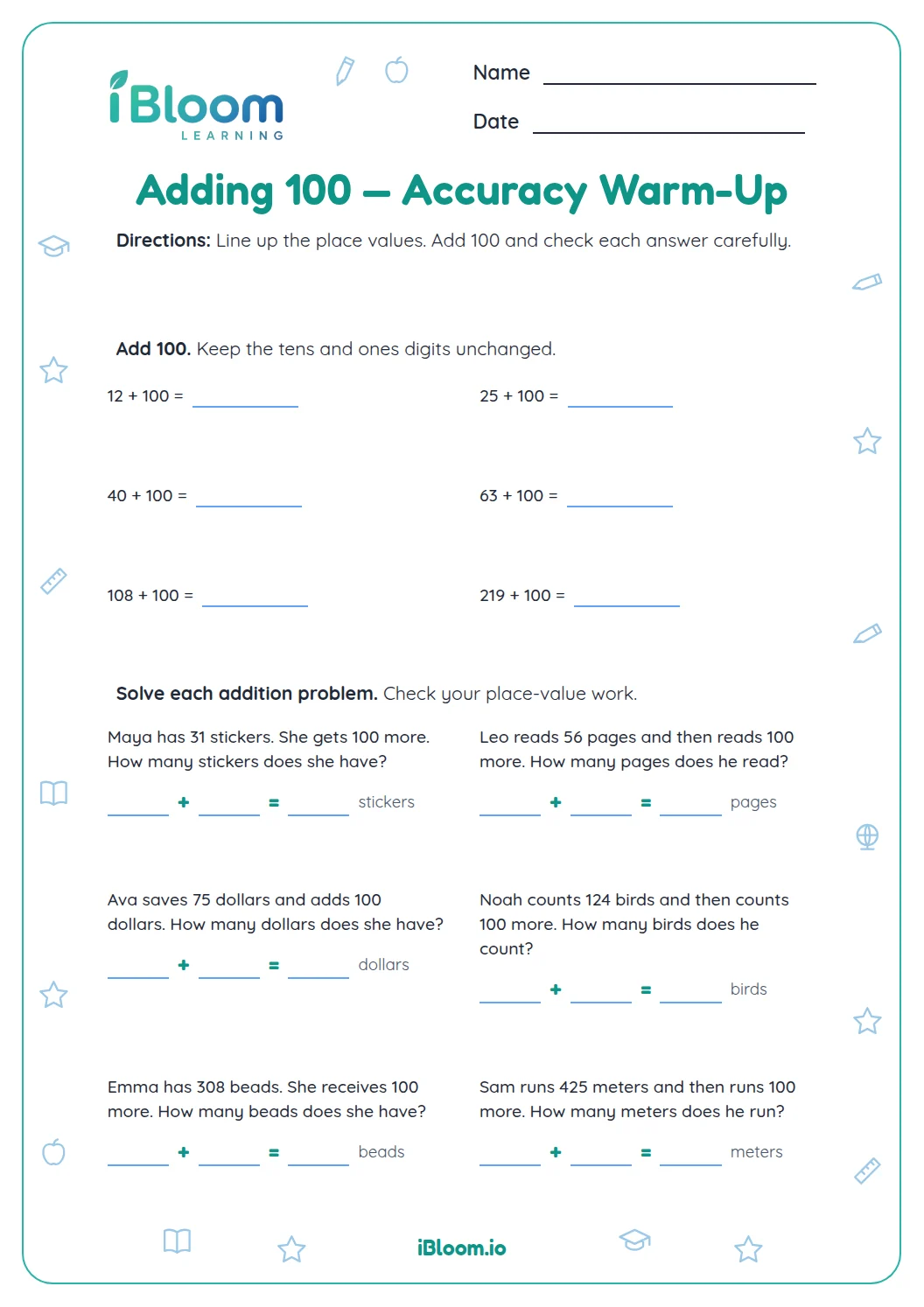
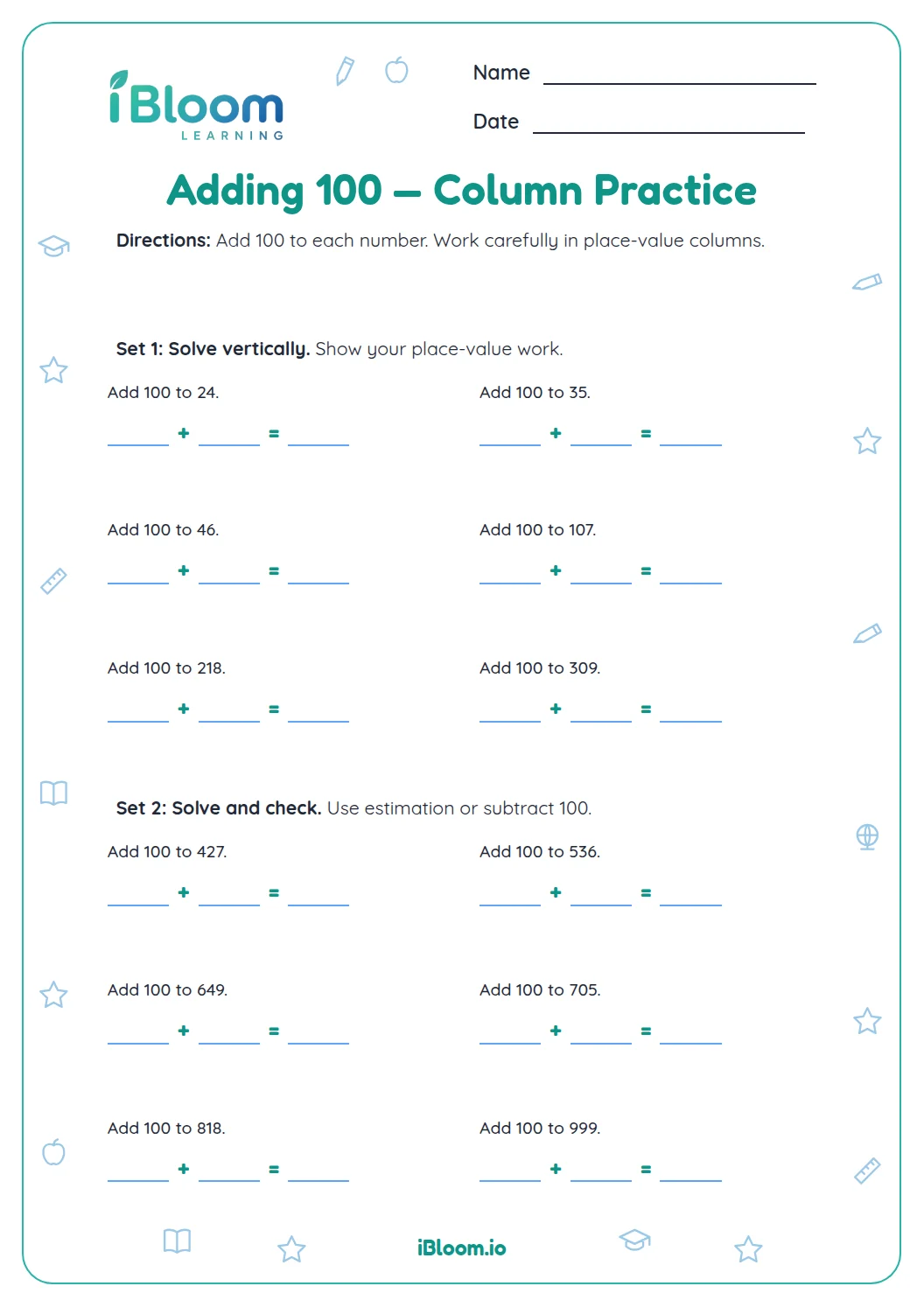
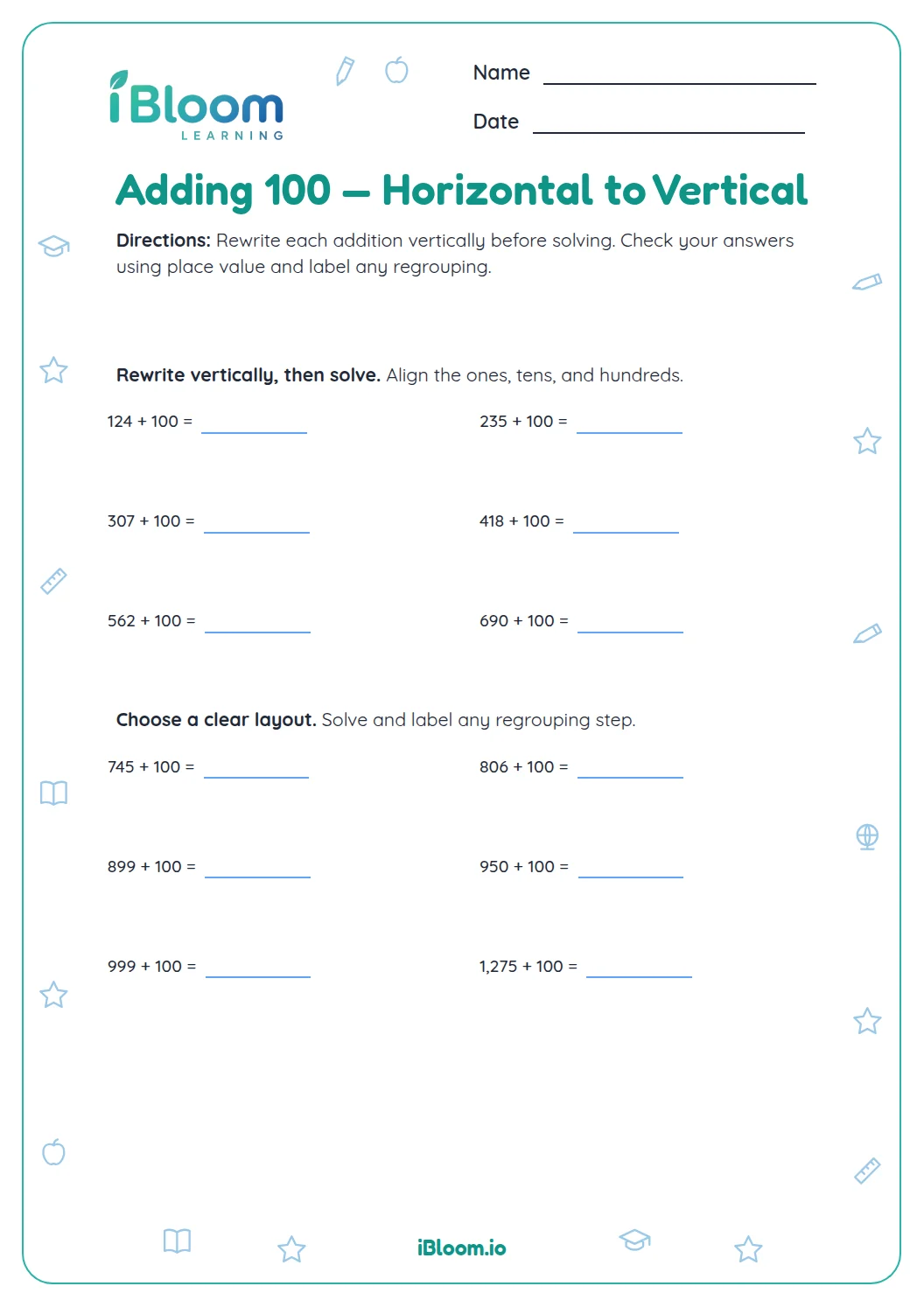
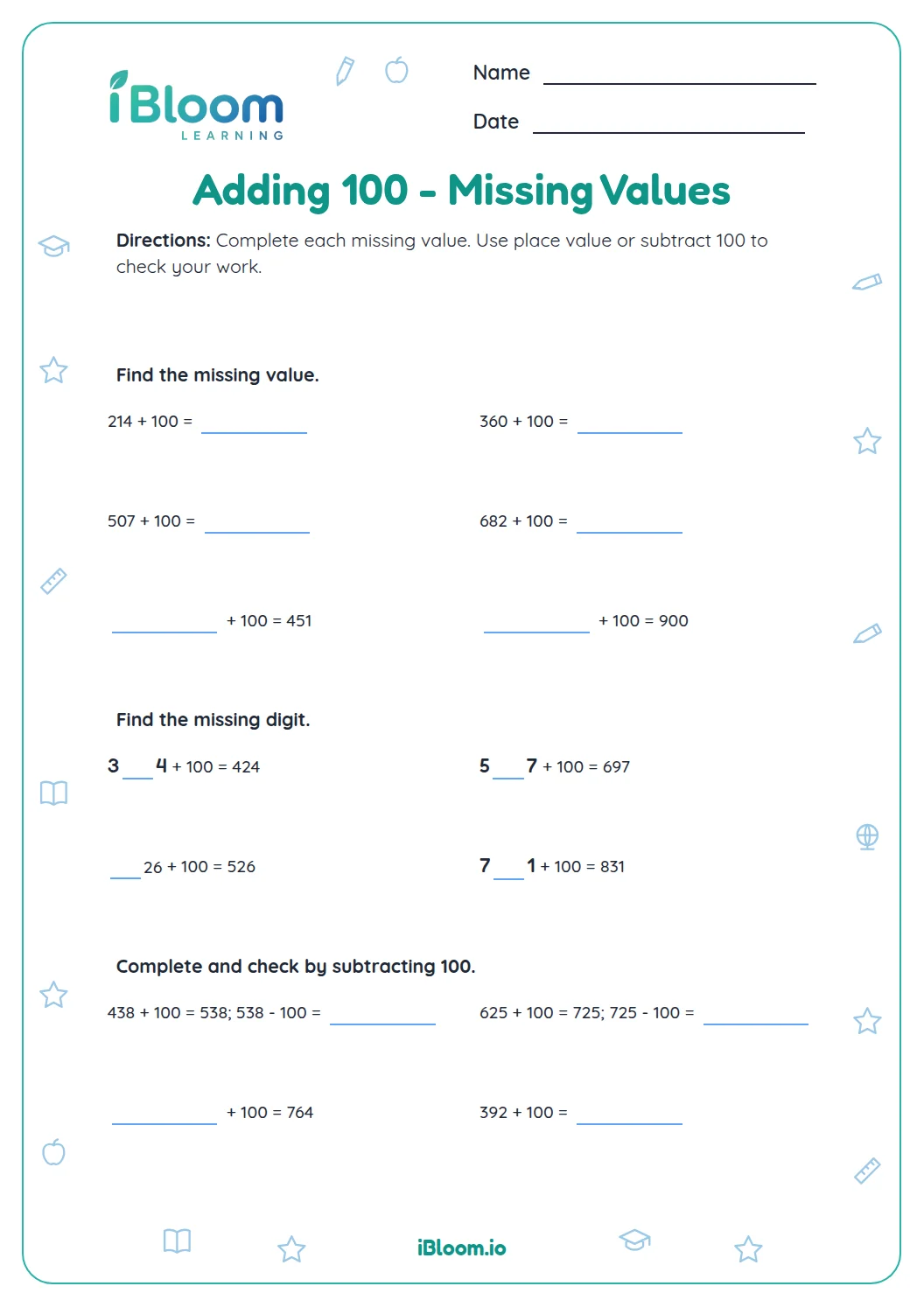
This free printable gives Grade 2 learners practice adding 100 mentally. Part A has two place-value checks, and Part B has four more error checks. Part C gives five sums to solve, including 957 + 100, which crosses into four digits. Part D applies the skill in four short stories. The answer key shows each correct sum. It practices Common Core 2.NBT.B.8: mentally add 10 or 100 to numbers from 100 to 900.
Aligned to 2.NBT.B.8
What changes when you add 100?
Adding 100 increases the hundreds value by one hundred while the tens and ones remain the same. In Part A, compare the student’s result with that place-value rule, then name the digit that changed incorrectly.
- 1A student writes 246 + 100 = 256.
- 2The answer changed the tens digit, so it added 10.
- 3Add one hundred by changing the hundreds value: 246 + 100 = 346.
How can you catch an addition slip?
Part A and Part B ask students to diagnose place-value slips. Part C gives five sums to solve, including 957 + 100, which crosses into four digits. Part D uses stickers, books, a score, and cans to practice the same +100 change in context.
How to use this worksheet
- 1Underline the amount being added.
- 2Name the place value that changes.
- 3Keep the tens and ones digits unchanged.
- 4Use subtraction by 100 to check.
Common mistakes and quick fixes
The mistake
Changing the tens digit instead of the hundreds digit.
The fix
Read the directions again, mark the important information, and check the answer against the model or operation.
The mistake
Changing both hundreds and tens; only the hundreds place changes for these examples.
The fix
Read the directions again, mark the important information, and check the answer against the model or operation.
The mistake
Copying the start number as the sum; check that the result is 100 greater.
The fix
Read the directions again, mark the important information, and check the answer against the model or operation.
Common Core alignment
This worksheet practices the following Common Core skill.
Mentally add 10 or 100 to a given number 100–900, and mentally subtract 10 or 100.
On this sheet: The questions ask learners to mentally add 10 or 100 to a given number 100–900, and mentally subtract 10 or 100..
Show the official wordingHide the official wording
Mentally add 10 or 100 to a given number 100–900, and mentally subtract 10 or 100.
What to practice next
Make more practice
Further reading
Questions parents and teachers ask
What changes when you add 100?
The hundreds value increases by one hundred, while the tens and ones stay the same. For example, 246 becomes 346. Comparing each place helps catch a slip such as 256, which is only 10 more than 246. Subtracting 100 from the result is another quick check.
How does Part A use error analysis?
Part A and Part B show calculations to inspect. Learners name a place-value error, identify a faulty step, or confirm a correct sum. For example, 518 + 100 = 528 changes the tens digit and adds only 10. The later parts let them apply that rule.
What is a quick way to check a sum?
Subtract 100 from the result. If the subtraction returns the starting number, the addition is consistent. For a story problem, reread the question too, so the answer gives the requested total and unit. Ask the learner to explain the clue they used so the answer connects back to the skill.
Why does 957 + 100 have four digits?
The hundreds digit increases from 9 hundreds to 10 hundreds. Ten hundreds regroup as one thousand, so the sum is 1,057. The value of the tens and ones digits remains 5 tens and 7 ones. Ask the learner to explain the clue they used so the answer connects back to the skill.
What does the answer key include?
The key lists each corrected sum, missing result, and word-problem total. For multiple choice items, use it to check the chosen answer, then ask the learner to describe which place value changed and why. Ask the learner to explain the clue they used so the answer connects back to the skill.