

About this worksheet
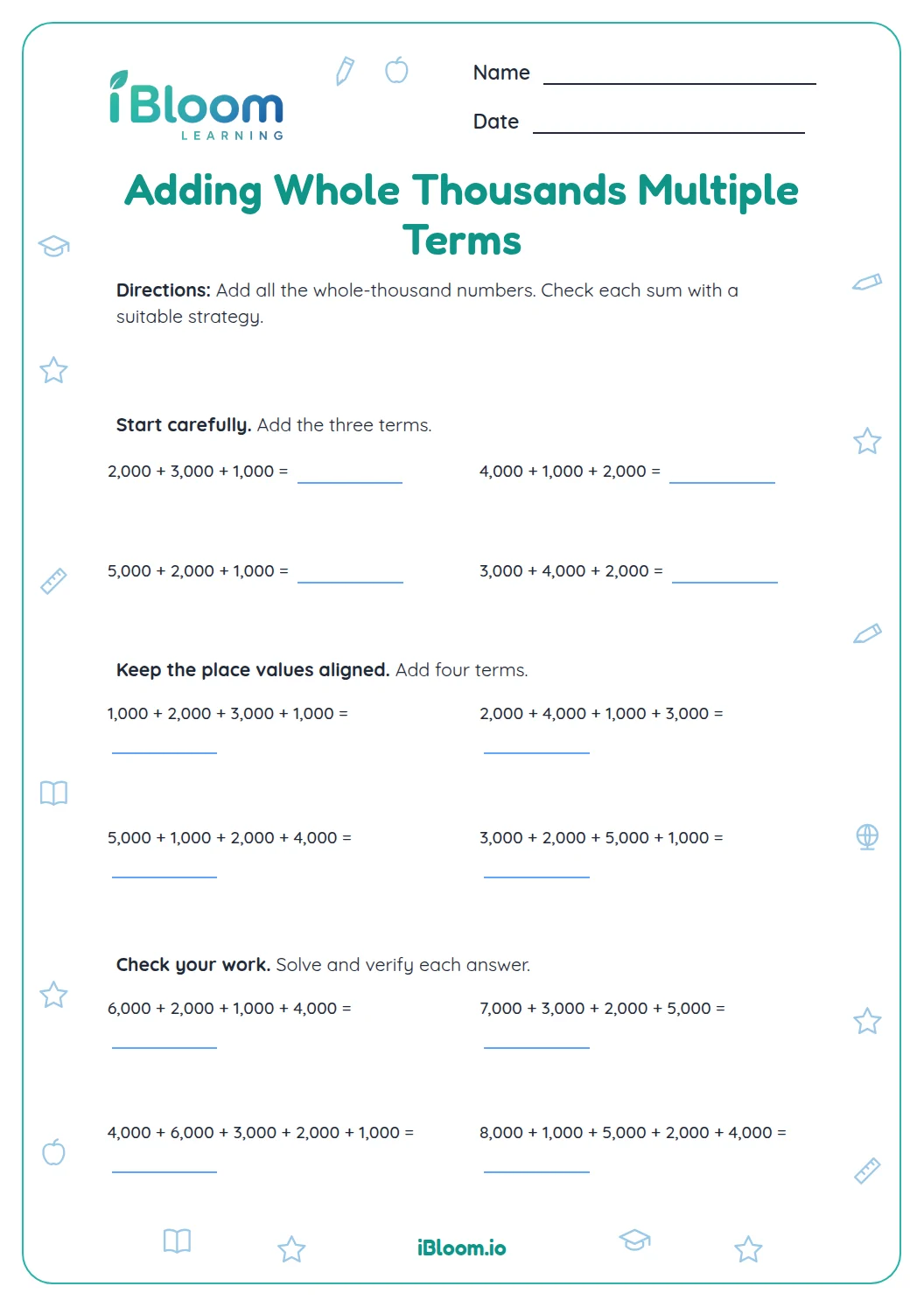
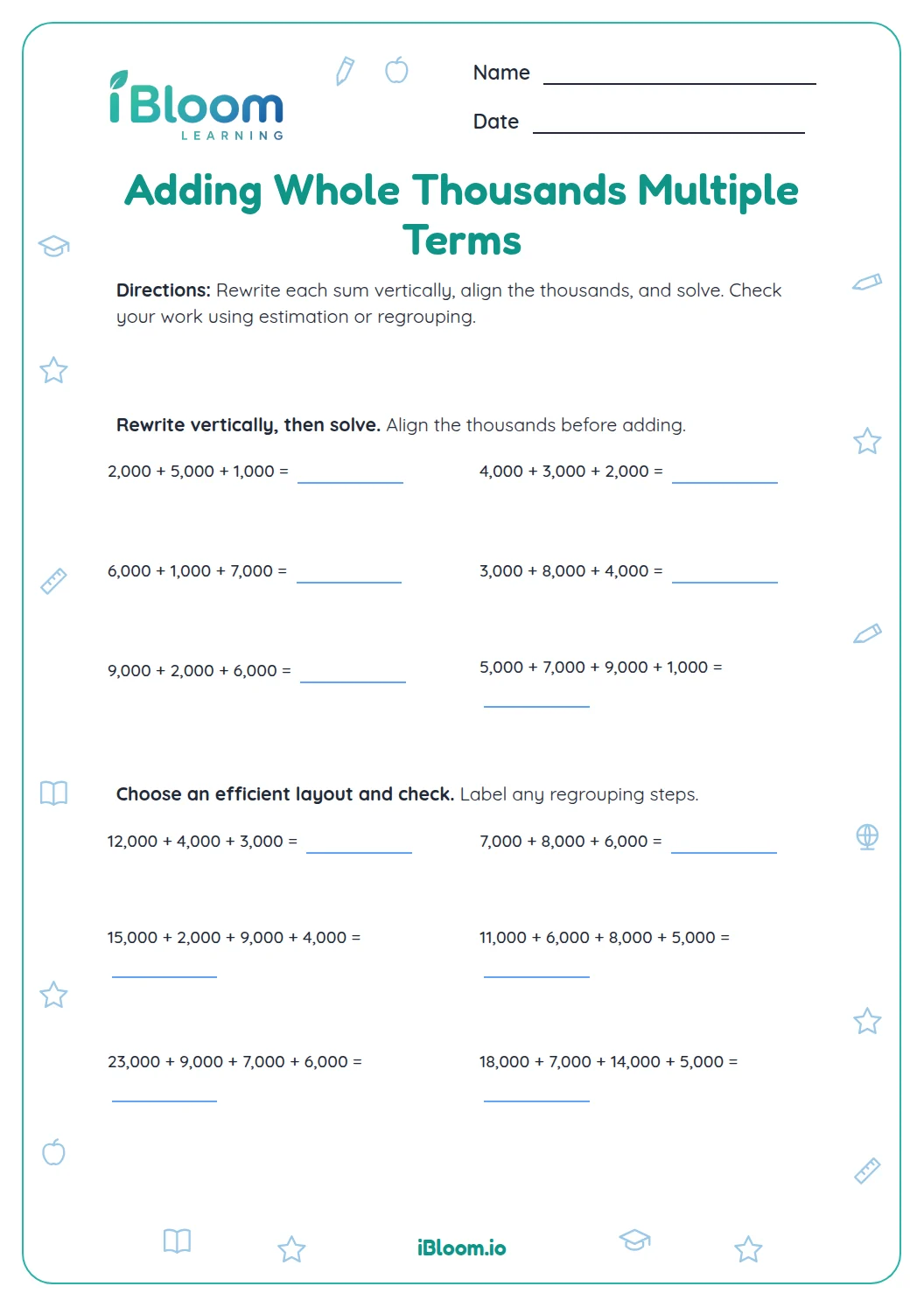
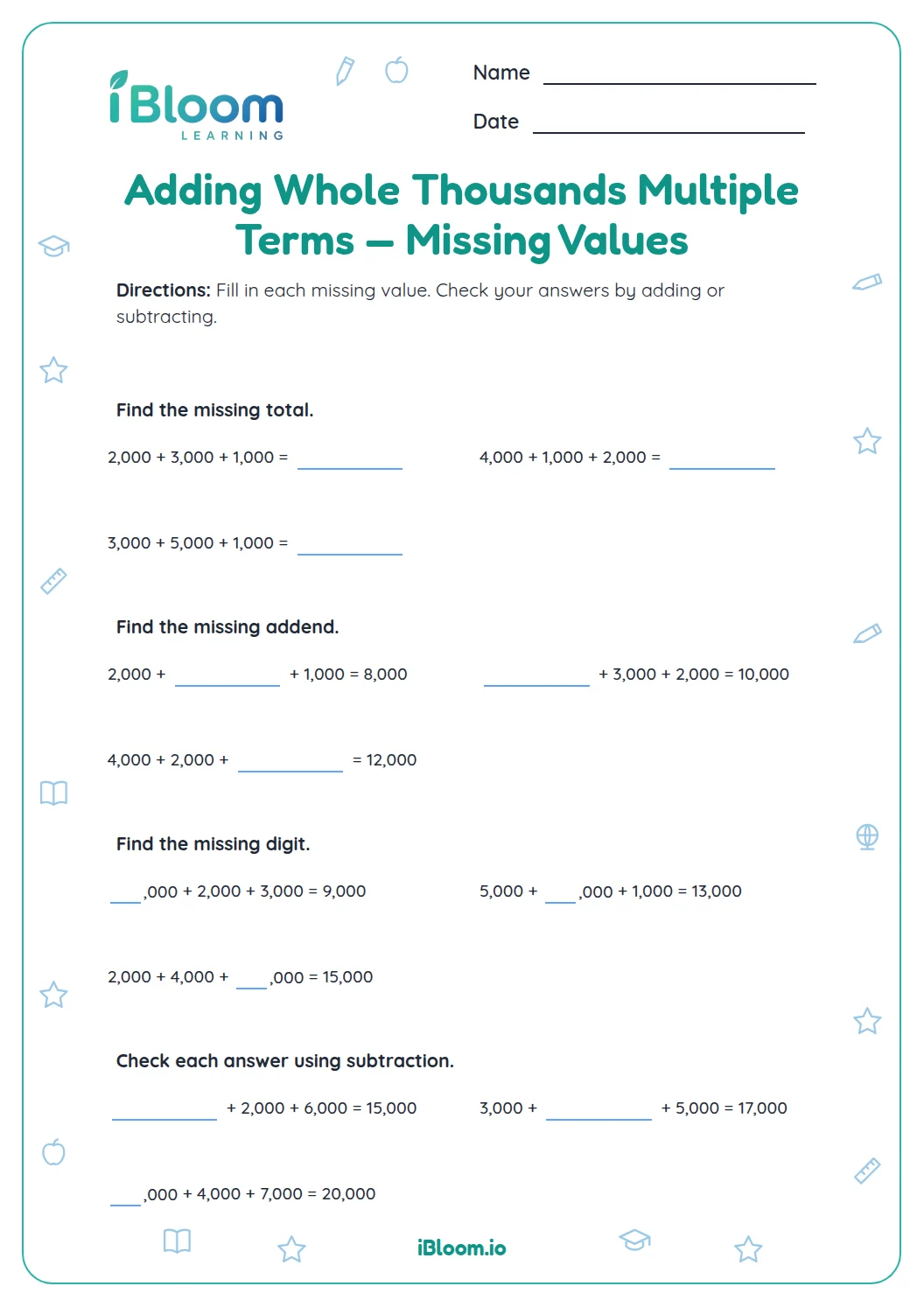
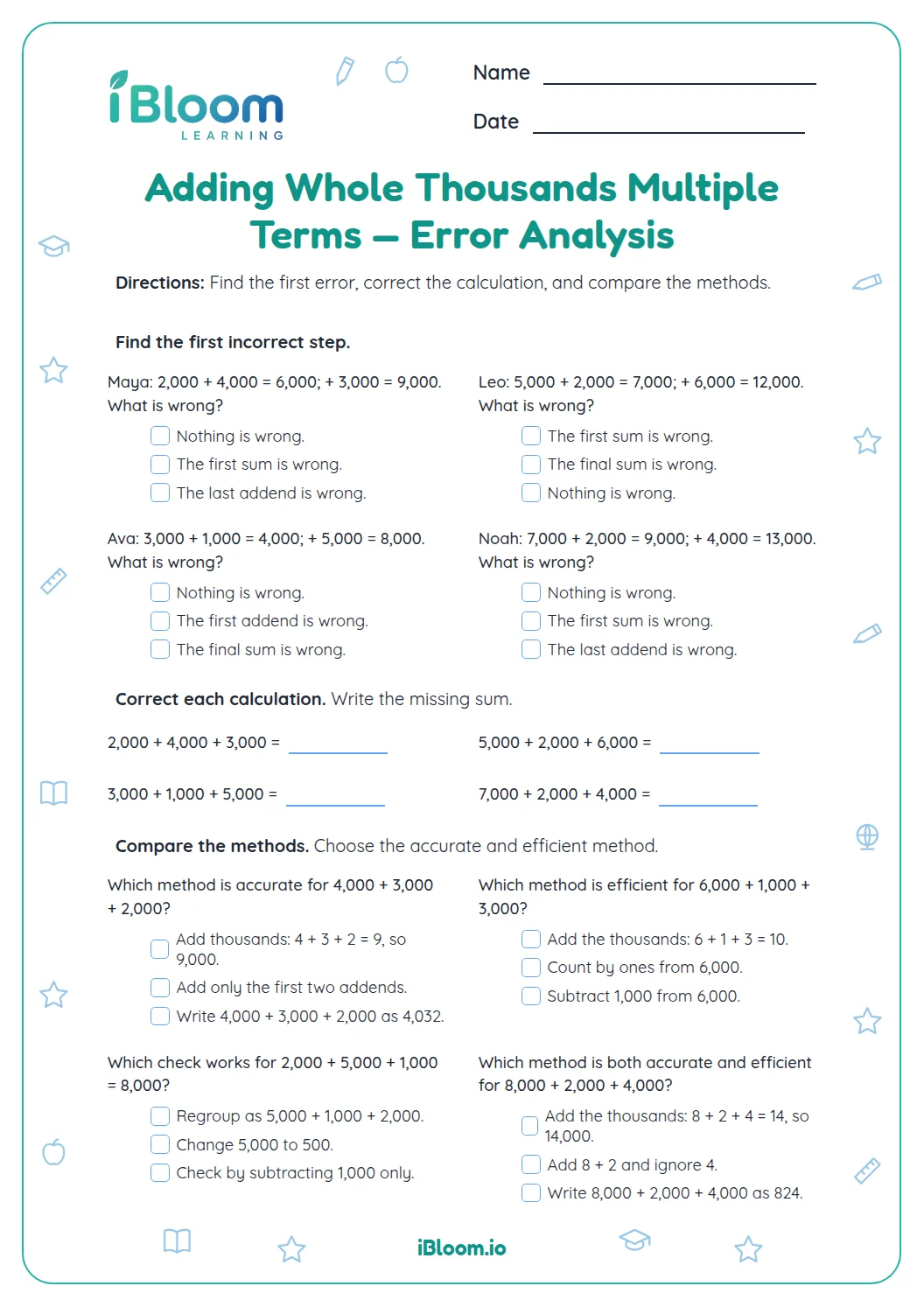
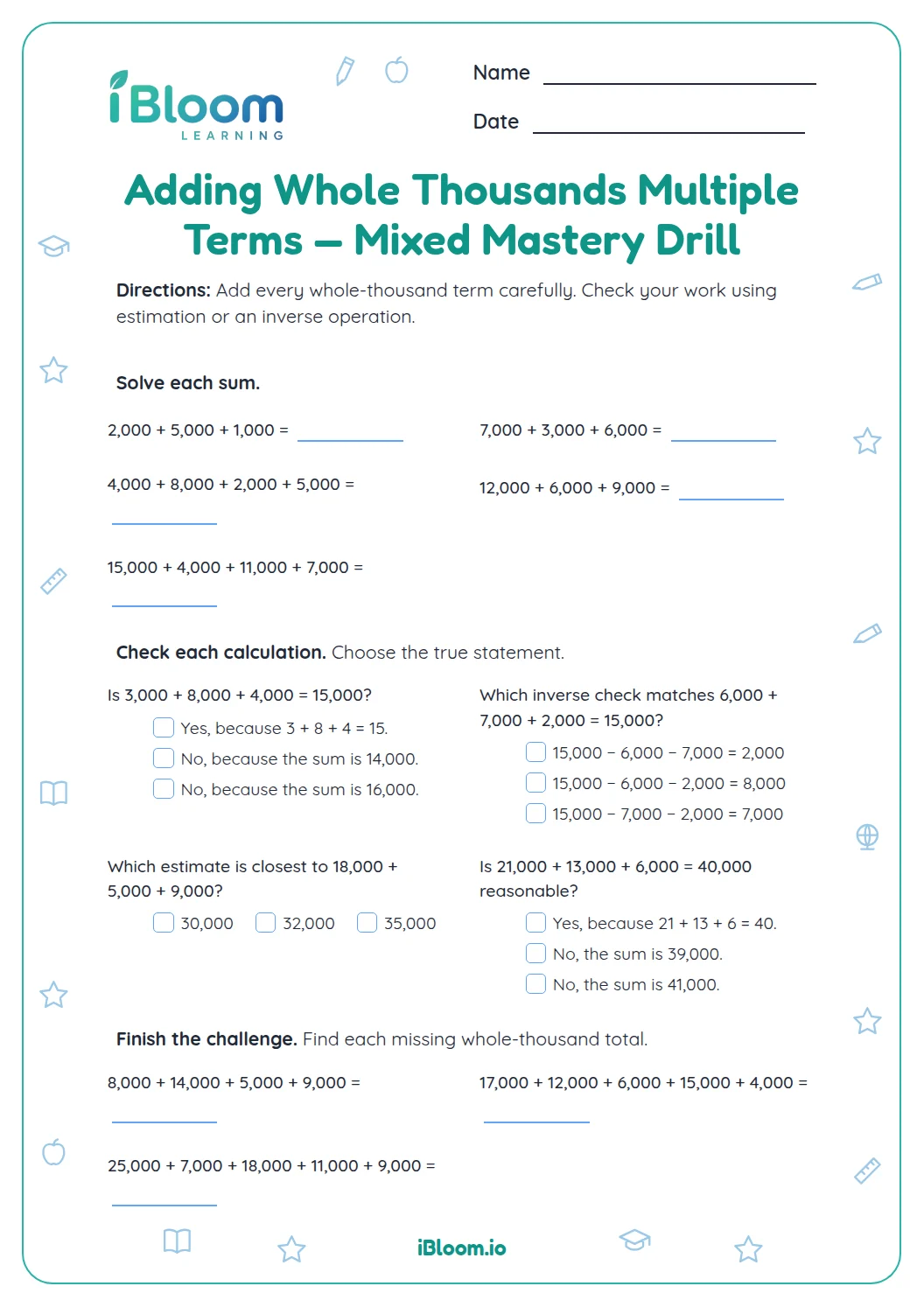
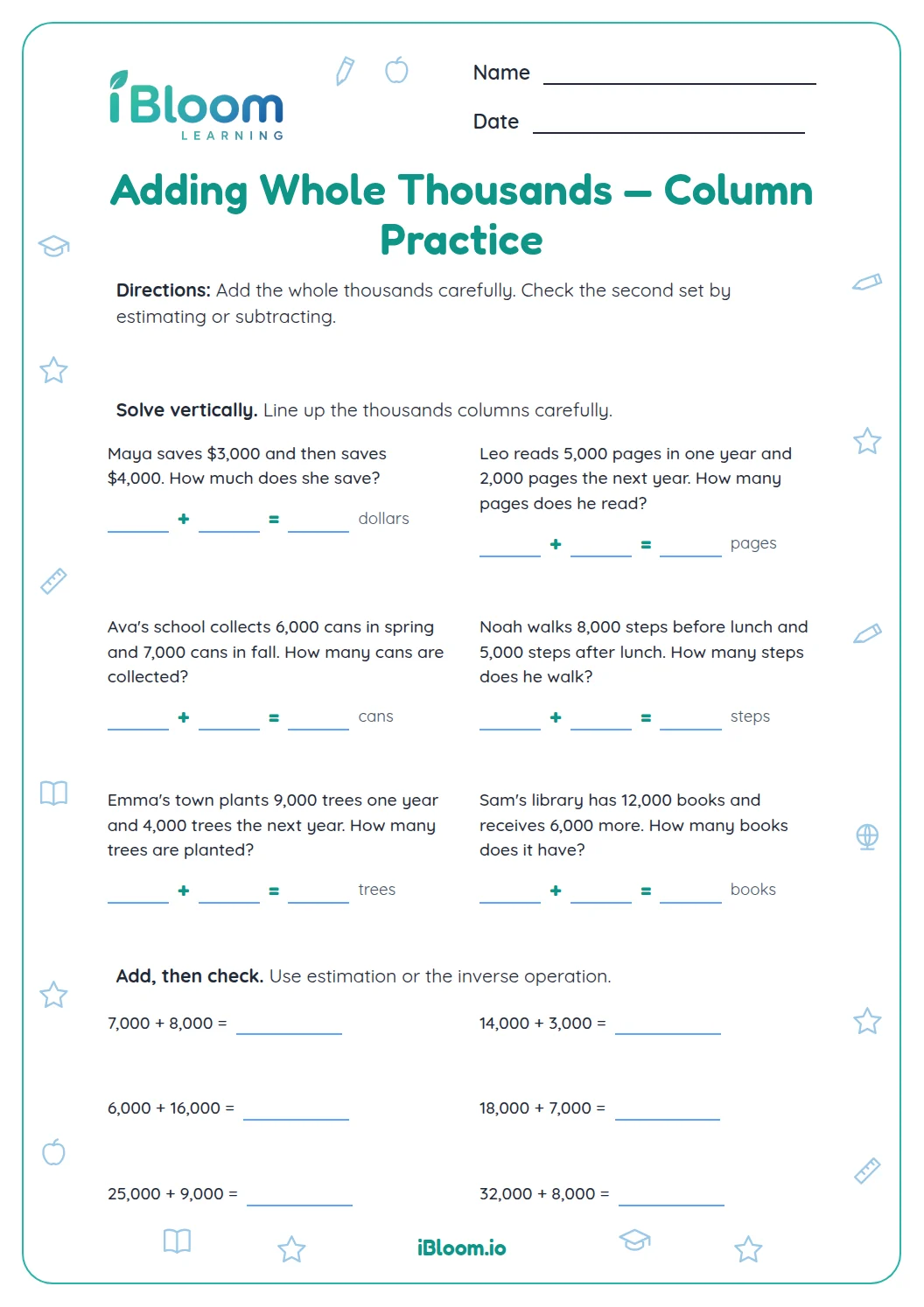
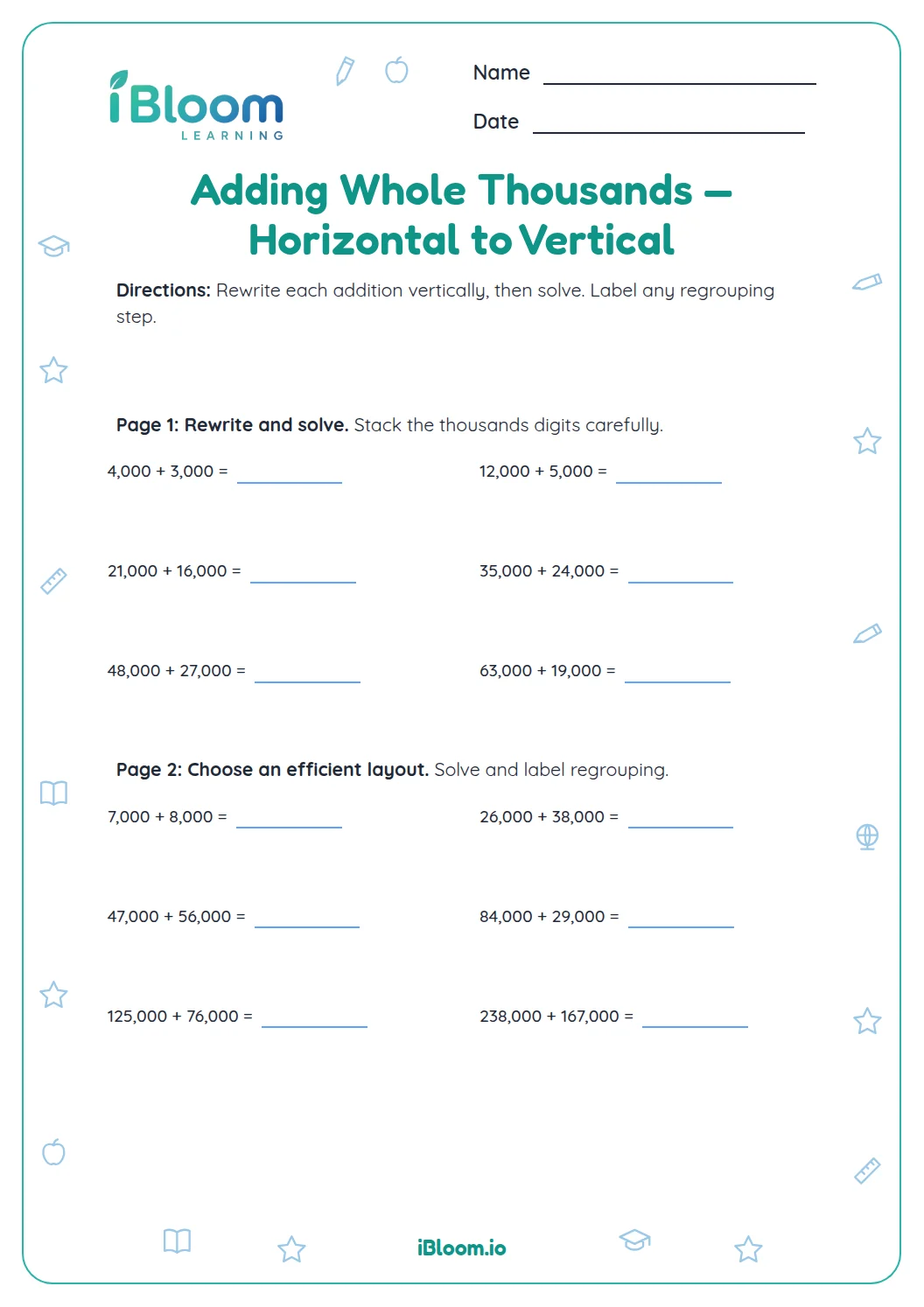
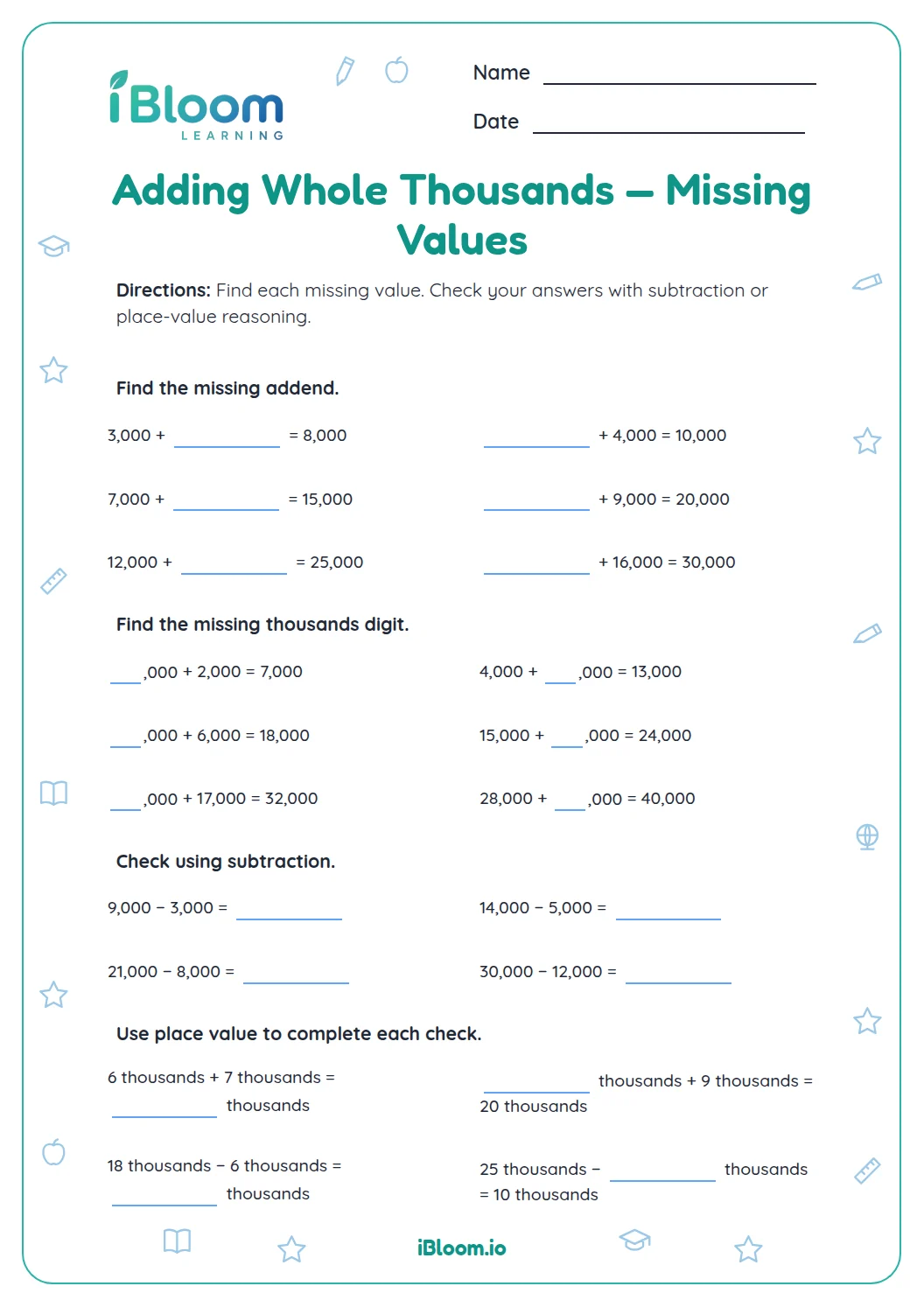
This printable gives 16 equations with three or more whole-thousand addends. Learners align the numbers in columns on their work area, add the thousands values, and check each sum for place value. The answer key lists all 16 results. It practices multi-digit addition in CCSS 4.NBT.B.4.
Aligned to 4.NBT.B.4
What is the place-value shortcut?
Each addend is a multiple of 1,000, so add the thousands values and keep three zeros at the end. For example, 12,000 + 34,000 + 25,000 is (12 + 34 + 25) thousands, or 71,000.
The equations are printed horizontally. Set up each addend in aligned columns on your work area, then enter the sum on the line.
How can an estimate catch a place-value error?
Round each addend to a nearby thousand and estimate the total. A sum of 12,000, 34,000, and 25,000 should be near 70,000, not 7,000 or 700,000. Check that the exact result is also a multiple of 1,000.
Add whole thousands
- 1Read every addend before starting.
- 2Add the thousands values, regrouping when they total ten or more.
- 3Write the sum with the correct thousands place and trailing zeros.
- 4Estimate the total to catch a misplaced zero.
- 5Add the terms in another order to check.
Common mix-ups
The mistake
Dropping a zero and writing 71,00 instead of 71,000.
The fix
Say the answer aloud in thousands, then check that a whole-thousand result ends in three zeros.
The mistake
Adding only the first two terms in a three-term problem.
The fix
Mark each addend after you include it, then check the sum by adding the terms in a different order.
Common Core alignment
This multi-term drill practices fluency and place-value reasoning with whole numbers.
Fluently add and subtract multi-digit whole numbers.
On this sheet: This practice reinforces fluent multi-digit addition using aligned place-value columns.
Show the official wordingHide the official wording
Fluently add and subtract multi-digit whole numbers using the standard algorithm.
What to practice next
Make more practice
Further reading
Questions parents and teachers ask
How do I add whole thousands in columns?
Add the number of thousands in each addend, then express that total in thousands. For 12,000 + 34,000 + 25,000, calculate 12 + 34 + 25 = 71. The sum is 71,000. You can line up the numbers on scratch paper; the printable itself gives horizontal equations and answer spaces.
What does regrouping mean in this drill?
Regrouping means trading ten thousands for one ten-thousand when the thousands add to 10 or more. You can add the thousands values first, then write the result with three trailing zeros to keep the place value clear. Ten groups of one thousand combine to make one group of ten thousand.
How can I check a sum?
Estimate the thousands before calculating. Then add the terms in a different order and see whether you get the same total. A correct answer must still be a multiple of 1,000 because every addend is a whole thousand. A quick estimate helps you notice misplaced zeros.
Why do the problems use several addends?
Several terms give practice keeping every addend in the calculation. Add the terms one at a time or group easy pairs, but make sure each number is included. Checking in another order can help catch a skipped term. Writing the terms in a different order is a useful check.
Does changing the order change the sum?
No. Addition has the same total when you add the terms in a different order. For example, you can add 12,000 + 34,000 first or combine 34,000 + 25,000 first. Reordering can make mental addition easier and gives you another way to check that every addend was included.