


About this worksheet
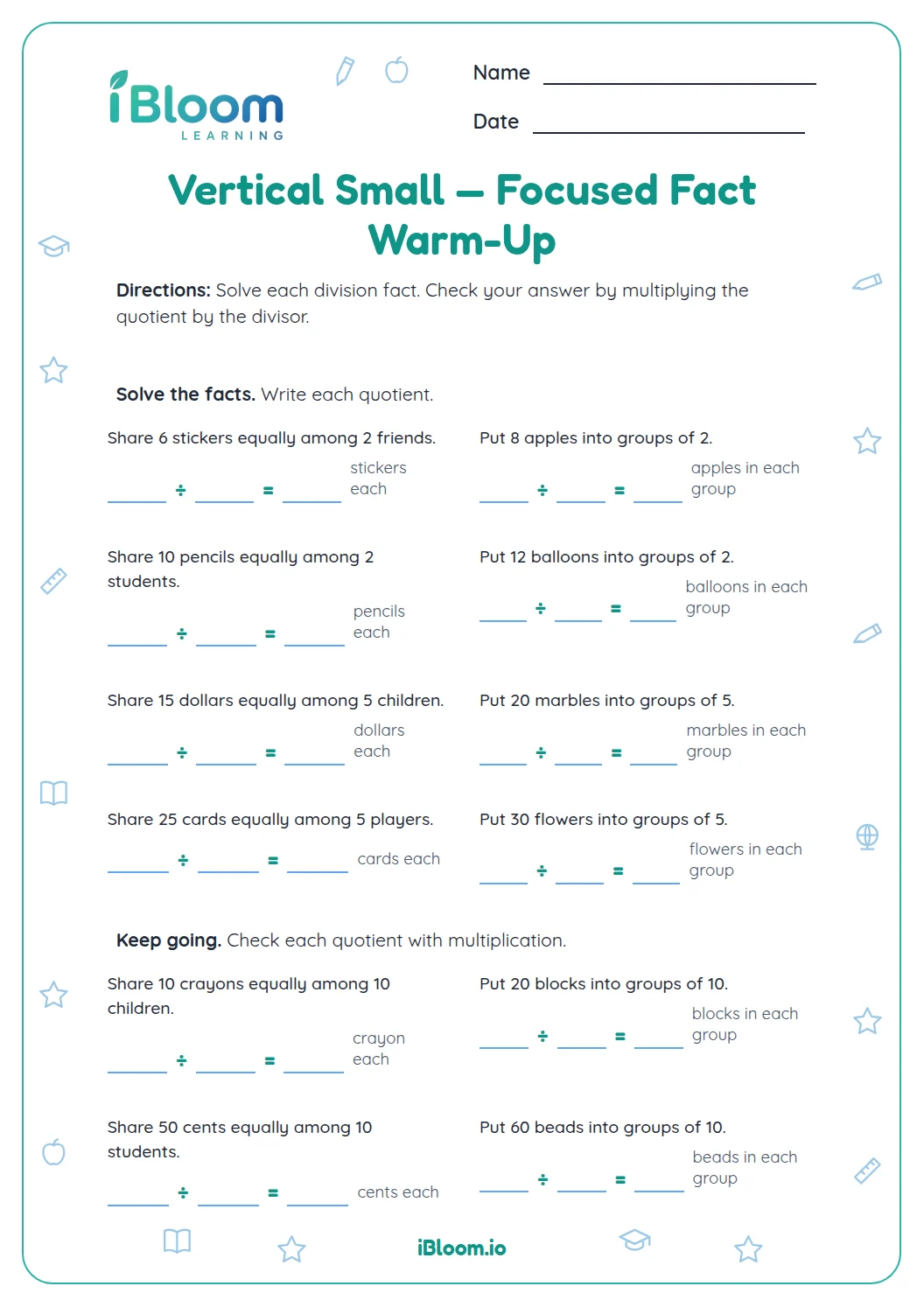
This Grade 3 division worksheet has 16 exact-quotient facts in two rounds. Learners solve each equation and can check a quotient by multiplying it by the divisor. The timed round is optional, so the page can be used for untimed fluency practice.
Aligned to 3.OA.C.7
How can multiplication check a division fact?
Division asks how many equal groups fit or how many are in each group. For 42 ÷ 7, find the number that makes 42 when multiplied by 7.
Check by multiplying the quotient by the divisor: 6 × 7 = 42.
How is the drill arranged?
There are 16 division facts in two rounds. The first round is untimed; the second is an optional timed round. Each fact has a whole-number quotient.
Use the separate key to check each answer, then redo any fact that needs another look.
Should learners use the timer?
Timing is optional. First focus on solving each fact correctly and checking it with multiplication. A timer can be added later if it suits the learner and the purpose of practice.
A steady way to practice
- 1Solve each division fact.
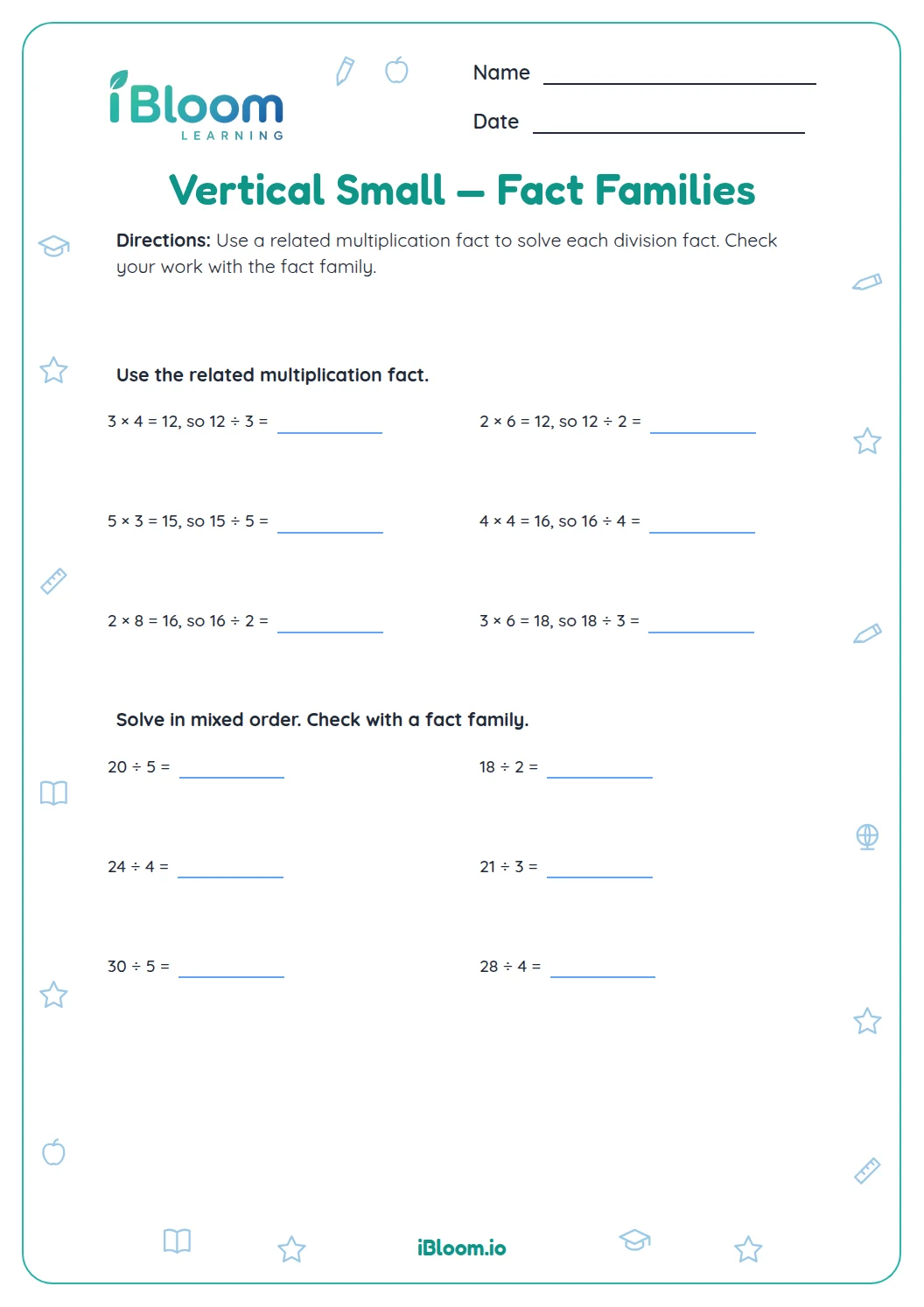
- 2Use a related multiplication fact to check.
- 3Mark any fact that needs another try.
- 4Complete the second round without a timer if preferred.
- 5Use timing only as an optional follow-up.
Division checks
The mistake
Reversing the quotient and divisor
The fix
Multiply the quotient by the divisor to check.
The mistake
Guessing from a nearby fact
The fix
Verify that the product equals the dividend.
The mistake
Rushing past a remainder
The fix
Each item here divides evenly, so recheck any non-whole answer.
Curriculum alignment
Division connects multiplication and division. For 42 ÷ 7, think of the factor that makes 42 when multiplied by 7.
Fluently multiply and divide within 100.
On this sheet: Learners solve division facts within 100 and can use related multiplication facts to check.
Show the official wordingHide the official wording
Fluently multiply and divide within 100, using strategies such as the relationship between multiplication and division (e.g., knowing that 8 × 5 = 40, one knows 40 ÷ 5 = 8) or properties of operations.
What to practice next
Questions parents and teachers ask
How many division facts are on the drill?
The worksheet has sixteen division facts, split into an untimed round and an optional timed round. Every dividend divides evenly by its divisor, so each answer is a whole number. Learners can solve the facts carefully and use multiplication to check each quotient.
Does a child have to use a timer?
No. Timing is optional. A learner can solve the facts without a timer, then use a clock for a later round if that feels helpful. Accuracy comes first: multiply the quotient by the divisor and check that the product equals the dividend.
How can learners check a quotient?
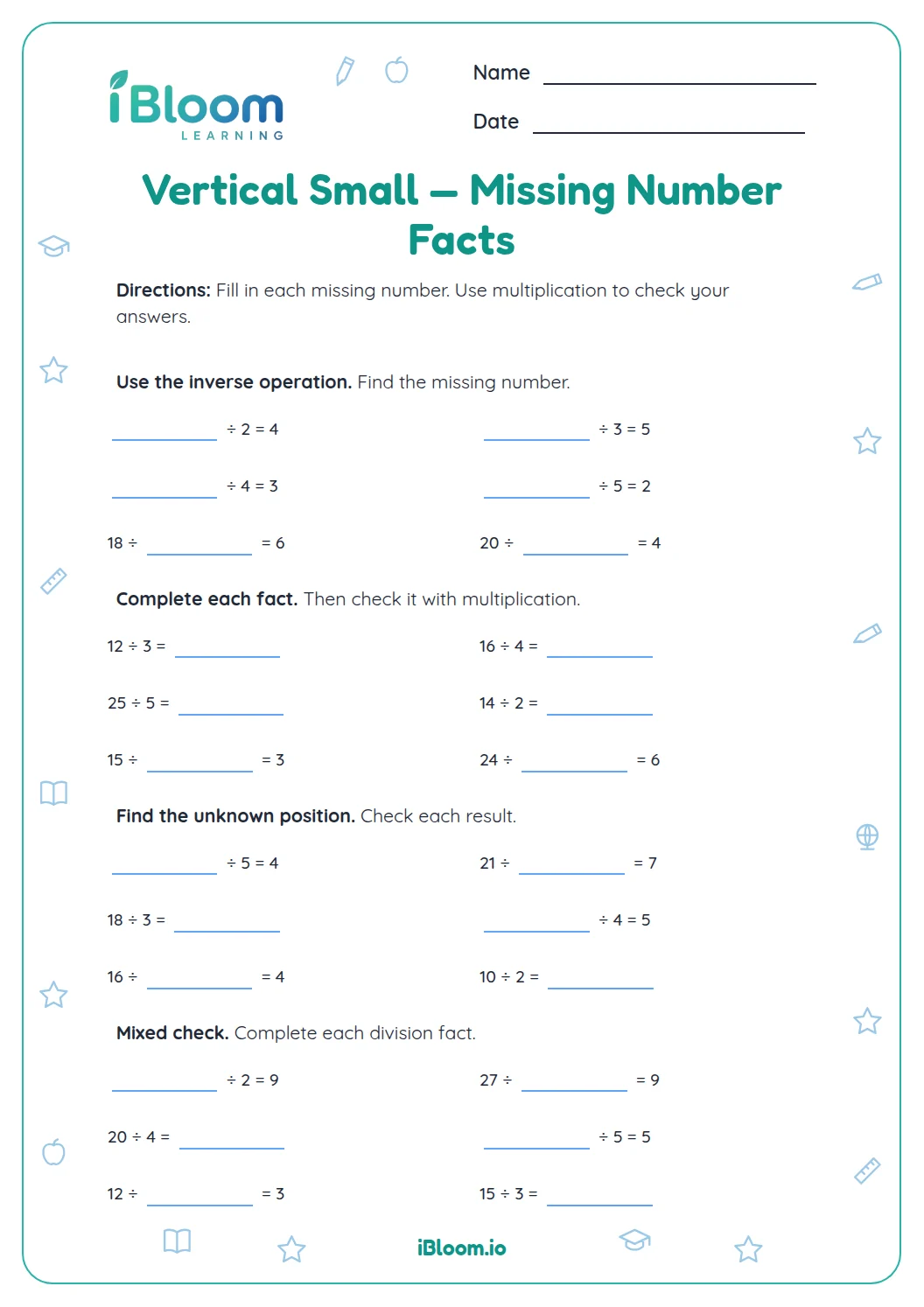
Multiply the quotient by the divisor. For example, for 42 ÷ 7 = 6, check that 6 × 7 equals 42. If the product does not match the dividend, revisit the division fact and check the multiplication. This inverse-operation check works for every item in the drill.
Which facts does this worksheet include?
The drill includes exact division facts with one-digit divisors and whole-number quotients. It mixes several multiplication families across the two rounds. Learners can use a related multiplication fact to reason through an answer instead of relying only on recall.