



About this worksheet
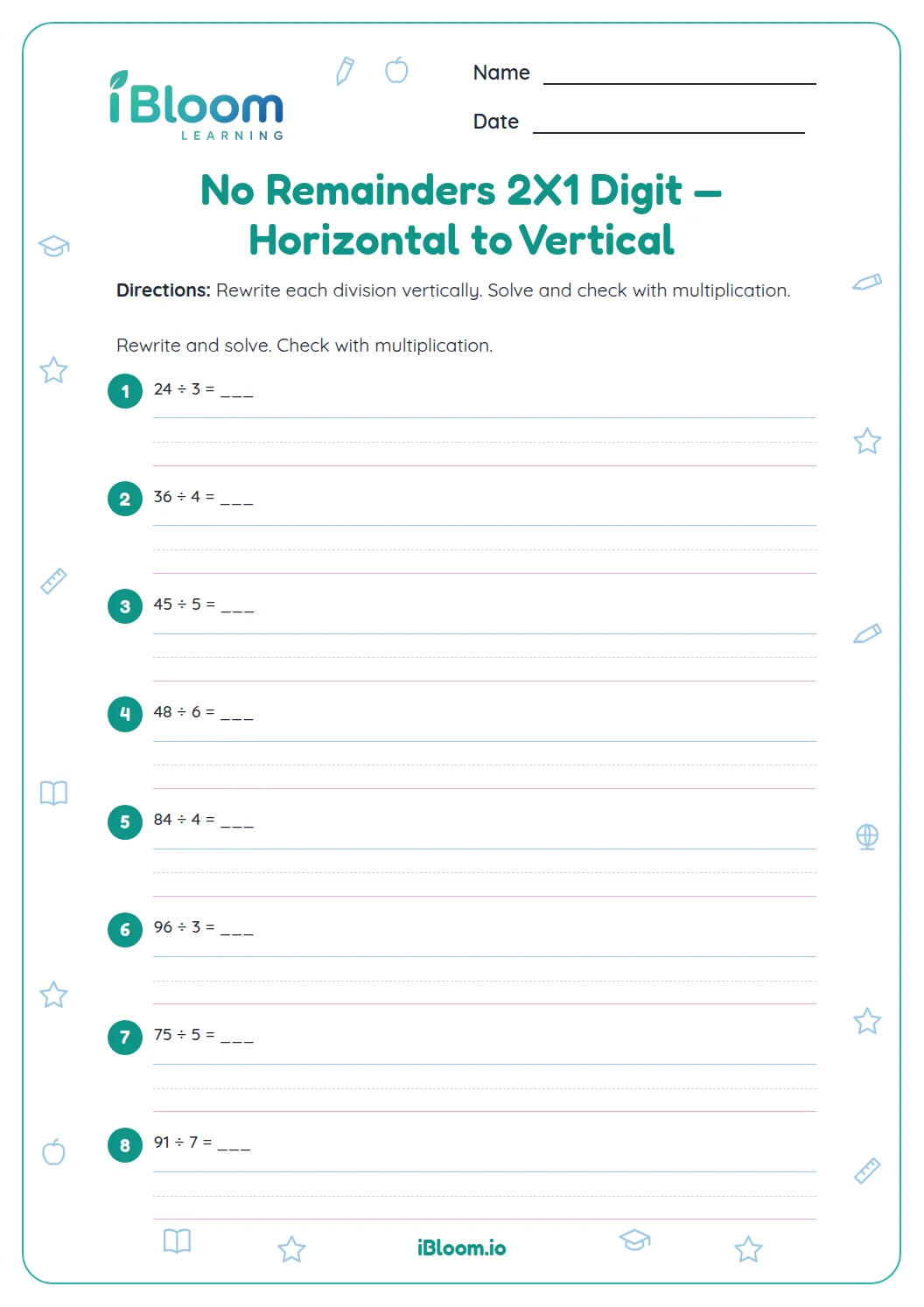
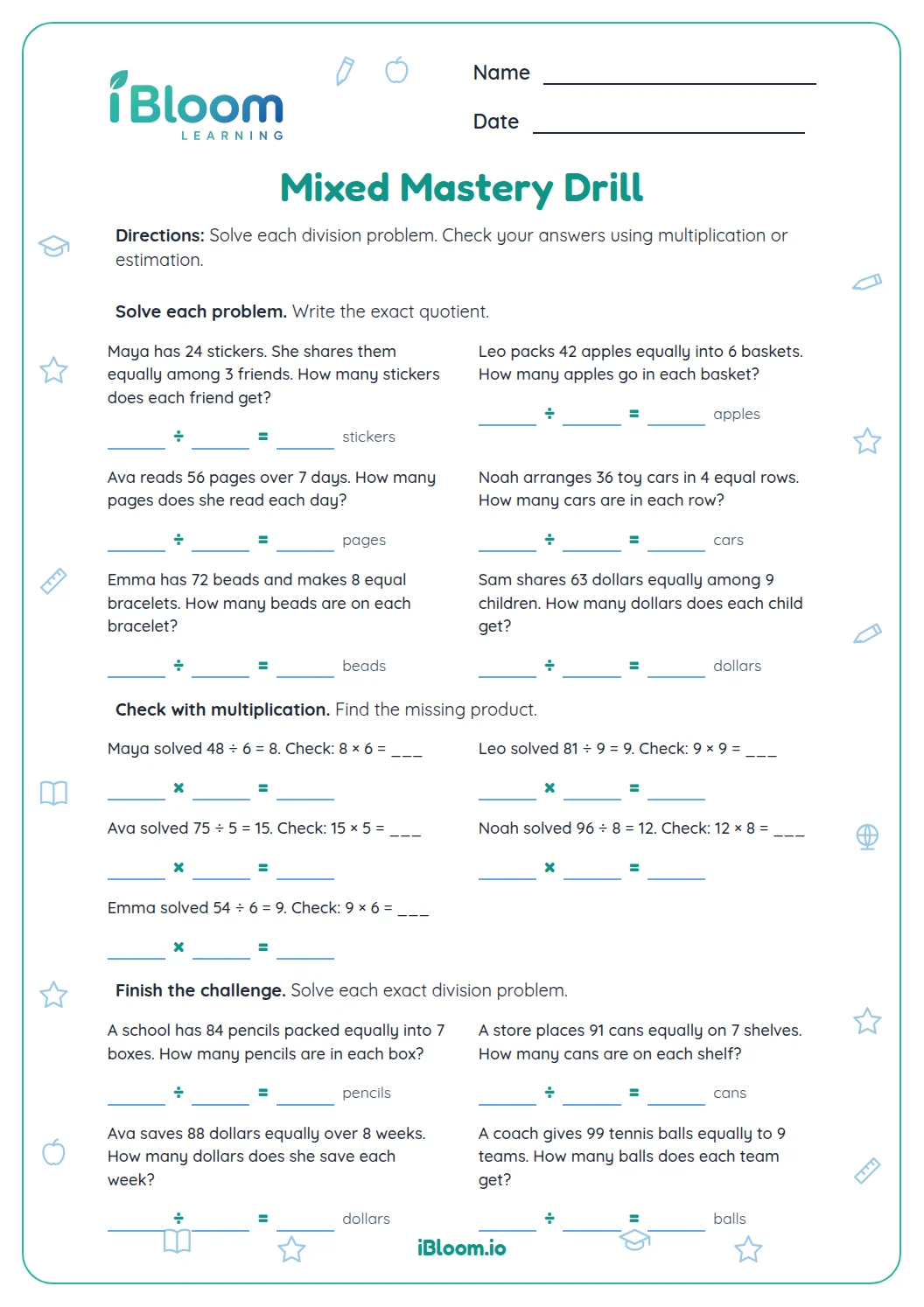
This printable Grades 4–6 worksheet focuses on how to divide two-digit numbers by one-digit divisors and check quotients. It includes 16 questions in two parts, followed by a separate answer key. The directions and examples keep the practice centered on division drill.
Aligned to 4.NBT.B.6
What is on this division drill worksheet?
This Grades 4–6 sheet contains 16 questions in 2 parts. Students work on the stated skill with a separate answer key for review.
Complete the page before checking the key. For written responses, compare the student's idea with the sample rather than requiring the same wording.
- Part A: Divide Without Remainders
- 16 questions across 2 parts
- A separate answer key is included
How do students practice division drill?
To divide two-digit numbers by one-digit divisors and check quotients, read each prompt and follow its part directions.
For example, choose one question and name the clue or model that leads to its answer before checking the key.
How can families review the answers?
Check each fixed answer against the key. For a written response, look for the idea requested by the prompt; the sample answer is a model, not the only possible wording.
What comes next?
After reviewing this page, try another worksheet that builds on divide two-digit numbers by one-digit divisors and check quotients.
How to use this worksheet
- 1Read the directions for the current part.
- 2Answer each question in order, using its model or response space.
- 3Reread written responses to check that they answer the prompt.
- 4Use the key after finishing and revisit any missed item.
A useful review habit
The mistake
Choosing an answer before checking what the prompt asks.
The fix
Reread the prompt and identify the clue, model, or writing goal.
The mistake
Skipping a part direction.
The fix
Check the part heading before starting its questions.
The mistake
Treating a sample response as the only possible wording.
The fix
Check that a written response includes the requested idea, even if phrased differently.
Curriculum alignment
This worksheet gives students practice with the listed Common Core skill.
Divide two-digit numbers by one-digit divisors and check each quotient.
On this sheet: The questions give practice with division drill.
Show the official wordingHide the official wording
Find whole-number quotients and remainders with up to four-digit dividends and one-digit divisors, using strategies based on place value, the properties of operations, and/or the relationship between multiplication and division. Illustrate and explain the calculation by using equations, rectangular arrays, and/or area models.
What to practice next
Make more practice
Further reading
Questions parents and teachers ask
What does this worksheet help students practice?
This Grades 4–6 page practices how to divide two-digit numbers by one-digit divisors and check quotients. Students work through the printed questions, then use the separate answer key to check fixed answers or compare written responses with the sample.
How many questions are included?
The worksheet contains 16 questions arranged in two parts. Each part has its own directions, and the separate answer key makes it easy for a family or teacher to review student responses after the work is complete. It fits a short practice session.
What is included in the answer key?
The key gives the correct response for each fixed-answer question and sample responses where students may write different valid answers. A sample is one strong way to respond; students can use different words while meeting the prompt. The page count, question count, and task types are listed above, so a teacher can plan the practice and review time before printing.
How can an adult support a student during this page?
Read the directions together, then let the student try each question. Ask them to point to the clue, model, or reason that supports an answer. Afterward, compare with the key and discuss any response that needs another look.
When should students use the answer key?
Students can complete the page first and check their work afterward. For a missed item, return to its directions and solve it again before looking at the key, then compare the reasoning as well as the final response.