
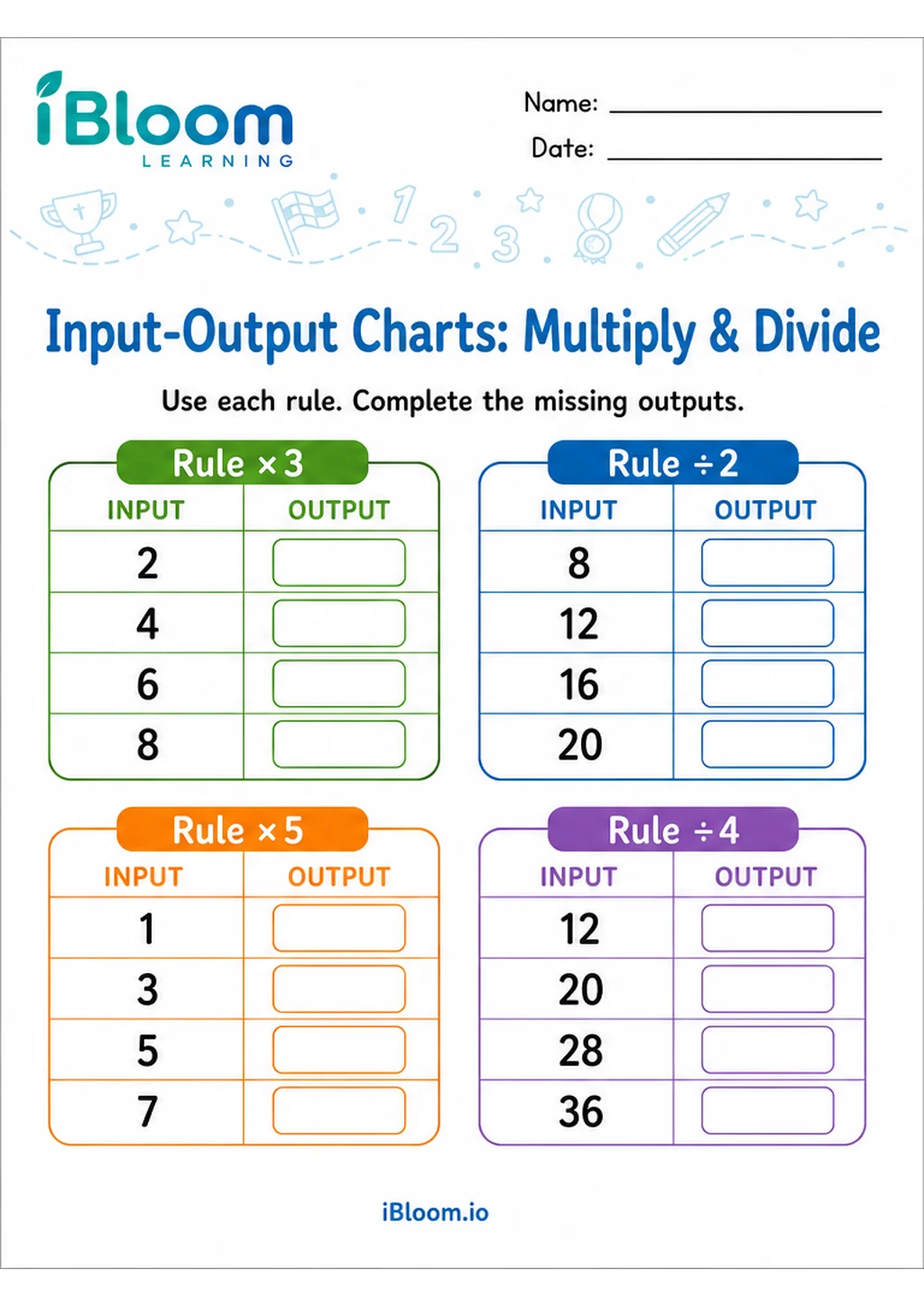
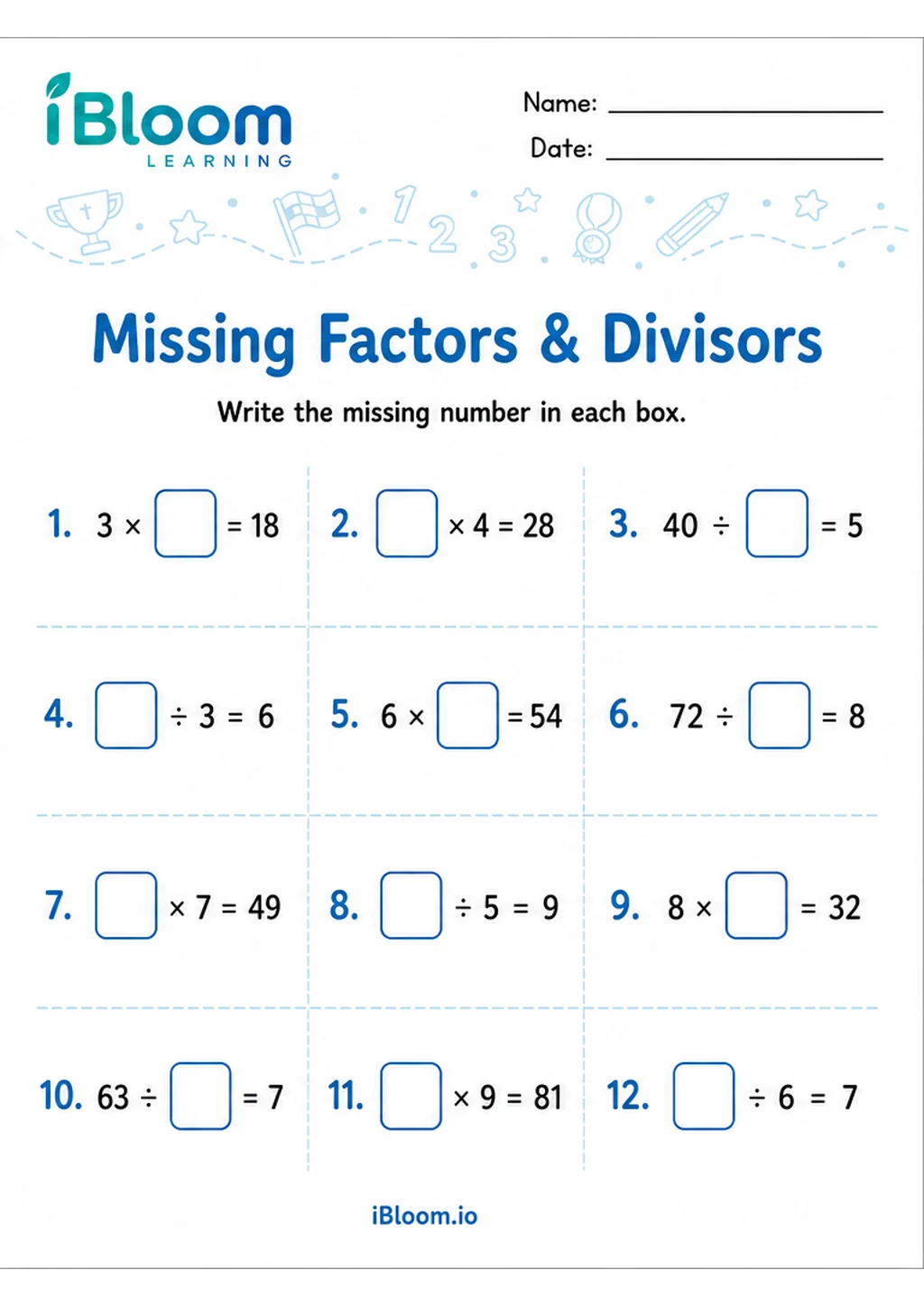
About this worksheet
This two-page printable helps students apply a fixed operation to an input and identify a missing output or input. Part A presents four small charts, one per operation. Part B mixes the four operations in horizontal form, and Part C asks students to reverse the rule. A separate answer key supports quick checking.
What is in the mixed-practice set?
Part A uses four small input-output charts, one for each operation. Part B practices eight horizontal rules with a single input. Part C works backward from an output to find the missing input. Each item names the operation so attention stays on applying the rule accurately.
- Part A: 4 chart entries
- Part B: 8 rule calculations
- Part C: 4 missing-input problems
How do you complete an input-output chart?
Apply the same rule to each input in the chart. For the rule ×3, an input of 5 becomes 15 because 5 groups of 3 make 15. Check the other completed pair to be sure the chart uses one consistent rule.
- 1Rule: ×3. Input 5 → ___
- 2Multiply 5 by 3.
- 3The output is 15.
How can you find a missing input?
Undo the operation to work backward. If the rule adds 7 and the output is 20, subtract 7 from 20 to get the input 13. For multiplication, use division to undo; for division, multiply to undo.
How to use this worksheet
- 1Read the operation shown before calculating.
- 2Complete each Part A table using its one rule.
- 3Solve Part B horizontally, keeping the operation sign in view.
- 4In Part C, undo the rule to find the missing input.
- 5Check a result by applying the original rule to your answer.
Common mistakes and quick fixes
The mistake
Changing the rule partway through a chart.
The fix
Write the operation beside each input and repeat that same operation.
The mistake
Using the same operation when working backward.
The fix
Choose the inverse operation to undo the stated rule.
The mistake
Mixing up × and + in a fast calculation.
The fix
Say the rule aloud and write a quick equation before answering.
What to practice next
Make more practice
Questions parents and teachers ask
What is an input-output rule?
An input-output rule tells how to change each starting number into an ending number. If the rule is multiply by 3, then input 5 gives output 15. The same operation applies to every row in a chart. The worksheet practices addition, subtraction, multiplication, and division.
How many items are on this worksheet?
There are 16 questions: four chart entries, eight horizontal input-output problems, and four missing-input problems. Part A shows a small table for each operation. Parts B and C use number sentences with one blank, and the separate answer key lists each result.
How do I check a completed chart?
Pick one row and apply the stated rule to its input. For example, with ×3, input 8 should produce 24. Then use the same multiplication on the row with the blank. If the listed outputs do not follow one rule, reread the operation and check each calculation.
How do I work backward to find an input?
Use the inverse operation. If the rule is subtract 8 and the output is 11, add 8 to find the input 19. If a rule multiplies by 3, divide the output by 3. Part C has one missing input for each of the four operations.
Are the questions meant to be timed?
No timer is needed. The goal is to read the operation carefully and apply it consistently. A learner can write a small side calculation if helpful, then check the result by putting the input through the rule once more. The full set has two worksheet pages and two answer-key pages.