





About this worksheet
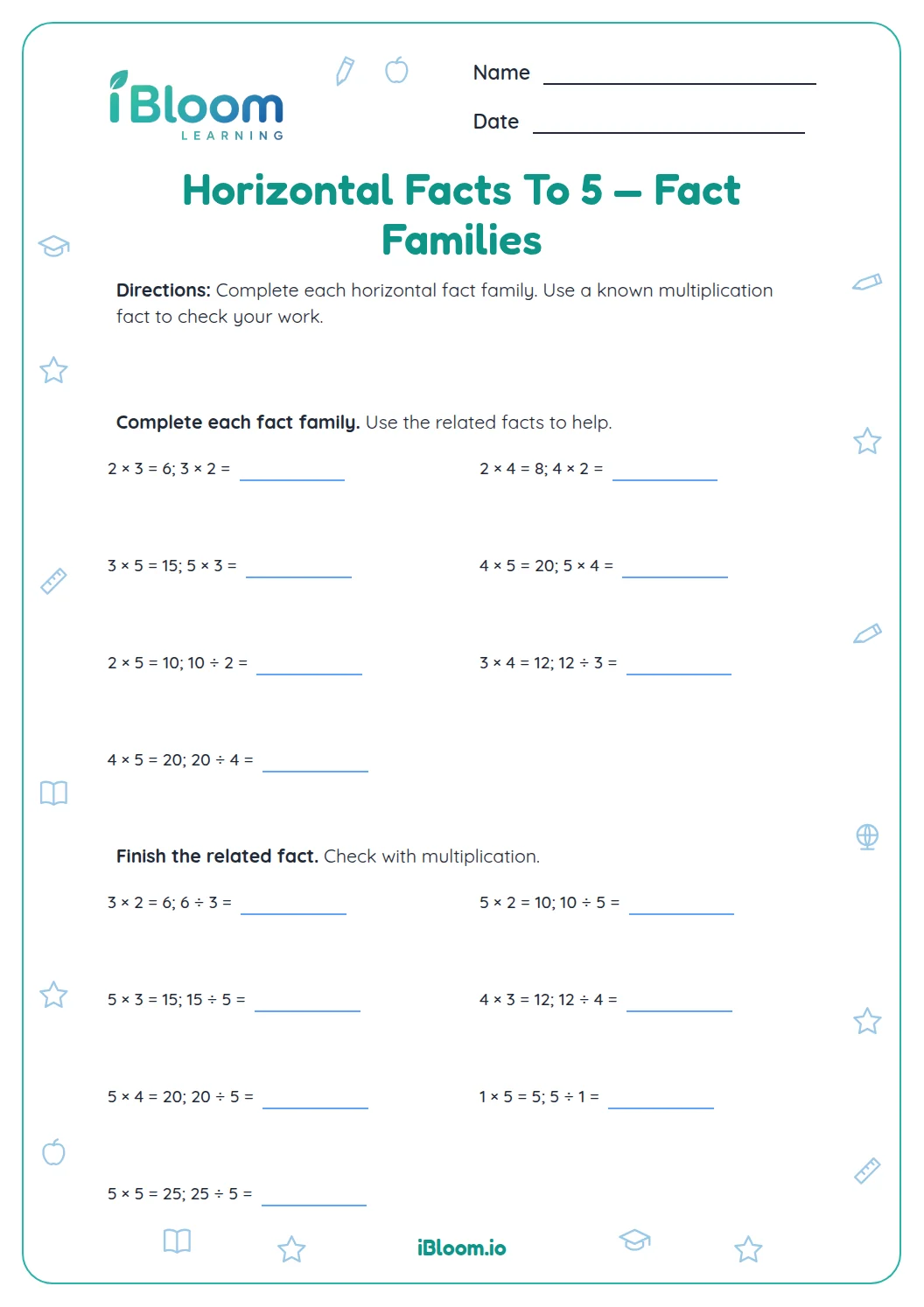
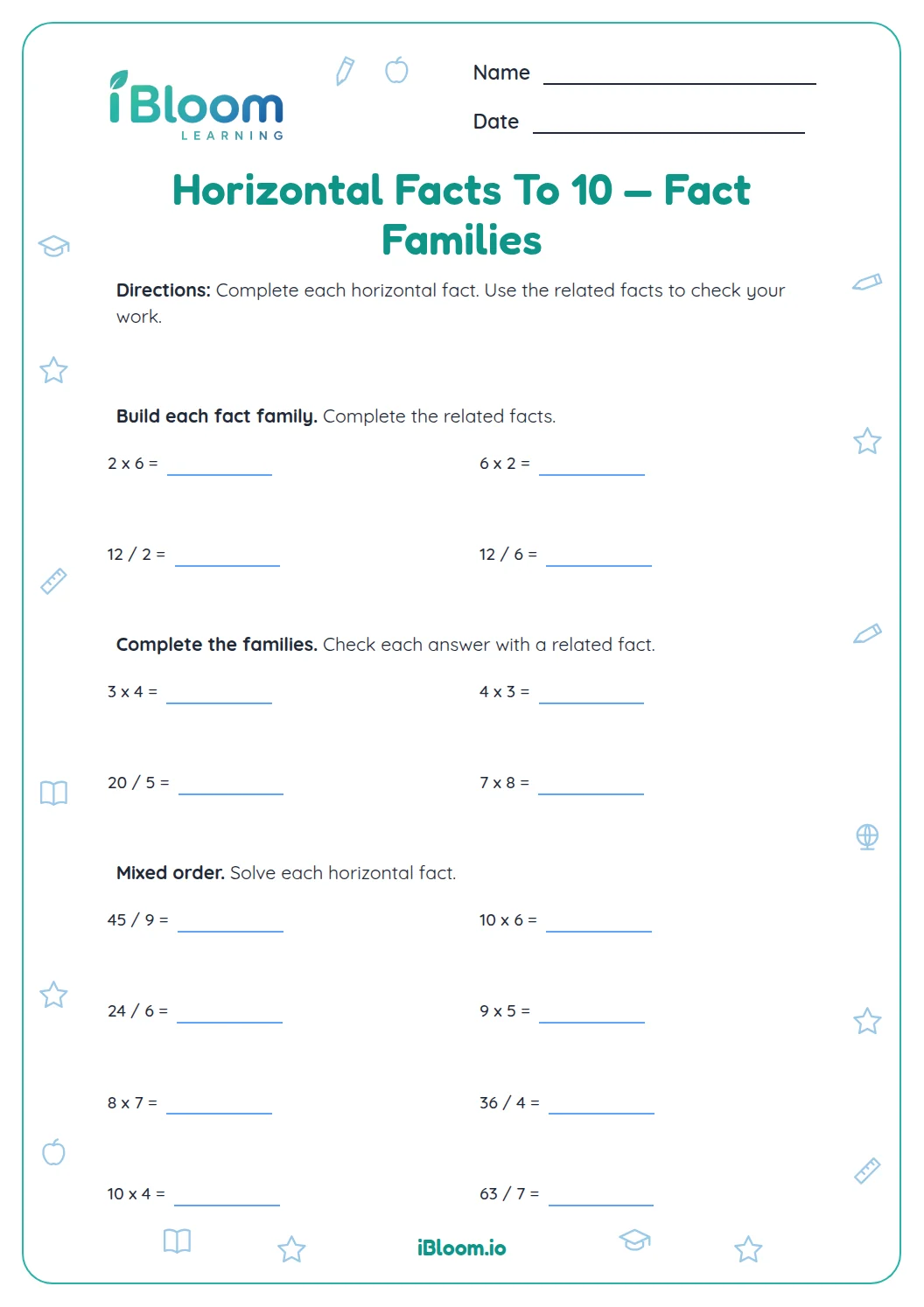
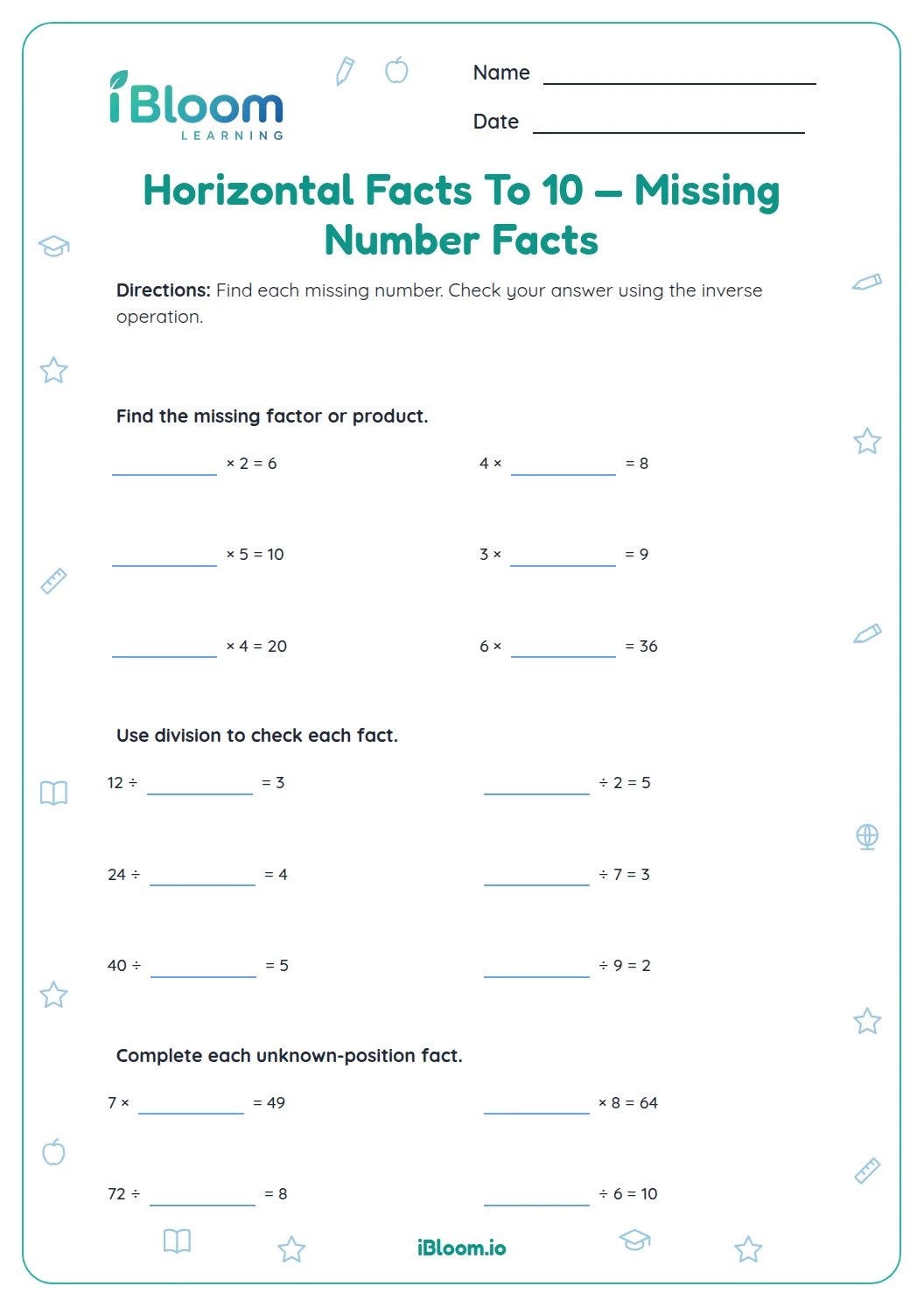
This free printable worksheet helps Grade 3 students connect multiplication and division; Grade 4 students can use it for review. Its 24 horizontal equations include four complete fact families followed by eight mixed facts. Parts A–C use 4, 6 and 24; 3, 7 and 21; and 5, 8 and 40. Part D starts with 6, 9 and 54, then asks children to find missing factors, products, divisors, dividends and quotients in other families. The practice supports Common Core 3.OA.C.7, using multiplication and division relationships within 100. A separate answer key fills every blank.
Aligned to 3.OA.C.7
Which families are on this sheet?
The first 16 equations form four complete families: 4, 6, 24; 3, 7, 21; 5, 8, 40; and 6, 9, 54. Each family has two multiplication facts and the two related division facts.
Part D then adds eight mixed facts with blanks in different positions. For ___ ÷ 5 = 9, the missing starting number is 45: multiply 5 by 9 to find it.
How does a multiplication fact help with division?
A division fact asks for one of the factors. In Part A, the total 24 is split into groups of 6. The other factor, 4, tells how many groups there are.
- 16 × 4 = 24
- 24 × 6 = 24
- 324 ÷ 6 = 4
- 424 ÷ 4 = 6
How can children check an unfamiliar blank?
Put the proposed answer into the equation and read it from left to right. For 40 ÷ ___ = 5, try 8: five groups of eight make forty.
Name what the blank represents before calculating. A missing factor or divisor can be found using a related fact; a missing dividend, as in ___ ÷ 5 = 9, is the product of the other two numbers.
How to use this worksheet
- 1Read the three numbers in the Part A heading.
- 2Complete the first multiplication fact and reverse its factors.
- 3Use 24 as the starting number for both division facts.
- 4Finish Parts B–D, using related facts when the families are mixed.
- 5Check all answers and say one multiplication check for each missed division fact.
Mistakes to check and how to fix them
The mistake
Writing 24 ÷ 6 = 6 after copying a nearby factor.
The fix
Ask which number times 6 makes 24; 4 is the missing factor.
The mistake
Reversing division to write 6 ÷ 24 = 4.
The fix
Start division with the product, 24, then divide by a factor.
The mistake
Adding 6 and 9 to answer 6 × 9.
The fix
Read × as groups of; six groups of nine make 54.
Common Core alignment
Use related multiplication and division facts to complete families within 100.
On this sheet: Sixteen equations build complete families; eight mixed facts use the same inverse relationships.
Show the official wordingHide the official wording
Fluently multiply and divide within 100, using strategies such as the relationship between multiplication and division (e.g., knowing that 8 × 5 = 40, one knows 40 ÷ 5 = 8) or properties of operations. By the end of Grade 3, know from memory all products of two one-digit numbers.
What to practice next
Make more practice
Further reading
Questions parents and teachers ask
How many fact families and mixed facts are included?
There are four complete families with four equations each, followed by eight mixed facts. The complete families use 4, 6 and 24; 3, 7 and 21; 5, 8 and 40; and 6, 9 and 54. Children fill one blank per equation, for 24 answers altogether.
Why are both multiplication orders included?
Both orders show that switching the factors keeps the product the same. For example, 6 × 4 and 4 × 6 both make 24. Once those are complete, children use the same three numbers in two division facts and see how all four equations belong together.
How do we solve 40 ÷ ___ = 5?
The missing number is 8. Think of the equation as asking which number, multiplied by 5, makes 40. Part C supplies the related fact 5 × 8 = 40. Put 8 into the blank, then read the completed division equation aloud to check it.
Should children race through these equations?
An untimed first attempt lets children concentrate on the family relationships. Ask them to use a completed fact when they hesitate, especially in Parts C and D. After checking the key, cover the answers and revisit just the equations that needed help in another short session.
What does the answer key show?
The key gives all 24 missing numbers in their equation blanks. Use it after a child has tried the questions. If a division answer is wrong, ask the child to write a related multiplication fact and explain which number belongs in the blank before checking again.