

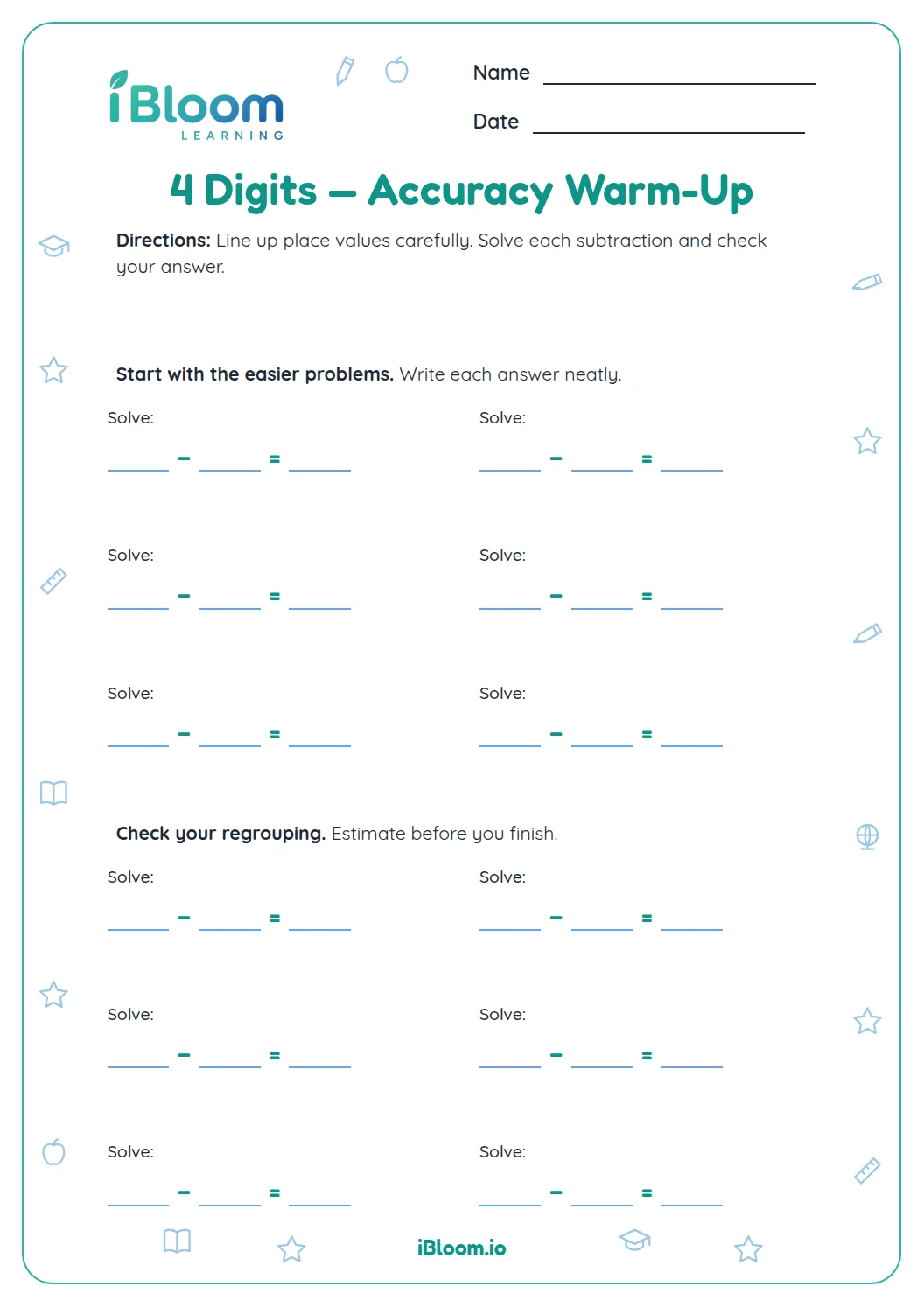
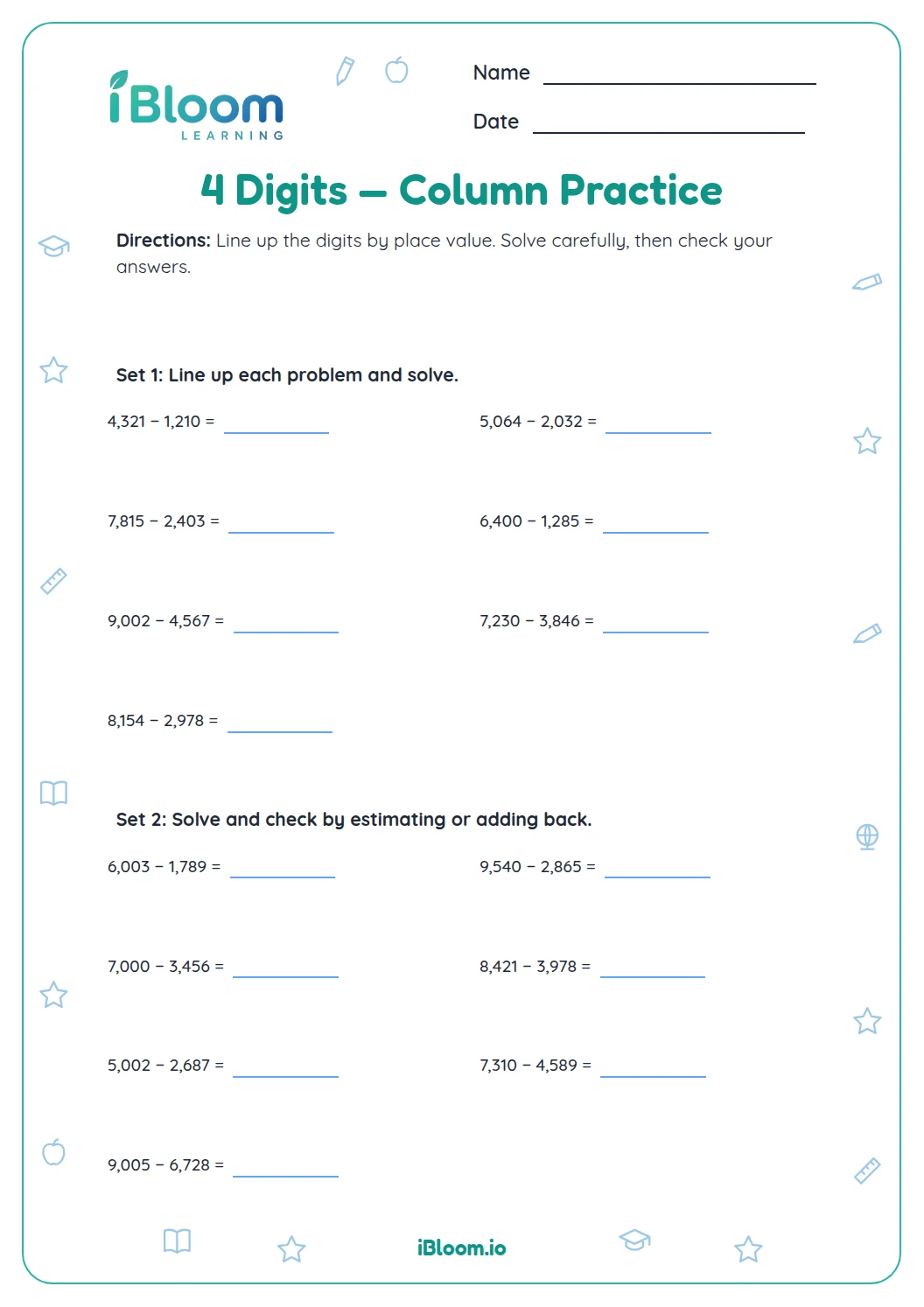
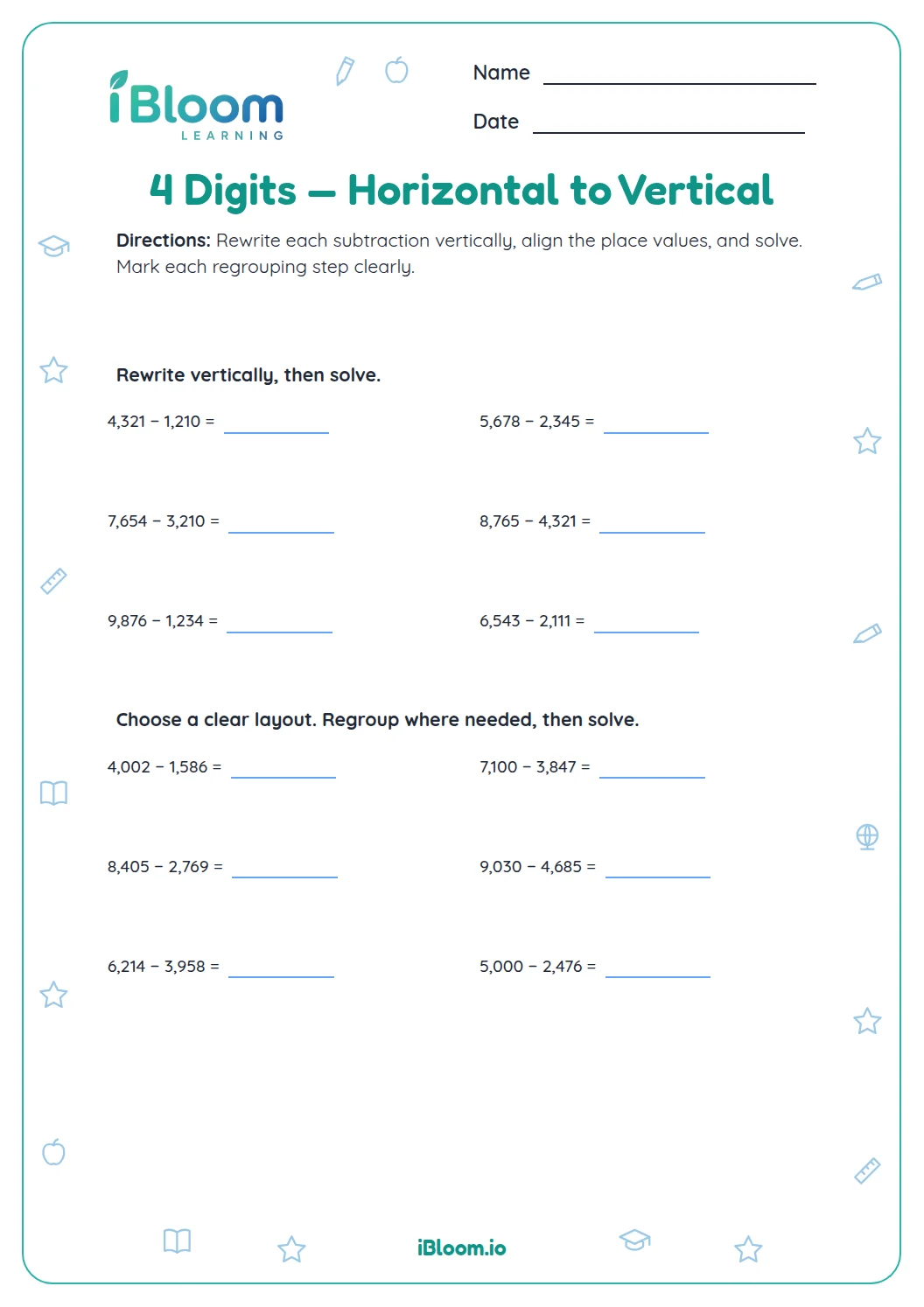
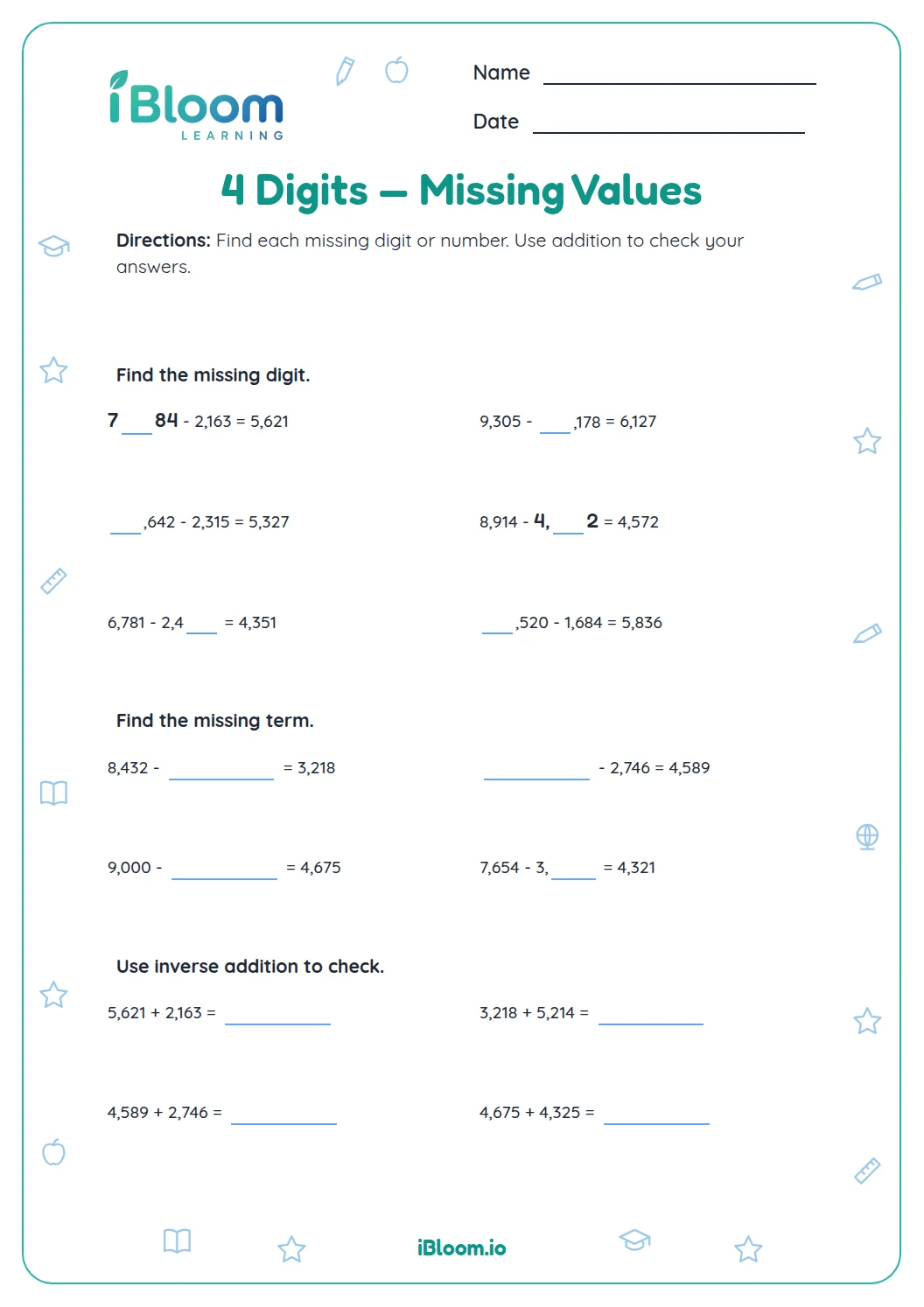

About this worksheet
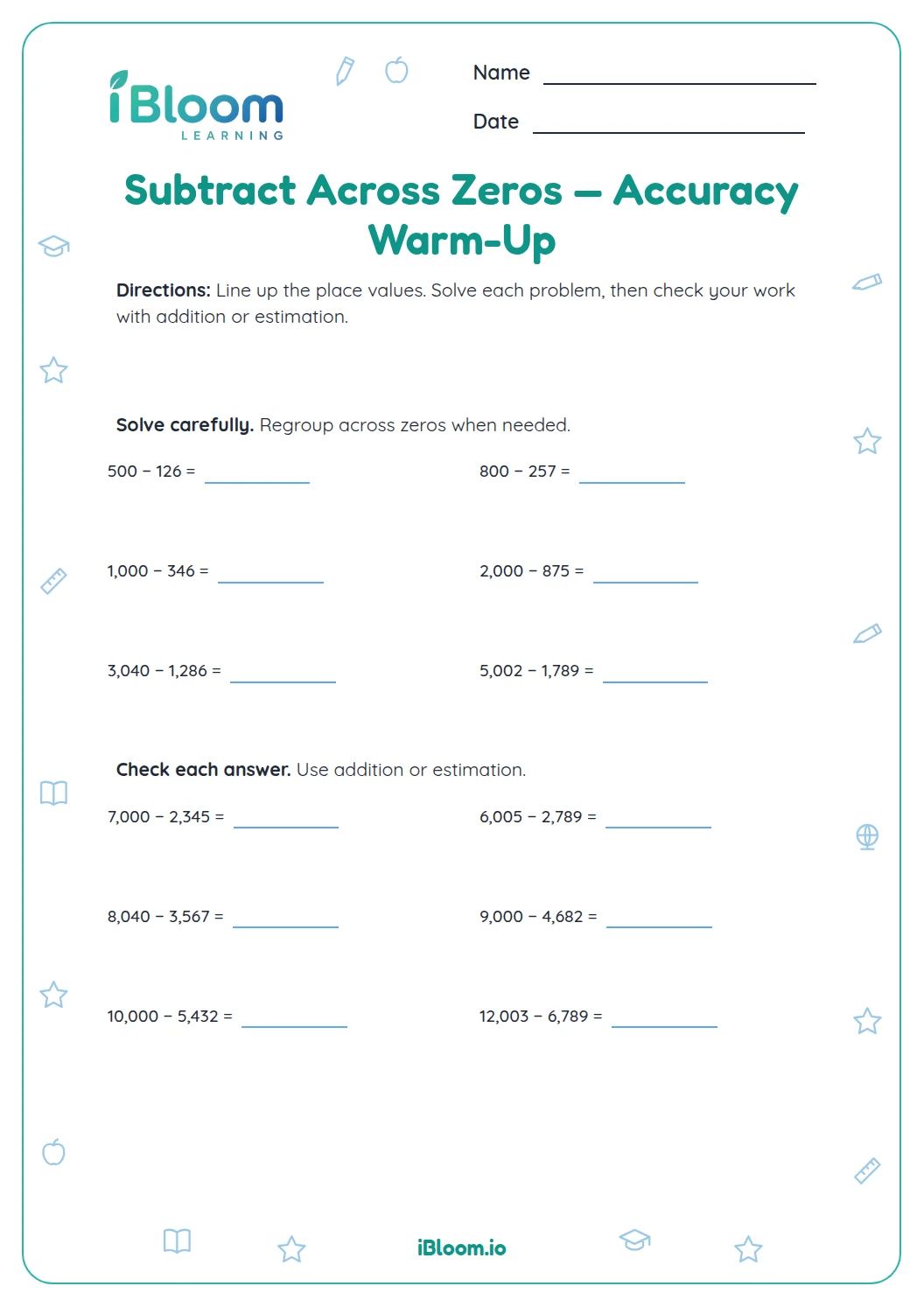
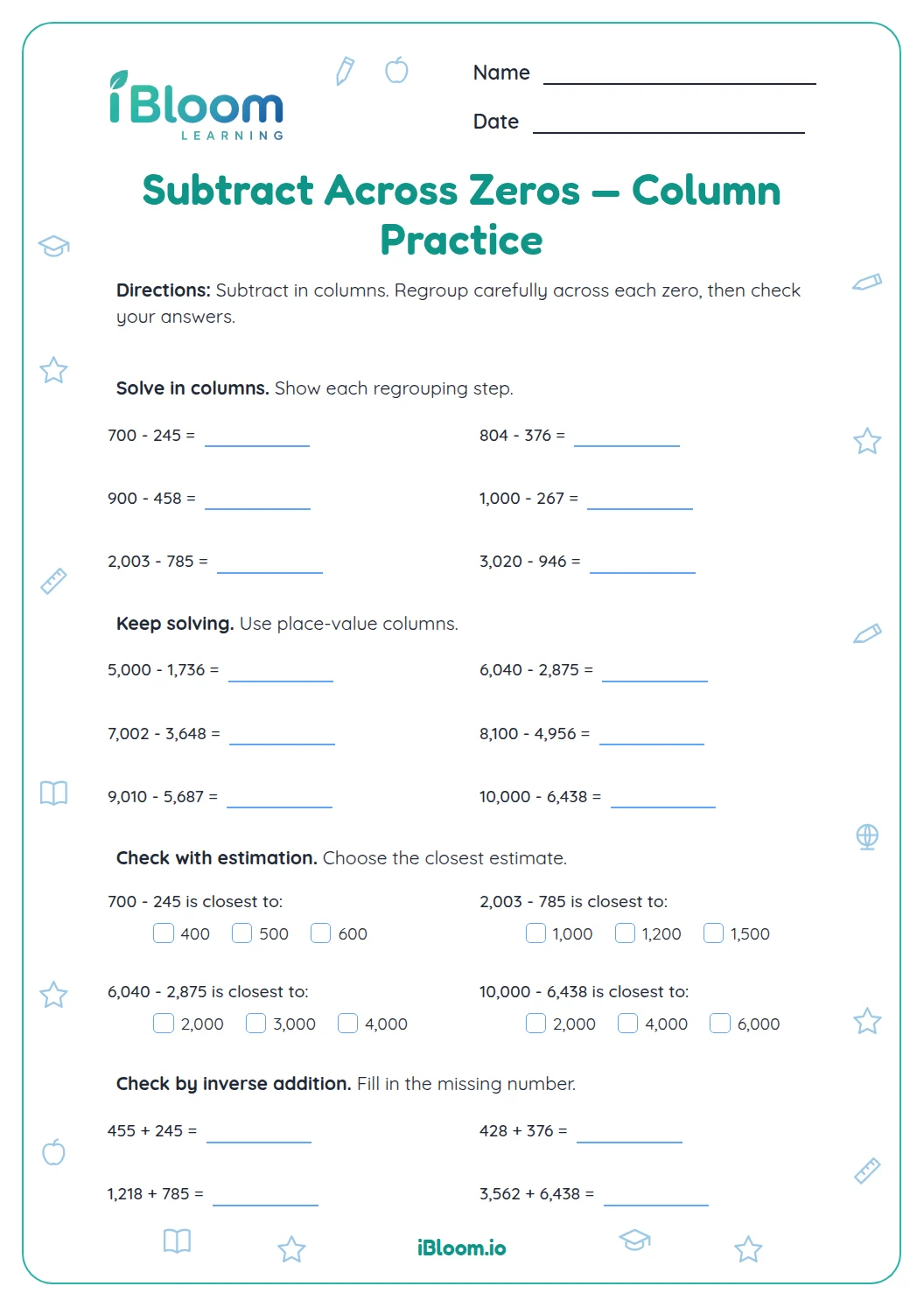
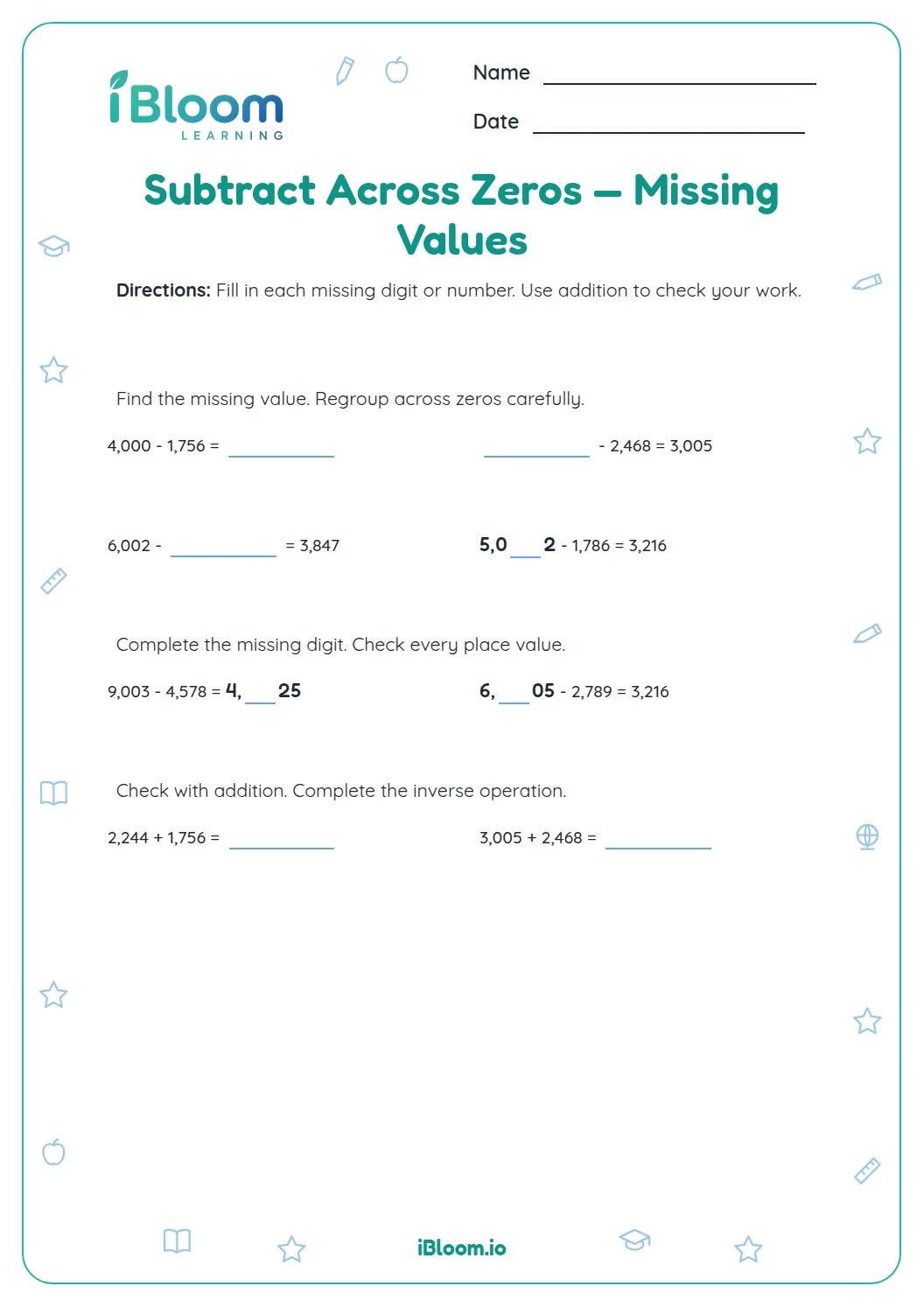
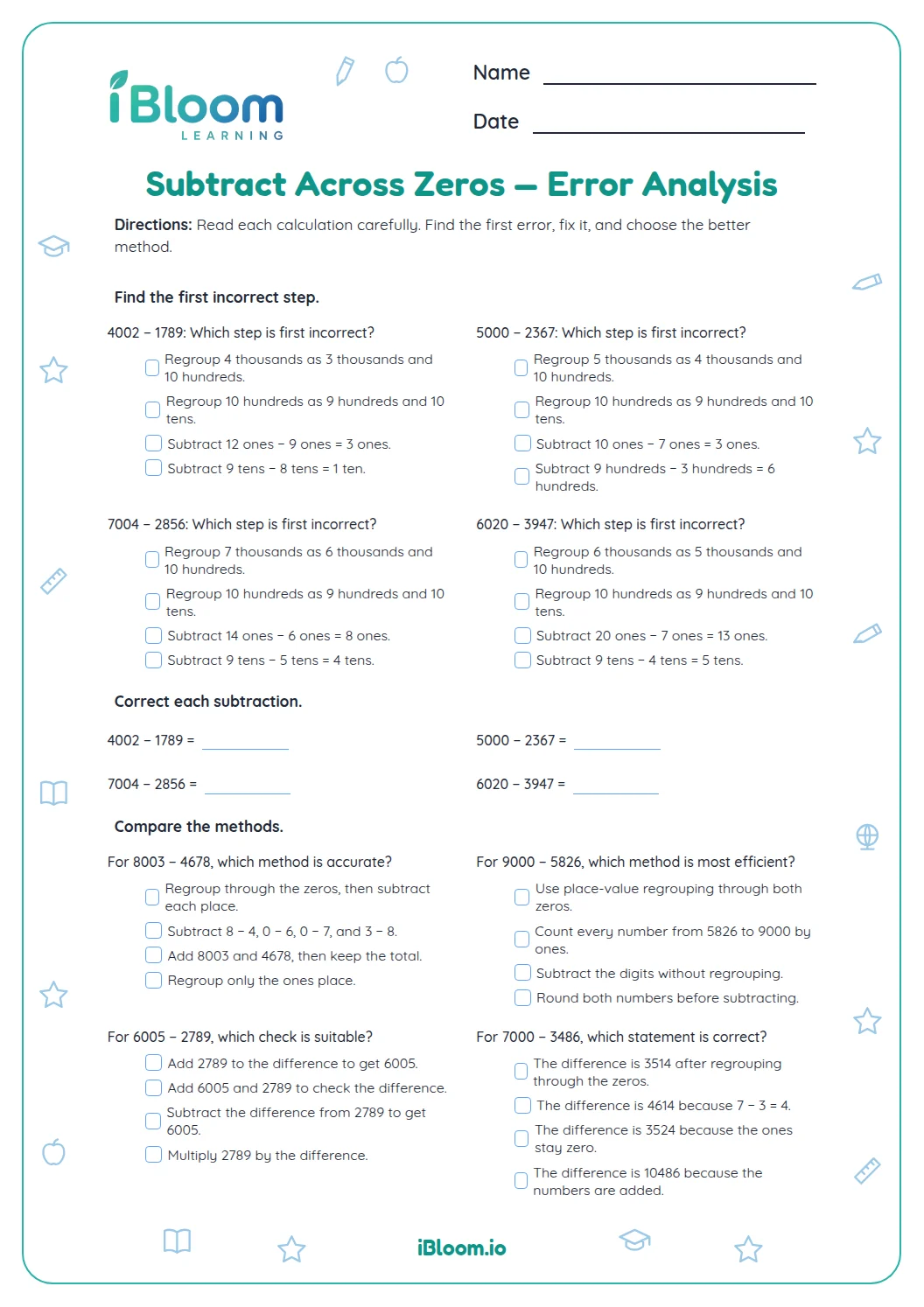
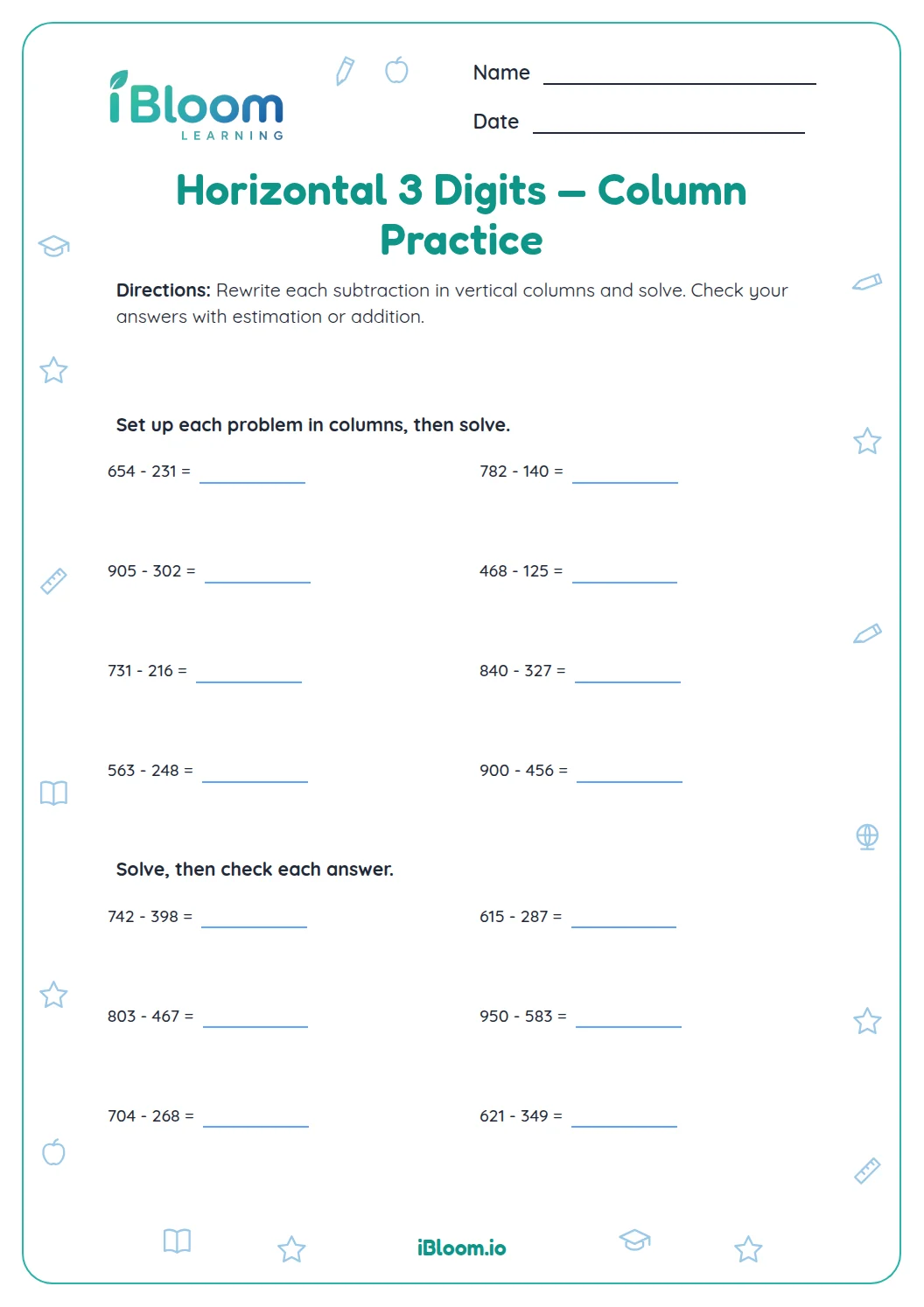
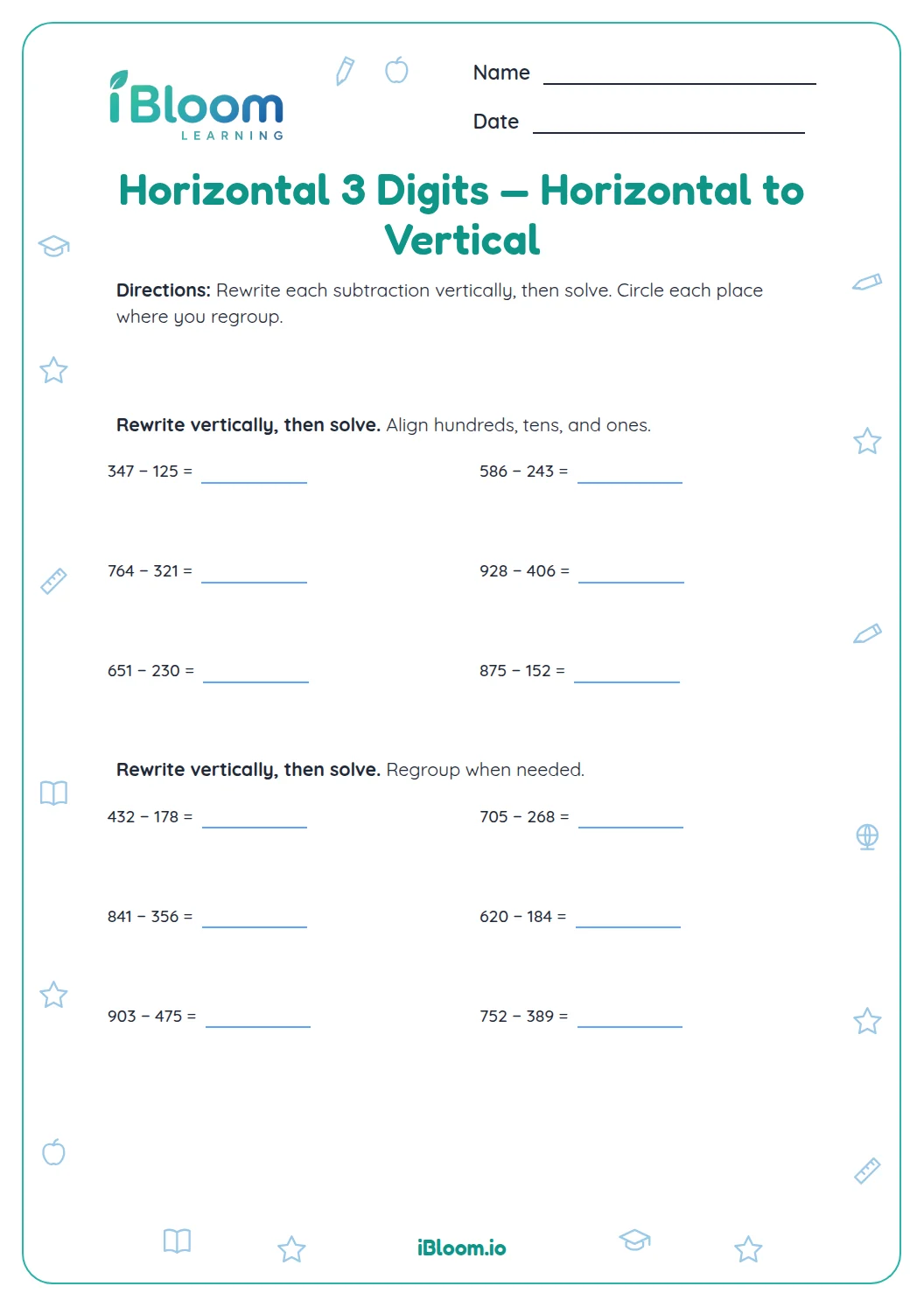
This drill turns horizontal expressions into vertical subtraction practice. The first part includes three- and four-digit minuends; the next moves to four- and five-digit numbers with zeros in different place-value columns. Every question asks children to line up the digits, regroup as needed and solve. A separate answer key is included.
Aligned to 4.NBT.B.4
How do you subtract across zeros?
Set the numbers in columns so the ones, tens, hundreds, and larger places line up. When a place has zero, regroup from a nonzero place to its left, passing a ten through each zero as needed.
For 700 − 286, regroup 700 as 6 hundreds, 9 tens, and 10 ones. Then subtract 6 from 10, 8 from 9, and 2 from 6 to get 414.
- 1700 becomes 6 hundreds, 9 tens and 10 ones
- 210 − 6 = 4 ones
- 39 − 8 = 1 ten
- 46 − 2 = 4 hundreds
- 5Difference: 414
What changes from part to part?
Part A includes three- and four-digit minuends. Part B increases the place value and includes more than one zero, so careful regrouping matters.
- Part A: six problems with three- and four-digit minuends
- Part B: eight four- and five-digit problems
- Every prompt starts horizontally; children set up the vertical work themselves
How can students check each difference?
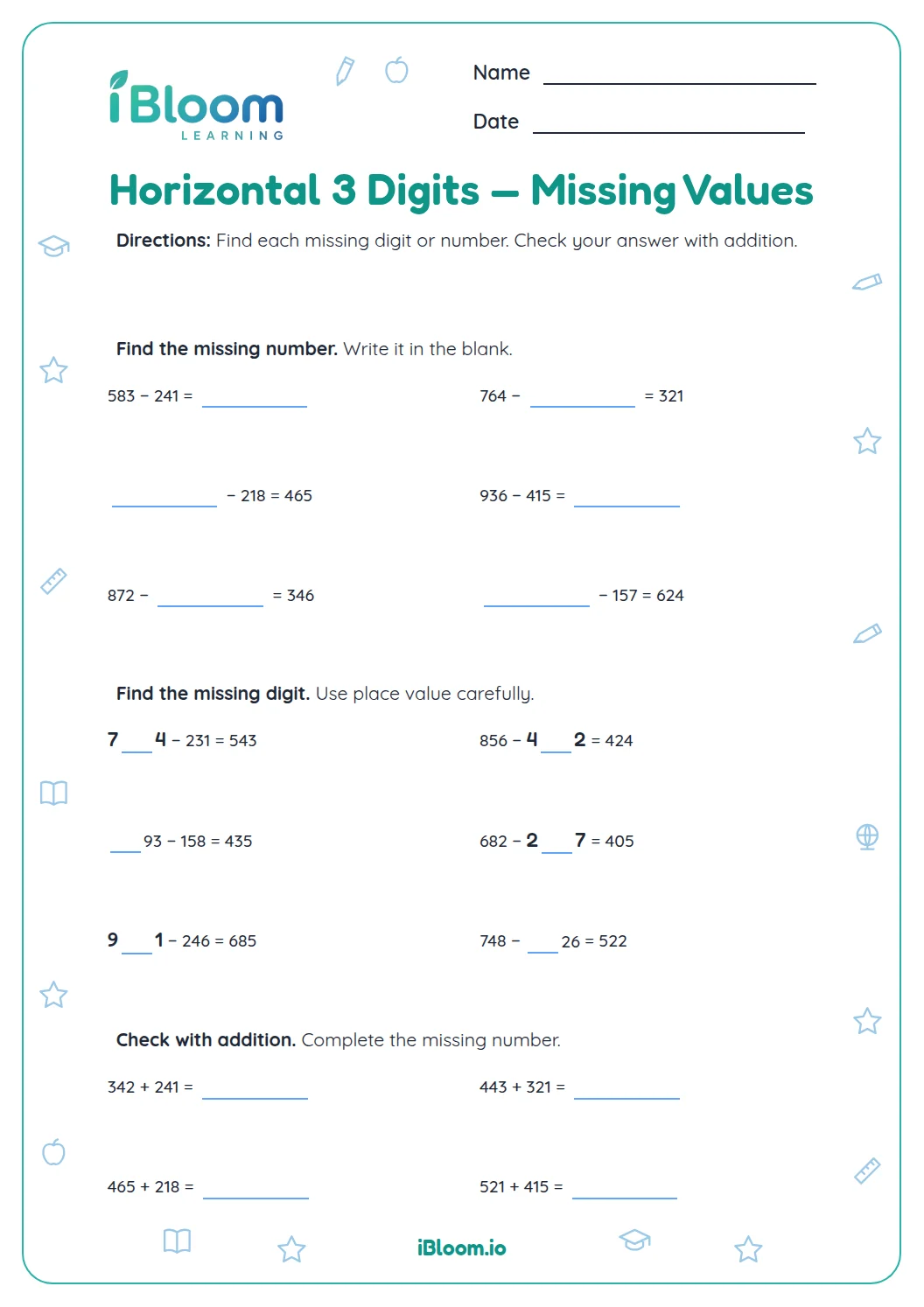
Add the difference to the number being subtracted. The sum should match the original minuend. This check is especially useful when regrouping passes through more than one zero.
Each problem provides working room to rewrite the horizontal expression vertically and solve it.
Set up each subtraction
- 1Copy the minuend on the top line and the subtrahend beneath it.
- 2Line up digits by place value, not by the left edge.
- 3Regroup from left to right as needed, showing each exchange across zeros.
- 4Subtract the ones, tens, hundreds and higher places.
- 5Check by adding the difference to the subtrahend.
Common regrouping slips
The mistake
Borrowing from a zero column as if it had a ten to give.
The fix
Move left to the closest nonzero place, regroup there, and pass one ten through each zero.
The mistake
Forgetting that a place value decreases after it gives one unit away.
The fix
Mark the changed digit before moving to the next column.
The mistake
Misaligning digits while copying a horizontal problem.
The fix
Use place-value columns so ones sit above ones and tens above tens.
Common Core alignment
The problems practice multi-digit subtraction with the standard algorithm.
Fluently add and subtract multi-digit whole numbers using the standard algorithm.
On this sheet: Each problem is set horizontally so students must organize place values vertically and regroup across zeros.
Show the official wordingHide the official wording
Fluently add and subtract multi-digit whole numbers using the standard algorithm.
What to practice next
Make more practice
Further reading
Questions parents and teachers ask
Why rewrite the problems vertically?
A vertical setup aligns ones with ones, tens with tens and so on. That makes regrouping easier to track across place values. After copying the horizontal expression, students can see which column needs an exchange and keep the digits lined up while subtracting.
What does regrouping across zeros mean?
It means exchanging from a nonzero place to the left and passing a ten through zero places until the needed column can subtract. Each place value changes as it gives one unit to the column on its right, so mark each exchange carefully.
How can students check a difference?
Add the difference to the subtrahend. The sum should equal the original minuend. For example, after solving 700 − 286, add 414 and 286 to see whether the total returns to 700. This inverse check can reveal a regrouping slip.
Is there a separate answer key?
Yes. The answer key lists every difference from the horizontal problems. Use it after the child has set up and solved each subtraction, then revisit any item where the regrouping or final check did not work. Ask the child to show the check as well.
Why does regrouping pass through a zero?
A zero means there are no units in that place to exchange, so regroup from the next nonzero place to the left. Each place along the way changes as one ten is passed to the place on its right. Keep the changed digits visible to avoid losing track.
How much working space does the page provide?
Each of the 14 questions has room for a vertical setup and calculation. The first six use three- or four-digit minuends, and the remaining eight include four- or five-digit minuends. A separate answer key lists each difference for checking. Students can check the first setup with an adult.