Free printable practice
Number Lines Practice Activities
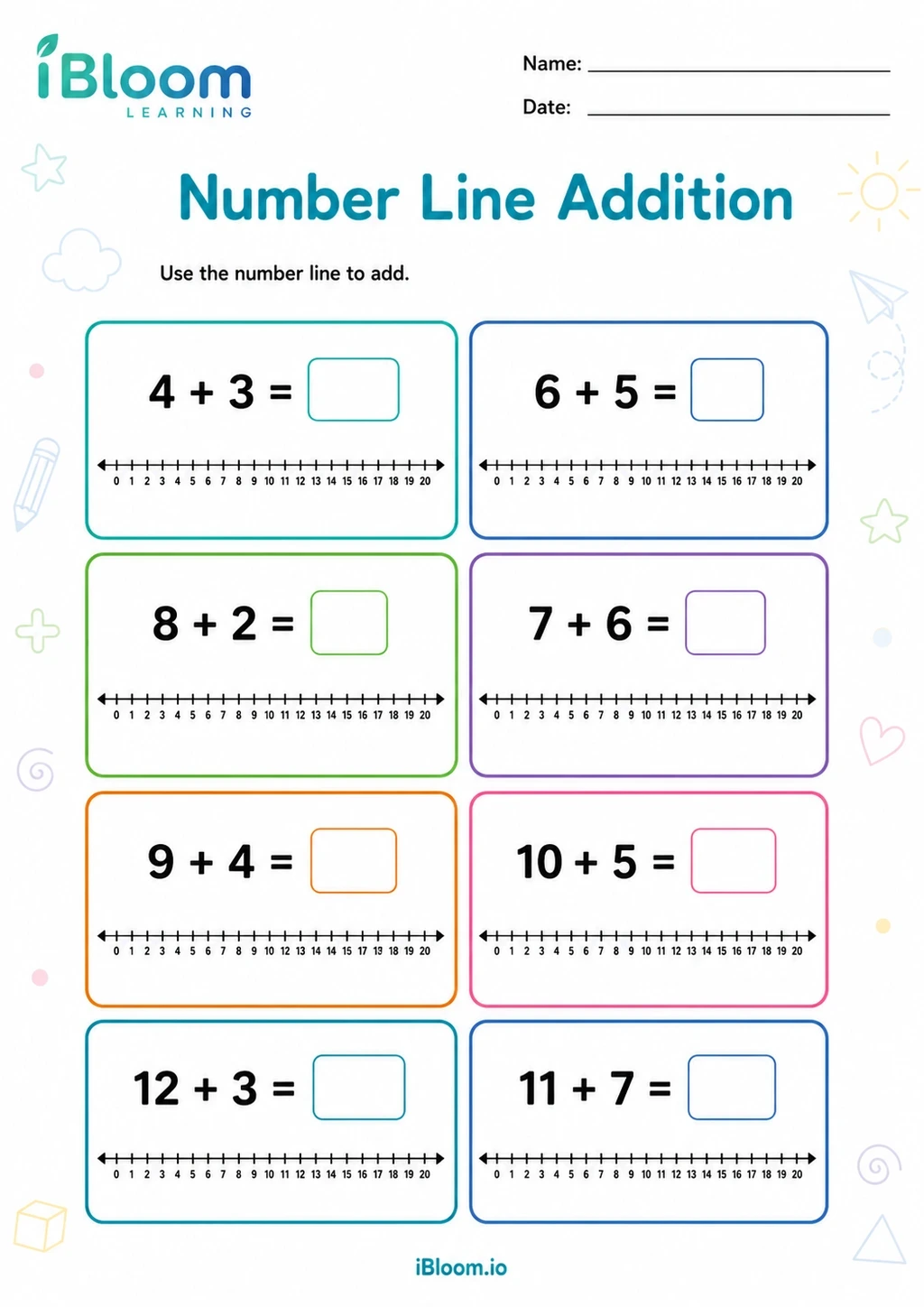
Class 1 addition worksheets that help children use number lines to count on, make forward jumps, and find sums with confidence.
Free printable worksheet PDFs
Preview every available page, then download the free worksheet PDF for home, homeschool, tutoring, or classroom practice.
Preview the exact activity before downloading it.
Practice that builds confidence
Building addition through jumps
These Class 1 maths worksheets help children practise addition on a number line by starting at a given number, making forward jumps, and landing on the sum. Children see addition as movement to the right, which makes counting on easier to understand.
The printable activities include marked number lines, hop-and-count tasks, missing-sum questions, and simple addition sentences to match with jumps. They are designed for the Mathematics > Class 1 > Addition > Number Lines skill path.
A number line gives Class 1 children a clear picture of what addition means. Instead of only counting objects, they learn to place the first addend on the line, move right for the second addend, and read the landing number as the answer. For example, in 4 + 3, the child starts at 4, makes 3 forward hops, and lands on 7. This connects the vocabulary of start, jump, forward, count on, and sum.

How the practice progresses
The worksheets begin with guided number lines where the jumps are easy to see. Children then complete missing jumps, write the addition sentence for a shown path, or draw their own hops for a given sum. This progression helps them move from tracing and counting each jump to mentally predicting where they will land. The work stays focused on the addition skill in the breadcrumb: Mathematics, Class 1, Addition, Number Lines.
A simple parent routine
At home, ask your child to point to the starting number before solving. Then say, “We are adding, so which way do we move?” Let the child draw or tap each hop while counting aloud: one, two, three. After landing, ask them to read the full number sentence, such as “5 plus 2 equals 7.” If they make a mistake, return to the start and recount the hops slowly rather than giving the answer first.

Classroom uses for teachers
Teachers can use these printables for small-group maths support, independent practice after a number line demonstration, or quick revision before moving to addition facts. They also work well in centres: one group can draw hops, another can match number lines to equations, and another can explain the jump pattern orally. The visual format helps teachers spot whether a child understands counting on or is only guessing.

Common errors to watch for
Many children start counting from the first number as “one” instead of making the first hop as “one.” In 6 + 2, they may say 6, 7 and land on 7 instead of hopping to 7 and then 8. Others may move left, skip a number, or forget to mark the landing point. Encourage careful pointing, one hop for each number added, and checking that addition moves to the right.
Free printable PDF download
Use this Class 1 number line addition worksheet page to preview the activity, print it, or download it as a PDF for quick practice. It works well for homework, homeschool lessons, tutoring, morning work, revision, and classroom centers.
Answers and answer key support
After the child completes the worksheet independently, parents and teachers can use the answer support or answer key information to check the work, review mistakes, and choose the next practice step.
Why iBloom worksheets help
iBloom number line worksheets give enough structure for early learners while still asking them to think. Children practise reading number lines, connecting pictures to addition sentences, and explaining their answer in words. A child-friendly strategy is: “Start on the first number, hop right the second number, circle where you stop.”
Helpful answers
Frequently asked questions
What does a child learn from addition on a number line?
A child learns that addition means moving forward to the right. They start on the first number, make the correct number of hops, and read the number where they land as the sum.
How should my child solve 4 + 3 on a number line?
They should point to 4, make three separate hops to the right, and land on 7. Encourage them to count the hops as 1, 2, 3 rather than counting 4 as the first hop.
Why is my child getting answers one less than the correct sum?
This often happens when the child counts the starting number as the first jump. Remind them that the first count begins only after they move from the starting number to the next number.
Can these worksheets be used before memorising addition facts?
Yes. Number line practice is useful before memorisation because it shows how addition works. It helps children understand counting on before they are expected to recall facts quickly.
How can teachers use these number line worksheets in class?
Teachers can use them after a board demonstration, in maths centres, for small-group support, or as independent practice to check whether children can connect jumps with addition sentences.
Is this Class 1 number line addition worksheet free?
Yes. You can preview it for free and use the printable worksheet for home or classroom practice.
Can I download this Class 1 number line addition worksheet as a PDF?
Yes. Use the worksheet download option to save a printable PDF, or print the worksheet directly from the page.
Does this Class 1 number line addition worksheet include answers or an answer key?
When the activity has fixed answers, iBloom includes answer support so parents and teachers can check the completed worksheet.