Free printable practice
Comparing Numbers Practice Activities
Class 1 maths worksheets for comparing, ordering, and arranging numbers from 0 to 100 using more than, less than, ascending, and descending order.
Explore Comparing Numbers
Free printable worksheet PDFs
Preview every available page, then download the free worksheet PDF for home, homeschool, tutoring, or classroom practice.
Preview the exact activity before downloading it.
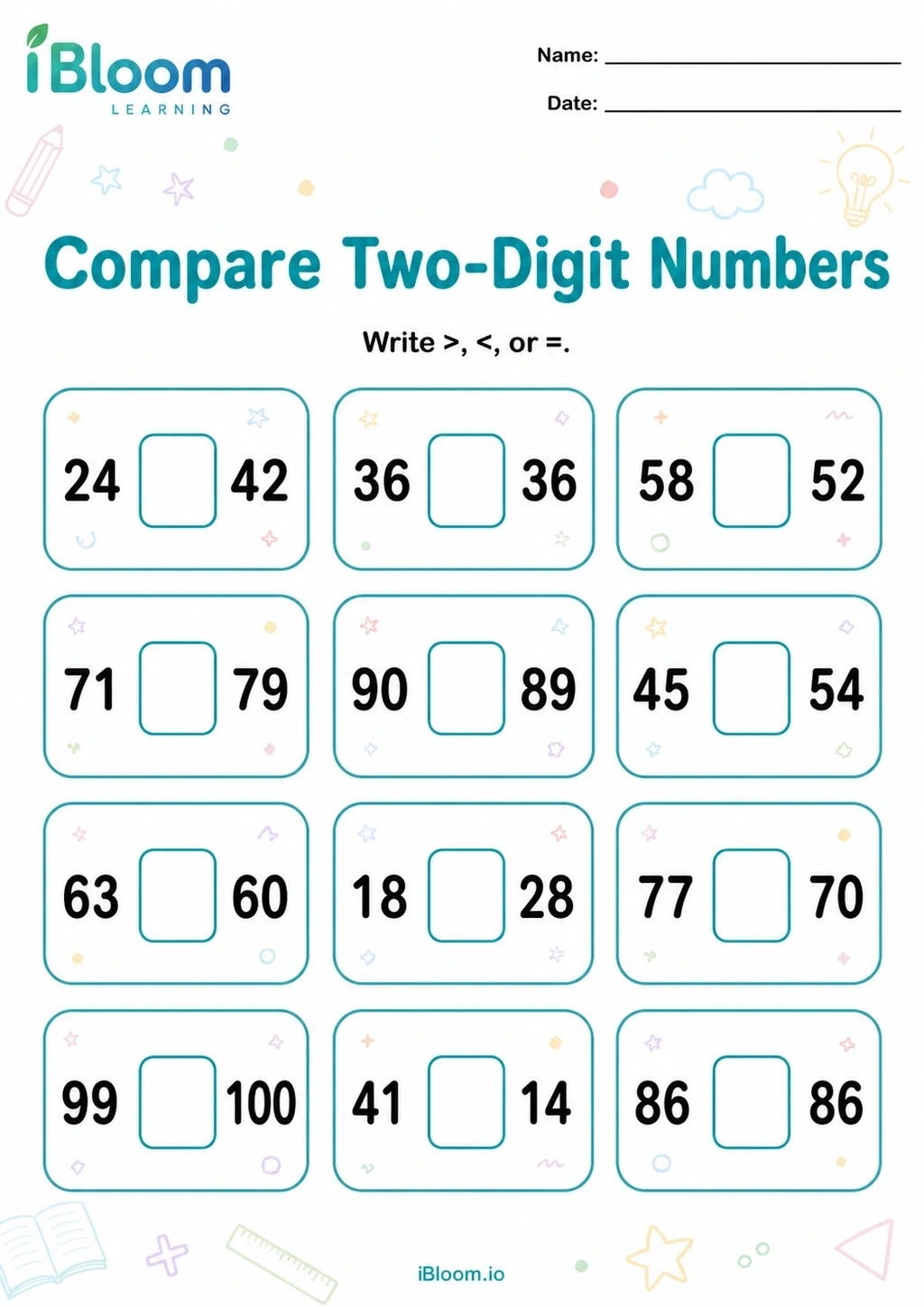 Compare Two-Digit NumbersA Class 1 comparing numbers worksheet where children write greater than, less than, or equal signs between two-digit numbers.Class 1Free PDF preview
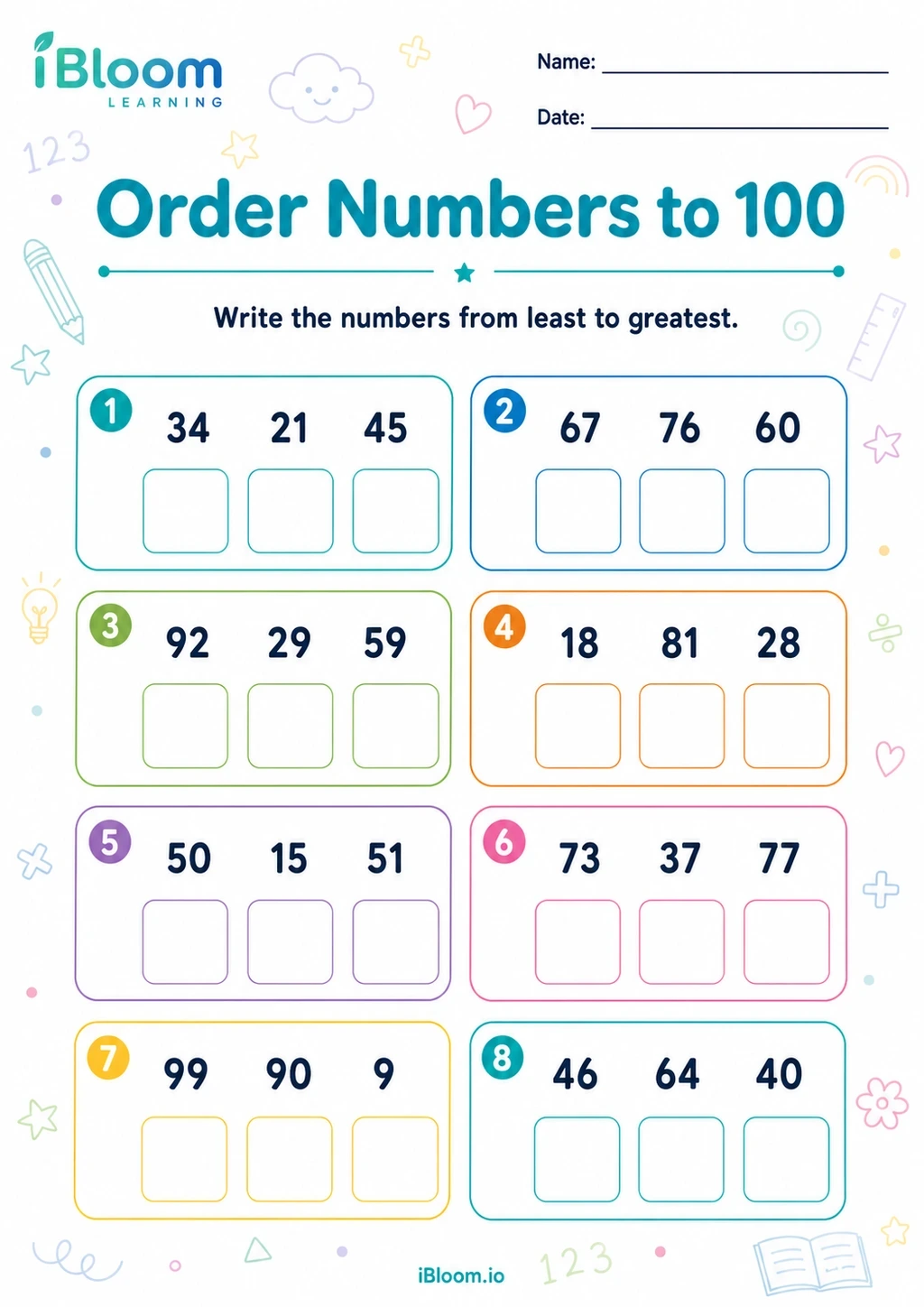 Order Numbers to 100A Class 1 comparing-numbers worksheet where children put two-digit numbers in order from least to greatest.Class 1Free PDF preview
Practice that builds confidence
Building comparison sense
These Class 1 comparing numbers worksheets help children practise deciding which number is greater, which is smaller, and when two numbers are equal. Activities focus on numbers from 0 to 100, using familiar vocabulary such as more than, less than, greater than, smaller than, before, after, ascending, and descending.
The printable practice includes comparing pairs of numbers, ordering groups of numbers, filling number sequences, and arranging numbers from least to greatest or greatest to least. Children build confidence by moving from simple comparisons to organised number order work.
Comparing numbers in Class 1 is not only about choosing the bigger numeral. Children learn to think about quantity, number position, and place value. With numbers from 0 to 100, they can compare by looking at the tens first, then the ones. For example, 64 is more than 46 because 6 tens is greater than 4 tens.

From comparing to ordering
The worksheets progress from single comparisons to ordering several numbers. Children practise more than and less than, then use the same thinking to arrange numbers in ascending order and descending order. Number order tasks help them connect counting forward with increasing numbers and counting backward with decreasing numbers.
A simple home routine
Parents can make this skill part of daily maths practice. Pick three numbers from a calendar, price tag, or book page and ask your child to say the smallest and greatest number. Then ask them to arrange the numbers in ascending order. For a quick challenge, swap one number and ask, “What changed?” This builds flexible thinking without needing extra materials.

Classroom and group use
Teachers can use these printables for independent practice, maths centres, quick revision, or small-group support. Pair a worksheet with number cards or a 0–100 number chart so children can explain their choices. Asking pupils to read answers aloud as “72 is greater than 27” strengthens both maths language and reasoning.

Common mix-ups to watch for
Some children compare only the first digit they notice or reverse the meaning of greater than and less than signs. Others arrange numbers correctly in ascending order but get confused when asked for descending order. A child-friendly strategy is: “Check tens, check ones, then choose the direction.” For ordering, underline the smallest number first for ascending and the greatest number first for descending.
Free printable PDF download
Use this Class 1 comparing numbers worksheet page to preview the activity, print it, or download it as a PDF for quick practice. It works well for homework, homeschool lessons, tutoring, morning work, revision, and classroom centers.
Answers and answer key support
After the child completes the worksheet independently, parents and teachers can use the answer support or answer key information to check the work, review mistakes, and choose the next practice step.
Why iBloom worksheets help
iBloom worksheets give focused practice across compare numbers 0–100, order numbers, number order, ascending and descending arrangements, and more than/less than statements. The varied question styles help children apply the same idea in different ways, so comparison becomes a clear habit rather than a guessed answer.
Helpful answers
Frequently asked questions
What numbers do these comparing worksheets cover?
They focus on numbers from 0 to 100, which is appropriate for Class 1 practice in comparing, ordering, and reading two-digit numbers.
Will my child practise both ascending and descending order?
Yes. The activities include arranging numbers from smallest to greatest and from greatest to smallest, helping children understand both directions of number order.
How can I help my child compare two-digit numbers?
Ask your child to compare the tens first. If the tens are the same, compare the ones. For example, in 58 and 53, both have 5 tens, so the ones decide.
Are more than and less than included?
Yes. Children practise identifying which number is more, which is less, and how numbers relate when comparing pairs or sets.
What is a common mistake in ordering numbers?
Many children start correctly but forget whether the question asks for ascending or descending order. Encourage them to circle the direction word before solving.
Is this Class 1 comparing numbers worksheet free?
Yes. You can preview it for free and use the printable worksheet for home or classroom practice.
Can I download this Class 1 comparing numbers worksheet as a PDF?
Yes. Use the worksheet download option to save a printable PDF, or print the worksheet directly from the page.
Does this Class 1 comparing numbers worksheet include answers or an answer key?
When the activity has fixed answers, iBloom includes answer support so parents and teachers can check the completed worksheet.