Free printable practice
Counting Money Practice Activities
Class 1 maths worksheets for identifying, sorting and counting coins across rupees and selected world currencies.
Explore Counting Money
Free printable worksheet PDFs
Preview every available page, then download the free worksheet PDF for home, homeschool, tutoring, or classroom practice.
Preview the exact activity before downloading it.
Practice that builds confidence
What children learn
These Class 1 maths worksheets help children recognise coins, sort them by value and features, and count small groups of coins. The practice moves from identifying rupee coins to exploring common coins from other currencies such as pennies, nickels, dimes, quarters, Canadian coins, euro, pound, Australian dollar, Philippine peso and South African rand coins.
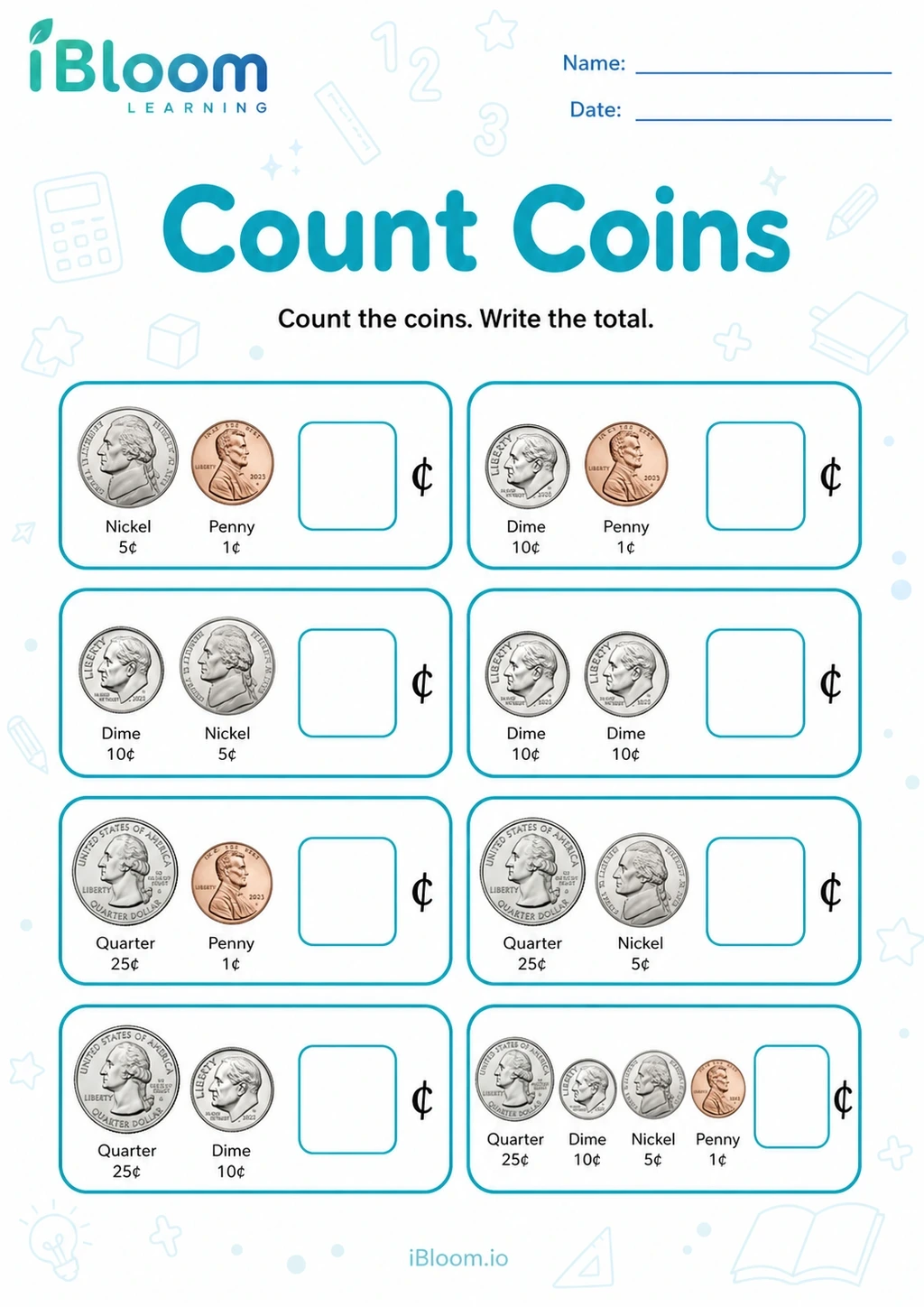
The printable activities include coin matching, sorting, value labelling and counting sets such as pennies with dimes, nickels with quarters, and dime-quarter groups. Children use pictures of coins, simple totals and familiar comparison language to build careful money habits.
Counting money in Class 1 begins with careful observation. Children look at coin size, colour, number, symbol and design, then connect each coin to its value. The worksheets include identifying coins, sorting mixed coins, and recognising rupee coins alongside selected coins from other countries, so learners see that money can look different while still having a fixed value.

Skill progression in the worksheets
The practice starts with naming and matching coins before moving to sorting by type or value. Children then count small groups of coins, such as pennies and dimes, nickels and quarters, or Canadian nickels, dimes and quarters. This progression helps them move from visual recognition to skip-counting and adding coin values in a clear order.
A simple home routine
Parents can place a few real or toy coins on the table and ask the child to sort first, then count. Begin with two types of coins only, saying, “Find all the dimes, now count by tens.” For rupee practice, ask your child to point to the number on the coin and say its value aloud. End by letting the child draw one coin group from the worksheet and write the total beside it.

Classroom uses for teachers
Teachers can use these printables in maths centres, small-group revision or early finishers’ folders. One group can identify rupee coins, another can sort Canadian or euro coins, and another can count dime-quarter or nickel-quarter sets. The pages also work well for oral maths: pupils explain how they counted and why they grouped coins in a certain way.

Common errors to watch for
Many children count the number of coins instead of the value of coins. Some mix up similar-looking coins or forget that a dime is worth more than a nickel even if it is smaller. When counting mixed coins, children may also switch skip-counting patterns too quickly. Encourage them to circle one coin type at a time before adding the next type.
Free printable PDF download
Use this counting money worksheets class 1 page to preview the activity, print it, or download it as a PDF for quick practice. It works well for homework, homeschool lessons, tutoring, morning work, revision, and classroom centers.
Answers and answer key support
After the child completes the worksheet independently, parents and teachers can use the answer support or answer key information to check the work, review mistakes, and choose the next practice step.
Child-friendly strategy and why iBloom worksheets help
Teach the phrase: “Name it, group it, count it.” First name each coin, then group matching coins, then count from the largest or easiest value. iBloom worksheets support this routine with clean coin pictures, focused sets and varied currencies, giving children repeated practice without clutter.
Helpful answers
Frequently asked questions
What money skills do these Class 1 worksheets cover?
They cover identifying coins, sorting coins by type or value, and counting small groups of coins using rupees and selected world currencies such as pennies, nickels, dimes, quarters, Canadian coins, euro and pound coins.
Are these worksheets only for Indian rupee coins?
No. Rupee coin identification is included, but the collection also introduces coins from other currencies. This helps children practise the wider maths skill of recognising and counting coin values.
How should my child count mixed coins like nickels and quarters?
Ask your child to sort the coins first, count one type at a time, and then combine the totals. For example, count quarters by 25s, nickels by 5s, and then add the two amounts.
What is a common mistake in counting money at this level?
A common mistake is counting how many coins there are instead of adding their values. Remind children that two coins can have different values, even if they are similar in size.
Can teachers use these pages for group activities?
Yes. Teachers can set up separate maths centres for identifying coins, sorting coins and counting coin groups, then ask pupils to explain their counting strategy aloud.
Is this counting money worksheets class 1 free?
Yes. You can preview it for free and use the printable worksheet for home or classroom practice.
Can I download this counting money worksheets class 1 as a PDF?
Yes. Use the worksheet download option to save a printable PDF, or print the worksheet directly from the page.
Does this counting money worksheets class 1 include answers or an answer key?
When the activity has fixed answers, iBloom includes answer support so parents and teachers can check the completed worksheet.