Free printable practice
Number Patterns Practice Activities
Class 1 number pattern worksheets for counting, finding rules, extending sequences, object patterns, what-next tasks and simple input-output charts.
Explore Number Patterns
Free printable worksheet PDFs
Preview every available page, then download the free worksheet PDF for home, homeschool, tutoring, or classroom practice.
Preview the exact activity before downloading it.
Practice that builds confidence
What children learn first
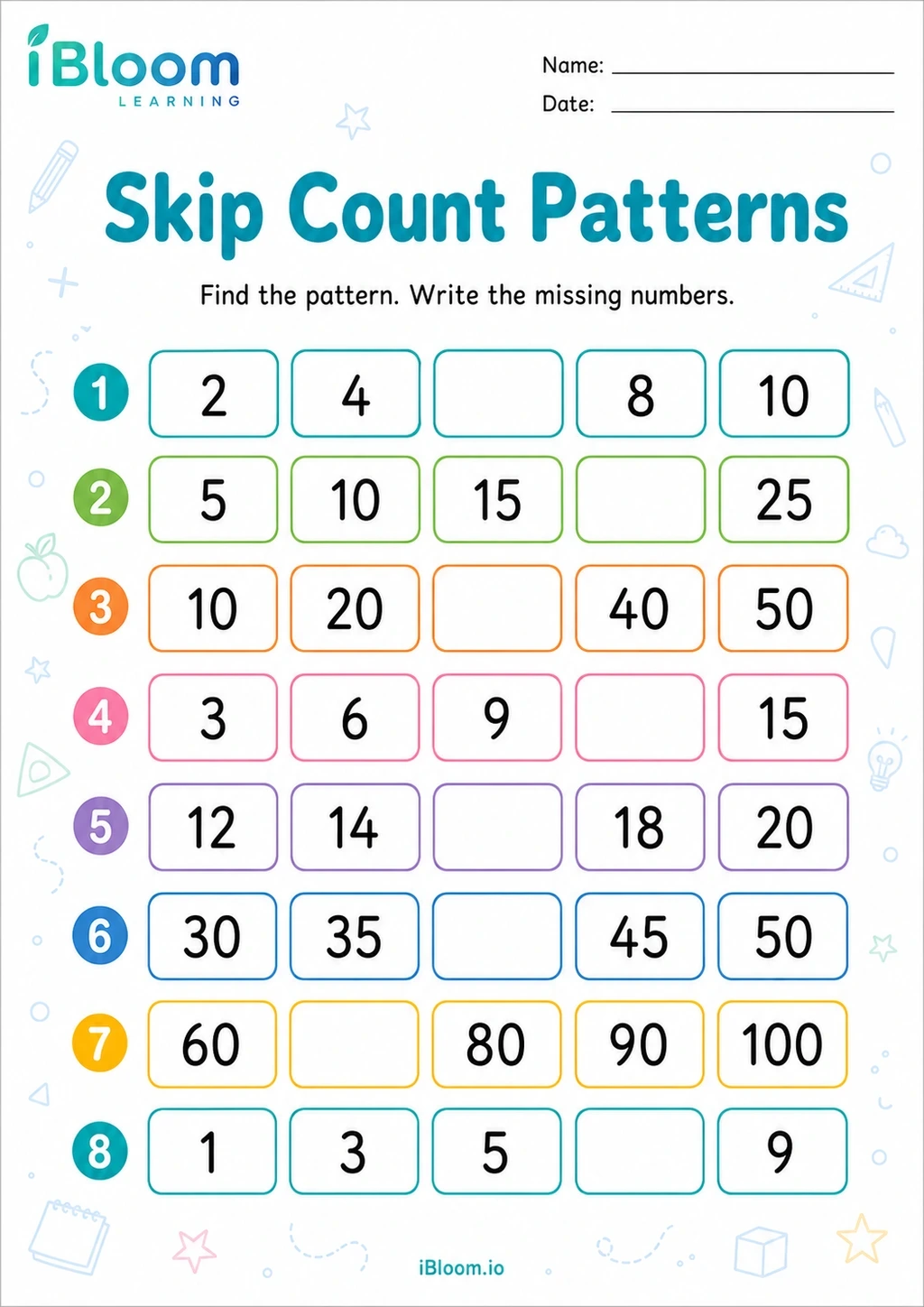
These Class 1 maths worksheets help children notice, describe and continue number patterns. Learners practise counting patterns, finding what changes, extending sequences, choosing what comes next, and using simple input-output charts.
The printable activities include number rows, missing-number tasks, object patterns and rule-based questions. Children move from spotting visible patterns to explaining the rule in words such as add, skip, next, before and after.
Number patterns begin with careful counting. Children look at numbers in order and notice whether the pattern goes forward, repeats, or has a missing part. In Class 1, this often means simple counting sequences, skip-like counting, and recognising that each next number follows a rule.

From objects to numbers
Object patterns make the idea visible before it becomes fully numerical. A child may see circle, square, circle, square and predict the next object. Then the same thinking is used with numbers: 2, 4, 6, __ or 10, 11, 12, __. The worksheets connect Identify Patterns, Find Patterns, What Next and Extending tasks so children do not only fill blanks, but also learn to say why an answer fits.
Input-output chart practice
Simple input-output charts introduce rule following in a gentle way. Children compare the input with the output and look for the change. If 3 becomes 4 and 5 becomes 6, they can notice the rule is add 1. These charts build early algebra thinking without using difficult language.
Parent routine at home
Use a short daily pattern talk. Count steps while walking: 1, 2, 3, 4, then ask, What comes next? Arrange spoons and cups in an alternating order and ask your child to continue it. On paper, write three numbers such as 5, 6, 7 and let your child say the next two. Ask them to point to the part that helped them decide.

Classroom use for teachers
Teachers can use these printables for maths practice, small-group work, revision, or independent seat work. One group can complete object patterns, another can extend counting rows, while confident learners try input-output charts. The pages also support oral maths: children can read a pattern aloud and describe the rule.

Common errors and a child-friendly strategy
Watch for children copying the last number, counting backwards by mistake, or filling a blank without checking the whole sequence. Some may look only at two numbers and miss a repeating object pattern. A helpful strategy is: look, say, check. Look at the whole row, say the rule aloud, then check whether the answer follows the same rule. Why iBloom worksheets help: the activities progress from concrete objects to number sequences and simple charts, giving Class 1 learners repeated practice with just enough variety to build confidence.
Free printable PDF download
Use this class 1 number patterns worksheet page to preview the activity, print it, or download it as a PDF for quick practice. It works well for homework, homeschool lessons, tutoring, morning work, revision, and classroom centers.
Answers and answer key support
After the child completes the worksheet independently, parents and teachers can use the answer support or answer key information to check the work, review mistakes, and choose the next practice step.
Helpful answers
Frequently asked questions
What types of number patterns are included for Class 1?
The worksheets include counting sequences, missing-number rows, what-next questions, object patterns, extending activities and simple input-output charts.
How can I help my child explain a pattern rule?
Ask your child to read the whole pattern aloud, point to what changes, and say the rule in simple words such as add 1, count on, repeat, or same order again.
Are object patterns useful for learning number patterns?
Yes. Object patterns help children see repetition and order visually. This makes it easier to understand number patterns later.
What is an input-output chart in Class 1 maths?
It is a simple table where a number goes in and a related number comes out. Children compare both numbers to find the rule, such as add 1.
What common mistakes should I watch for?
Children may fill the blank by guessing, copy the last number, or check only one part of the sequence. Encourage them to look at the whole row before answering.
Is this class 1 number patterns worksheet free?
Yes. You can preview it for free and use the printable worksheet for home or classroom practice.
Can I download this class 1 number patterns worksheet as a PDF?
Yes. Use the worksheet download option to save a printable PDF, or print the worksheet directly from the page.
Does this class 1 number patterns worksheet include answers or an answer key?
When the activity has fixed answers, iBloom includes answer support so parents and teachers can check the completed worksheet.