Free printable practice
Mixed Practice Activities
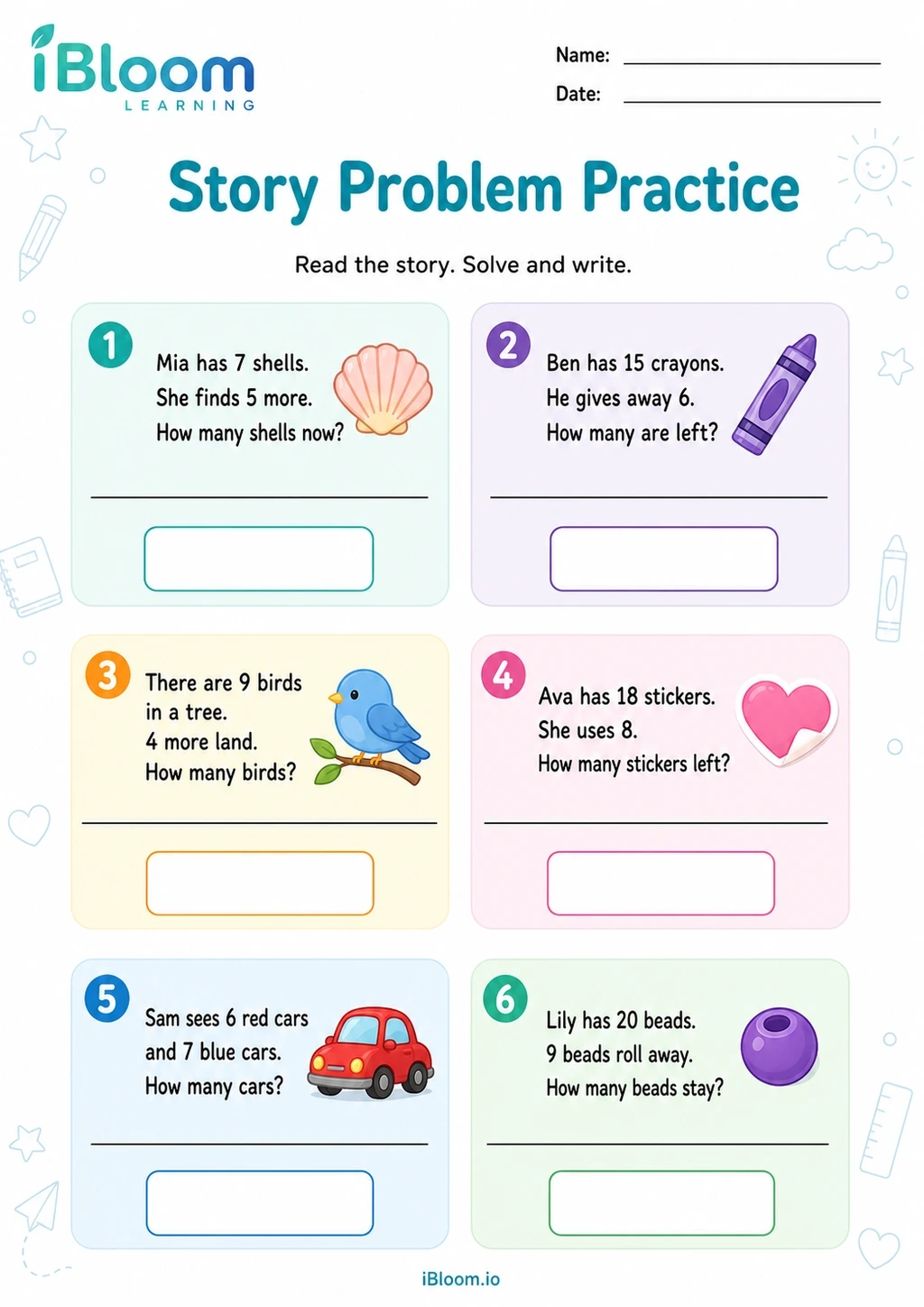
Mixed Class 1 word problem worksheets help children choose between addition and subtraction by reading each story carefully.
Free printable worksheet PDFs
Preview every available page, then download the free worksheet PDF for home, homeschool, tutoring, or classroom practice.
Preview the exact activity before downloading it.
Practice that builds confidence
How mixed practice builds understanding
These Class 1 mixed word problem worksheets help children decide which operation a story needs instead of solving only one type of sum. They practise reading simple situations, spotting what is known and unknown, and choosing whether to add or subtract.
The printable activities include varied everyday questions about objects, people and quantities, so learners can draw, count, write a number sentence and answer in words. The mix keeps practice closer to real maths, where the clue is in the meaning of the story.
Mixed word problems ask children to slow down and think about the action in the story. A question may describe more being added, some being taken away, or two groups being compared. Instead of looking for one fixed pattern, Class 1 learners begin to connect words, pictures and number sentences.

A simple home routine
Read one problem aloud with your child, then ask, “What is happening?” Let the child underline or circle the important numbers and say what the answer will tell. Encourage a quick drawing with dots, fingers, tally marks or small objects before writing the sum. After solving, ask the child to speak the answer in a full sentence, such as “There are 8 mangoes left.”

Using the sheets in class
Teachers can use these worksheets after separate addition and subtraction lessons, during revision, or in maths centres. One useful routine is to let pairs sort problems into “put together”, “take away” and “not sure yet” groups before solving. The same page can support oral maths too: pupils explain why they chose + or −, while classmates listen for the story clue.
Common errors to watch for
Some children add every pair of numbers because addition feels easier. Others choose subtraction whenever they see words like “left”, even if the story is actually asking for a total. Watch for copied numbers in the wrong order, missing labels and answers that do not match the question. If an answer seems too big or too small, ask the child to reread the last sentence.
Child-friendly solving strategy
Teach children: Read, Picture, Choose, Solve, Check. Read the whole problem. Picture the objects. Choose add or subtract. Solve with counting, drawing or a number sentence. Check by asking, “Does my answer make sense in the story?”
Free printable PDF download
Use this class 1 mixed word problems worksheet page to preview the activity, print it, or download it as a PDF for quick practice. It works well for homework, homeschool lessons, tutoring, morning work, revision, and classroom centers.
Answers and answer key support
After the child completes the worksheet independently, parents and teachers can use the answer support or answer key information to check the work, review mistakes, and choose the next practice step.
Why iBloom worksheets help
iBloom mixed practice keeps the focus on meaning, not guessing. The questions are short enough for Class 1 readers, but varied enough to build flexible thinking. Children get repeated practice with real-life maths language while parents and teachers can quickly see whether the difficulty is reading, choosing the operation or calculating.
Helpful answers
Frequently asked questions
What does mixed practice mean in Class 1 word problems?
It means children solve different types of story sums on the same worksheet, usually needing to decide whether to add or subtract instead of being told the operation in advance.
Should my child read the problems independently?
If your child can read them comfortably, yes. If reading is still developing, you can read the question aloud and let the child do the maths thinking, drawing and solving.
How can I help if my child always adds the numbers?
Ask your child to explain what is happening in the story before writing a sum. Use objects or a quick drawing to show whether the group is growing, shrinking or being compared.
Are drawings allowed when solving these worksheets?
Yes. Drawings, tally marks, fingers and small objects are helpful for Class 1 learners because they connect the story to the number sentence.
How do I know whether the mistake is in reading or calculation?
Ask your child to retell the problem in their own words. If the retelling is correct but the answer is wrong, the calculation needs practice. If the retelling is confused, focus on understanding the story first.
Is this class 1 mixed word problems worksheet free?
Yes. You can preview it for free and use the printable worksheet for home or classroom practice.
Can I download this class 1 mixed word problems worksheet as a PDF?
Yes. Use the worksheet download option to save a printable PDF, or print the worksheet directly from the page.
Does this class 1 mixed word problems worksheet include answers or an answer key?
When the activity has fixed answers, iBloom includes answer support so parents and teachers can check the completed worksheet.