Free printable practice
Powers Of Ten Practice Activities
Class 5 maths worksheets for practising powers of ten, exponent notation, place-value patterns, and writing 10, 100, 1,000 and beyond in compact form.
Free printable worksheet PDFs
Preview every available page, then download the free worksheet PDF for home, homeschool, tutoring, or classroom practice.
Preview the exact activity before downloading it.
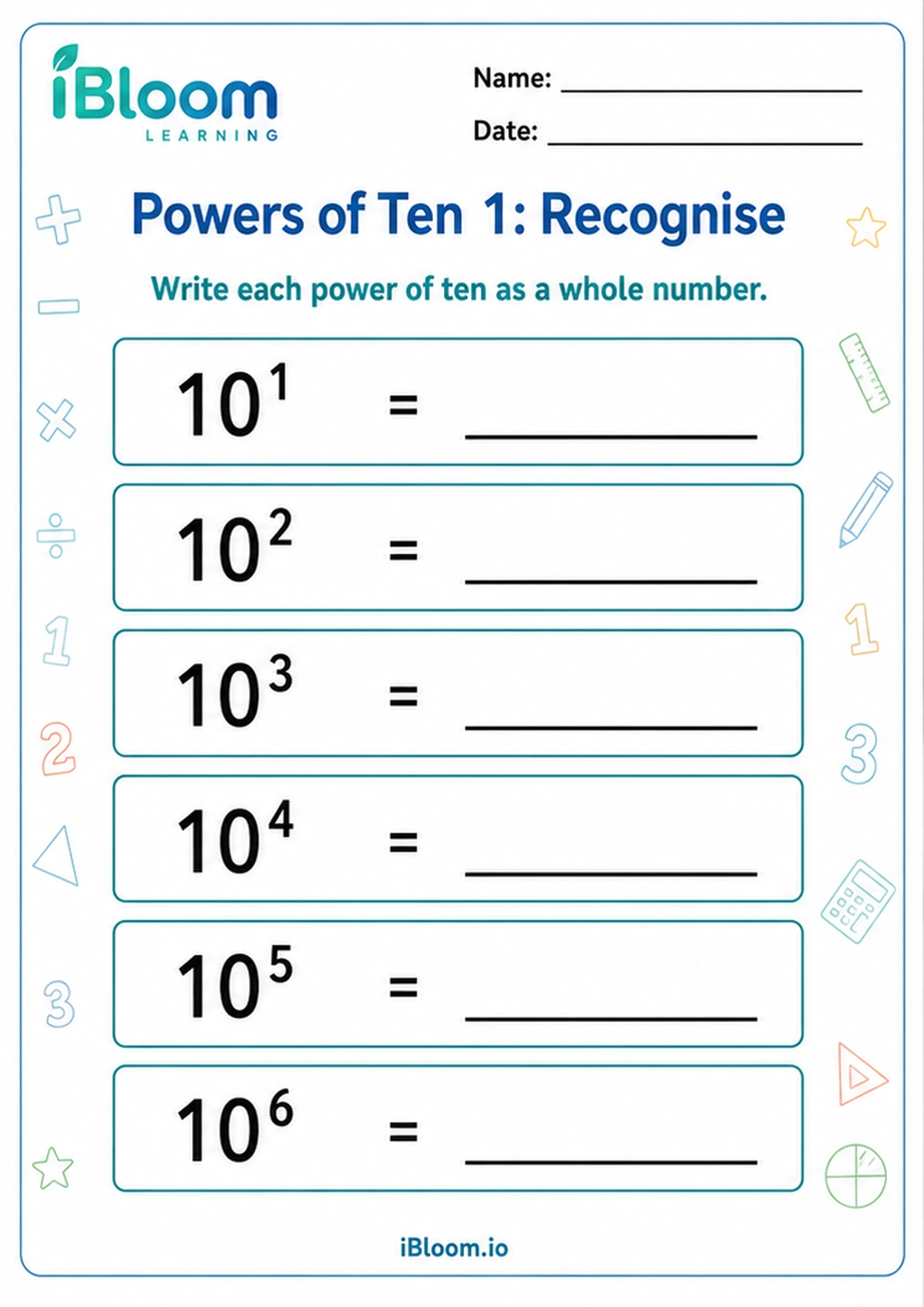 Powers of Ten 1: RecogniseClass 5 printable practice for Powers of Ten.Class 5Free PDF preview
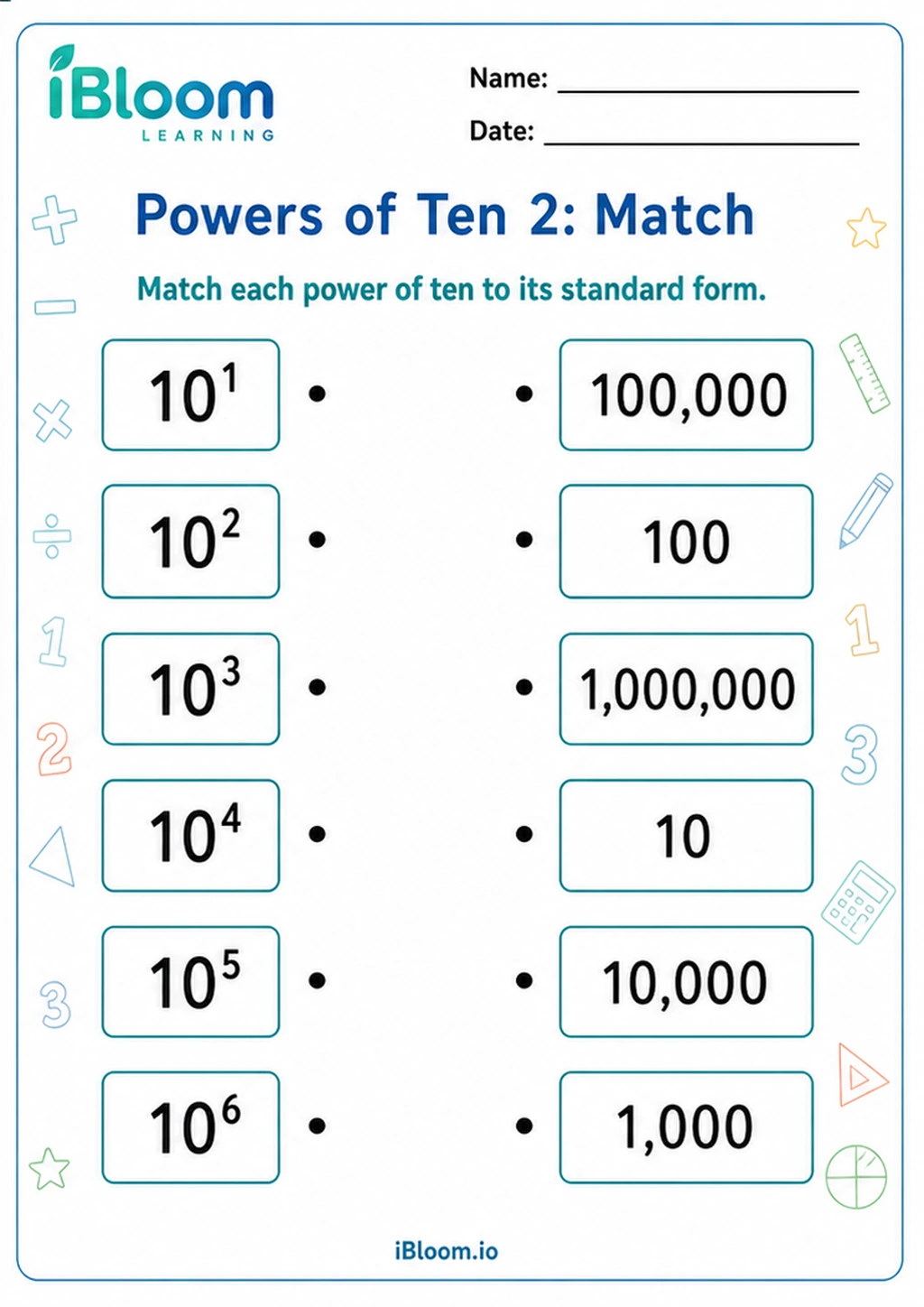 Powers of Ten 2: MatchClass 5 printable practice for Powers of Ten.Class 5Free PDF preview
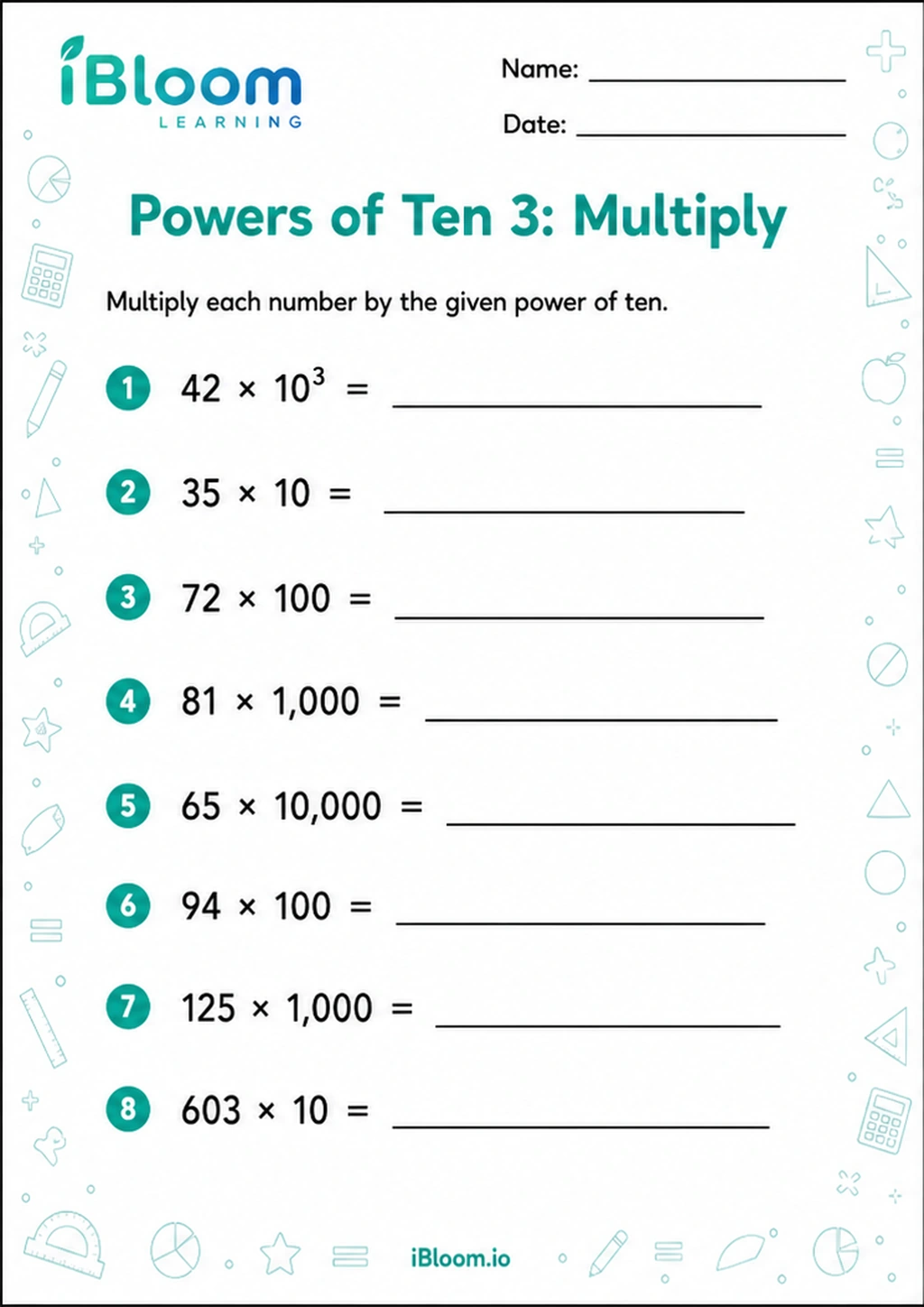 Powers of Ten 3: MultiplyClass 5 printable practice for Powers of Ten.Class 5Free PDF preview
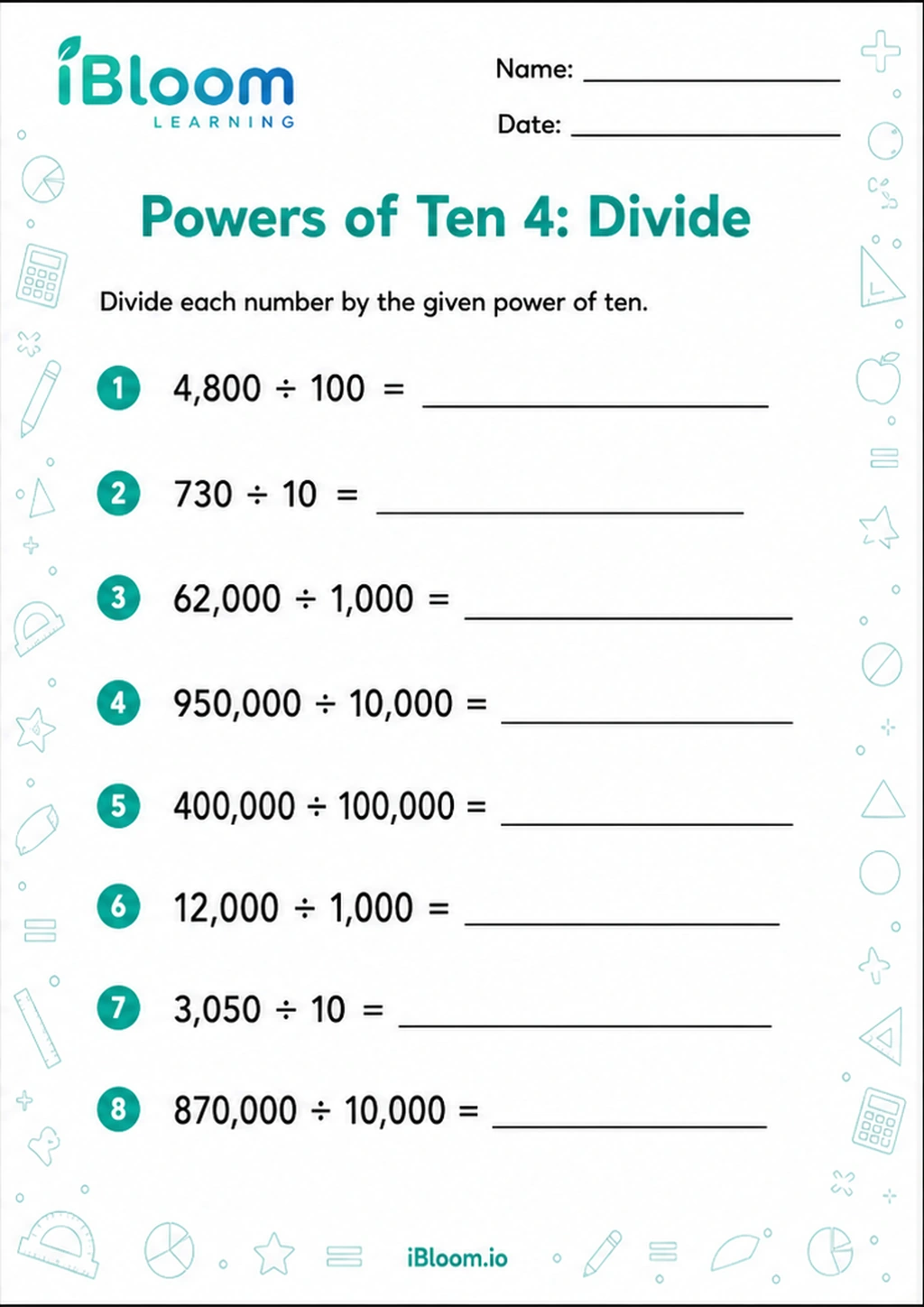 Powers of Ten 4: DivideClass 5 printable practice for Powers of Ten.Class 5Free PDF preview
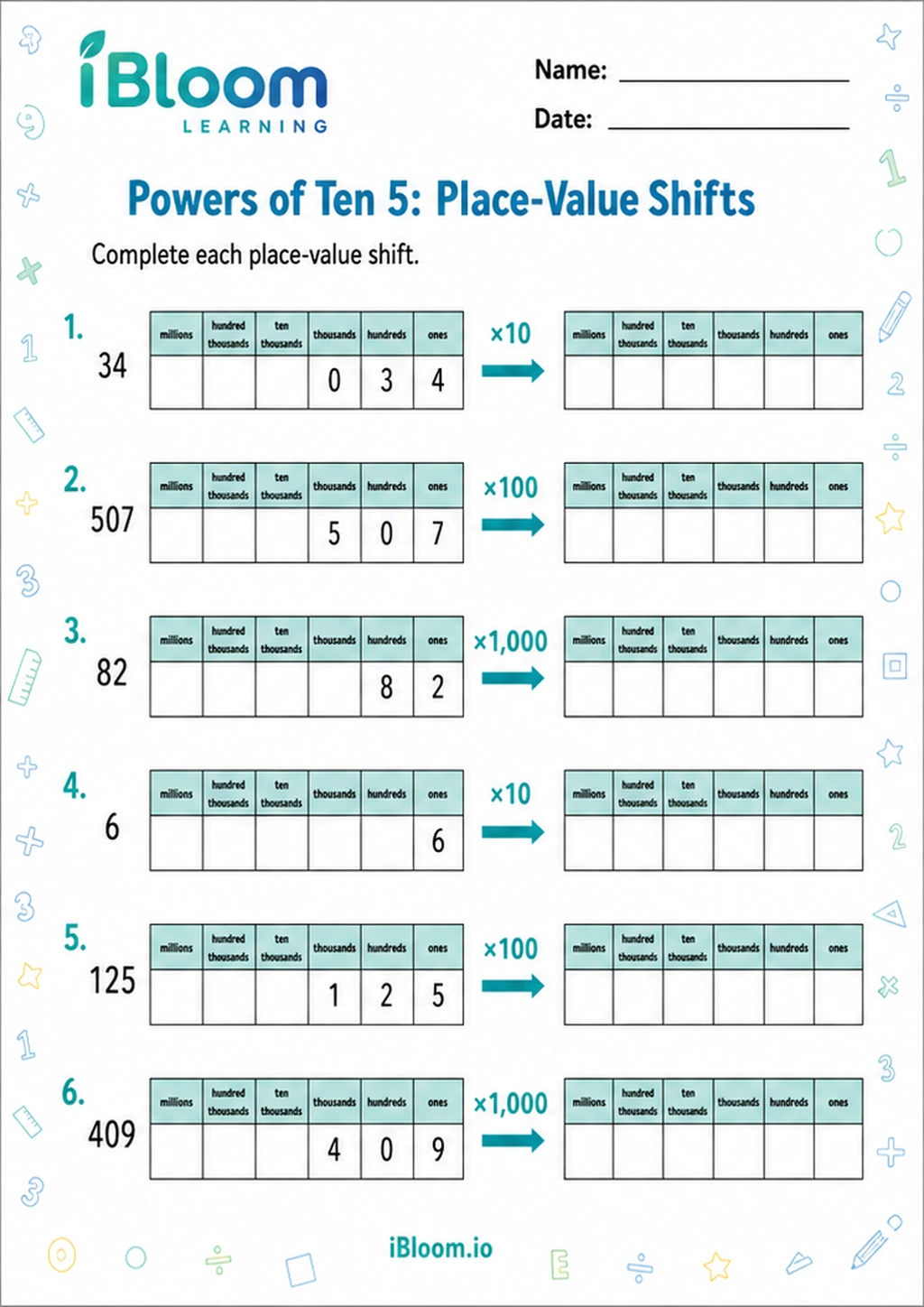 Powers of Ten 5: Place-Value ShiftsClass 5 printable practice for Powers of Ten.Class 5Free PDF preview
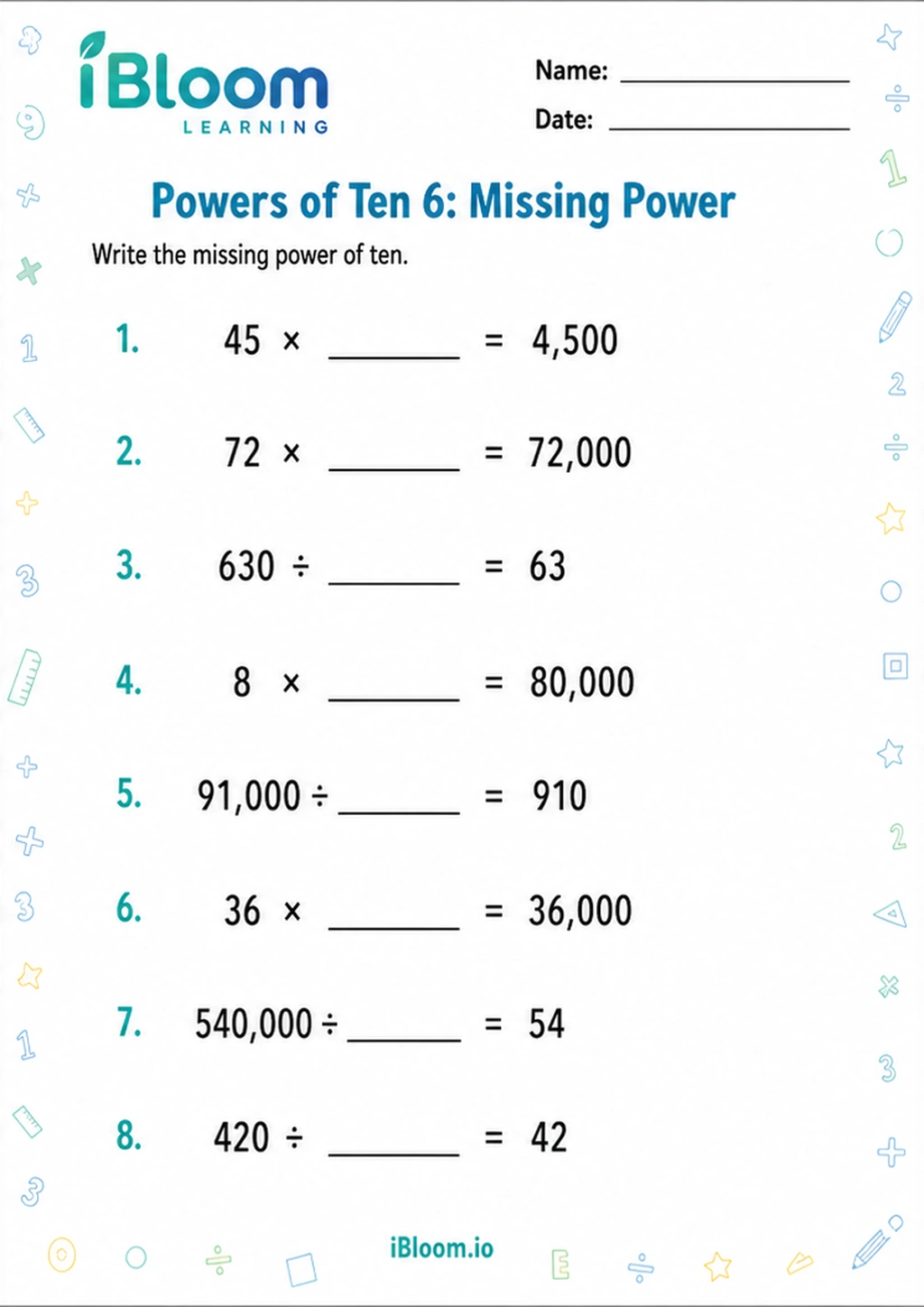 Powers of Ten 6: Missing PowerClass 5 printable practice for Powers of Ten.Class 5Free PDF preview
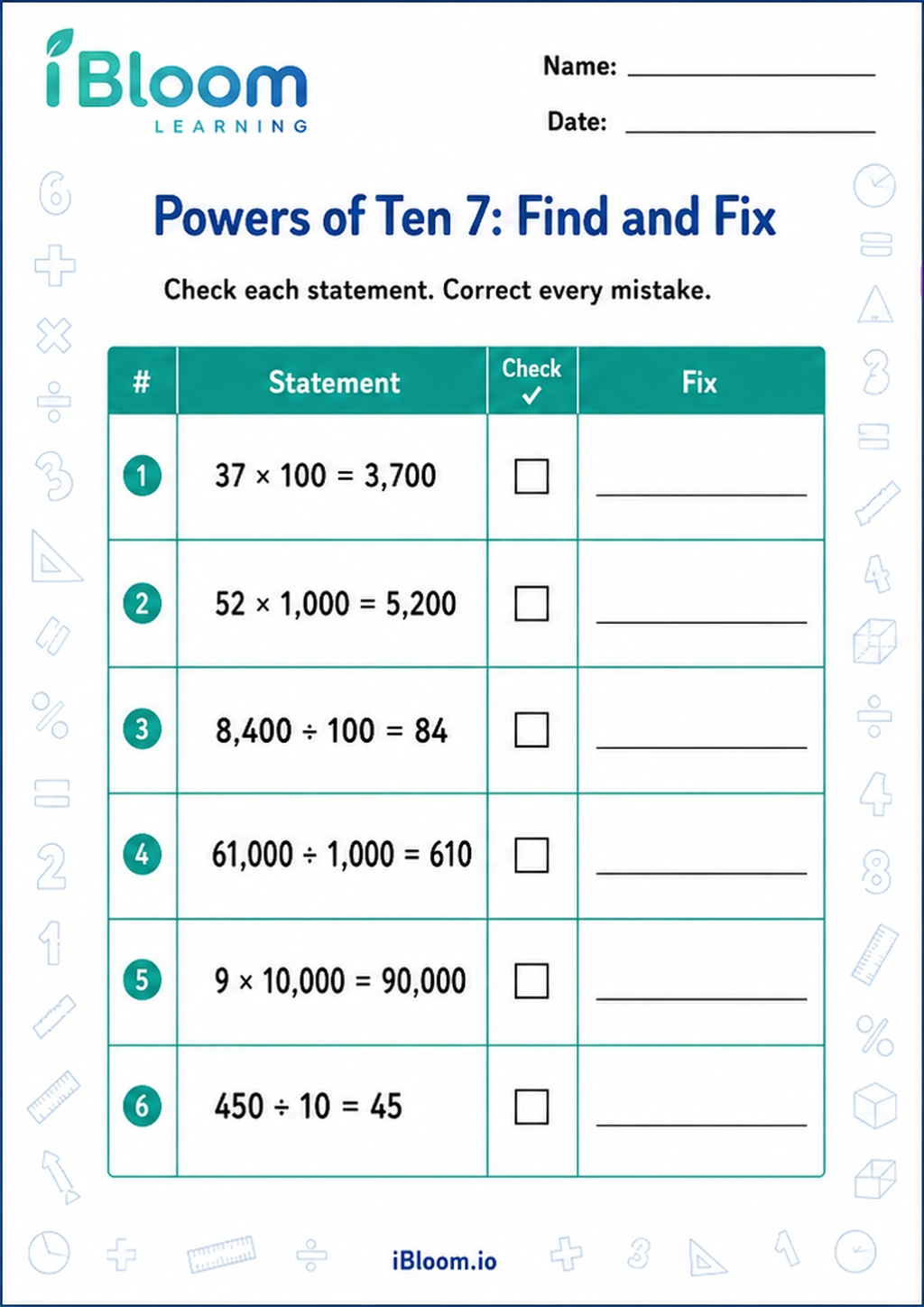 Powers of Ten 7: Find and FixClass 5 printable practice for Powers of Ten.Class 5Free PDF preview
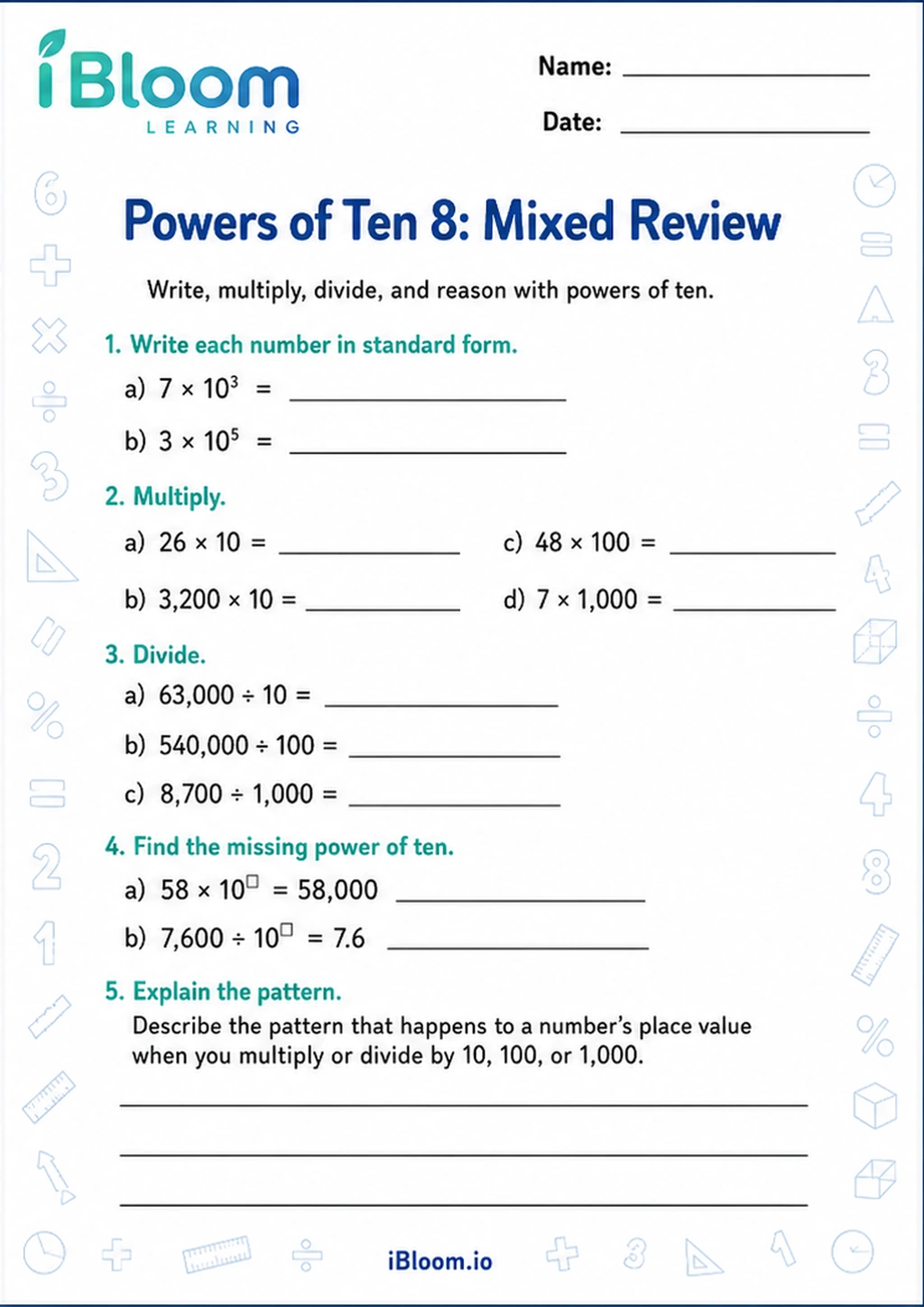 Powers of Ten 8: Mixed ReviewClass 5 printable practice for Powers of Ten.Class 5Free PDF preview
Practice that builds confidence
What children learn
These Class 5 powers of ten worksheets help children connect exponents with the familiar pattern of 10, 100, 1,000, 10,000 and larger place values. Learners practise reading the base and exponent, evaluating expressions such as 10³, and seeing why each new power has one more zero.
The printable activities include matching, fill-in-the-blank, value writing, notation conversion, and short reasoning tasks. They are designed for the Exponents section in Mathematics and build confidence before children move on to broader exponent rules.
Powers of ten give children a clear first step into exponents because the pattern is visible. In 10⁴, 10 is the base and 4 is the exponent; the value is 10 × 10 × 10 × 10 = 10,000. These worksheets strengthen the link between repeated multiplication, exponent form, standard form, and place-value language such as ones, tens, hundreds, thousands, and ten-thousands.

Progression in the worksheets
Practice usually begins with recognising simple powers such as 10¹, 10² and 10³. Children then write numbers like 100,000 as 10⁵, count zeros to find the exponent, and compare nearby powers. Later questions may ask them to complete patterns, spot the missing exponent, or explain why 10⁰ is treated differently if it is included. This step-by-step movement helps them avoid memorising symbols without meaning.
A parent routine at home
Ask your child to draw a two-column chart: “power of ten” and “value”. Start with 10¹ and build down the page to 10⁶, saying each value aloud. Then cover one side and ask quick questions: “What is 10³?” or “How can we write 1,00,000 using an exponent?” Let the child count the zeros, but also ask them to say the repeated multiplication once or twice so the exponent does not become just a zero-counting trick.

Classroom uses for teachers
Teachers can use these printables for maths warm-ups, independent practice after an exponent lesson, peer checking, or small-group support for place-value revision. They also work well in centres: one group can match cards, another can convert values to exponent form, and another can solve short explanation questions. The answers reveal whether pupils understand the base 10 pattern or are only guessing from the size of the number.

Common errors to watch for
Children may write 10³ as 30, confuse the exponent with the number of digits, or think 10² means 10 × 2. Some may count all digits instead of counting zeros, so 1,000 becomes 10⁴ by mistake. Encourage them to expand the expression when unsure: 10³ means three factors of 10. A helpful child-friendly strategy is: “Read the tiny number, write that many 10s, multiply, then check the zeros.”
Free printable PDF download
Use this Class 5 powers of ten worksheet page to preview the activity, print it, or download it as a PDF for quick practice. It works well for homework, homeschool lessons, tutoring, morning work, revision, and classroom centers.
Answers and answer key support
After the child completes the worksheet independently, parents and teachers can use the answer support or answer key information to check the work, review mistakes, and choose the next practice step.
Why iBloom worksheets help
The activities focus on one important exponent idea at a time, with enough variety to move from recognition to reasoning. Clear layouts, repeated representations, and class-appropriate numbers help children see powers of ten as a place-value pattern they can explain, not a rule to copy.
Helpful answers
Frequently asked questions
What does 10³ mean for a Class 5 learner?
10³ means 10 multiplied by itself three times: 10 × 10 × 10. Its value is 1,000. The 10 is the base and the 3 is the exponent.
How do these worksheets connect exponents with place value?
They show that each higher power of ten moves to the next place value: 10, 100, 1,000, 10,000 and so on. Children practise matching these values with exponent form.
Should children just count zeros to solve powers of ten?
Counting zeros is useful, but children should also understand the meaning of the exponent. For example, 10⁴ has four factors of 10, which gives 10,000.
What mistakes are common in powers of ten?
Common mistakes include reading 10² as 20, treating the exponent as a multiplier, or counting the digit 1 along with the zeros when finding the exponent.
How can I practise powers of ten at home?
Make a simple chart from 10¹ to 10⁶, write each value, and ask your child to switch between forms. For example, ask, “How do we write 100,000 as a power of 10?”
Is this Class 5 powers of ten worksheet free?
Yes. You can preview it for free and use the printable worksheet for home or classroom practice.
Can I download this Class 5 powers of ten worksheet as a PDF?
Yes. Use the worksheet download option to save a printable PDF, or print the worksheet directly from the page.
Does this Class 5 powers of ten worksheet include answers or an answer key?
When the activity has fixed answers, iBloom includes answer support so parents and teachers can check the completed worksheet.